In the intricate world of healthcare, language is more than a means of communication; it is a tool for diagnosis, a framework for reimbursement, and a powerful shaper of patient identity. Few phrases exemplify this duality more than “wheelchair bound.” For decades, this term has been used colloquially and even in clinical settings to describe individuals for whom a wheelchair is a primary means of mobility. Yet, for the individuals themselves, this label can feel restrictive, defining them not by their abilities or personhood, but by their reliance on a piece of equipment. It implies a state of being “tied down” or “confined,” a passive condition that overlooks the active role a wheelchair plays in granting freedom, independence, and access to the world.
This article delves into the critical juncture where clinical reality, human dignity, and administrative necessity meet: the accurate and respectful ICD-10 coding of mobility status. The quest for an “ICD-10 code for wheelchair bound” is, in itself, a reflection of an outdated paradigm. The International Classification of Diseases, 10th Revision, Clinical Modification (ICD-10-CM) does not contain such a code because modern medical and rehabilitative philosophy no longer views wheelchair use in this light. Instead, the coding system offers nuanced codes that describe a patient’s need for care and dependence on enabling technology.
Understanding this distinction is not merely an academic exercise. It has profound implications for patient care, functional outcomes, and the financial viability of healthcare providers. Accurate coding ensures that the resources required for a patient’s well-being—from home health aides to specialized equipment—are appropriately justified and reimbursed. It facilitates crucial data collection that informs public health policy and resource allocation for people with disabilities. Perhaps most importantly, it pushes clinicians and coders to adopt a more precise, person-centric language that recognizes the wheelchair not as a cage, but as a key to autonomy.
This exhaustive guide will navigate the complexities of ICD-10 coding related to mobility limitations. We will explore the specific codes like Z74.3 and Z99.3, dissect their official guidelines, and walk through real-world clinical scenarios. We will examine the pivotal role of clinical documentation, the ethical weight of the terminology we use, and the future of mobility coding in the upcoming ICD-11. By the end, you will have a masterful understanding of how to correctly and respectfully capture a patient’s mobility status, moving far beyond the simplistic and stigmatizing notion of being “bound.”
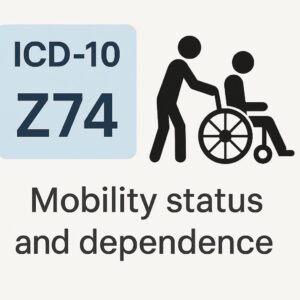
ICD-10 Code for Mobility Status and Dependence
2. Deconstructing “Wheelchair Bound”: The Shift to Person-First, Function-Focused Language
To understand the ICD-10 approach, one must first understand why the term “wheelchair bound” has fallen out of favor within the medical and disability communities. The objection is both philosophical and practical.
Philosophical Objections: Identity and Agency
The word “bound” carries negative connotations—shackled, imprisoned, obligated. When applied to a person using a wheelchair, it frames their entire existence around a limitation. This is known as identity-first language in its most damaging form, where the disability defines the person. The modern approach, championed by disability advocates, is Person-First Language. This emphasizes the individual before the condition. One is not a “wheelchair-bound patient”; they are a “patient who uses a wheelchair,” or a “person with a mobility impairment.” This subtle shift linguistically separates the person from the equipment, affirming their humanity and agency.
Furthermore, for most users, a wheelchair is not a prison but a liberator. It is a tool that enables movement, participation, and engagement with society that would otherwise be impossible. To call someone “bound” to this tool is to fundamentally misunderstand its purpose. It is akin to calling a driver “car-bound” or a pilot “airplane-bound.” The device is an extension of their capability, not a restriction of it.
Practical and Clinical Objections: Imprecision and Assumption
From a clinical perspective, “wheelchair bound” is dangerously imprecise. It tells a provider nothing about:
-
The underlying etiology of the mobility impairment (e.g., spinal cord injury, cerebral palsy, advanced osteoarthritis, cardiorespiratory failure).
-
The functional level of the patient (e.g., can they transfer independently? Do they use the wheelchair for all mobility or only long distances?).
-
The type of wheelchair used (e.g., manual, power, sport, standing).
-
The prognosis (e.g., is the condition permanent, progressive, or temporary?).
This lack of precision can lead to clinical assumptions that compromise care. For instance, a note that simply states “patient is wheelchair bound” might lead a new clinician to assume the patient requires total care for transfers, when in reality they may be fully independent in that domain.
The preferred terminology is “Wheelchair User” or “Full-Time Wheelchair User.” These terms are accurate, descriptive, and neutral. They state a fact without imposing a value judgment. This shift in language is directly reflected in the structure of the ICD-10-CM code set, which focuses on factual statements about “need” and “dependence” rather than pejorative labels.
3. The ICD-10-CM System: A Primer for the Uninitiated
Before diving into the specific codes, a brief overview of the ICD-10-CM system is essential for context. The International Classification of Diseases is a global health diagnostic tool maintained by the World Health Organization (WHO). The “Clinical Modification” (CM) used in the United States is a more detailed version managed by the Centers for Disease Control and Prevention (CDC) and the National Center for Health Statistics (NCHS).
ICD-10-CM serves several critical functions:
-
Morbidity and Mortality Tracking: It is the foundation for recording diseases, causes of injury, and reasons for death, providing vital data for public health surveillance and research.
-
Reimbursement: In the U.S., it is integral to the healthcare reimbursement system. Diagnosis codes are required on all insurance claims (CMS-1500, UB-04) to justify the medical necessity of services rendered, from a physician’s visit to a surgical procedure.
-
Epidemiological Research: Researchers use coded data to track disease patterns, assess risk factors, and evaluate the effectiveness of treatments.
The codes themselves are alphanumeric and can be up to seven characters long, allowing for incredible specificity. The structure is hierarchical:
-
Chapter: The first character is a letter, representing a broad chapter (e.g., Chapter 19: Injury, poisoning and certain other consequences of external causes (S00-T88)).
-
Category: The first three characters (e.g., S83) define the general category of the disease or injury.
-
Subcategory and Extension: Characters four through seven add detail regarding etiology, anatomical site, severity, and encounter type.
Of particular importance for our discussion is Chapter 21: Factors Influencing Health Status and Contact with Health Services (Z00-Z99). This chapter is used when a circumstance other than a disease or injury is recorded as a diagnosis or problem. This is where we find the codes for encounters related to mobility devices and care needs. These are not codes for diseases, but for situations that require medical care or oversight.
4. The Cornerstone Code: Z74.3 – Need for Continuous Supervision
When a clinician or coder searches for a concept like “wheelchair bound,” the code that often surfaces is Z74.3. However, using this code requires a deep understanding of its specific meaning and its limitations.
Official Code Description: Z74.3 – Need for continuous supervision
Code Placement and Hierarchy: This code belongs to the category Z74, “Problems related to care provider dependency.” Other codes in this category include Z74.1 (Need for assistance with personal care) and Z74.2 (Need for assistance at home and no other household member able to render care). This placement is crucial—it frames the code not around the patient’s disability, but around their need for care from another person.
When to Use Z74.3:
Code Z74.3 is appropriate when a patient’s condition is such that they require round-the-clock monitoring or assistance from another individual to ensure their safety and well-being. The wheelchair use is often a contributing factor to this need, but it is not the code for the wheelchair use itself.
Clinical Examples:
-
A patient with advanced Alzheimer’s disease who is also a full-time wheelchair user and is prone to wandering or attempting to stand unsafely, requiring constant observation.
-
A patient with a high-level spinal cord injury (e.g., C5) who requires assistance with all activities of daily living (ADLs), is on a ventilator, and needs continuous care to manage respiratory secretions and prevent complications.
-
A patient with severe cognitive deficits from a traumatic brain injury who, despite physical capability, requires constant redirection and supervision to prevent self-harm, even while using a wheelchair.
When NOT to Use Z74.3:
This code is frequently misapplied. It is not appropriate for a patient who is independent in their wheelchair use but simply cannot walk. If a patient can self-propel, transfer independently, manage their own toileting and feeding, and live alone, they do not require “continuous supervision.” Applying Z74.3 in this case would be clinically inaccurate and could be construed as fraudulent, as it would misrepresent the patient’s level of need.
Coding Guidelines: The ICD-10-CM Official Guidelines for Coding and Reporting state that Z codes can be used as either a first-listed (principal) diagnosis or a secondary diagnosis, depending on the circumstances of the encounter. For a encounter solely for the purpose of establishing or reviewing a care plan due to the need for continuous supervision, Z74.3 could be the first-listed diagnosis. In most acute care encounters, it will be a secondary code that provides context for the patient’s overall care needs.
5. The Technology Dependence Code: Z99.3 – Dependence on Wheelchair
This is the most direct and accurate code for capturing the functional status of a long-term wheelchair user. It moves the focus from the need for human supervision to the relationship with an enabling device.
Official Code Description: Z99.3 – Dependence on wheelchair
Code Placement and Hierarchy: This code is found under the category Z99, “Dependence on enabling machines and devices, not elsewhere classified.” This category includes other dependence codes like Z99.1 (Dependence on respirator) and Z99.8 (Dependence on other enabling machines and devices). The key word here is “dependence.” In a coding context, this signifies that the device is essential for the patient’s mobility and is used consistently.
When to Use Z99.3:
Code Z99.3 is used to indicate that a patient requires a wheelchair for their daily mobility and that this is a long-term or permanent state. It is the correct code to communicate that a patient is a “full-time wheelchair user.”
Clinical Examples:
-
A patient with a low-level spinal cord injury (e.g., T10) who is fully independent in a manual wheelchair for all mobility within the home and community.
-
A patient with muscular dystrophy who uses a power wheelchair for all functional mobility.
-
A patient with bilateral lower limb amputations who uses a wheelchair as their primary means of locomotion.
Specificity and Laterality:
A significant limitation of Z99.3 is its lack of specificity. It does not distinguish between manual and power wheelchairs, nor does it provide information about the underlying cause. The coder must rely on additional codes to paint a complete picture. For instance, the code for the spinal cord injury (e.g., S14.109A) or the muscular dystrophy (e.g., G71.0) would be the primary diagnosis, with Z99.3 listed as a secondary code to describe the functional outcome.
The Concept of “Dependence” vs. “Use”:
There is a nuanced discussion in the coding community about when “use” becomes “dependence.” A patient who uses a wheelchair only for long distances at a mall (a “community mobility” device) but can walk within their home might not be considered “dependent” on the wheelchair. Z99.3 is best reserved for patients for whom the wheelchair is their primary and necessary means of mobility. For temporary use (e.g., post-surgery), this code is not appropriate.
6. Clinical Scenarios and Code Application: A Practical Walkthrough
The best way to understand the application of these codes is through concrete examples. The following scenarios illustrate how a coder must synthesize clinical documentation to arrive at an accurate code set.
Scenario 1: The Patient with Spinal Cord Injury
-
Patient: 32-year-old male.
-
History: Sustained a T4 complete traumatic spinal cord injury 2 years ago in a motor vehicle accident.
-
Presentation: Admitted to the hospital for management of a stage 3 sacral pressure ulcer. He is fully independent in all aspects of his manual wheelchair, including transfers, bed mobility, and wheelchair propulsion. He lives alone in an accessible apartment.
-
Clinical Documentation: “Patient is a full-time wheelchair user since his T4 SCI. He is independent in his ADLs and mobility. Admitted for debridement of sacral decubitus ulcer.”
-
Coding Analysis:
-
The reason for admission is the pressure ulcer. The primary diagnosis would be L89.313 (Pressure ulcer of sacral region, stage 3).
-
The spinal cord injury is the underlying cause and must be coded. The code would be S24.109S (Unspecified injury at T4 level of thoracic spinal cord, sequela). The ‘S’ seventh character indicates this is a sequela, a condition resulting from the initial injury.
-
The patient’s functional status is that of a full-time wheelchair user. The correct code is Z99.3 (Dependence on wheelchair).
-
Is Z74.3 appropriate? No. The documentation clearly states he is independent and lives alone. There is no indication of a need for continuous supervision.
-
-
Final Code Set: L89.313, S24.109S, Z99.3
Scenario 2: The Patient with Advanced Multiple Sclerosis
-
Patient: 58-year-old female.
-
History: Progressive-relapsing Multiple Sclerosis for 20 years.
-
Presentation: Admitted to a skilled nursing facility for subacute rehabilitation and long-term care. She has severe spastic quadriparesis, cognitive decline, and dysphagia. She is unable to transfer or reposition herself in her power wheelchair. She requires total care for all ADLs and is incontinent. The care plan notes “requires 1:1 supervision due to high fall risk and cognitive impairment.”
-
Clinical Documentation: “Patient with advanced MS, dependent for all care. Non-ambulatory and requires a tilt-in-space power wheelchair for positioning and mobility. Requires continuous supervision for safety.”
-
Coding Analysis:
-
The primary diagnosis for the stay is the Multiple Sclerosis, coded as G35 (Multiple sclerosis).
-
The patient is dependent on a wheelchair for mobility, so Z99.3 is applicable.
-
Crucially, the documentation explicitly states “requires continuous supervision for safety.” This, combined with her total dependence for care, makes Z74.3 (Need for continuous supervision) a perfectly justified and accurate code.
-
-
Final Code Set: G35, Z99.3, Z74.3
Scenario 3: The Post-Surgical Hip Fracture Patient
-
Patient: 80-year-old female.
-
History: Osteoporosis. Sustained a right femoral neck fracture after a fall.
-
Presentation: Status post right total hip arthroplasty. During her acute hospital stay, she is non-weight-bearing on the right lower extremity. Physical Therapy has issued her a wheelchair for mobility during her recovery. She is expected to resume walking with a walker in 6-8 weeks.
-
Clinical Documentation: “Patient is non-weight-bearing on the right lower extremity and is using a wheelchair for mobility during this acute post-operative phase.”
-
Coding Analysis:
-
The primary diagnosis is the aftercare following the joint replacement, coded as Z47.1 (Aftercare following joint replacement surgery).
-
The fracture and surgery would also be coded for history: S72.009S (Unspecified fracture of neck of unspecified femur, sequela) and 0SR90JZ (Insertion of Right Hip Joint, Synthetic Substitute, Open Approach).
-
Is Z99.3 appropriate? No. Z99.3 implies long-term dependence. This is a temporary situation due to a post-surgical protocol. There is no specific code for “temporary wheelchair use.” The functional limitation is captured by the aftercare code and the physical therapy notes. Using Z99.3 here would be incorrect.
-
-
Final Code Set: Z47.1, S72.009S, (and the appropriate procedure code).
Scenario 4: The Pediatric Patient with Cerebral Palsy
-
Patient: 8-year-old male.
-
History: Spastic quadriplegic cerebral palsy, GMFCS Level V (meaning he has no means of independent mobility and requires a wheelchair for all transportation, which is pushed by a caregiver).
-
Presentation: Outpatient encounter for fitting and prescription of a new custom-molded seating system for his manual wheelchair. He is non-verbal, has a G-tube for feeding, and has seizures.
-
Clinical Documentation: “Patient presents for wheelchair seating evaluation. He has spastic quadriplegic CP and is completely dependent for all mobility and care. He uses a specialized wheelchair for positioning and transport.”
-
Coding Analysis:
-
The reason for the encounter is the fitting and adjustment of the wheelchair, coded as Z46.1 (Encounter for fitting and adjustment of wheelchair).
-
The underlying diagnosis is G80.0 (Spastic quadriplegic cerebral palsy).
-
Given his complete dependence on the device for all mobility, Z99.3 is appropriate.
-
Given his total dependence for all care and need for constant supervision due to his medical complexity (seizures, aspiration risk), Z74.3 is also highly applicable and justified.
-
-
Final Code Set: Z46.1, G80.0, Z99.3, Z74.3
The following table summarizes the key differences and applications of the primary codes discussed:
Comparison of Key ICD-10-CM Codes for Mobility and Care
| Code | Code Description | Primary Use Case | When to Use | When to Avoid |
|---|---|---|---|---|
| Z99.3 | Dependence on wheelchair | To indicate a patient’s long-term or permanent reliance on a wheelchair as their primary means of mobility. | Patient is a full-time wheelchair user, regardless of independence level. | For temporary wheelchair use (e.g., post-surgery, short-term injury). For patients who can walk but use a wheelchair only for long distances. |
| Z74.3 | Need for continuous supervision | To indicate that a patient’s condition requires round-the-clock monitoring or assistance from another person for safety. | Patient has cognitive impairments, total physical dependence, or medical instability that necessitates constant oversight, and uses a wheelchair. | For patients who are independent in their wheelchair use and self-care, even if they cannot walk. Do not use simply because a patient uses a wheelchair. |
| Z74.1 | Need for assistance with personal care | To indicate a patient requires help with ADLs like bathing, dressing, or feeding, but not necessarily continuous supervision. | Patient needs partial or total assistance with ADLs but can be left alone for periods. | If the patient is independent in ADLs, or if the need is already captured by Z74.3 (which implies a higher level of need). |
7. The Crucial Role of Clinical Documentation
The coder’s ability to assign accurate codes is entirely dependent on the quality of the clinical documentation. Vague, outdated, or imprecise language in the medical record is the root cause of most coding errors related to mobility status.
Problematic Documentation:
-
“Patient is wheelchair bound.”
-
“Patient is confined to a wheelchair.”
-
“Patient is a paraplegic.” (Without specifying functional level)
Excellent, Codeable Documentation:
-
“Patient is a full-time manual wheelchair user and is independent with all transfers and wheelchair mobility.”
-
“Patient has spastic quadriplegic CP and is dependent for all mobility. She uses a custom power wheelchair for positioning and transportation, which is operated by a caregiver.”
-
“Patient with advanced Parkinson’s disease requires a wheelchair for all functional mobility beyond a few steps. He requires moderate assistance for transfers and continuous supervision due to high fall risk and impulsivity.”
Specific Elements Documentation Should Include:
-
Etiology: The underlying medical reason for the mobility impairment.
-
Device Type: Manual wheelchair, power wheelchair, scooter.
-
Functional Level: Independent, standby assistance, moderate assistance, maximal assistance, or dependent for transfers and propulsion.
-
Scope of Use: Is it for all mobility (full-time), or only for community distances?
-
Cognitive/Behavioral Factors: Does the patient require supervision for safety? Why?
Physicians, nurse practitioners, physical therapists, and occupational therapists must be educated on the impact of their documentation. A clear, detailed note not only ensures accurate coding and reimbursement but also facilitates better continuity of care by providing a precise picture of the patient’s functional abilities for all members of the healthcare team.
8. Beyond the Wheelchair: Other Relevant Z-Codes for Mobility and Care
While Z74.3 and Z99.3 are the most directly relevant, a comprehensive assessment of a patient’s situation may warrant additional Z-codes from Chapter 21.
-
Z74.1 – Need for assistance with personal care: This code is used when a patient requires help with ADLs (bathing, dressing, toileting, feeding) but does not necessarily require the continuous supervision denoted by Z74.3. It represents a lower level of care need.
-
Z74.0 – Limited ability to manage self-care: Used for a patient who has a reduced capacity for self-care, which may be related to their mobility limitation.
-
Z73.6 – Limitation of activities due to disability: A broader code for when a disability is causing restrictions in normal activities.
-
Z46.1 – Encounter for fitting and adjustment of wheelchair: This is a crucial encounter code used when the specific reason for the visit is to be fitted for, or to adjust, a wheelchair.
-
Z99.8 – Dependence on other enabling machines and devices: This could be used for other mobility devices like walkers (canes, crutches) if the concept of “dependence” is clearly documented, though this is less common.
-
Z59.0 – Homelessness: Relevant if lack of accessible housing is a social determinant of health impacting the patient’s mobility status.
Using a combination of these codes allows for a rich, multi-faceted representation of the patient’s health status and social circumstances.
9. The Intersection of Coding, Medical Necessity, and Reimbursement
Accurate ICD-10 coding is the linchpin that connects a patient’s clinical needs to the financial mechanisms that allow care to be provided. This is the concept of medical necessity.
For a healthcare service or piece of equipment to be reimbursed by insurance, it must be deemed medically necessary. The diagnosis codes on the claim form are the primary justification for this necessity.
Example: Justifying a Power Wheelchair
A provider submits a claim to Medicare for a power wheelchair. The claim will include:
-
Procedure Code: For the specific wheelchair (e.g., K0823 – Power wheelchair, group 2 standard, single power option).
-
Diagnosis Codes: These must paint an undeniable picture of medical necessity.
-
Primary Code: The underlying disease causing the mobility impairment (e.g., G20 – Parkinson’s disease).
-
Contributing Codes: Codes that describe the functional limitations (e.g., R26.2 – Difficulty in walking, not elsewhere classified; Z99.3 – Dependence on wheelchair).
-
Other Relevant Codes: Any code that supports the need for a power chair over a manual one (e.g., I48.91 – Unspecified atrial fibrillation, if the patient has poor endurance due to a cardiac condition).
-
If the coder only used the primary code (G20) and omitted Z99.3 and others, the claim might be denied because it fails to fully justify the need for the wheelchair itself. The Z99.3 code provides the critical link between the disease (Parkinson’s) and the required intervention (the wheelchair). Similarly, using Z74.3 inappropriately for an independent user could be seen as “upcoding” to justify a higher level of home health services, which is considered fraud.
10. Ethical and Social Implications: How Coding Shapes Perception and Care
The move away from “wheelchair bound” and towards precise codes like Z99.3 is part of a larger ethical evolution in healthcare. The language embedded in our coding systems does not merely describe reality; it helps to construct it.
Data and Advocacy: When thousands of patients are accurately coded with Z99.3, it creates a powerful data set. Public health officials can query this data to understand the prevalence of long-term wheelchair use. This information can be used to advocate for better accessibility in public transportation, housing, and infrastructure. It helps justify funding for rehabilitation research and technology development. Inaccurate or outdated coding obscures the true size and needs of this community.
Combating Stigma: Every time a coder correctly uses Z99.3 based on documentation that says “full-time wheelchair user” instead of defaulting to a Z74.3 based on “wheelchair bound,” it reinforces a more empowering narrative. It trains the healthcare system to see the device as a tool for independence. This has a trickle-down effect, influencing how nurses, aides, and administrators interact with patients.
Person-Centered Care: At its heart, accurate coding is a component of person-centered care. It requires clinicians to see the whole person—their diagnosis, their functional abilities, their goals, and their social context—and to document it with precision. This detailed understanding is the foundation for developing a care plan that truly respects the individual’s autonomy and promotes their highest possible quality of life.
11. The Future of Mobility Coding: A Look at ICD-11 and Beyond
The World Health Organization released the 11th Revision of the ICD (ICD-11) in 2019, and it is gradually being adopted by member states. ICD-11 offers even greater specificity and a more modern conceptual framework.
In ICD-11, the concept of “dependence on wheelchair” is found under the code QB0Z (Dependence on products and technology for mobility). However, the real power of ICD-11 lies in its ability to link codes together using “clustering” or “post-coordination.”
For example, a coder could create a more detailed clinical picture by combining:
-
A code for the health condition (e.g., MB50.60 – Traumatic paraplegia).
-
A code for the product used (e.g., PK73.1 – Manual wheelchair).
-
A code for the body functions affected (e.g., b770 – Gait pattern functions).
-
A code for the environmental factor (e.g., e155 – Design, construction and building products and technology of buildings for private use, as a barrier or facilitator).
This multi-axial approach moves coding from a simple listing of diagnoses to a rich, interactive model of the patient’s health experience. It directly captures the interaction between the person’s impairment, the technology they use, and the environment they live in. This will provide an unprecedented level of data for outcomes research, health policy, and individualized care planning, fully cementing the transition from the passive “wheelchair bound” to an active, contextualized model of mobility.
12. Conclusion: Mastering the Code, Honoring the Individual
The journey from the colloquialism “wheelchair bound” to the precise ICD-10 codes Z74.3 and Z99.3 is a microcosm of the evolution in healthcare towards greater accuracy, ethical responsibility, and person-centeredness. These codes are not interchangeable; they represent fundamentally different concepts of need and function. Z99.3 accurately describes a functional state of dependence on a mobility device, while Z74.3 describes a much higher level of need for continuous human supervision. The mastery of this distinction is critical for every medical coder, clinician, and healthcare administrator. It ensures that data is meaningful, reimbursement is appropriate, and care plans are tailored to the true needs of the individual. By moving beyond outdated labels, we do more than just assign the correct code—we affirm the dignity, agency, and potential of every person who uses a wheelchair to navigate their world.
13. Frequently Asked Questions (FAQs)
Q1: Is there a specific ICD-10 code for “wheelchair bound”?
A: No. The term “wheelchair bound” is clinically imprecise and considered outdated and potentially offensive. The ICD-10-CM system uses more specific and functional codes, primarily Z99.3 (Dependence on wheelchair) for long-term wheelchair use and Z74.3 (Need for continuous supervision) for patients who require round-the-clock care.
Q2: Can I use Z99.3 for a patient who is temporarily in a wheelchair after surgery?
A: No. Z99.3 is intended to indicate long-term or permanent dependence. For temporary situations, the reason for the encounter (e.g., aftercare code Z47.1) and the underlying condition are sufficient. Using Z99.3 for a temporary condition is inaccurate.
Q3: What is the difference between Z74.3 and Z99.3?
A: Z99.3 describes the patient’s relationship with a device (the wheelchair). Z74.3 describes the patient’s relationship with a caregiver (need for continuous supervision). A patient can have Z99.3 without Z74.3 (an independent wheelchair user), but many patients with Z74.3 will also have Z99.3.
Q4: How many codes can I list on a claim form?
A: Claim forms (like the CMS-1500) allow for multiple diagnosis codes. The primary reason for the encounter should be listed first. Other codes that paint a complete picture of the patient’s condition and justify medical necessity, including Z99.3 and Z74.3 when appropriate, should be listed subsequently.
Q5: Who is responsible for ensuring the correct code is used—the doctor or the coder?
A: It is a shared responsibility. The clinician is responsible for providing detailed, accurate, and precise documentation that supports the codes. The coder is responsible for translating that documentation into the correct ICD-10-CM codes based on official coding guidelines. Clear communication between these two roles is essential.
14. Additional Resources
-
CDC ICD-10-CM Official Guidelines: https://www.cdc.gov/nchs/icd/icd-10-cm.htm (The definitive source for coding rules.)
-
American Health Information Management Association (AHIMA): https://www.ahima.org/ (Provides education, certifications, and resources for medical coders.)
-
American Academy of Professional Coders (AAPC): https://www.aapc.com/ (Another leading organization for coder education and certification.)
-
The Center for Dignity in Healthcare for People with Disabilities: (An advocacy organization promoting person-first, respectful care.)
-
World Health Organization ICD-11 Website: https://www.who.int/standards/classifications/classification-of-diseases (To explore the future of disease classification.)