In the intricate world of medical coding, a string of alphanumeric characters is never just a string of characters. It is a story—a concise, standardized narrative of a patient’s illness, its cause, its severity, and its impact. For a condition as complex and potentially devastating as pancreatitis, the accuracy of this story is paramount. The International Classification of Diseases, Tenth Revision, Clinical Modification (ICD-10-CM) codes for pancreatitis, primarily residing within the K85 and K86 families, are the linchpins connecting clinical practice, financial reimbursement, public health data, and medical research.
A misplaced decimal, an overlooked etiology, or a misclassified chronicity can have cascading consequences. It can lead to claim denials, financial losses for healthcare providers, skewed epidemiological data, and ultimately, a failure to capture the true burden of this disease. This article is designed to be the definitive guide for coders, clinicians, healthcare administrators, and students who seek to master the nuanced art and science of coding for pancreatitis. We will move beyond simple code lookup and embark on a detailed journey through the anatomy of the pancreas, the pathophysiology of its inflammation, the structure of the ICD-10-CM system, and the practical application of coding principles to real-world clinical scenarios. Our goal is to transform the task of coding from a clerical duty into an act of clinical intelligence, ensuring that every coded case of pancreatitis tells a complete, accurate, and actionable story.
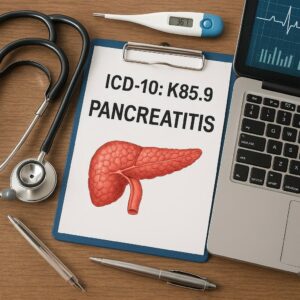
ICD-10 code for pancreatitis
2. Understanding the Organ: A Primer on the Pancreas and its Functions
To accurately code for a disease of an organ, one must first understand the organ itself. The pancreas is a slender, J-shaped organ, approximately 6 to 10 inches long, located deep in the abdomen behind the stomach. It is a dual-function gland, playing a vital role in both the digestive and endocrine systems.
-
Exocrine Function: The majority of the pancreas is composed of exocrine tissue. These cells produce and secrete powerful digestive enzymes (amylase, lipase, proteases) into a network of ducts that eventually empty into the duodenum, the first part of the small intestine. These enzymes are essential for breaking down carbohydrates, fats, and proteins in our food. To protect itself from self-digestion, the pancreas secretes these enzymes in an inactive form, which only become activated upon reaching the small intestine.
-
Endocrine Function: Scattered throughout the exocrine tissue are small clusters of cells known as the Islets of Langerhans. These islets are the endocrine component of the pancreas, producing critical hormones directly released into the bloodstream. The most famous of these are:
-
Insulin: Lowers blood sugar levels.
-
Glucagon: Raises blood sugar levels.
-
This dual identity makes the pancreas indispensable. Dysfunction of the exocrine component leads to malabsorption and nutritional deficiencies, while dysfunction of the endocrine component results in diabetes mellitus. Pancreatitis is primarily an inflammation of the exocrine tissue, but severe or chronic cases can also impair endocrine function.
3. Deciphering the Disease: The Pathophysiology of Pancreatitis
Pancreatitis occurs when the digestive enzymes produced by the pancreas become activated prematurely, while still inside the organ. This leads to autodigestion—the pancreas literally begins to digest itself. This process triggers a localized inflammatory response that can, in severe cases, spiral into a systemic inflammatory response syndrome (SIRS), affecting distant organs.
Acute Pancreatitis: The Sudden Storm
Acute Pancreatitis (AP) is characterized by the sudden onset of inflammation that resolves, in most cases, with appropriate treatment. It can range from a mild, self-limiting condition requiring brief hospitalization to a severe, life-threatening illness with multi-organ failure and a high mortality rate.
Key Pathophysiological Events:
-
Injury/Incitement: A trigger (e.g., a gallstone, alcohol binge) causes injury to the acinar cells.
-
Premature Enzyme Activation: Intracellular protective mechanisms fail, leading to the activation of trypsin and other digestive enzymes.
-
Autodigestion and Inflammation: Activated enzymes digest pancreatic and peripancreatic tissue, releasing cytokines and other inflammatory mediators.
-
Systemic Inflammatory Response: The inflammation can spill over into the bloodstream, causing fever, tachycardia, tachypnea, and potentially shock and organ failure.
Chronic Pancreatitis: The Smoldering Fire
Chronic Pancreatitis (CP) is a persistent, long-standing inflammation that leads to irreversible morphological changes, such as fibrosis and stricturing of the ducts. This results in a progressive and permanent loss of both exocrine and endocrine function. Patients with CP suffer from chronic pain, malabsorption, steatorrhea (fatty stools), and often develop diabetes.
Key Pathophysiological Events:
-
Recurrent Injury: Repeated episodes of subclinical or clinical acute inflammation (often from prolonged alcohol use).
-
Fibrosis and Scarring: The healing process replaces functional tissue with fibrous, non-functional scar tissue.
-
Ductal Distortion and Obstruction: Scarring leads to strictures and calcifications within the pancreatic ducts, further impairing enzyme flow and creating a cycle of obstruction and inflammation.
-
Parenchymal Destruction: The glandular tissue is slowly destroyed, leading to pancreatic insufficiency.
4. Navigating the ICD-10-CM Codebook: The K85 and K86 Code Families
The ICD-10-CM coding system is structured with a high degree of specificity. For pancreatitis, the primary codes are found in Chapter 11: “Diseases of the Digestive System” (K00-K95).
K85.- Acute Pancreatitis: A Deep Dive into Specificity
The code block K85 is used for acute pancreatitis. It requires a fourth or fifth digit to specify the etiology, which is a critical component of accurate coding.
-
K85.0 – Idiopathic acute pancreatitis: Used when no specific cause is identified after a thorough investigation.
-
K85.1 – Biliary acute pancreatitis: This is one of the most common types, caused by gallstones (cholelithiasis) obstructing the common bile duct and pancreatic duct.
-
K85.2 – Alcohol-induced acute pancreatitis: Assigned when an acute episode is directly attributed to alcohol consumption.
-
K85.3 – Drug-induced acute pancreatitis: Used when a medication is identified as the cause. An additional code from T36-T50 with fifth or sixth character 5 is used to identify the causative drug.
-
K85.8 – Other acute pancreatitis: This is a catch-all for other specified causes, such as:
-
Post-ERCP (Endoscopic Retrograde Cholangiopancreatography)
-
Infectious causes (e.g., mumps, coxsackievirus)
-
Traumatic
-
Hypertriglyceridemia-induced
-
-
K85.9 – Acute pancreatitis, unspecified: This code should be a last resort, used only when the documentation is insufficient to assign a more specific code. It is often a target for audits.
K86.0-K86.1 Chronic Pancreatitis: Alcohol and Other Etiologies
The coding for chronic pancreatitis is less granular than for acute, but the distinction based on etiology remains crucial.
-
K86.0 – Alcohol-induced chronic pancreatitis: This code is explicitly for the chronic form of the disease caused by long-term alcohol abuse.
-
K86.1 – Other chronic pancreatitis: This code is used for all other forms of chronic pancreatitis. This includes:
-
Hereditary pancreatitis
-
Obstructive chronic pancreatitis (e.g., from a tumor or stricture)
-
Idiopathic chronic pancreatitis
-
Autoimmune pancreatitis (AIP) – It is vital to note that while AIP is a specific subtype, ICD-10-CM does not provide a unique code for it, so it falls under K86.1.
-
K86.2-K86.9: Other Disorders of the Pancreas
This range includes codes for conditions that may be related to or confused with pancreatitis.
-
K86.2 – Cyst of pancreas
-
K86.3 – Pseudocyst of pancreas: A common complication of both acute and chronic pancreatitis. It is a localized collection of pancreatic fluid rich in enzymes, enclosed by a wall of fibrous or granulation tissue.
-
K86.8 – Other specified diseases of pancreas (e.g., atrophy, fibrosis, calculi of the pancreas).
-
K86.9 – Disease of pancreas, unspecified
5. The Art of Code Assignment: A Step-by-Step Clinical Documentation Guide
Accurate code assignment is a diagnostic process in itself. Follow this logical sequence to ensure precision.
Step 1: Acute vs. Chronic – The Fundamental Dichotomy
The first and most critical decision is to determine whether the condition is acute (K85), chronic (K86.0/K86.1), or an acute exacerbation of an underlying chronic condition.
-
Clinical Clues for Acute: Sudden onset of severe epigastric pain, elevated serum lipase/amylase (often >3x upper limit of normal), imaging showing pancreatic edema/inflammation without chronic changes like calcifications.
-
Clinical Clues for Chronic: Long-standing history of recurrent abdominal pain, evidence of pancreatic insufficiency (steatorrhea, weight loss), endocrine dysfunction (diabetes), imaging showing calcifications, ductal dilatation, or atrophy.
Crucial Scenario: Acute on Chronic Pancreatitis
This is a common and often miscoded situation. When a patient with known chronic pancreatitis presents with a new episode of acute inflammation, you must code both conditions.
-
First, code the acute exacerbation (e.g., K85.2 for an alcohol-induced acute flare).
-
Then, code the underlying chronic condition (K86.0 for alcohol-induced chronic pancreatitis).
Step 2: Unraveling the Etiology – The “Why” Behind the Inflammation
Once the chronicity is established, the next step is to identify the cause. This is where physician documentation is paramount. The coder cannot assume etiology.
-
If the physician documents “acute pancreatitis due to gallstones,” the code is K85.1.
-
If the physician documents “chronic pancreatitis, alcoholic,” the code is K86.0.
-
If the cause is not documented, you must use the unspecified code (K85.9 or K86.1).
Step 3: Documenting Severity and Complications
While the core pancreatitis codes do not specify severity, it is essential to code for any associated complications or organ dysfunctions. This paints a complete clinical picture and impacts reimbursement through DRG (Diagnosis-Related Group) assignment.
-
Necrotizing Pancreatitis: Code also K85.- and K85.81 for infected necrosis or K85.82 for sterile necrosis, if documented.
-
Pancreatic Pseudocyst: Code also K86.3.
-
Organ Failure: Code for acute kidney failure (N17.9), respiratory failure (J96.0-), shock (R57.9), etc.
-
Ascites: Code R18.8.
-
Pain: Code R10.1- (Upper abdominal pain) or R10.9 (Unspecified abdominal pain).
Step 4: The Role of Laterality (and its Absence in Pancreatitis Coding)
Unlike some body systems, the pancreas is not a paired organ. Therefore, there are no laterality (left/right) designations for pancreatitis codes.
6. Clinical Vignettes: From Patient Chart to Accurate Code
Let’s apply our knowledge to realistic patient scenarios.
Vignette 1: The Gallstone Crisis
-
Presentation: A 45-year-old female presents to the ER with sudden, severe epigastric pain radiating to her back, nausea, and vomiting. She has a history of gallstones. Labs show serum lipase 1200 U/L. An ultrasound confirms cholelithiasis and a thickened gallbladder wall. The physician’s final diagnosis is “Acute Biliary Pancreatitis.”
-
Code Assignment: K85.1 (Biliary acute pancreatitis). An additional code for the cholelithiasis (e.g., K80.20 for calculus of gallbladder without mention of cholecystitis) would also be assigned.
Vignette 2: The Alcoholic Exacerbation
-
Presentation: A 55-year-old male with a known 20-year history of chronic alcoholic pancreatitis is admitted with severe abdominal pain and vomiting after a weekend binge. CT scan shows pancreatic calcifications (chronic) and new peri-pancreatic stranding and inflammation (acute). Diagnosis: “Acute exacerbation of chronic alcoholic pancreatitis.”
-
Code Assignment: K85.2 (Alcohol-induced acute pancreatitis) and K86.0 (Alcohol-induced chronic pancreatitis).
Vignette 3: The Complex Case of Necrotizing Pancreatitis
-
Presentation: A patient is admitted with severe acute pancreatitis. A contrast-enhanced CT scan reveals >50% non-viable, necrotic pancreatic tissue. A percutaneous aspiration confirms infection. The diagnosis is “Severe Acute Necrotizing Pancreatitis with Infected Necrosis.”
-
Code Assignment: K85.1 (if biliary, for example) and K85.81 (Acute pancreatitis with infected necrosis). Additional codes for any organ failure (e.g., acute respiratory failure J96.00) would also be required.
Vignette 4: Drug-Induced Pancreatitis
-
Presentation: A patient being treated for HIV is started on a new antiretroviral medication. One week later, they develop acute pancreatitis. After ruling out other causes, the physician attributes it to the medication. Diagnosis: “Acute Drug-Induced Pancreatitis due to [Drug Name].”
-
Code Assignment: K85.3 (Drug-induced acute pancreatitis) and T36.-T50.- with 5th or 6th character 5 to identify the drug. For example, if it was due to azathioprine, you would also assign T45.1X5A (Adverse effect of antineoplastic and immunosuppressive drugs, initial encounter).
7. The Crucial Role of Specificity: How Precise Coding Impacts Healthcare
Using an unspecified code when a specific code is available is more than a minor oversight; it has tangible repercussions across the healthcare ecosystem.
Driving Quality Patient Care and Research
Accurate, specific codes contribute to robust data sets. Epidemiologists use this data to track the incidence of biliary vs. alcoholic pancreatitis, identifying public health trends. Researchers rely on this data to recruit appropriate patients for clinical trials (e.g., a trial for a new drug to treat autoimmune pancreatitis). Hospital administrators use it to identify service line needs—for instance, a high volume of biliary pancreatitis might justify investing in more advanced ERCP technology.
Ensuring Appropriate Reimbursement and Financial Stability
Payment models like DRGs and APCs (Ambulatory Payment Classifications) are heavily influenced by the principal and secondary diagnoses. A case of “K85.1 Biliary acute pancreatitis” with a cholecystectomy will reimburse at a different rate than “K85.9 Acute pancreatitis, unspecified.” Specificity justifies the resources used and ensures the hospital is paid fairly for the complexity of care provided.
Mitigating Audit Risk and Ensuring Compliance
Government and private payers routinely audit medical records. Unspecified codes are red flags that often lead to denials and recoupments. Demonstrating that the code assigned is supported by clear, specific clinical documentation is the best defense in an audit.
8. Common Pitfalls and How to Avoid Them: A Coder’s Survival Guide
-
Pitfall 1: Assuming etiology. (e.g., Coding K85.2 for every patient with a history of alcohol use, without explicit physician linkage).
-
Solution: Query the physician. “Can you clarify if this acute episode is attributed to alcohol?”
-
-
Pitfall 2: Confusing “acute on chronic” with just “chronic.”
-
Solution: Look for keywords like “exacerbation,” “flare,” “acute symptoms,” alongside the history of chronic disease. Code both.
-
-
Pitfall 3: Overlooking the need for additional codes for complications.
-
Solution: Perform a thorough review of the entire record, including imaging and lab reports, for documented complications like pseudocysts, necrosis, or organ failure.
-
-
Pitfall 4: Miscoding autoimmune pancreatitis.
-
Solution: Remember that AIP falls under K86.1 (Other chronic pancreatitis) until a specific code is created in a future update.
-
9. Beyond the Basics: Associated Codes and Comorbidities
A complete coding picture often requires codes from other chapters.
Commonly Associated ICD-10-CM Codes in Pancreatitis
| Condition/Complication | ICD-10-CM Code(s) | Notes |
|---|---|---|
| Abdominal Pain | R10.1- (Upper abdominal pain) | Always code the symptom if it is documented as a reason for the encounter. |
| Nausea and Vomiting | R11.0, R11.2 | |
| Acute Kidney Failure | N17.9 | A common complication in severe cases. |
| Acute Respiratory Failure | J96.0- | |
| Pancreatic Pseudocyst | K86.3 | Code in addition to the underlying pancreatitis code. |
| Diabetes Mellitus | E08-E13 | Code the specific type of diabetes if known. Pancreatitis can be a cause (E08.-). |
| Malnutrition | E43-E46 | Common in chronic pancreatitis due to malabsorption. |
| Alcohol Use Disorder | F10.1- (Alcohol abuse) / F10.2- (Alcohol dependence) | Crucial to code when applicable, as it is a major comorbidity. |
| Cholelithiasis (Gallstones) | K80.- | The underlying cause for biliary pancreatitis. |
10. The Future of Coding: A Glimpse into ICD-11 and Beyond
The World Health Organization’s ICD-11 has been implemented and offers even greater specificity. While the US has not yet transitioned to ICD-11, understanding its structure is forward-thinking.
In ICD-11, the coding for pancreatitis is found under “Disorders of the pancreas” (DC10-DC13). It offers more detailed etiological options and, importantly, separate codes for Autoimmune Pancreatitis (DC13.0). The structure also allows for easier coding of combinations, such as “Acute pancreatitis due to alcohol with infection,” in a more integrated way. The eventual transition to ICD-11 will further enhance the precision of medical data collection for this disease.
11. Conclusion: Mastering the Code, Honoring the Patient
Accurate ICD-10 coding for pancreatitis is a multidisciplinary skill rooted in clinical understanding and coding expertise. It begins with a clear distinction between acute and chronic forms, demands a diligent search for the underlying etiology, and is completed by capturing the full spectrum of severity and complications. By moving beyond K85.9 and K86.1 as defaults and embracing the specificity that ICD-10-CM offers, healthcare professionals ensure financial integrity, contribute to valuable health data, and, most importantly, create a medical record that truly reflects the patient’s complex clinical journey. In the world of modern healthcare, precise coding is not just about numbers—it’s about narrative fidelity.
12. Frequently Asked Questions (FAQs)
Q1: What is the correct code for “acute and chronic pancreatitis” when the physician does not specify an etiology?
A1: If the documentation only states “acute and chronic pancreatitis” without any mention of cause, you would have to assign K85.9 (Acute pancreatitis, unspecified) and K86.1 (Other chronic pancreatitis). This highlights the importance of a physician query to obtain the necessary specificity.
Q2: How do I code for hypertriglyceridemia-induced pancreatitis?
A2: Code first K85.8 (Other acute pancreatitis). Then, assign an additional code for the hypertriglyceridemia, E78.1 (Pure hyperglyceridemia) or E78.2 (Mixed hyperlipidemia), whichever is documented.
Q3: Is there a separate code for post-ERCP pancreatitis?
A3: Yes. Post-ERCP pancreatitis is classified under K85.8 (Other acute pancreatitis). You may also use an external cause code, if desired, to indicate that the cause was a medical procedure.
Q4: Can a patient have both K85.2 and K86.0 at the same time?
A4: Absolutely. This is the classic “acute on chronic” scenario. K85.2 represents the current acute flare-up caused by alcohol, and K86.0 represents the underlying, long-standing chronic damage from alcohol.
Q5: Why is autoimmune pancreatitis coded under K86.1 and not given its own code?
A5: The ICD-10-CM system is updated annually, but it has not yet created a unique code for AIP. It is categorized under the “other chronic pancreatitis” umbrella. This is a known limitation of the current system and is addressed in ICD-11.
Date: October 22, 2025
Author: Dr. Anya Sharma, MD, MMI, CIC
Disclaimer: The information contained in this article is intended for educational and informational purposes only. It is not a substitute for professional medical coding, billing, or legal advice. Code assignment can be complex and is dependent on specific patient documentation. Always consult the current official ICD-10-CM coding guidelines, payer-specific policies, and the patient’s medical record for accurate code selection.