If you’ve found your way here, you’re likely looking for a clear, straightforward answer to a specific medical billing question: What is the ICD-10 code for PMB?
In the world of healthcare, precision is everything. Whether you are a medical coder entering data, a physician documenting a patient encounter, or a student learning the ropes, using the right code is crucial. It affects everything from treatment plans and insurance reimbursement to public health data.
PMB, or Postmenopausal Bleeding, is a symptom that always warrants attention. It’s a red flag in gynecology, and the ICD-10 system has a specific, dedicated code for it. In this article, we will dive deep into that code, explore the clinical context behind it, and provide you with the knowledge to use it correctly and confidently.
Let’s clear up the confusion and get straight to the point.
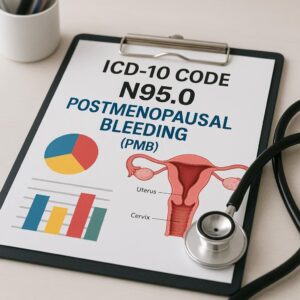
ICD-10 Code for PMB
The Straight Answer: ICD-10 Code for PMB
The primary and most specific ICD-10-CM code for Postmenopausal Bleeding is:
H3: N95.0 – Postmenopausal Bleeding
This is your go-to code. It falls under the broader category of “N95” which covers menopausal and other perimenopausal disorders.
Important Note: Before assigning this code, the documentation must clearly indicate that the patient is indeed postmenopausal. This is typically defined as the permanent cessation of menstruation for 12 consecutive months with no other pathological or physiological cause.
Understanding the Clinical Context: What is PMB?
To code accurately, you need to understand the condition. You can’t just match a word to a number; you have to ensure the clinical picture fits.
Postmenopausal bleeding (PMB) is defined as vaginal bleeding that occurs in a woman after one year or more of no menstrual periods. It is not a disease in itself, but rather a symptom of an underlying condition.
Why is PMB a Significant Symptom?
In a postmenopausal woman, the endometrium (the lining of the uterus) is typically thin and inactive. Any bleeding suggests something is causing it to become active or that a structural lesion is present. While many causes are benign, PMB can be an early sign of endometrial cancer, which is why it requires immediate investigation.
Common Etiologies (Causes) of PMB
Understanding the cause helps in understanding why the code N95.0 is used in conjunction with others. The causes generally fall into a few categories:
-
Atrophy (Most Common): As estrogen levels drop, the tissues of the vagina (atrophic vaginitis) and the uterine lining (endometrial atrophy) become thin, dry, and fragile. They can bleed easily.
-
Hormonal: This can occur if a woman is on hormone therapy (HT), especially if it’s a sequential regimen where progesterone is taken part of the month.
-
Structural Lesions:
-
Polyps: Benign growths on the endometrium or cervix are a frequent cause.
-
Fibroids (Leiomyomas): While they often shrink after menopause, they can still cause bleeding, especially if they are submucosal (located near the uterine cavity).
-
-
Endometrial Hyperplasia: This is a thickening of the uterine lining, which can be a precursor to cancer. It is often caused by excess estrogen without enough progesterone.
-
Malignancy: Endometrial cancer is the most common gynecologic cancer in the US, and bleeding is its primary symptom. Cervical cancer can also cause bleeding.
-
Other Sites: Bleeding can sometimes originate from the urethra, bladder, or rectum, and be mistaken for vaginal bleeding.
Important Note for Coders: While N95.0 is the primary code for the symptom, if a definitive diagnosis is made (e.g., endometrial polyp, cancer), the coding guidelines require you to code the definitive diagnosis first, and the symptom code (N95.0) may be used as an additional code if desired or if the condition is not fully described by the diagnosis code alone.
A Deeper Dive into the Code: N95.0
Let’s look at the specifics of the code itself.
-
Code: N95.0
-
Description: Postmenopausal bleeding
-
Category: Diseases of the genitourinary system > Noninflammatory disorders of female genital tract > Menopausal and other perimenopausal disorders
-
Clinical Relevance: This code is used when the primary reason for the encounter is the bleeding itself, and the documentation confirms the patient is postmenopausal.
-
Excludes2 Notes: It’s vital to check for “Excludes2” notes in the ICD-10 manual. This code excludes:
-
Excessive bleeding in premenopausal periods (menorrhagia: N92.0)
-
Postmenopausal osteoporosis (M81.0)
-
Symptoms involving the female genital tract that are not menopausal (R10.2, R39.1, etc.)
-
Laterality and Specificity
One of the great things about ICD-10 is its specificity. However, N95.0 is a “standalone” code. It does not require a laterality digit (like .1 for right or .2 for left) because it describes a condition (bleeding) that is not a lateralized structure.
ICD-10 Coding Guidelines and Best Practices for PMB
Using N95.0 is often the first step, but correct coding requires a bit more thought. Here are the key guidelines to follow.
Symptom vs. Definitive Diagnosis
This is the golden rule of medical coding. When a patient presents with a symptom (like PMB) and the physician diagnoses a specific condition linked to that symptom, you must code the definitive diagnosis first.
-
Scenario A (No definitive diagnosis yet): A patient presents with PMB. The provider performs an initial workup but doesn’t find a clear cause yet. The encounter is for the symptom itself.
-
Coded as: N95.0 (Postmenopausal bleeding)
-
-
Scenario B (Definitive diagnosis made): A patient presents with PMB. An endometrial biopsy reveals an endometrial polyp.
-
Coded as:
-
Primary: N84.0 (Polyp of corpus uteri)
-
Secondary: N95.0 (Postmenopausal bleeding) [Optional, but provides useful specificity]
-
-
Coding for Associated Conditions
PMB often occurs with other symptoms or findings. You can, and often should, code these concurrently.
-
Atrophy: If the bleeding is due to atrophic vaginitis, you would code the cause.
-
Primary: N95.2 (Postmenopausal atrophic vaginitis)
-
Secondary: N95.0 (Postmenopausal bleeding)
-
-
Hormone Therapy: If a patient on hormone therapy experiences breakthrough bleeding, you still use N95.0. You may also want to include a code for long-term (current) use of hormones (Z79.890).
The Importance of Accurate Documentation
As a coder, you are only as good as the documentation you receive. If a physician writes “PMB” in the chart, you can confidently assign N95.0. However, if the physician writes “Routine exam with complaint of postmenopausal spotting,” you need to ensure the note clarifies the reason for the encounter is the bleeding itself, not the exam.
Common Differential Diagnoses and Their ICD-10 Codes
When a physician is evaluating PMB, they are considering a list of potential causes. Here is a helpful table comparing the primary diagnosis (the symptom) with the specific diagnoses that might explain it.
| Condition (Diagnosis) | ICD-10 Code | Description | Relation to PMB |
|---|---|---|---|
| Postmenopausal Bleeding | N95.0 | Bleeding occurring after 12 months of amenorrhea. | The presenting symptom itself. |
| Polyp of Corpus Uteri | N84.0 | A benign, usually pedunculated growth from the endometrial lining. | A common structural cause of PMB. |
| Polyp of Cervix Uteri | N84.1 | A benign growth on the cervix. | Can cause contact or spontaneous bleeding. |
| Leiomyoma of Uterus | D25.9 | Benign smooth muscle tumor of the uterus (fibroid). | If submucosal, a potential cause. |
| Endometrial Hyperplasia | N85.0- N85.1 | Thickening of the endometrium, often due to estrogen imbalance. (N85.0 for benign, N85.01 for atypia, N85.1 for adenomatous). | A precursor condition to cancer that causes bleeding. |
| Malignant neoplasm of endometrium | C54.1 | Cancer of the lining of the uterus. | The most serious cause of PMB. |
| Malignant neoplasm of cervix uteri | C53.9 | Cancer of the cervix. | Bleeding, especially post-coital, is a key symptom. |
| Atrophic Vaginitis | N95.2 | Inflammation and thinning of the vaginal walls due to low estrogen. | A very common, non-cancerous cause of spotting. |
The Patient Journey: From Symptom to Code
To put all this information into a real-world context, let’s follow a hypothetical patient, Sarah, through her experience with PMB. This will illustrate how the diagnosis and coding evolve.
The Initial Visit
Sarah, a 58-year-old woman who has not had a period in two years, notices light spotting on her underwear. She makes an appointment with her gynecologist.
-
Chief Complaint: “I saw some blood. I haven’t had a period in years.”
-
Physician’s Assessment (after history and physical): Postmenopausal bleeding. Plan: Schedule a transvaginal ultrasound and possible endometrial biopsy.
-
Coding for this Encounter: N95.0 (Postmenopausal bleeding). This is the reason for the visit.
The Diagnostic Phase
Sarah undergoes a transvaginal ultrasound. The report shows a thickened endometrium (8mm) and a possible polyp.
-
Physician’s Interpretation: The ultrasound is abnormal. The bleeding is likely due to the thickened lining or the polyp. A hysteroscopy with biopsy is scheduled to get a definitive answer.
The Definitive Diagnosis and Treatment
Sarah undergoes a hysteroscopy. The surgeon visualizes and removes an endometrial polyp. The tissue is sent to pathology.
-
Pathology Report: Benign endometrial polyp.
-
Post-Operative Diagnosis: Endometrial polyp, status-post polypectomy.
-
Coding for the Surgical Encounter:
-
Primary Diagnosis: N84.0 (Polyp of corpus uteri)
-
Secondary Diagnosis: N95.0 (Postmenopausal bleeding)
-
Procedure Code: 58558 (Hysteroscopy with biopsy and polypectomy)
-
This journey highlights the fluidity of coding. The code evolves from a symptom code (N95.0) to a definitive diagnosis code (N84.0) once the underlying cause is identified.
Frequently Asked Questions (FAQ) About the ICD-10 Code for PMB
Here are answers to some of the most common questions we receive.
Q1: Is N95.0 the only code I can use for bleeding after menopause?
A: It is the most specific and common code. However, if the bleeding is a known side effect of a medication like tamoxifen, you might also code for the medication status. If it’s post-coital (after sex) bleeding in a postmenopausal woman, N95.0 is still appropriate, but you could also code Z30.09 (Encounter for other general counseling and advice on contraception) if counseling is provided, though N95.0 remains the primary diagnosis for the bleeding itself.
Q2: My patient is 45 and hasn’t had a period in 8 months, but is now bleeding. Can I use N95.0?
A: No. Technically, this patient is perimenopausal, not postmenopausal. The definition of postmenopause requires 12 consecutive months without a period. You would look for a code describing perimenopausal bleeding, such as N92.4 (Excessive bleeding in the premenopausal period) or N92.1 (Excessive and frequent menstruation with irregular cycle), depending on the specific pattern.
Q3: What if the documentation just says “PMB”?
A: That is sufficient to assign code N95.0, provided the rest of the chart (like the patient’s age or history) supports that she is postmenopausal. Good documentation practice, however, is to write it out as “postmenopausal bleeding” at least once.
Q4: Can I code N95.0 with a cancer code?
A: Yes, absolutely. In fact, it’s good practice. If a patient has known endometrial cancer (C54.1) and presents with bleeding, you would code the cancer first (C54.1) and then the manifestation, postmenopausal bleeding (N95.0), as a secondary code to fully capture the reason for the encounter.
Q5: What is the difference between N95.0 and R39.1 (Other difficulties with micturition)?
A: They are completely different. R39.1 relates to urinary problems, like hesitancy or straining. It is critical not to confuse genital tract bleeding with urinary tract symptoms.
Key Takeaways for Accurate Coding
To wrap up the core of this guide, here are the essential points to remember when dealing with postmenopausal bleeding codes.
-
Verify Menopausal Status: Always confirm the patient has had 12 months of amenorrhea before using N95.0.
-
Code What is Known: If only the symptom is known, code the symptom (N95.0). If a definitive diagnosis is made, code the diagnosis first.
-
Read the Excludes Notes: Be mindful of what N95.0 does and does not include to avoid common coding errors.
-
Use Additional Codes Freely: Don’t be afraid to add codes for associated conditions like atrophy or long-term drug use to create a complete clinical picture.
-
Documentation is King: Clear, precise physician documentation is the foundation of accurate coding.
Conclusion: Mastering the PMB Code
Understanding the ICD-10 code for PMB, N95.0, is about more than just memorizing a number. It’s about understanding the clinical significance of the condition itself—a critical symptom that always requires investigation. By following the guidelines that distinguish a symptom from a definitive diagnosis, and by paying close attention to the details of the patient’s medical record, you can ensure accurate coding that reflects the patient’s true clinical status. This not only ensures proper reimbursement but also contributes to high-quality patient data and care.
In short, remember the code is N95.0, but the context is everything.
Additional Resource
For the most up-to-date official information, you can always refer to the Centers for Medicare & Medicaid Services (CMS) ICD-10 website or the American College of Obstetricians and Gynecologists (ACOG) for clinical practice bulletins on postmenopausal bleeding.
-
CMS ICD-10 Homepage: [Link to CMS official site]
Disclaimer: This article is for informational purposes only and does not constitute legal or professional medical coding advice. Coders and healthcare providers should always refer to the most current official ICD-10-CM coding manuals and guidelines for their specific situations. Reimbursement policies can vary by payer.