Within the intricate symphony of the human heart, a precise electrical cadence dictates every life-sustaining beat. This rhythm, a complex interplay of ion channels and cellular depolarization, is elegantly captured on the surface electrocardiogram (ECG). Among the various waveforms and intervals of the ECG, the QT interval represents a critical phase—the period of ventricular depolarization and subsequent repolarization. It is the heart’s vulnerable moment, a pause for recharge before the next contraction. When this interval becomes abnormally prolonged, it sets the stage for a potentially fatal electrical storm known as Torsades de Pointes (TdP), a polymorphic ventricular tachycardia that can degenerate into ventricular fibrillation and sudden cardiac death.
For healthcare professionals, medical coders, and health information managers, accurately capturing this condition is not merely an administrative task; it is a vital link in the chain of patient safety, clinical research, and appropriate reimbursement. The International Classification of Diseases, Tenth Revision, Clinical Modification (ICD-10-CM) provides the standardized language for this purpose. However, coding for QT prolongation is fraught with nuance. Is it congenital or acquired? Is it a symptom or a syndrome? What is the underlying cause? A misunderstanding can lead to inaccurate data, which in turn can affect public health surveillance, drug safety monitoring, and the perceived risk profile of a patient. This article delves deep into the clinical, physiological, and administrative complexities of QT prolongation, providing a definitive guide to its accurate representation within the ICD-10-CM framework. We will journey from the cellular mechanisms of cardiac repolarization to the precise alphanumeric codes that define it in the modern healthcare system, ensuring you have the knowledge to code with confidence and precision.
ICD-10 code for QT prolongation
2. Understanding the QT Interval: The Physiology of a Heartbeat
To appreciate the pathology of QT prolongation, one must first understand the physiology of a normal cardiac cycle. The ECG is a graphical representation of the heart’s electrical activity. The “QRS complex” corresponds to the rapid depolarization of the ventricles, which triggers their contraction and pumps blood to the lungs and body. The “T wave” that follows represents ventricular repolarization—the resetting of the heart’s cells in preparation for the next beat.
The QT interval is measured from the beginning of the QRS complex to the end of the T wave. It encompasses the total time taken for ventricular depolarization and repolarization. Critically, this interval is not static; it varies with heart rate. A faster heart rate shortens the QT interval, while a slower heart rate lengthens it. Therefore, the measured QT interval is almost always corrected for heart rate, yielding the QTc interval. The most common correction formula is Bazett’s formula (QTc = QT / √RR), though others like Fridericia’s are also used. A normal QTc value is typically considered to be below 440-450 milliseconds (ms) in men and below 460-470 ms in women. Values exceeding these thresholds define QT prolongation.
At a cellular level, the repolarization phase is a delicate ballet of ion channels. Primarily, it is driven by the outward flow of potassium ions through the rapid (IKr) and slow (IKs) delayed rectifier potassium channels. Any disruption to this outward potassium current, or an enhancement of inward depolarizing currents (e.g., sodium or calcium), can delay repolarization, prolong the QT interval on the ECG, and create a substrate for arrhythmia.
3. The Clinical Significance of a Prolonged QT Interval
A prolonged QT interval is clinically significant because it signifies a prolonged cardiac action potential duration. This creates a state of electrical instability within the ventricles. The primary and most feared consequence is the initiation of Torsades de Pointes (TdP), which translates to “twisting of the points.” This distinctive form of ventricular tachycardia appears on the ECG as a continuous, undulating sequence of QRS complexes that seem to twist around the isoelectric line.
TdP is often paroxysmal. It may terminate spontaneously, causing a brief episode of dizziness or palpitations, or it may persist, leading to syncope (fainting), seizures, or sudden cardiac death due to degeneration into ventricular fibrillation. The mechanism behind TdP is often attributed to early afterdepolarizations (EADs). These are abnormal oscillations in the membrane voltage during the prolonged repolarization phase (phase 2 or 3 of the action potential), which can trigger a premature beat that, in the right substrate, initiates the re-entrant circuit of TdP.
The risk of TdP is not a linear function of the QTc duration. While the risk increases with progressive prolongation, it is generally accepted that:
-
QTc < 470 ms: Low risk.
-
QTc 470-500 ms: Moderate risk.
-
QTc > 500 ms: High risk.
However, the absolute risk for any individual patient is influenced by a multitude of factors, including the presence of structural heart disease, electrolyte imbalances (hypokalemia, hypomagnesemia, hypocalcemia), bradycardia, and recent conversion from atrial fibrillation.
4. Etiology: Unraveling the Causes of QT Prolongation
The causes of QT prolongation are broadly categorized into two groups: acquired and congenital. This distinction is not just clinically critical but is also the cornerstone of accurate ICD-10 coding.
4.1. Acquired QT Prolongation: The Ubiquitous Threat
Acquired QT prolongation is far more common than the congenital form. It occurs due to external factors or other medical conditions that disrupt the heart’s normal repolarization process. The most common causes include:
-
Medications: This is the single largest and most clinically relevant cause. Hundreds of drugs are known to block the IKr potassium channel, effectively prolonging the QT interval. Key drug classes include:
-
Antiarrhythmics: (e.g., Sotalol, Amiodarone, Dofetilide, Quinidine)
-
Antipsychotics: (e.g., Haloperidol, Ziprasidone, Quetiapine)
-
Antidepressants: (e.g., Citalopram, Escitalopram, Amitriptyline)
-
Antibiotics: (e.g., Macrolides like Erythromycin and Azithromycin, Fluoroquinolones like Levofloxacin and Moxifloxacin)
-
Antifungals: (e.g., Fluconazole, Voriconazole)
-
Antiemetics: (e.g., Ondansetron, Dolasetron)
-
-
Electrolyte Imbalances: Hypokalemia, hypomagnesemia, and hypocalcemia are potent contributors to QT prolongation and can synergistically increase the risk of TdP when combined with a culprit drug.
-
Cardiovascular Conditions: Bradycardia (especially from heart block), myocardial ischemia, and cardiomyopathy can all lead to QT prolongation.
-
Endocrine and Metabolic Disorders: Hypothyroidism and anorexia nervosa are well-known associations.
-
Intracranial Pathology: Subarachnoid hemorrhage, stroke, and traumatic brain injury can cause significant QT prolongation.
4.2. Congenital Long QT Syndrome (LQTS): The Inherited Predisposition
Congenital LQTS is a genetic channelopathy, typically inherited in an autosomal dominant pattern (Romano-Ward syndrome) or, more rarely, an autosomal recessive pattern associated with deafness (Jervell and Lange-Nielsen syndrome). It is caused by mutations in genes encoding for cardiac ion channel subunits or their associated proteins. The most common subtypes are:
-
LQT1: Mutation in KCNQ1 gene affecting the IKs potassium channel. Events are often triggered by physical exertion or swimming.
-
LQT2: Mutation in KCNH2 gene affecting the IKr potassium channel. Events are often triggered by auditory stimuli or emotional stress.
-
LQT3: Mutation in SCN5A gene affecting the sodium channel, leading to a persistent late sodium current. Events often occur during sleep.
Patients with congenital LQTS are at a lifelong increased risk of syncope and sudden cardiac death, and their management involves beta-blockers, lifestyle modifications, and sometimes an implantable cardioverter-defibrillator (ICD).
5. Navigating the ICD-10-CM Codebook for QT Prolongation
Accurate coding requires a meticulous approach that reflects the clinical reality of the patient’s condition.
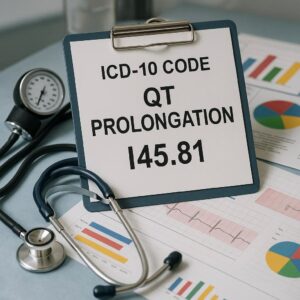
5.1. The Primary Code: I45.81 – Long QT Syndrome
The central code for this condition is I45.81. Its official descriptor in the ICD-10-CM manual is “Long QT syndrome.”
This is a critical point of potential confusion. The code I45.81 is housed within Chapter 9: “Diseases of the Circulatory System,” block I30-I52: “Other Forms of Heart Disease.” The term “syndrome” in its name can be misleading, as the code is used for both the congenital syndrome and the acquired prolongation of the QT interval. The ICD-10-CM Official Guidelines for Coding and Reporting do not provide a separate code for acquired QT prolongation. Therefore, I45.81 is the default and correct code for any documented diagnosis of QT prolongation or long QT syndrome, regardless of etiology.
5.2. The Crucial Role of Secondary Codes
While I45.81 is the primary code, its use in isolation is often incomplete and fails to tell the whole clinical story. The power and accuracy of coding for QT prolongation lie in the application of secondary codes to specify the cause.
-
For Drug-Induced QT Prolongation: This is where coding becomes particularly nuanced. You must use a code from the T36-T50 series to identify the drug. Furthermore, you must use an additional code to specify the nature of the adverse effect.
-
Adverse Effect: Use this when the drug was taken correctly as prescribed. The coding structure is:
-
Primary Code: I45.81 (Long QT syndrome)
-
Secondary Code: T-code for the drug (e.g., T43.4X5A for quetiapine) with the 5th or 6th character ‘5’ indicating “adverse effect.”
-
Additional Code: A code from Chapter 18 (R00-R99) may be used to manifest the condition, but I45.81 is sufficient in this context.
-
-
Poisoning/Overdose: Use this when the drug was taken in error or as an overdose.
-
Primary Code: The poisoning code (T-code) with the 5th/6th character representing ‘1’ (accidental), ‘2’ (intentional self-harm), etc.
-
Secondary Code: I45.81 to represent the resulting QT prolongation.
-
-
-
For Congenital LQTS: The index pathway in ICD-10 leads you to I45.81. There is no separate code for “congenital” LQTS. However, you can add a code from the Q00-Q99 chapter to provide further detail, though it is not mandatory. The code Q89.9 – Congenital malformation, unspecified could be considered, but its utility is limited. The clinical documentation of “congenital long QT syndrome” is the key driver.
-
For Other Underlying Causes:
-
Hypokalemia: E87.6
-
Hypomagnesemia: E83.42
-
Hypocalcemia: E83.51
-
Hypothyroidism: E03.9, E01.2, etc.
-
Acute Myocardial Infarction: I21.-
-
5.3. Coding for Adverse Effects and Poisoning
The table below provides a clear summary of the coding approach for drug-induced QT prolongation, highlighting the critical differences.
ICD-10-CM Coding for Drug-Induced QT Prolongation
| Clinical Scenario | Description | Primary Code | Secondary Code(s) | Notes |
|---|---|---|---|---|
| Adverse Effect | Patient develops QT prolongation while taking a medication exactly as prescribed by their physician. | I45.81 (Long QT syndrome) | T36-T50 with 5th/6th character ‘5’ (Adverse effect). e.g., T45.1X5A (Adverse effect of haloperidol, initial encounter) |
The T-code is sequenced secondarily. The ‘A’ (or D/S) for encounter is crucial. |
| Poisoning / Overdose | Patient intentionally overdoses on a medication, or takes it accidentally in the wrong dose, resulting in QT prolongation. | T36-T50 with 5th/6th character ‘1’, ‘2’, ‘3’, etc. (Poisoning, accidental, intentional, etc.). e.g., T43.4X2A (Poisoning by quetiapine, intentional self-harm, initial encounter) |
I45.81 (Long QT syndrome) | The poisoning code is sequenced first, as it describes the cause of the injury. |
| Underlying Condition | QT prolongation is due to a non-drug medical condition (e.g., electrolyte imbalance). | I45.81 (Long QT syndrome) | Code for the underlying condition (e.g., E87.6 for Hypokalemia) | The underlying condition provides essential context for the QT prolongation. |
6. Clinical Scenarios: Applying ICD-10 Codes in Practice
Let’s translate this knowledge into practical coding examples.
Scenario 1: The Psychiatric Patient
A 45-year-old female with schizophrenia, maintained on haloperidol, presents for a routine check-up. A routine ECG reveals a QTc of 490 ms. The physician documents “Drug-induced QT prolongation due to haloperidol.”
-
Coding:
-
I45.81 – Long QT syndrome
-
T43.4X5A – Adverse effect of haloperidol, initial encounter
-
F20.9 – Schizophrenia, unspecified (to provide the context for why she is on the medication)
-
Scenario 2: The Post-Infection Complication
A 68-year-old male is hospitalized for community-acquired pneumonia. He is started on intravenous azithromycin. Two days later, he has a syncopal episode. ECG shows Torsades de Pointes with a baseline QTc of 520 ms. The diagnosis is “Acquired long QT syndrome with Torsades de Pointes due to azithromycin.”
-
Coding:
-
I47.2 – Ventricular tachycardia (to code for the Torsades de Pointes)
-
I45.81 – Long QT syndrome
-
T36.8X5A – Adverse effect of other systemic antibiotics, initial encounter (Azithromycin is classified here)
-
J15.9 – Unspecified bacterial pneumonia
-
Scenario 3: The Family History
A 19-year-old college athlete is referred to cardiology after his sister was diagnosed with genetic LQT1. His ECG shows a QTc of 480 ms at rest. Genetic testing confirms a pathogenic variant in the KCNQ1 gene. The diagnosis is “Congenital Long QT Syndrome, type 1.”
-
Coding:
-
I45.81 – Long QT syndrome
-
*(Note: While there is no specific code for LQT1, the detailed documentation is paramount. A code like Z84.89 – Family history of other specified conditions, could be considered for the sister’s record, but not for the patient’s active diagnosis.)*
-
Scenario 4: The Overdose
A patient is brought to the ED after a suspected intentional overdose of amitriptyline. The ECG shows a QTc of 600 ms and wide QRS complexes.
-
Coding:
-
T43.012A – Poisoning by amitriptyline, intentional self-harm, initial encounter
-
I45.81 – Long QT syndrome
-
R94.31 – Abnormal electrocardiogram [ECG] [EKG] (can be used as an additional code)
-
7. The Intersection of Coding and Clinical Documentation
The accuracy of ICD-10 coding is entirely dependent on the quality of clinical documentation. Physicians and providers must be precise. Phrases like “QT prolongation” should be accompanied by an etiology. Coders must be trained to query providers for clarification when documentation is ambiguous. Is it “probable,” “suspected,” or “confirmed”? Is it “drug-induced” or “idiopathic”? This collaboration is essential for generating clean claims and, more importantly, for creating a medical record that accurately reflects the patient’s health status and risks.
8. The Future: ICD-11 and Beyond
The World Health Organization’s ICD-11, which is gradually being adopted, offers a more refined structure for coding QT prolongation. It provides distinct entities:
-
BC64.0 – Long QT syndrome (which includes both congenital and acquired)
-
BC64.00 – Hereditary long QT syndrome
-
BC64.01 – Drug-induced long QT syndrome
This enhanced specificity will significantly improve the granularity of health data, making it easier to track drug safety issues and the prevalence of genetic forms. For now, mastering the nuanced application of ICD-10-CM code I45.81 and its accompanying etiological codes remains the standard of practice.
9. Conclusion
Accurate ICD-10 coding for QT prolongation hinges on the fundamental code I45.81. The true precision, however, is achieved by meticulously layering secondary codes that identify the root cause, be it a specific medication, an electrolyte imbalance, or a congenital predisposition. Mastering this approach ensures data integrity, supports patient safety initiatives, and reflects the complex clinical reality of this potentially life-threatening electrical disorder of the heart.
10. Frequently Asked Questions (FAQs)
Q1: Is there a different ICD-10 code for congenital vs. acquired long QT syndrome?
A: No. The primary code I45.81 is used for both forms. The distinction is made through the clinical documentation and, when appropriate, the use of additional codes for the cause (e.g., a T-code for a drug).
Q2: How do I code a patient with a borderline prolonged QTc (e.g., 455 ms) that the physician is “watching”?
A: Do not code a condition that is not definitively diagnosed. If the physician documents “borderline QT prolongation” or “prolonged QTc, monitor,” and does not formally diagnose “Long QT syndrome,” you should not assign I45.81. Instead, you may use R94.31 – Abnormal electrocardiogram [ECG] [EKG].
Q3: A medication is known to cause QT prolongation, but my patient’s QTc is normal. Should I code for the risk?
A: No. ICD-10-CM codes represent diagnoses, symptoms, and reasons for encounter, not potential risks (unless it’s a code for “family history” or “personal history of”). You cannot code for a condition the patient does not have.
Q4: What is the correct 7th character for I45.81?
A: Code I45.81 does not require a 7th character. It is a stand-alone code.
Q5: How do I code Torsades de Pointes (TdP) with QT prolongation?
A: Code both. Sequence I47.2 – Ventricular tachycardia first (as TdP is a type of VT), followed by I45.81 – Long QT syndrome. Then, add any codes for the underlying cause (drug, electrolyte imbalance, etc.).
11. Additional Resources
-
ICD-10-CM Official Guidelines for Coding and Reporting: Published annually by the CDC and CMS. This is the definitive source for coding rules.
-
American Heart Association (AHA) Scientific Statements: Search for publications on “Channels, Receptors, and Arrhythmias” or “Drug-Induced Arrhythmias” for the latest clinical insights.
-
CredibleMeds® (www.crediblemeds.org): A renowned resource maintained by the Arizona Center for Education and Research on Therapeutics (AZCERT). It provides a continuously updated list of drugs that are known to have a risk of TdP.
-
The Genetic and Rare Diseases (GARD) Information Center: Provides detailed information for patients and providers on congenital Long QT syndrome.
Date: October 23, 2025
Author: Dr. Alistair Finch
Disclaimer: This article is intended for educational and informational purposes only and does not constitute medical advice, diagnosis, or treatment. Always seek the advice of your physician or other qualified health provider with any questions you may have regarding a medical condition. The coding information provided is based on current guidelines as of the publication date and is subject to change.