Rhabdomyolysis is a complex and potentially life-threatening clinical syndrome characterized by the rapid breakdown of skeletal muscle tissue and the subsequent release of intracellular contents into the systemic circulation. This cascade of events can lead to severe complications, most notably acute kidney injury (AKI), electrolyte disturbances, and disseminated intravascular coagulation. From a clinical standpoint, the diagnosis and management of rhabdomyolysis demand swift and precise intervention. However, from an administrative, financial, and data analytics perspective, the process begins with a single, yet profoundly important, element: the correct International Classification of Diseases, Tenth Revision, Clinical Modification (ICD-10-CM) code.
The assignment of the ICD-10 code for rhabdomyolysis is far from a mundane clerical task. It is a critical junction where clinical medicine meets healthcare administration. An accurately assigned code does more than just populate a billing form; it tells a patient’s story in a standardized language understood by payers, researchers, and public health officials. It influences reimbursement, impacts hospital quality metrics, contributes to epidemiological data, and can even affect the legal standing of a healthcare facility in cases of malpractice or denials. This article aims to be the definitive guide for medical coders, health information management (HIM) professionals, physicians, and advanced practice providers seeking to master the nuances of coding for rhabdomyolysis. We will move beyond the basic code itself, delving into the intricacies of documentation requirements, sequencing rules, complication coding, and the profound implications of getting it right—or wrong.
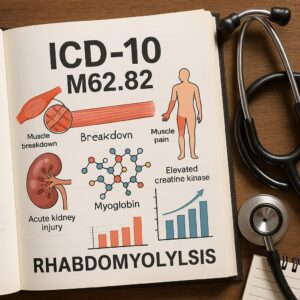
ICD-10 code for Rhabdomyolysis
2. Understanding the Pathophysiology of Rhabdomyolysis: Why Muscle Breakdown Matters
To code rhabdomyolysis accurately, one must first understand what it is. At its core, rhabdomyolysis results from direct or indirect muscle injury. The pathophysiology involves damage to the sarcolemma, the membrane of muscle cells, leading to an unregulated influx of calcium and the release of intracellular components into the bloodstream. The most significant of these components are:
-
Myoglobin: A heme-protein that carries and stores oxygen in muscle. When released in large quantities, it is filtered by the kidneys but can precipitate in the renal tubules, causing obstructive nephropathy and direct cytotoxic injury, leading to AKI.
-
Creatine Kinase (CK): An enzyme highly concentrated in muscle cells. A serum CK level more than five times the upper limit of normal is a key diagnostic criterion for rhabdomyolysis.
-
Electrolytes: Potassium, phosphate, and organic acids are released, potentially causing hyperkalemia (which can trigger fatal cardiac arrhythmias), hyperphosphatemia, and metabolic acidosis.
-
Purines: These are metabolized to uric acid, leading to hyperuricemia.
The etiologies of rhabdomyolysis are vast and can be broadly categorized as follows:
-
Traumatic: Crush injuries, compartment syndrome, prolonged immobilization (e.g., after a fall), burns, electrocution.
-
Exertional: Strenuous exercise (especially in unconditioned individuals), seizures, delirium tremens, status asthmaticus.
-
Ischemic: Arterial thrombosis, embolism, tourniquet use during surgery.
-
Metabolic: Hypokalemia, hypophosphatemia, diabetic ketoacidosis, hypothyroidism.
-
Genetic: Inherited metabolic myopathies (e.g., McArdle’s disease, Carnitine palmitoyltransferase II deficiency).
-
Infectious: Influenza, Coxsackievirus, Sepsis.
-
Toxic/Medication-Induced: Statins, fibrates, antipsychotics, illicit drugs (cocaine, amphetamines), alcohol.
This understanding of pathophysiology and etiology is not merely academic; it is the foundation upon which specific and compliant coding is built. The cause of the muscle injury directly influences how the encounter is coded.
3. The ICD-10-CM Code for Rhabdomyolysis: A Deep Dive into M62.82
The official ICD-10-CM code for Rhabdomyolysis is M62.82.
3.1. Code Structure and Placement
The code M62.82 belongs to a specific chapter and category within the ICD-10-CM manual:
-
Chapter 13: Diseases of the Musculoskeletal System and Connective Tissue (M00-M99)
-
Category M62: Other disorders of muscle
-
Code M62.82: Rhabdomyolysis
This placement indicates that the classification system views rhabdomyolysis primarily as a disorder of the muscle itself. It is crucial to note that this code is “other specified” under the M62 category, which includes other conditions like muscle wasting, muscle strain, and other specific muscle disorders not elsewhere classified.
3.2. Excludes Notes and Their Critical Importance
Perhaps the most critical aspect of using M62.82 correctly is understanding and applying the “Excludes” notes associated with it. These notes are essential instructions that prevent double-coding and ensure diagnostic precision.
-
Excludes1: “malignant hyperpyrexia due to anesthesia (T88.3)”
-
An Excludes1 note means “NOT CODED HERE.” It indicates that the two conditions are mutually exclusive. If a patient develops rhabdomyolysis as a direct result of malignant hyperthermia triggered by anesthesia, you would code T88.3, not M62.82. This is because the rhabdomyolysis is an integral part of the malignant hyperthermia syndrome.
-
-
Excludes2: “traumatic myopathy (M62.81-)”
-
An Excludes2 note means “not included here.” It indicates that the condition excluded is not part of the condition represented by the code, but a patient may have both conditions at the same time. This is a vital distinction. If a patient has rhabdomyolysis due to a specific trauma (e.g., a crush injury), you would code the traumatic myopathy (M62.81-) instead of M62.82. M62.82 is reserved for non-traumatic causes.
-
Furthermore, you must also consider the Excludes1 note at the parent category M62, which states:
-
Excludes1: “alcoholic myopathy (G72.1), cramp and spasm (R25.2), drug-induced myopathy (G72.0), myalgia (M79.1-), stiff-man syndrome (G25.82)”
This means if the rhabdomyolysis is directly caused by alcohol or a specific drug, you would use the code from the G72.- category (Diseases of myoneural junction and muscle), not M62.82.
4. The Art of Sequencing: Primary Diagnosis, Comorbidity, or Manifestation?
The order in which you list diagnoses—a process known as sequencing—is governed by the Uniform Hospital Discharge Data Set (UHDDS) guidelines. The principal diagnosis is defined as “that condition established after study to be chiefly responsible for occasioning the admission of the patient to the hospital for care.”
The sequencing of M62.82 depends entirely on the clinical circumstances of the encounter:
-
Rhabdomyolysis as the Principal Diagnosis: If a patient is admitted primarily for the management and treatment of rhabdomyolysis (e.g., a marathon runner presenting with severe muscle pain, dark urine, and a sky-high CK level), then M62.82 should be sequenced first.
-
Rhabdomyolysis as a Comorbidity: If the patient is admitted for another condition, but pre-existing or concurrently developing rhabdomyolysis significantly affects the patient’s care (increasing length of stay, requiring additional monitoring or treatment), then M62.82 is listed as a secondary diagnosis.
-
Rhabdomyolysis as a Manifestation of Another Condition: In some cases, rhabdomyolysis is a direct consequence of another disease. The coding guidelines often instruct us to code both the underlying etiology and the manifestation. However, for rhabdomyolysis, the standard is to code the cause. For example, if rhabdomyolysis is due to hypothyroidism, you would code the hypothyroidism (E03.9). The rhabdomyolysis itself is a clinical feature of that underlying disease. However, if the rhabdomyolysis is severe and requires specific treatment, coding both may be justified, with the underlying cause sequenced first. Always consult the Tabular List for instructional notes.
5. Documentation is Key: What Providers Must Include for Accurate Coding
The coder’s world is defined by the documentation in the medical record. Vague or incomplete documentation leads to coding errors, denials, and inaccurate data. For rhabdomyolysis, providers must be explicit.
5.1. The Etiology: The Cornerstone of Specificity
The single most important piece of information a provider can document is the cause. Instead of just writing “rhabdomyolysis,” the documentation should specify:
-
Poor Documentation: “Patient has rhabdomyolysis.”
-
Excellent Documentation: “Patient presents with severe rhabdomyolysis secondary to prolonged immobilization after a mechanical fall.” OR “Diagnosis: Exertional rhabdomyolysis due to extreme physical exertion during a new fitness regimen.” OR “Admitted for management of statin-induced rhabdomyolysis.“
This level of detail allows the coder to move beyond the generic M62.82 and assign a more precise code (like M62.81- for trauma or G72.0 for the drug-induced cause), which is clinically accurate and often required for correct reimbursement.
5.2. Documenting Associated Conditions and Complications
Providers should also clearly document any associated acute conditions or complications.
-
Acute Kidney Injury (AKI): Document the stage (e.g., AKI Stage 3) and, if known, the cause (e.g., “AKI due to myoglobinuria”).
-
Compartment Syndrome: Document the location and laterality.
-
Electrolyte Imbalances: Document specific abnormalities like hyperkalemia, hyperphosphatemia, and hypocalcemia.
-
Clinical Findings: Documenting the presence of myoglobinuria (dark, tea-colored urine), severe muscle pain, and elevated CK levels strengthens the medical necessity for the admission and treatment.
6. Navigating Complex Scenarios: Case Studies in Rhabdomyolysis Coding
Let’s apply the principles discussed above to realistic patient scenarios.
Case Study 1: The Overzealous Athlete
-
Scenario: A 22-year-old male with no significant past medical history is brought to the ER after collapsing during his first high-intensity cross-fit class. He complains of severe muscle pain and weakness and has passed dark brown urine. His CK is 25,000 U/L. He is admitted for IV hydration and monitoring.
-
Analysis: The rhabdomyolysis is clearly due to extreme exertion. There is no mention of trauma, drugs, or other underlying diseases. The admission is solely for the management of rhabdomyolysis.
-
Correct Coding: M62.82 (Rhabdomyolysis) sequenced as the principal diagnosis.
Case Study 2: The Statin User
-
Scenario: A 68-year-old female is admitted for generalized muscle weakness and pain. She has a history of hyperlipidemia and has been on high-dose atorvastatin for one year. Her CK is 18,000 U/L. The attending physician documents “statin-induced myopathy with rhabdomyolysis.”
-
Analysis: The provider has explicitly linked the rhabdomyolysis to the statin medication. This falls under “drug-induced myopathy.”
-
Correct Coding: G72.0 (Drug-induced myopathy) sequenced as the principal diagnosis. The hyperlipidemia (E78.5) would be listed as a secondary, chronic condition.
Case Study 3: Rhabdomyolysis in Trauma
-
Scenario: A construction worker is admitted after his leg was pinned by a heavy beam for 45 minutes. He is diagnosed with a crush injury to the right lower leg, resulting in rhabdomyolysis and acute compartment syndrome.
-
Analysis: The rhabdomyolysis is a direct result of a specific traumatic event (the crush injury).
-
Correct Coding:
-
S87.81XA (Crush injury of right lower leg, initial encounter)
-
M62.831 (Traumatic myopathy of right lower leg) – This code is used instead of M62.82.
-
T79.A0XA (Compartment syndrome, unspecified, initial encounter) – A more specific code may be available based on documentation.
-
Sequencing: The crush injury (S87.81XA) is typically sequenced first as the cause of the entire clinical picture.
-
Case Study 4: Post-Procedural Rhabdomyolysis
-
Scenario: An obese patient undergoes a lengthy, complex cardiac bypass surgery lasting 8 hours. Post-operatively, he develops dark urine and a rising CK level. The surgeon documents “rhabdomyolysis likely secondary to prolonged immobilization and pressure on muscle groups during the prolonged surgical procedure.”
-
Analysis: This is a form of traumatic/ischemic myopathy caused by the surgical positioning and duration. It is not due to anesthesia-induced malignant hyperthermia.
-
Correct Coding: M62.82 (Rhabdomyolysis) would be appropriate. This would be sequenced as a secondary diagnosis, as the principal diagnosis would be the reason for the original surgery (e.g., I25.110, Atherosclerotic heart disease of native coronary artery with unstable angina). It would also be crucial to assign a code from category Y84.6 (Procedure as the cause of abnormal reaction of the patient, or of later complication, without mention of misadventure at the time of the procedure) to indicate the link to the surgery.
7. The Domino Effect: Complications of Rhabdomyolysis and Their Corresponding Codes
Rhabdomyolysis is dangerous not just for the muscle damage, but for its systemic complications. Accurate coding requires capturing these associated conditions.
7.1. Acute Kidney Injury (AKI)
AKI is the most feared complication. Coding requires specificity.
-
Code Category: N17. (Acute kidney failure)
-
Specific Codes:
-
N17.0 – Acute kidney failure with tubular necrosis (this is often appropriate for myoglobinuric AKI)
-
N17.1 – Acute kidney failure with cortical necrosis
-
N17.2 – Acute kidney failure with medullary necrosis
-
N17.8 – Other acute kidney failure
-
N17.9 – Acute kidney failure, unspecified
-
-
Sequencing: If the AKI develops after admission and is the primary reason for ongoing hospitalization or a change in care, it may be sequenced as a secondary diagnosis. If a patient is admitted with rhabdomyolysis and already has AKI on admission, both are coded, with the principal diagnosis typically being the condition that prompted the admission.
7.2. Compartment Syndrome
This is a surgical emergency occurring when pressure within a muscle compartment builds, compromising blood flow.
-
Code Category: T79.A- (Compartment syndrome)
-
Specificity: The code requires a 5th digit to specify the site (e.g., T79.A1- for upper extremity, T79.A2- for lower extremity) and a 7th character for encounter (A-initial, D-subsequent, S-sequela).
7.3. Disseminated Intravascular Coagulation (DIC)
A severe coagulopathy that can be triggered by massive muscle damage.
-
Code: D65 (Disseminated intravascular coagulation [defibrination syndrome])
7.4. Electrolyte Imbalances
These must be coded when documented.
-
E87.5 Hyperkalemia
-
E83.51 Hypocalcemia
-
E87.2 Acidosis (if documented as metabolic acidosis)
Common Rhabdomyolysis Complications and ICD-10 Codes
| Complication | ICD-10-CM Code | Notes |
|---|---|---|
| Acute Kidney Injury (AKI) | N17.0-N17.9 | Use the most specific code based on documentation. N17.0 (with tubular necrosis) is common. |
| Compartment Syndrome | T79.A0XA-T79.A9XS | Requires 5th digit for body site and 7th character for encounter type. |
| Disseminated Intravascular Coagulation (DIC) | D65 | |
| Hyperkalemia | E87.5 | A common and dangerous electrolyte imbalance. |
| Hypocalcemia | E83.51 | |
| Hyperphosphatemia | E83.39 | Other disorders of phosphorus metabolism. |
| Metabolic Acidosis | E87.2 | |
| Myoglobinuria | R82.1 | This is a symptom, not a diagnosis, but can be coded if documented. |
8. The Financial and Legal Implications of Miscoding Rhabdomyolysis
Inaccurate coding is not a victimless error. It has tangible consequences.
-
Financial Impact (Reimbursement): Using an incorrect code can lead to claim denials or down-coding. For instance, if a payer’s policy requires a code for “traumatic myopathy” (M62.81-) for a crush injury case and the coder uses the generic M62.82, the claim may be denied for lack of medical necessity or incorrect diagnosis. Conversely, failing to code a major complication like AKI (N17.9) can result in a lower Diagnosis-Related Group (DRG) weight, leading to significant underpayment for the hospital stay.
-
Legal and Compliance Risks: Inaccurate coding can be construed as fraud or abuse, especially if it consistently results in higher reimbursement (upcoding). Audits by Recovery Audit Contractors (RACs) or the Office of Inspector General (OIG) can identify these patterns and lead to hefty fines, penalties, and exclusion from federal healthcare programs.
-
Impact on Quality Metrics and Data Integrity: Hospital quality scores, mortality rates, and complication profiles are all derived from coded data. Miscoding rhabdomyolysis and its complications skews this data, making it impossible to accurately track outcomes, conduct research, or compare performance across institutions.
9. Beyond M62.82: Differentiating Rhabdomyolysis from Other Myopathies and Injuries
The coder must be vigilant to distinguish rhabdomyolysis from other similar conditions.
-
Myalgia (M79.1-): This is simple muscle pain. It does not involve muscle breakdown or elevated CK levels.
-
Muscle Strain (S29.01XA, etc.): A strain is a tearing of muscle fibers, often localized. While it can cause pain and a mild CK elevation, it is not the systemic syndrome of rhabdomyolysis.
-
Muscle Wasting and Atrophy (M62.5-): This refers to the loss of muscle mass over time, not an acute breakdown.
-
Other Myopathies (G72.-): As discussed, this category is for specific types like drug-induced (G72.0) and alcoholic (G72.1) myopathy, which include or can lead to rhabdomyolysis.
The key differentiator in the documentation is the combination of muscle symptoms, dark urine (myoglobinuria), and a significantly elevated Creatine Kinase level.
10. The Future of Coding: ICD-11 and the Potential for Greater Specificity
The World Health Organization’s (WHO) International Classification of Diseases, 11th Revision (ICD-11) was implemented in January 2022 and offers a more modernized structure. In ICD-11, the code for Rhabdomyolysis is FB32.0.
ICD-11 allows for greater detail through clustering and the use of “post-coordination.” For example, one could code the rhabdomyolysis and simultaneously specify the etiology (e.g., a code for “effects of statins”) in a single cluster. This enhanced specificity promises to improve the richness of health data for public health surveillance and clinical research, providing a more nuanced picture of the condition than the current ICD-10 code M62.82. The US has not yet set a timeline for transitioning to ICD-11, but understanding its structure is forward-thinking for any HIM professional.
11. Conclusion: Synthesizing Knowledge for Precision and Compliance
Accurately coding rhabdomyolysis with ICD-10-CM requires a deep understanding of the code M62.82 and its many nuances.
The process hinges on identifying the underlying etiology to determine if a more specific code, such as for traumatic or drug-induced myopathy, is required.
Robust clinical documentation is the indispensable foundation, enabling coders to capture the full clinical picture, including severe complications like acute kidney injury, which directly impacts patient care and reimbursement.
12. Frequently Asked Questions (FAQs)
Q1: Can I code M62.82 if the provider only documents an elevated CK level without explicitly writing “rhabdomyolysis”?
A: No. Coding must be based on physician documentation. An elevated CK can occur in other conditions (e.g., myocardial infarction, minor muscle trauma). The provider must establish the diagnosis of “rhabdomyolysis” based on the clinical picture (symptoms, CK level, urinalysis). A query may be necessary.
Q2: How do I code rhabdomyolysis that is due to a viral infection like the flu?
A: In this case, the rhabdomyolysis is a complication of the viral illness. You would code the viral infection first (e.g., J11.1 for Influenza due to unidentified influenza virus with other respiratory manifestations). If the rhabdomyolysis is a significant part of the treatment and hospitalization, you would also code M62.82 as a secondary diagnosis.
Q3: What is the difference between M62.82 and T79.5 (Traumatic ischaemia of muscle)?
A: T79.5 is for a condition like Volkmann’s ischemic contracture, which is a specific sequela of compartment syndrome leading to muscle contracture. It is not a code for the acute process of rhabdomyolysis. For acute traumatic muscle breakdown, M62.81- (Traumatic myopathy) is the correct code.
Q4: A patient has chronic kidney disease (CKD) and develops rhabdomyolysis-induced AKI. How do I code this?
A: You would code both the acute and chronic conditions.
-
N17.9 (Acute kidney failure, unspecified) – or a more specific code from the N17 category.
-
The appropriate code for the stage of the pre-existing CKD (e.g., N18.3, Chronic kidney disease, stage 3).
The sequencing depends on the reason for admission. If the AKI is the primary focus, sequence it first.
13. Additional Resources
For the most accurate and up-to-date information, always refer to these official sources:
-
CDC ICD-10-CM Official Guidelines for Coding and Reporting: https://www.cdc.gov/nchs/icd/icd-10-cm.htm (Updated annually; the definitive source for coding rules).
-
American Health Information Management Association (AHIMA): https://www.ahima.org/ (Provides educational resources, journals, and position papers on coding best practices).
-
American Academy of Professional Coders (AAPC): https://www.aapc.com/ (Offers certification, training, and networking opportunities for coders).
-
ICD-10-CM Tabular List and Index: Available through the CDC website or via commercial coding software vendors (e.g., Optum, 3M).
Date: October 25, 2025
Author: Healthcare Coding Insights
Disclaimer: This article is for informational and educational purposes only and is not a substitute for professional medical coding, billing, or legal advice. Code assignment must be based on the complete clinical documentation in the patient’s medical record, official coding guidelines, and payer-specific policies. The authors and publishers are not responsible for any errors or omissions, or for any outcomes resulting from the use of this information.