Shortness of breath, known medically as dyspnea, is one of the most common and alarming symptoms driving patients to seek medical care. It is a subjective experience of breathing discomfort that can range from a mild, temporary sensation to a severe, life-threatening emergency. In the world of healthcare data, this universal symptom must be translated into a precise, standardized language—the International Classification of Diseases, Tenth Revision, Clinical Modification (ICD-10-CM). The code for shortness of breath, R06.0, is deceptively simple. It represents not just a single condition, but the tip of a vast diagnostic iceberg. This article will embark on a deep dive beneath the surface, exploring the intricate world of coding for dyspnea. We will move beyond merely memorizing a code to developing a sophisticated understanding of when to use it, when to look deeper, and how this single data point is crucial for patient care, accurate reimbursement, and the very integrity of our health information systems. For medical coders, physicians, and healthcare administrators, mastering the nuances of R06.0 is not an administrative task; it is a fundamental clinical skill.
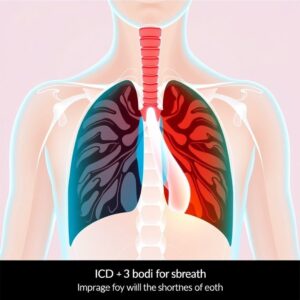
ICD-10 Code for Shortness of Breath
2. Understanding the Symptom: What is Shortness of Breath (Dyspnea)?
Before we can accurately code for dyspnea, we must understand it clinically. Dyspnea is a complex, multi-factorial symptom involving an interaction between physiological, psychological, social, and environmental factors. Patients describe it as “air hunger,” “tightness in the chest,” “inability to take a deep breath,” or “feeling smothered.”
The physiological mechanisms are varied:
-
Stimulation of Lung Receptors: Irritation in the airways (as in asthma) or stretching of the lung tissue (as in pulmonary edema) can send signals to the brain.
-
Increased Work of Breathing: Conditions like COPD or obesity make the respiratory muscles work harder to move air, leading to a sensation of effort.
-
Abnormal Blood Gases: Low oxygen levels (hypoxemia) or high carbon dioxide levels (hypercapnia) directly stimulate the brain’s respiratory centers.
-
Cardiac Output Mismatch: When the heart cannot pump enough blood to meet the body’s demands, as in heart failure, it can cause breathlessness.
Understanding these pathways is essential for coders because it directly links the symptom to its potential underlying cause, which is the primary target for accurate coding.
3. The Structure of ICD-10-CM: A Primer for Precision
ICD-10-CM is a highly detailed classification system with over 70,000 codes. Its alphanumeric structure is logical:
-
Chapters: Codes are grouped into 22 chapters based on etiology or body system (e.g., Chapter 9: Diseases of the Circulatory System; Chapter 10: Diseases of the Respiratory System).
-
Code Format: Codes can be 3 to 7 characters long. The more characters, the more specific the diagnosis.
-
Category (3 characters): e.g., R06 – Abnormalities of breathing
-
Subcategory (4 characters): e.g., R06.0 – Dyspnea
-
Subclassification (5th, 6th, or 7th characters): These provide specificity regarding laterality, acuity, or other clinical details. Note that R06.0 does not have further subdivisions.
-
This hierarchical structure demands precision. Coding “shortness of breath” requires determining if it is a standalone, unexplained symptom or a manifestation of a documented disease.
4. The Central Code: A Deep Dive into R06.0
4.1. Code Definition and Placement
The ICD-10-CM code for shortness of breath is R06.0 – Dyspnea. It is found in Chapter 18: Symptoms, Signs, and Abnormal Clinical and Laboratory Findings, Not Elsewhere Classified (R00-R99). This chapter is reserved for situations where no definitive diagnosis has been established. The code R06.0 is a “billable code,” meaning it is specific enough to be used for reimbursement purposes.
4.2. The “Signs and Symptoms” Chapter (Chapter 18)
The existence of Chapter 18 is a critical concept. It acknowledges that patients present with symptoms long before a diagnosis is confirmed. Codes from this chapter are used when:
-
A diagnosis cannot be made after study and examination.
-
The symptom is transient and a definitive diagnosis is not required.
-
The patient has a condition that is not classifiable elsewhere.
4.3. When is it Appropriate to Use R06.0?
R06.0 is appropriate only when the medical record does not specify a known cause for the shortness of breath. For example:
-
A patient presents to the Emergency Department complaining of acute shortness of breath. After a preliminary workup (chest X-ray, EKG, blood tests), no specific cause is identified, and the patient is discharged with a diagnosis of “dyspnea.”
-
A patient is seen in a clinic for ongoing shortness of breath. Extensive testing has been inconclusive, and the physician’s final assessment is “dyspnea, unspecified.”
5. The Golden Rule of ICD-10: Code First the Underlying Cause
This is the single most important rule in coding for dyspnea. The official ICD-10-CM coding guidelines state: “Code first the underlying etiology, if known.”
This means that if the physician has documented a condition that is causing the shortness of breath, you must code that condition first, and you generally should not also code R06.0. The symptom is inherent to the disease.
-
Incorrect Approach: A patient with acute decompensated heart failure presents with severe dyspnea. The coder assigns both I50.23 (Acute on chronic systolic heart failure) and R06.0. This is redundant and incorrect. The dyspnea is a symptom of the heart failure.
-
Correct Approach: Code only I50.23. The dyspnea is implied.
There are rare exceptions where an additional code from Chapter 18 might be used if the symptom is not typically associated with the disease or is a major, separate problem, but these are uncommon and must be supported by clear documentation.
6. A Systematic Approach to Coding Dyspnea: The Clinical Coder’s Thought Process
An expert coder follows a mental algorithm:
-
Review the Entire Record: Start with the final diagnosis, then the history of present illness, physical exam, and diagnostic results.
-
Identify the Physician’s Stated Cause: Does the physician explicitly link the dyspnea to a condition? (e.g., “Shortness of breath due to COPD exacerbation”).
-
Apply the “Code First” Rule: If a cause is documented, code that condition. Do not code R06.0.
-
Assess Specificity: If a cause is documented, ensure you are using the most specific code available (e.g., J44.1 for COPD with acute exacerbation).
-
Resort to R06.0 Only if Necessary: If, and only if, after a thorough review, no cause is documented or inferred, then assign R06.0.
7. Common Etiologies and Their Corresponding Codes: Moving Beyond R06.0
The following sections outline common causes of dyspnea and their correct ICD-10-CM codes.
7.1. Cardiovascular Causes
-
Heart Failure (I50.-): A leading cause of dyspnea. Codes are highly specific.
-
I50.2-: Systolic heart failure.
-
I50.3-: Diastolic heart failure.
-
I50.4-: Combined systolic and diastolic heart failure.
-
Specificity: The 5th character denotes acuity (e.g., .21 = Acute systolic HF, .22 = Chronic systolic HF, .23 = Acute on chronic systolic HF).
-
-
Acute Pulmonary Edema (J81.0): Often a consequence of acute heart failure. Fluid fills the air sacs of the lungs, causing severe dyspnea. Code J81.0 would be used.
-
Pulmonary Embolism (I26.-): A blood clot in the lungs is a medical emergency.
-
I26.99: Other pulmonary embolism without acute cor pulmonale.
-
7.2. Respiratory Causes
-
Asthma (J45.-):
-
J45.2-: Mild intermittent asthma.
-
J45.3-: Mild persistent asthma.
-
J45.4-: Moderate persistent asthma.
-
J45.5-: Severe persistent asthma.
-
J45.901- / J45.902-: Unspecified asthma, with status asthmaticus or with acute exacerbation. The acuity is critical.
-
-
Chronic Obstructive Pulmonary Disease (COPD) (J44.-):
-
J44.0: COPD with acute lower respiratory infection.
-
J44.1: COPD with acute exacerbation. This is a common code for COPD patients presenting with worsened dyspnea.
-
-
Pneumonia (J12-J18): Lung infection. Codes are specific to the organism (e.g., J13 for pneumonia due to Streptococcus pneumoniae).
-
Interstitial Lung Disease (J84.-): A group of diseases causing lung scarring.
7.3. Other Major Causes
-
Anemia (D50-D64): A reduced oxygen-carrying capacity of the blood can cause dyspnea, especially on exertion. Code the specific type of anemia (e.g., D64.9 for anemia, unspecified).
-
Anxiety Disorders (F41.-): Panic attacks can cause hyperventilation and a sensation of breathlessness.
-
F41.0: Panic disorder.
-
F41.1: Generalized anxiety disorder.
-
-
Deconditioning and Obesity (E66.-): Poor physical fitness or severe obesity can lead to dyspnea with minimal exertion.
-
E66.9: Obesity, unspecified.
-
8. The Importance of Specificity: Laterality, Acuity, and Type
While R06.0 itself is not highly specific, the codes for its underlying causes often are. Capturing this detail is vital.
-
Acuity: The difference between chronic dyspnea and acute respiratory failure is profound. Codes like J96.0- (Acute respiratory failure) and J96.1- (Chronic respiratory failure) carry significant clinical and reimbursement weight.
-
Type: Documentation of specific types of abnormal breathing may have their own codes, which can be used alongside a causal code if relevant:
-
R06.2: Wheezing
-
R06.3: Periodic breathing (e.g., Cheyne-Stokes respirations)
-
R06.81: Apnea, not elsewhere classified
-
R06.83: Snoring
-
R06.89: Other abnormalities of breathing (e.g., tachypnea, hyperventilation)
-
9. Clinical Documentation Improvement (CDI): The Physician-Coder Partnership
Often, a coder cannot assign a precise code because the physician’s documentation is incomplete or vague. This is where the CDI process comes in. A CDI specialist or coder may query the physician for clarification.
Common Documentation Gaps and CDI Queries for Dyspnea
| Documentation Gap | Impact on Coding | Example CDI Query |
|---|---|---|
| “Shortness of breath in a patient with history of COPD.” | Unable to code an exacerbation. Must use a less specific COPD code (J44.9). | “The patient is documented with COPD and acute shortness of breath. Can you clarify if this represents a COPD exacerbation?” |
| “Dyspnea due to heart failure.” | Unable to specify the type (systolic/diastolic) or acuity (acute/chronic) of heart failure. | “Thank you for documenting heart failure. Could you please specify the type (systolic, diastolic, or combined) and the acuity (acute, chronic, or acute on chronic)?” |
| “Patient has dyspnea and anemia.” | Are the two related? Is the dyspnea a symptom of the anemia, or is there another cause? | “The patient has both dyspnea and anemia. Is the dyspnea attributed to the anemia, or is there a separate underlying etiology?” |
| “Shortness of breath, cause unknown.” | This is the clearest scenario for appropriately using R06.0. |
10. Case Studies: Applying Knowledge in Real-World Scenarios
Case Study 1: The Asthmatic Exacerbation
-
Presentation: A 25-year-old female presents to the ED with acute onset of shortness of breath and wheezing after visiting a friend who has cats. She has a history of allergic asthma.
-
Physician Documentation: Final Diagnosis: “Acute asthma exacerbation secondary to allergen exposure.”
-
Coding Analysis: The cause of the dyspnea is clearly documented as an asthma exacerbation. The “code first” rule applies.
-
Correct Code: J45.901 (Unspecified asthma with status asthmaticus). *Note: If the record specified the type of asthma (e.g., mild persistent), a more specific code from the J45.3- series would be used.*
Case Study 2: The Post-Surgical Pulmonary Embolism
-
Presentation: A 68-year-old male develops sudden, severe shortness of breath and pleuritic chest pain three days after a total knee replacement.
-
Diagnostic Results: CT angiogram confirms a large pulmonary embolism in the right main pulmonary artery.
-
Physician Documentation: Final Diagnosis: “Acute pulmonary embolism.”
-
Coding Analysis: The dyspnea is a direct symptom of the pulmonary embolism.
-
Correct Code: I26.99 (Other pulmonary embolism without acute cor pulmonale). The dyspnea is not coded separately.
Case Study 3: Dyspnea with a Known Underlying Cause
-
Presentation: A 55-year-old female with a known history of systolic heart failure presents to her cardiologist with increased shortness of breath when walking up one flight of stairs over the past two weeks.
-
Physician Documentation: Assessment: “Worsening chronic systolic heart failure.”
-
Coding Analysis: The dyspnea is a symptom of the worsening heart failure.
-
Correct Code: I50.22 (Chronic systolic heart failure). The worsening is captured by the clinical detail, but the code itself is for the chronic condition. Note: If the physician had documented “acute decompensation,” I50.21 would be used.
Case Study 4: Dyspnea, Unspecified
-
Presentation: A previously healthy 40-year-old male presents to an urgent care center with a complaint of intermittent shortness of breath for one week. Physical exam and a quick strep test are normal.
-
Physician Documentation: Final Diagnosis: “Dyspnea, unspecified. Likely viral syndrome. Recommend follow-up if symptoms persist.”
-
Coding Analysis: No definitive underlying cause is identified. The symptom is the diagnosis.
-
Correct Code: R06.0 (Dyspnea).
11. The Consequences of Incorrect Coding: Reimbursement, Compliance, and Data Integrity
Using R06.0 inappropriately has real-world consequences:
-
Reimbursement: Undercoding (using R06.0 when a more severe, billable condition like heart failure is documented) leads to significant financial loss for the healthcare facility. Overcoding (using both the cause and R06.0) can be seen as “unbundling” and lead to claim denials or audits.
-
Compliance: Incorrect coding violates rules set by payers like Medicare and can result in fines, penalties, and legal action under the False Claims Act.
-
Data Integrity: Health data drives public health decisions, research, and quality metrics. Miscoding dyspnea as a symptom when it is actually heart failure skews national statistics on heart disease prevalence and outcomes, leading to misallocated resources and flawed research.
12. Conclusion: Mastering the Code for a Critical Symptom
The ICD-10 code R06.0 for shortness of breath is a small but powerful component of the healthcare data ecosystem. Its correct application hinges on a fundamental principle: code the cause, not the symptom. By understanding the clinical nature of dyspnea, adhering strictly to the “code first” guideline, and engaging in collaborative CDI processes, medical coders transform a simple patient complaint into accurate, meaningful data. This precision ensures proper patient care, fair reimbursement, regulatory compliance, and the reliability of the health information that shapes our understanding of disease. Mastering R06.0 is, therefore, a testament to the coder’s role as a crucial link between clinical practice and health information science.
13. Frequently Asked Questions (FAQs)
Q1: Can I ever use both a cause code and R06.0 together?
A: Almost never. The ICD-10 guidelines instruct to “code first the underlying etiology.” Using both is typically redundant. An exception might be if a symptom is present but is not a typical manifestation of the disease, and the physician explicitly notes it as a separate, significant issue. Always follow official guidelines and facility policy.
Q2: What is the difference between R06.0 (Dyspnea) and R06.00 (Dyspnea, unspecified)?
A: There is no code R06.00 in the current ICD-10-CM system. R06.0 is the complete and billable code for dyspnea. The code has no further subdivisions.
Q3: How do I code “shortness of breath on exertion” (SOBOE)?
A: “Shortness of breath on exertion” is still dyspnea. The same rules apply. If a cause is known (e.g., anemia, heart failure), code the cause. If no cause is documented, code R06.0. The “on exertion” is a descriptive detail but does not change the code assignment.
Q4: What code should be used for acute respiratory failure?
A: Acute respiratory failure has its own specific codes (J96.0-) and is a serious diagnosis, not a symptom. If a patient has acute respiratory failure causing dyspnea, you would code the respiratory failure (J96.0-) and not R06.0.
Q5: Where can I find the most up-to-date official coding guidelines?
A: The official guidelines are published by the Centers for Disease Control and Prevention (CDC) and the Centers for Medicare & Medicaid Services (CMS). They are updated annually and are available on the CDC’s website.
14. Additional Resources
-
CDC ICD-10-CM Official Guidelines for Coding and Reporting: https://www.cdc.gov/nchs/icd/icd-10-cm.htm (The primary source for all rules).
-
American Health Information Management Association (AHIMA): https://www.ahima.org (Provides educational resources, journals, and networking for coding professionals).
-
American Academy of Professional Coders (AAPC): https://www.aapc.com (Offers certification, training, and local chapter meetings for coders).
-
ICD10Data.com: An excellent, free online tool for quickly looking up codes and their guidelines. (Note: Always verify against the official manual).
Disclaimer: This article is for informational purposes only and is intended for medical coding professionals and healthcare students. It is not a substitute for the official ICD-10-CM guidelines, coding manuals, or professional medical advice. Code assignment must be based on the complete patient medical record and the most current official coding guidelines. The author and publisher are not responsible for errors or omissions, or for any outcomes resulting from the use of this information.
Date: September 22, 2025
Author: The Medical Coding Specialist