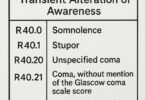
When a patient presents with difficulty speaking, the words might come out slowly, sound jumbled, or be barely understandable. As a healthcare professional, you know this symptom as dysarthria, often described in layman’s terms as “slurred speech.” But moving from a patient’s description to a precise medical record requires accuracy, especially when it comes to coding.
Finding the right ICD-10 code for slurred speech is more than just a billing formality. It’s about painting an accurate picture of the patient’s health status, ensuring proper reimbursement, and communicating clearly with other healthcare providers.
In this guide, we’ll walk through everything you need to know about the ICD-10 code for slurred speech. We’ll break down the specific codes, discuss how to differentiate between symptoms and diagnoses, and explore the nuances of coding for underlying conditions. Whether you’re a medical coder, a physician, or a student, consider this your friendly, reliable roadmap to coding dysarthria correctly.
ICD-10 Code for Slurred Speech
What is Slurred Speech? A Clinical Overview
Before we dive into the codes themselves, it’s helpful to understand what we’re actually coding. Slurred speech isn’t a disease itself; it’s a symptom. In the medical world, we call this specific type of speech disorder dysarthria.
Dysarthria occurs when the muscles you use for speaking are weak, or you have difficulty controlling them. It’s a motor speech disorder. The brain has trouble sending the right signals to the lips, tongue, vocal cords, and diaphragm, causing speech to become:
-
Slurred or slow
-
Quiet or difficult to hear
-
Jerky or robotic
-
Nasal or strained
It’s important not to confuse dysarthria with aphasia. Aphasia affects the language centers of the brain, impacting a person’s ability to find words or understand speech. Dysarthria, on the other hand, affects the mechanics of speaking. A person with dysarthria knows what they want to say; they just can’t physically form the words correctly.
Common Causes of Slurred Speech
Because dysarthria is a symptom, it always has an underlying cause. Understanding this is crucial for accurate coding, as we often need to code both the symptom and the cause. Some of the most common culprits include:
-
Neurological Conditions: This is the most frequent category. Stroke (cerebrovascular accident) is a leading cause, as are conditions like Parkinson’s disease, Multiple Sclerosis (MS), Cerebral Palsy, and Amyotrophic Lateral Sclerosis (ALS).
-
Traumatic Brain Injury: Damage from a blow to the head can affect the areas of the brain that control speech muscles.
-
Brain Tumors: Tumors can press on or damage parts of the brain involved in motor control.
-
Medications: Certain drugs, particularly sedatives and high doses of some anticonvulsants, can cause slurred speech as a side effect.
-
Intoxication: Alcohol and drug intoxication are temporary but common causes of slurred speech.
-
Vascular Issues: A transient ischemic attack (TIA or “mini-stroke”) can cause temporary slurred speech.
-
Autoimmune Disorders: Conditions like Myasthenia Gravis, which causes muscle weakness, can affect the facial muscles used for speech.
The Primary Code: R47.81
So, what is the specific ICD-10 code you’ll use most often? It falls under the category of “Symptoms and signs involving speech and voice.”
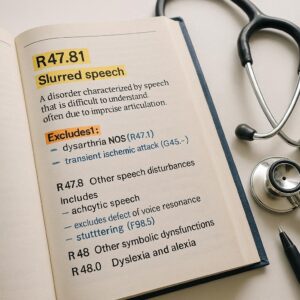
The primary ICD-10 code for slurred speech is R47.81.
This code is classified under:
-
R00-R99: Symptoms, signs and abnormal clinical and laboratory findings, not elsewhere classified
-
R47-R49: Symptoms and signs involving speech and voice
-
R47: Speech disturbances, not elsewhere classified
R47.81 is officially titled “Slurred speech.” In the ICD-10 index, you will also find it cross-referenced with “Dysarthria.”
Important Note: R47.81 is a symptom code. This means it is used when the symptom is present but a definitive diagnosis for the underlying cause has not yet been established, or when you are documenting the symptom itself alongside a chronic condition.
When to Use R47.81
You should use R47.81 in several specific scenarios:
-
Undiagnosed Symptom: A patient comes to the Emergency Department with sudden-onset slurred speech. The workup is just beginning, and the cause (e.g., stroke, TIA, intoxication) is not yet confirmed. R47.81 is the perfect code to capture the presenting problem.
-
Chronic Condition Flare-up: A patient with a known history of Parkinson’s disease comes in for an evaluation because their speech has become noticeably more slurred than usual. You would code the Parkinson’s disease (G20) first, and then use R47.81 to capture this specific symptom of the flare-up.
-
Ongoing Management: A patient in speech therapy for dysarthria secondary to an old traumatic brain injury. You might use R47.81 to indicate the reason for the ongoing therapy, alongside the sequela code for the brain injury.
Exclusions for R47.81
It’s just as important to know when not to use R47.81. This code is excluded for conditions that are more specific or classified elsewhere.
-
Do not use R47.81 if the slurred speech is due to a confirmed, acute condition like a stroke (I60-I69) – you would code the stroke.
-
Do not use R47.81 for aphasia (R47.01), which is a language comprehension or expression problem.
-
Do not use R47.81 for speech problems related to a developmental delay in children (F80.-).
Beyond the Symptom: Coding the Underlying Condition
In the world of medical coding, specificity is key. While R47.81 is accurate for the symptom, a truly comprehensive and billable record will often link this symptom to its cause. The general rule is to code the underlying condition first, followed by the symptom code if it is a pertinent part of the current encounter.
Let’s look at a comparative table to see how this works in practice.
Symptom vs. Diagnosis: A Coding Comparison
| Scenario | Primary Diagnosis (Code) | Secondary Diagnosis (Code) | Rationale |
|---|---|---|---|
| Patient presents with acute stroke and slurred speech. | Acute ischemic stroke (I63.9) | Slurred speech (R47.81) | The stroke is the definitive diagnosis and the reason for the encounter. The slurred speech is a key symptom of the stroke. |
| Patient with known MS experiences new-onset slurred speech. | Multiple sclerosis (G35) | Slurred speech (R47.81) | The MS is the chronic condition. The new symptom is a significant change that needs to be documented. |
| Patient is brought to ER with sudden slurred speech; tests are pending. | Slurred speech (R47.81) | Encounter for observation for suspected stroke (Z03.6) | The cause is unknown. The symptom is the reason for the visit. The Z code indicates the reason for observation. |
| Patient with slurred speech due to alcohol intoxication. | Acute alcohol intoxication (F10.129) | Slurred speech (R47.81) | The intoxication is the direct, underlying cause. The symptom is a manifestation of it. |
| Child with diagnosed speech articulation disorder. | Phonological disorder (F80.0) | None | The speech issue is the diagnosis itself, not a symptom of another condition. R47.81 is not appropriate here. |
Specific Diagnoses and Their Associated Codes
Let’s delve deeper into some of the most common neurological diagnoses that cause slurred speech. This will help you navigate the coding manual with more confidence.
Cerebrovascular Accident (Stroke) – I60-I69
Stroke is perhaps the most common acute cause of dysarthria. When a patient has a stroke, the location and extent of brain damage determine the symptoms. Slurred speech can be a primary indicator.
-
I63.9: Cerebral infarction, unspecified (often used for ischemic stroke)
-
I61.9: Intracerebral hemorrhage, unspecified
-
I60.9: Subarachnoid hemorrhage, unspecified
-
I69.391: Dysarthria following cerebral infarction (This is a specific sequela code for the late effect of a stroke. If a patient is months or years post-stroke and still has slurred speech, you would use I69.391, not R47.81, for the speech issue related to that old stroke.)
Parkinson’s Disease – G20
Parkinson’s disease is a progressive neurological disorder that affects movement. A common symptom is hypokinetic dysarthria, which can make the voice sound soft, monotone, or slurred.
-
G20: Parkinson’s disease
-
The code G20 is sufficient for the diagnosis. The specific symptom of slurred speech, if present and being addressed, can be added with R47.81.
Multiple Sclerosis (MS) – G35
MS is an autoimmune disease where the immune system attacks the protective covering of nerves. This can disrupt signals to the muscles used for speech, leading to various types of dysarthria.
-
G35: Multiple sclerosis
-
Again, G35 is the primary code. Using R47.81 as a secondary code is excellent practice to capture the functional impact of the disease during an exacerbation or for a therapy visit.
Transient Ischemic Attack (TIA) – G45.9
A TIA, often called a “mini-stroke,” is a temporary blockage of blood flow to the brain. The symptoms, which can include slurred speech, are identical to a stroke but resolve completely within a short time, usually within an hour.
-
G45.9: Transient cerebral ischemic attack, unspecified
-
Z03.6: Encounter for observation for suspected stroke (if the patient is admitted to rule out a full-blown stroke)
The Importance of Specificity in Medical Records
Why do we go through all this trouble to find the exact code? It’s not just about following rules. Accurate and specific coding has real-world implications.
-
Accurate Reimbursement: Payers, including Medicare and private insurance companies, use codes to determine payment. Using a generic symptom code (R47.81) when a specific diagnosis code (like I63.9) is confirmed can lead to claim denials or lower reimbursement, as it doesn’t accurately reflect the complexity of the patient’s condition.
-
Data and Research: Public health data, epidemiological studies, and medical research rely on coded data. When we accurately code stroke-related dysarthria as part of an I63.9 diagnosis, we contribute to a body of knowledge that helps researchers understand the prevalence and impact of stroke. If we only use R47.81, that crucial link is lost.
-
Quality of Care and Communication: The medical record is a communication tool. A record that says “Slurred speech (R47.81) due to acute ischemic stroke (I63.9)” tells the next healthcare provider everything they need to know immediately. It paints a complete picture, ensuring continuity of care.
Clinical Documentation Tips for Slurred Speech
For physicians and clinicians, the quality of your coding is only as good as your documentation. Here are a few tips to ensure your notes support accurate coding.
-
Be Descriptive: Don’t just write “slurred speech.” If possible, note the characteristics. Is it a “strained and strangled” quality? Is it “slow and labored”? This can help differentiate between types of dysarthria (e.g., spastic, flaccid, ataxic) which can be clues to the underlying cause.
-
Establish the Etiology: The most critical piece of information is the “why.” Always document the suspected or confirmed cause. For example: “Patient with known Parkinson’s disease presenting with progressively slurred speech, making communication difficult.”
-
Distinguish Onset: Note if the symptom is:
-
New Onset: “Sudden onset of slurred speech 2 hours ago.”
-
Acute on Chronic: “Patient with baseline dysarthria from old stroke, now with acutely worsening speech.”
-
Chronic/Persistent: “Ongoing dysarthria secondary to TBI, continues with speech therapy.”
-
-
Document the Impact: How does the slurred speech affect the patient’s life? “Difficulty being understood by family,” “frustration with communication,” “social withdrawal.” This supports the medical necessity for speech therapy.
An Overview of Speech Disturbance Codes (R47)
To give you a better sense of where R47.81 fits in, here is a list of related codes within the same R47 category. This helps ensure you’re selecting the most accurate code.
-
R47.01: Aphasia
-
R47.02: Dysphasia
-
R47.1: Dysarthria and anarthria (This is an older, broader code. R47.81 is now the more specific and preferred code for slurred speech.)
-
R47.2: Dysphonia (hoarseness)
-
R47.3: Hypernasality
-
R47.8: Other speech disturbances
-
R47.81: Slurred speech
-
R47.89: Other speech disturbances
FAQ: Frequently Asked Questions About ICD-10 Coding for Slurred Speech
Q1: Is R47.1 the same as R47.81?
A: Historically, R47.1 was used for “Dysarthria.” However, ICD-10 has become more specific. R47.81 “Slurred speech” is now the most accurate code for dysarthria. While some systems may still accept R47.1, R47.81 is the preferred and more precise code.
Q2: Can I code R47.81 if the slurred speech is due to dementia?
A: Yes, you can. You would code the specific type of dementia first (e.g., Alzheimer’s disease G30.9), followed by R47.81 to capture the speech symptom if it’s a prominent part of the clinical picture during that encounter.
Q3: What is the ICD-10 code for slurred speech after a stroke, if the stroke happened a year ago?
A: You would use a sequela code. For dysarthria resulting from a previous stroke, the correct code is I69.391 (Dysarthria following cerebral infarction). This indicates the condition is a late effect of the stroke.
Q4: My patient has slurred speech from a brain injury. What code do I use?
A: This depends on the timing. If it’s a new injury, code the specific brain injury (e.g., S06.9X9A for traumatic brain injury with loss of consciousness). If it’s a chronic condition from an old injury, you would likely use a sequela code for the brain injury followed by R47.81, or if the dysarthria is the primary focus, you might use R47.81.
Q5: What is the difference between coding for a TIA and a stroke regarding speech symptoms?
A: For a TIA, you code the TIA (G45.9) as the primary diagnosis, as the symptoms are transient. For a confirmed acute stroke (I63.9), you code the stroke. In both acute cases, R47.81 can be a secondary code to document the symptom. The key difference is the primary diagnosis.
Conclusion
Navigating the ICD-10 code for slurred speech doesn’t have to be a struggle. By remembering that R47.81 is your go-to code for the symptom of dysarthria, and that its real power lies in being paired with a specific underlying diagnosis, you can ensure your coding is both accurate and meaningful.
Whether you’re dealing with an acute stroke, a chronic neurological condition, or an undiagnosed symptom, taking the time to find the right code—and documenting it clearly—supports better patient care, more accurate data, and a smoother revenue cycle.
Summary: This guide explained that the primary ICD-10 code for slurred speech (dysarthria) is R47.81. We explored how to use this symptom code in conjunction with codes for underlying conditions like stroke (I63.9) or Parkinson’s disease (G20). Accurate coding depends on linking the symptom to its specific cause through detailed clinical documentation.
Additional Resource:
For the most up-to-date information and to explore the official ICD-10 code set, you can visit the CMS website for the latest ICD-10 files:
Centers for Medicare & Medicaid Services – ICD-10
Disclaimer: This article is for informational purposes only and does not constitute legal or medical advice. Coders and healthcare providers should always rely on their official coding manuals, current guidelines, and clinical judgment to ensure accurate and compliant coding.