In the intricate world of healthcare, pain is a universal language of distress, but its translation into the precise lexicon of medical coding is anything but simple. Suprapubic pain—that often vague, sometimes acute discomfort felt in the lower abdominal region, just above the pubic bone—serves as a prime example of this complexity. For the medical coder, encountering this symptom in a patient’s chart is not a signal to assign a single, straightforward code and move on. Instead, it is the beginning of a meticulous investigative process, a call to understand the nuanced narrative of the patient’s condition as told through the provider’s documentation.
The ICD-10 code for suprapubic pain, at its core, is R10.30. However, to stop there is to miss the entire point of the modern coding system. ICD-10-CM was designed for specificity. It demands that we ask questions: Is the pain acute or chronic? Is it associated with dysuria? Is it related to menses? The answers to these questions, found (or sometimes frustratingly absent) within the medical record, determine the final, accurate code. This journey from a general symptom to a precise alphanumeric representation is critical. It affects patient care continuity, drives medical research, and ensures appropriate reimbursement for the clinical intellectual labor required to diagnose and treat the underlying cause.
This article aims to be the definitive guide for medical coders, billers, students, and healthcare providers on navigating the coding landscape of suprapubic pain. We will dissect the code itself, explore the vast differential diagnoses it represents, emphasize the paramount importance of detailed clinical documentation, and walk through practical case studies. Our goal is to transform this common yet complex symptom from a coding challenge into an opportunity for precision and clarity.
ICD-10 Code for Suprapubic Pain
2. Understanding Suprapubic Pain: Anatomy and Sensation
To accurately code suprapubic pain, one must first understand what it is and what structures reside in that region. The suprapubic area, also known as the hypogastrium, is the central lower portion of the abdomen, bounded above by the umbilicus and below by the pubic symphysis.
Key anatomical structures within or adjacent to the suprapubic region include:
-
Bladder: A hollow muscular organ that stores urine. When full, it rises into the suprapubic area, making it a primary source of pain related to conditions like cystitis (bladder inflammation) or urinary retention.
-
Lower Ureters: The distal ends of the tubes that carry urine from the kidneys to the bladder.
-
Urethra: The tube through which urine exits the body.
-
Small and Large Intestines: Specifically, sections of the ileum, the cecum (the beginning of the large intestine), and the appendix.
-
Sigmoid Colon: The S-shaped part of the colon that empties into the rectum.
-
Reproductive Organs:
-
In females: The uterus, fallopian tubes, ovaries, and cervix are situated in the pelvic cavity, directly behind the suprapubic area. Pain from these organs is often referred to this region.
-
In males: The prostate gland, located just below the bladder, can cause significant suprapubic pain when inflamed or infected.
-
-
Muscles and Fascia: The abdominal wall muscles and connective tissue.
-
Nerves: A network of nerves that can themselves be a source of pain (e.g., pinched nerve) or transmit pain signals from other organs.
Patients describe suprapubic pain in various ways: as a constant ache, a sharp stabbing sensation, a feeling of pressure or fullness, or a cramping pain. Its character, timing, and associated symptoms are the vital clues that guide both the clinician’s diagnosis and the coder’s choice of the most specific ICD-10 code.
3. The Central Code: A Deep Dive into R10.30
The foundational ICD-10-CM code for suprapubic pain is categorized within Chapter 18: Symptoms, signs, and abnormal clinical and laboratory findings, not elsewhere classified (R00-R99). More specifically, it falls under the subcategory R10: Abdominal and pelvic pain.
The code R10.30 is defined as: Lower abdominal pain, unspecified.
This is the default code. It is used when a provider documents “suprapubic pain,” “lower abdominal pain,” or “hypogastric pain” without providing any further qualifying details about its nature or associated symptoms. While accurate as a general representation of the symptom, its lack of specificity is its greatest weakness. In the world of ICD-10-CM, “unspecified” codes are often seen as a last resort, to be used only when more precise information is not available.
4. Beyond the Basics: The Crucial 5th and 6th Digits
The power of ICD-10-CM is revealed in its ability to add layers of detail through additional digits. For abdominal pain codes, the 5th and sometimes 6th digits are critical for moving from the general (R10.30) to the specific.
The category R10.- requires a 5th digit to specify the location and/or type of pain. The code R10.30 already includes the 5th digit ‘0’ for “unspecified.”
However, if the provider’s documentation includes more descriptive terms, the coder must use a more specific code. The following table outlines the primary codes relevant to suprapubic pain and its common descriptions.
ICD-10-CM Codes for Abdominal and Pelvic Pain
| ICD-10-CM Code | Code Description | Clinical Scenario & Application |
|---|---|---|
| R10.30 | Lower abdominal pain, unspecified | The default code. Used for “suprapubic pain,” “lower abdominal pain,” or “hypogastric pain” with no further detail. |
| R10.31 | Right lower quadrant pain | Pain localized to the right lower quadrant (RLQ). Highly suggestive of appendicitis but can also be ovarian or tubal pain in women. |
| R10.32 | Left lower quadrant pain | Pain localized to the left lower quadrant (LLQ). Often associated with diverticulitis or issues with the sigmoid colon. |
| R10.33 | Periumbilical pain | Pain localized to the area around the navel (umbilicus). Often an early sign of appendicitis before it migrates to the RLQ. |
| R10.811 | Right upper quadrant pain | Not typically used for suprapubic pain. Pertains to pain in the right upper abdomen (e.g., gallbladder, liver). |
| R10.812 | Left upper quadrant pain | Not typically used for suprapubic pain. Pertains to pain in the left upper abdomen (e.g., spleen). |
| R10.813 | Epigastric pain | Not typically used for suprapubic pain. Pertains to pain in the upper central abdomen (e.g., stomach, pancreas). |
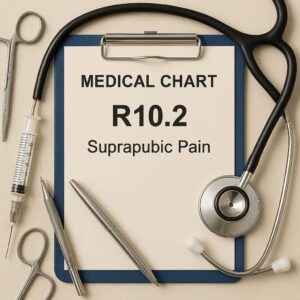
| R10.2 | Pelvic and perineal pain | Crucial distinction: This code is for pain in the pelvic bones or perineum (the area between the genitals and anus), not pain originating from organs within the pelvis. It is less common for general suprapubic pain. |
| R10.84 | Generalized abdominal pain | Pain not localized to any one quadrant; felt throughout the abdomen. |
| N94.89 | Other specified conditions associated with female genital organs and menstrual cycle | This code can be used for cyclical suprapubic pain related to menstruation (e.g., mittelschmerz – ovulation pain) if that is the confirmed cause. |
Furthermore, Chapter 14 of ICD-10-CM covers Diseases of the Genitourinary System. If the suprapubic pain is directly linked to a diagnosed condition from this chapter, that code takes precedence over a symptom code from Chapter 18.
Examples:
-
N30.00 – Acute cystitis without hematuria: If suprapubic pain is due to a confirmed UTI, this code is primary. The pain is a symptom of this condition.
-
N41.0 – Acute prostatitis: For male patients with suprapubic pain caused by this inflammation.
-
N70 – Salpingitis and oophoritis: For female patients with pelvic inflammatory disease (PID) causing pain.
-
K57 – Diverticular disease of intestine: If diverticulitis is the confirmed cause of LLQ/suprapubic pain.
The golden rule of ICD-10 coding is: Code to the highest level of specificity documented by the provider.
5. Differential Diagnoses: Why Suprapubic Pain is a Clinical Puzzle
Suprapubic pain is a nonspecific symptom that can point to a myriad of underlying conditions. A proficient coder understands this differential, as the provider’s working diagnosis or final diagnosis will directly dictate the correct code.
Genitourinary Causes (Most Common)
-
Urinary Tract Infection (UTI) / Cystitis: The most frequent cause. Inflammation of the bladder lining causes suprapubic pressure, pain, and a persistent urge to urinate. Often accompanied by dysuria (painful urination) and frequency.
-
Urinary Retention: The inability to empty the bladder, which can cause severe suprapubic pain and distension. Causes include prostate enlargement in men, urethral strictures, or neurological issues.
-
Bladder Stones: Hard masses of minerals that can form in the bladder and cause intermittent pain, especially with movement.
-
Interstitial Cystitis/Bladder Pain Syndrome (IC/BPS): A chronic condition causing bladder pressure, suprapubic pain, and pelvic pain, without evidence of infection. The pain ranges from mild to severe.
-
Urethritis: Inflammation of the urethra, often due to infection, which can cause suprapubic discomfort and dysuria.
-
Prostatitis: Inflammation of the prostate gland in men, which frequently presents with suprapubic pain, perineal pain, and urinary symptoms.
Gastrointestinal Causes
-
Constipation: Severe constipation can cause significant lower abdominal bloating and aching pain.
-
Irritable Bowel Syndrome (IBS): A functional disorder that can cause cramping, abdominal pain (often relieved by defecation), bloating, and changes in bowel habits. Pain can be suprapubic.
-
Inflammatory Bowel Disease (IBD): Crohn’s disease or ulcerative colitis can cause inflammation and pain in any part of the GI tract, including the lower abdomen.
-
Diverticulitis: Inflammation or infection of small pouches (diverticula) in the colon, most commonly in the sigmoid colon. It causes intense, often constant pain in the LLQ, which can be perceived as suprapubic.
-
Appendicitis: While classic appendicitis starts as periumbilical pain (R10.33) before migrating to the RLQ (R10.31), an atypically located appendix can cause suprapubic pain.
Reproductive and Gynecological Causes (in Females)
-
Menstrual Cramps (Dysmenorrhea): Painful menstruation is a very common cause of cyclical suprapubic cramping.
-
Endometriosis: A condition where tissue similar to the uterine lining grows outside the uterus, causing severe pelvic and suprapubic pain, especially during periods.
-
Pelvic Inflammatory Disease (PID): An infection of the female reproductive organs, often causing lower abdominal and suprapubic pain.
-
Ovarian Cysts: Fluid-filled sacs on an ovary. If they rupture or cause ovarian torsion, they can cause sudden, severe unilateral or suprapubic pain.
-
Uterine Fibroids: Noncancerous growths in the uterus that can cause a feeling of pressure, fullness, and aching in the suprapubic area.
-
Ectopic Pregnancy: A medical emergency where a pregnancy implants outside the uterus. It can cause sharp, stabbing lower abdominal pain and is life-threatening.
-
Mittelschmerz: Ovulation pain, a brief, one-sided ache that occurs midway through the menstrual cycle.
Other Causes
-
Musculoskeletal Strain: Strain of the lower abdominal muscles from exercise or heavy lifting.
-
Pelvic Floor Dysfunction: Hypertonic (too tight) pelvic floor muscles can cause chronic suprapubic and pelvic pain.
-
Nerve Entrapment: Such as ilioinguinal nerve entrapment, which can cause burning or shooting pain in the lower abdomen.
-
Referred Pain: Pain that originates elsewhere (e.g., the back) but is felt in the suprapubic region.
6. The Provider’s Role: Documentation is Key for Accurate Coding
The accuracy of the final ICD-10 code is almost entirely dependent on the quality of the clinical documentation. A provider who simply notes “suprapubic pain” forces the coder to assign the unspecified code R10.30. However, a provider who paints a detailed clinical picture empowers the coder to choose a precise code.
What providers should document to ensure accurate coding:
-
Location: Be specific. Is it “suprapubic,” “RLQ,” “LLQ,” or “generalized”?
-
Quality: Describe the character of the pain. Is it “cramping,” “aching,” “sharp,” “stabbing,” “pressure,” or “burning”?
-
Severity: Use a pain scale (e.g., 5/10).
-
Timing: Is it “acute” (sudden onset), “chronic” (lasting >3 months), “constant,” or “intermittent”? Is it related to a specific activity (urination, eating, menstruation)?
-
Associated Symptoms: This is critical. Document the presence or absence of:
-
Dysuria (painful urination)
-
Hematuria (blood in urine)
-
Urinary frequency/urgency
-
Fever or chills
-
Nausea or vomiting
-
Changes in bowel habits (diarrhea, constipation)
-
Vaginal discharge or bleeding
-
-
Working or Final Diagnosis: If a diagnosis is made (e.g., “acute cystitis,” “diverticulitis”), it must be clearly stated. The symptom code may be listed secondarily, but the diagnosis code is primary.
Example of poor documentation: “Patient c/o stomach pain. Assessed. Rx given.”
Example of excellent documentation: “Patient presents with acute, sharp, suprapubic pain, rated 7/10, for 24 hours. Pain is associated with dysuria and urinary frequency. No fever or flank pain. Urinalysis positive for nitrites and leukocytes. Assessment: Acute cystitis.”
The second example allows for accurate coding of N30.00 (Acute cystitis without hematuria) instead of the vague R10.30.
7. The Coder’s Dilemma: Navigating Ambiguity in the Medical Record
Medical coders are not clinicians; they cannot assume or infer a diagnosis. They are bound by the information in the medical record. This often creates dilemmas.
-
Scenario: A provider documents “suprapubic pain and dysuria.” The urinalysis results are pending and not documented. The coder cannot assume a UTI. The correct codes would be R10.30 (Lower abdominal pain, unspecified) and R39.15 (Other difficulties with micturition) for the dysuria. Once a confirmed diagnosis of UTI is documented, the codes can be updated.
-
Scenario: A female patient is seen for “cyclic suprapubic cramping pain occurring with menses.” The provider does not give a specific diagnosis like “dysmenorrhea.” The coder should use R10.30. If the provider documents “primary dysmenorrhea,” the coder can then use N94.6 (Dysmenorrhea, unspecified).
When in doubt, the coder must query the provider for clarification. A query is a formal communication asking the provider to elaborate on the documentation to ensure accurate code assignment. This is a standard and essential practice in modern healthcare.
8. Case Studies: Applying Knowledge to Real-World Scenarios
Case Study 1: The Urgent Care Visit
-
Presentation: A 25-year-old female presents to urgent care with a 2-day history of constant, pressure-like suprapubic pain and a burning sensation when urinating. She reports urinating small amounts frequently. No fever or back pain.
-
Documentation: “Patient presents with symptoms consistent with a urinary tract infection. Suprapubic tenderness on exam. Urinalysis dipstick positive for leukocytes and nitrites.”
-
Assessment: “Acute cystitis.”
-
Coding: The primary code is N30.00 (Acute cystitis without hematuria). The symptom of suprapubic pain is inherent to this diagnosis and does not need to be coded separately. The UTI is the reason for the encounter.
Case Study 2: The Emergency Department Visit
-
Presentation: A 40-year-old male presents to the ED with sudden onset, severe, sharp pain in his left lower quadrant. The pain is 9/10 and constant. He has a fever of 101.5°F and nausea.
-
Documentation: “CT abdomen/pelvis reveals inflammation and micro-perforation consistent with acute diverticulitis of the sigmoid colon.”
-
Assessment: “Acute diverticulitis with micro-perforation.”
-
Coding: The primary code is K57.32 (Diverticulitis of large intestine without perforation or abscess with bleeding). Note: The code selection depends on the specifics of perforation/abscess/bleeding as confirmed by the CT and provider. The LLQ pain (which could be coded as R10.32) is a symptom of the diverticulitis and would not be used as a primary code.
Case Study 3: The Ambiguous Primary Care Visit
-
Presentation: A 35-year-old female sees her PCP for “lower abdominal pain” for the past month. The pain is dull and achy. She reports no changes in urinary or bowel habits. Her last period was normal.
-
Documentation: “Patient reports nonspecific lower abdominal pain. Physical exam unremarkable. No clear etiology at this time. Will schedule pelvic ultrasound to rule out gynecologic cause. Recommend OTC ibuprofen for pain.”
-
Assessment: “Lower abdominal pain, unspecified.”
-
Coding: In this case, no definitive diagnosis is made. The provider’s assessment is a description of the symptom itself. The correct code is R10.30 (Lower abdominal pain, unspecified).
9. The Importance of Specificity: Clinical and Reimbursement Impacts
Using the correct, most specific code is not an academic exercise; it has real-world consequences.
-
Patient Care: Specific codes create accurate medical records. This ensures that any future provider reviewing the patient’s history has a clear understanding of past issues. It also helps in identifying trends and managing population health.
-
Medical Research: Data aggregated from ICD-10 codes is used for public health tracking, clinical research, and epidemiological studies. Vague data (e.g., a high volume of R10.30 codes) is useless. Specific data (e.g., tracking rates of N30.00) can help identify outbreaks, assess treatment effectiveness, and direct research funding.
-
Reimbursement: This is a critical factor. Insurance payers use diagnosis codes to justify the medical necessity of procedures, tests, and treatments. An unspecified code like R10.30 may not be sufficient to justify the medical necessity of an urinalysis, a CT scan, or a course of antibiotics. A claim could be denied as not medically necessary if the diagnosis code is too vague. A specific code like N30.00 or K57.32 clearly justifies the associated care and leads to cleaner claims and faster reimbursement.
10. Conclusion: The Art and Science of Medical Coding
Suprapubic pain, represented by the ICD-10 code R10.30, is a gateway to a complex clinical landscape. Accurate coding transcends simple data entry; it is a sophisticated process that requires a deep understanding of anatomy, pathophysiology, and coding guidelines. The journey from a patient’s symptom to a precise alphanumeric code hinges on the synergy between detailed clinical documentation and meticulous coding expertise. By moving beyond the unspecified to the specific, healthcare professionals ensure not only proper reimbursement but, more importantly, contribute to high-quality patient care and the advancement of medical knowledge.
11. Frequently Asked Questions (FAQs)
Q1: Can I use a code from Chapter 14 (Genitourinary) if the provider only documents “suprapubic pain” but the urinalysis suggests a UTI?
A: No. Coders must code based on the provider’s documented diagnosis. If the provider has not stated “UTI” or “cystitis,” you cannot assign code N30.00, even with supporting lab results. You must code the symptom (R10.30) and query the provider for a definitive diagnosis.
Q2: What is the difference between pelvic pain (R10.2) and suprapubic pain (R10.30)?
A: Code R10.2 specifically refers to pain in the pelvic bones or the perineal body (the area between the anus and scrotum/vagina). It is musculoskeletal or somatic pain. Code R10.30 refers to pain in the lower abdomen, which is often caused by the organs contained within the pelvic cavity (bladder, intestines, reproductive organs). The provider’s documentation of the pain’s location is crucial for choosing between these two.
Q3: How do I code suprapubic pain in a pregnant patient?
A: Pregnancy adds another layer of complexity. Chapter 15 (Pregnancy, Childbirth, and the Puerperium) codes take precedence. Suprapubic pain could be related to a normal pregnancy (e.g., round ligament pain, coded as O26.89-) or a complication (e.g., urinary tract infection in pregnancy, coded O23.-). Always consult the ICD-10-CM guidelines for coding in pregnancy first.
Q4: When should I use an “unspecified” code like R10.30?
A: You should use an unspecified code only when the medical record lacks the necessary information to assign a more specific code. It is a last resort. Your goal should always be to code to the highest level of specificity documented.
12. Additional Resources
For the most accurate and up-to-date coding, always rely on official resources:
-
CDC ICD-10-CM Official Guidelines for Coding and Reporting: https://www.cdc.gov/nchs/icd/icd-10-cm.htm – The essential rulebook for all coders.
-
American Health Information Management Association (AHIMA): https://www.ahima.org/ – A premier association for health information professionals offering resources, education, and certifications.
-
American Academy of Professional Coders (AAPC): https://www.aapc.com/ – A leading organization for medical coders, providing certification, training, and local chapter networking.
-
ICD10data.com: https://www.icd10data.com/ – A free, quick online reference tool for ICD-10 codes (but always verify with the official manual).
-
Current Year ICD-10-CM Code Book: A physical or digital copy of the current year’s code set is mandatory for any coding professional.
Date: September 18, 2025
Author: The Medical Coding Specialist Team
Disclaimer: *This article is intended for informational and educational purposes only. It is not a substitute for professional medical advice, diagnosis, or treatment. Always seek the advice of your physician or other qualified health provider with any questions you may have regarding a medical condition or coding practice. The codes and guidelines referenced are subject to change. Always consult the most current, official ICD-10-CM coding manuals and guidelines for accurate coding.*