Let’s be honest: dealing with medical codes can sometimes feel like trying to read a foreign language. If you are a medical biller, a coder, a clinician, or even a patient trying to make sense of a recent diagnosis summary, you have likely stumbled upon the search for the “ICD 10 code for upper back pain unspecified.”
You might be staring at a line on a superbill or an explanation of benefits (EOB), wondering if the code used is correct. Or perhaps you are a healthcare professional looking to ensure your documentation is as accurate as possible.
In this guide, we are going to demystify this specific code. We’ll talk about what it means, when to use it, what not to use, and how it fits into the larger picture of musculoskeletal health. We’ll keep things clear, practical, and straightforward—because medical coding is complicated enough already.
Let’s get started.
ICD 10 Code for Upper Back Pain Unspecified
What is the ICD 10 Code for Upper Back Pain Unspecified?
If you take nothing else away from this article, remember this one specific code:
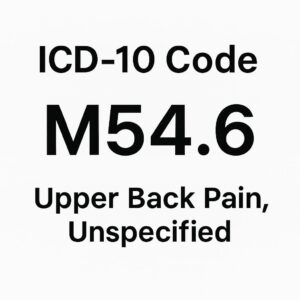
M54.6 – Pain in Thoracic Spine
This is the official, HIPAA-approved ICD-10-CM code for what we commonly refer to as upper back pain when a more specific diagnosis hasn’t been established.
The code falls under the broader category of M54 (Dorsalgia) , which is itself nestled within the larger section for M50-M54 (Other dorsopathies) .
When we say “unspecified,” we are referring to the fact that the code does not require details about the exact cause of the pain. It doesn’t specify if the pain is due to a muscle strain, a ligament sprain, or nerve irritation. It simply states the anatomical location: the thoracic spine.
Breaking Down the Code: M54.6
To really understand a code, it helps to look at its family tree. Here is how the ICD-10 structure organizes back pain:
-
M50-M54: Other dorsopathies (This is the “neighborhood”).
-
M54: Dorsalgia (This is the “street”).
-
M54.6: Pain in thoracic spine (This is your specific “house address”).
This code is distinct from its neighbors. For example:
-
M54.5 is for Low back pain (Lumbago).
-
M54.4 is for Lumbago with sciatica.
-
M54.2 is for Cervicalgia (neck pain).
So, using M54.6 tells the insurance company and any other healthcare provider reading the chart that the problem is specifically located in the upper-to-mid-back region, between the base of the neck and the bottom of the ribcage.
Understanding the Thoracic Spine: Where is “Upper Back”?
Before we dive deeper into coding, it’s vital to understand the geography of the spine. This helps ensure you are using the correct code.
The human spine is divided into three main sections:
-
Cervical Spine (Neck): The top 7 vertebrae (C1-C7).
-
Thoracic Spine (Upper/Mid Back): The next 12 vertebrae (T1-T12). This is the realm of M54.6.
-
Lumbar Spine (Lower Back): The final 5 vertebrae (L1-L5).
The thoracic spine is unique. It is the only part of the spine that connects to the rib cage, forming a protective cavity for the heart and lungs. Because of this connection, the thoracic spine is naturally less flexible than the neck or lower back. This stability is great for protecting organs, but it also means that pain in this area is often related to poor posture, muscle imbalances, or issues with the joints connecting the ribs to the vertebrae.
When is “Upper Back Pain” not “Thoracic Pain”?
It’s a common mistake to lump all “back” pain together. In casual conversation, we say “my back hurts” to refer to anything from the shoulders down to the hips. But in the world of ICD-10, specificity is key.
-
Pain at the very top of the shoulders or base of the skull? That’s more likely cervical (neck) pain.
-
Pain between the shoulder blades and down the middle of the back? That’s your classic thoracic pain, fitting M54.6.
-
Pain in the lower back, near the waistline? That’s lumbar pain.
Clinical Context: What Usually Causes Upper Back Pain?
As a writer or a coder, you might not be diagnosing patients, but understanding the “why” behind the code helps you appreciate its use. Why would a physician use an “unspecified” code? Because the initial complaint is often vague.
Patients with thoracic pain might describe it as:
-
A dull, aching soreness between the shoulder blades.
-
A sharp, stabbing pain when taking a deep breath.
-
A feeling of tightness or a “knot” in the muscles next to the spine.
-
Pain that gets worse after sitting at a desk for a long time.
Common causes that lead a doctor to use the ICD 10 code for upper back pain unspecified on the first visit include:
-
Muscle Strain: Overuse, poor posture (think “text neck” or slouching at a computer), or sudden twisting movements can strain the large muscles of the upper back, like the trapezius and rhomboids.
-
Joint Dysfunction: The facet joints in the thoracic spine or the costovertebral joints (where the ribs attach) can become irritated or stiff.
-
Myofascial Pain: Trigger points, or “knots,” in the muscle tissue can refer pain to other areas.
-
Poor Ergonomics: This is a massive one in the modern age. “Desk posture” is a leading contributor to thoracic discomfort.
Important Note for Readers: If you are a patient reading this to understand your own diagnosis, please remember that M54.6 is a symptom code. It describes what you feel, not why you feel it. Your doctor may use this code initially while they investigate the root cause. Always follow your physician’s treatment plan.
The “Unspecified” Factor: When is it Appropriate to Use M54.6?
The word “unspecified” sometimes gets a bad rap, as if it’s a lazy way out. In reality, it is a necessary and perfectly valid part of the coding system. The ICD-10 guidelines recognize that not every patient encounter results in a definitive, specific diagnosis.
Here are the perfect scenarios for using M54.6:
1. The Initial Visit (New Patient)
A patient comes in complaining of pain in their upper back. They haven’t had any imaging (X-rays, MRI). The physical exam reveals tenderness but no clear signs of a specific disease like a fracture or infection. In this case, it is entirely appropriate to code the encounter as M54.6. It tells the story: “The patient has pain in their thoracic spine, and we are still figuring out the exact cause.”
2. The Symptoms are Vague
Sometimes, a patient’s pain doesn’t fit neatly into a specific box. It might be a combination of muscular and joint pain. Until a clearer picture emerges, the unspecified code is the most honest representation of the patient’s condition.
3. The Provider Chooses Not to Specify
In some cases, the provider’s documentation may simply state “upper back pain” without further details about the etiology. Coders must code what is documented. If the documentation doesn’t specify a cause, then the code must remain unspecified.
When NOT to Use M54.6
Just as important as knowing when to use a code is knowing when to look for a more specific one. You should not use M54.6 if:
-
The cause is known: If the doctor has diagnosed a “thoracic disc herniation” (M51.26) or “thoracic spinal stenosis” (M48.02), you must use the more specific code.
-
The pain is post-procedural: If the pain started after spinal surgery, you would look at codes in the M96.- category (intraoperative and postprocedural complications and disorders of musculoskeletal system).
-
The pain is due to trauma: If the patient was in a car accident and has a fracture, you would use a code from the S22.- category (fracture of thoracic spine).
-
The pain is referred from an organ: Sometimes, pain in the thoracic area can be a sign of a heart attack (I20-I25) or a lung issue. These, of course, take priority and have their own specific code families.
Differential Diagnosis: What Else Could It Be?
This is a crucial section for anyone in the medical field. When a patient presents with thoracic pain and receives the ICD 10 code for upper back pain unspecified, the clinician is essentially putting a pin in the map while they rule out other, more serious conditions.
The “differential diagnosis” for thoracic pain includes:
| Possible Condition | Description | ICD-10 Code (Example) |
|---|---|---|
| Musculoskeletal (Most Common) | Muscle strain, myofascial pain, facet joint syndrome. | M54.6 (Initial) |
| Degenerative Disc Disease | Age-related wear and tear on the spinal discs. | M51.34 |
| Herniated Thoracic Disc | Rupture of the disc cushion, potentially pressing on a nerve. (Rare in the thoracic spine). | M51.24 |
| Osteoporosis with Fracture | Weakened vertebrae that can collapse, causing sudden pain. | M80.08A |
| Compression Fracture | Often due to trauma or osteoporosis. | S22.0xxA |
| Scoliosis / Kyphosis | Abnormal spinal curvatures that can lead to muscle pain. | M41.xx |
| Herpes Zoster (Shingles) | A viral reactivation that can cause severe burning pain before a rash appears. | B02.29 |
| Referred Pain (Cardiac) | Angina or heart attack can sometimes feel like upper back pain. | I20.9 |
| Costochondritis | Inflammation of the cartilage connecting the ribs to the breastbone. | M94.0 |
Critical Reader Note: This table is for educational and coding context only. It is not a diagnostic tool. If you are experiencing upper back pain, especially if it is accompanied by chest pain, shortness of breath, or fever, seek immediate medical attention.
Practical Guide to Coding M54.6
Okay, let’s get down to the practicalities. You are in the coding office or reviewing a chart. Here’s how to handle M54.6 correctly.
Coding Guidelines and Best Practices
-
Follow the Documentation: Your primary source of truth is the provider’s note. If they write “thoracic myalgia” or “mid-back pain,” M54.6 is your code.
-
One Code is Often Enough: For a simple visit for upper back pain where no specific diagnosis is made, M54.6 will likely be the only diagnosis code.
-
Think About Medical Necessity: For the visit to be covered by insurance, the treatment provided (e.g., an office visit, physical therapy evaluation) must be medically necessary for treating “pain in the thoracic spine.”
-
Don’t Code for “Rule Out”: In the outpatient setting, you never code a condition that is being “ruled out.” You code the symptoms that are present today. So, if the doctor is ruling out a fracture, you still code the symptom: M54.6.
Common Documentation Terms for M54.6
When looking at a clinical note, these phrases all point toward using M54.6:
-
“Patient complains of pain in the upper back.”
-
“Thoracic spine tenderness to palpation.”
-
“Mid-back pain, worse with extension.”
-
“Dorsalgia of the thoracic region.”
-
“Interscapular pain” (pain between the shoulder blades).
-
“Muscle spasm in the thoracic paraspinals.”
The Impact of Accurate Coding on Reimbursement and Patient Care
Why does getting this one code right matter? It goes far beyond just checking a box.
-
For Reimbursement: Insurance companies use codes to determine if a service was medically necessary. Using M54.6 for a visit that involved an extensive workup for lower back pain would be a red flag and could lead to a denied claim.
-
For Data and Research: Public health data relies on accurate coding. If every case of back pain is lumped into a single code, it becomes impossible to track the prevalence of specific conditions or the effectiveness of treatments.
-
For Continuity of Care: The code is a shorthand summary for any other provider who sees the patient’s chart. It tells the next physical therapist or specialist the location of the problem, allowing them to quickly understand the history.
Treatment Landscape: What Happens After the M54.6 Diagnosis?
Once a patient is diagnosed with unspecified thoracic pain (M54.6), what’s the typical next step? Treatment usually focuses on conservative, non-invasive methods, especially since serious pathology is often ruled out first.
Common treatment plans include:
-
Physical Therapy: Focused on strengthening the rhomboids and lower trapezius, and stretching the pectoral muscles to improve posture.
-
Pain Management: Over-the-counter NSAIDs like ibuprofen or naproxen.
-
Heat/Ice Therapy: To reduce muscle spasm and inflammation.
-
Ergonomic Adjustments: Setting up a workstation to promote better posture.
-
Manual Therapy: Chiropractic adjustments or massage therapy to improve joint mobility and release muscle tension.
Frequently Asked Questions (FAQ)
Here are some of the most common questions people have about this specific code.
Q1: Is M54.6 the same as “dorsalgia”?
A: Yes, it falls under the dorsalgia category. M54.6 is the specific code for dorsalgia located in the thoracic spine.
Q2: Can I use M54.6 if the patient also has neck pain?
A: It depends on the documentation. If the pain is primarily in the upper back and the neck, you would likely code both M54.6 (pain in thoracic spine) and M54.2 (cervicalgia). If the pain is a continuous ache from the neck down to the mid-back, you would code both.
Q3: Is M54.6 a “billable” code?
A: Yes, absolutely. M54.6 is a valid and billable ICD-10 code used to specify a medical diagnosis for reimbursement.
Q4: What is the difference between M54.6 and M54.5?
A: This is a critical distinction. M54.6 is for the upper back (thoracic spine). M54.5 is for the lower back (lumbar spine, or lumbago). They are not interchangeable.
Q5: What if the upper back pain is due to cancer that has spread?
A: In that case, the primary diagnosis would be the cancer. You would code the malignancy first (e.g., C79.51 for secondary malignant neoplasm of bone), and you could also use M54.6 to capture the symptom of pain, but the cancer code takes precedence. This is governed by coding guidelines for sequencing.
Additional Resource
For the most up-to-date official information and to explore the ICD-10 code tree yourself, the best resource is the Centers for Medicare & Medicaid Services (CMS). You can download the official ICD-10-CM files and guidelines here:
CMS.gov ICD-10 Homepage
Conclusion
In summary, the correct ICD 10 code for upper back pain unspecified is M54.6 (Pain in thoracic spine) . It is a specific, billable code used to pinpoint the location of pain in the upper-to-mid-back region when the underlying cause has not yet been identified. Using it correctly ensures clear communication between providers, accurate data for health trends, and proper reimbursement for medical services.
Disclaimer
The information provided in this article is for general informational and educational purposes only and is not a substitute for professional medical advice, diagnosis, or coding certification. Always consult a qualified health provider with any questions regarding a medical condition and a certified professional coder for specific coding scenarios. Medical coding guidelines are subject to change; ensure you are using the most current codes and payer policies.