Viruses are the quintessential shapeshifters of the pathogen world. Invisible to the naked eye, they command an outsized influence on human health, from the common cold that sidelines us for a day to global pandemics that reshape societies. In the modern healthcare ecosystem, the process of classifying these elusive entities is not merely an academic exercise; it is a critical function that fuels public health, dictates financial reimbursement, and informs medical research. This classification is orchestrated through the International Classification of Diseases, Tenth Revision, Clinical Modification (ICD-10-CM).
For many healthcare professionals, ICD-10 coding can feel like a labyrinthine system of alphanumeric codes, a necessary evil for billing and compliance. However, this perspective underestimates its profound significance. Accurate coding for viral illnesses is the linchpin that connects a single patient’s diagnosis to a vast network of data-driven decisions. A miscoded case of influenza doesn’t just represent a billing error; it represents a corrupted data point that can skew regional outbreak maps, misallocate public health resources, and hinder our understanding of viral trends.
This article aims to demystify the complex world of ICD-10 coding for viral illnesses. We will journey through the structure of the code set, delve into the specifics of major viral categories, unravel the critical guidelines that govern code selection, and explore real-world clinical scenarios. Our goal is to equip medical coders, physicians, nurse practitioners, practice managers, and healthcare students with the knowledge to navigate this domain with confidence and precision. By mastering this language of disease, we can ensure that the story of every viral infection is told accurately, completely, and with the clarity required to advance both individual patient care and global health outcomes.
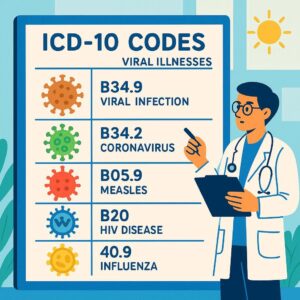
ICD-10 Code for Viral Illnesses
2. Understanding the Foundation: The Structure of the ICD-10-CM
Before diving into specific viruses, one must first understand the architecture of the ICD-10-CM system. It is a hierarchical, alphanumeric code set organized into 22 chapters, covering all diseases, injuries, and reasons for contact with health services.
The Chapter on Certain Infectious and Parasitic Diseases (Chapter 1: A00-B99)
The primary home for most viral illness codes is Chapter 1: Certain Infectious and Parasitic Diseases (A00-B99). This chapter is organized anatomically and etiologically, meaning it groups diseases based on the causative organism and the system it affects.
-
Code Blocks: The chapter is divided into blocks of codes. For viral illnesses, the most relevant blocks are:
-
Intestinal infectious diseases (A00-A09): Includes viral agents like rotavirus (A08.0) and norovirus (A08.1).
-
Viral infections characterized by skin and mucous membrane lesions (B00-B09): A critical block covering herpes simplex, varicella, zoster, smallpox, and other exanthematous viruses.
-
Other viral diseases (B25-B34): A broad category that includes cytomegalovirus, mumps, viral hepatitis, and human papillomavirus (HPV).
-
Mycoses (B35-B49): Not viral (fungal), but located nearby.
-
Pediculosis, acariasis and other infestations (B85-B89): Not viral (parasitic).
-
Other and unspecified infectious diseases (B99-B99): Includes the general code for viral infection, unspecified (B34.9).
-
The structure within these blocks emphasizes specificity. For example, the code for herpesviral infection doesn’t stop at a single number; it expands to specify the type and manifestation.
The Role of Code Chapters Beyond Infectious Disease
A crucial concept in ICD-10 coding is that a viral illness is rarely coded in isolation. Viruses cause manifestations in specific body systems, and these manifestations often require codes from other chapters. This is where the principle of sequencing becomes paramount.
-
Chapter 10: Diseases of the Respiratory System (J00-J99): Used for viral pneumonia (J12.9), bronchitis (J20.9), and other respiratory manifestations of viruses like influenza, RSV, and SARS-CoV-2.
-
Chapter 11: Diseases of the Digestive System (K00-K95): Used for viral hepatitis (though the etiology code is in Chapter 1), and gastroenteritis.
-
Chapter 6: Diseases of the Nervous System (G00-G99): Used for conditions like viral meningitis (G02) and encephalitis (G04.9).
-
Chapter 9: Diseases of the Circulatory System (I00-I99): Used for viral myocarditis (I40.1) or pericarditis.
The relationship between the viral etiology (from Chapter 1) and the resulting condition (from another chapter) is the core of accurate viral illness coding.
3. The Alphabet of Affliction: Major Viral Code Categories
Let’s explore the specific codes for some of the most clinically and epidemiologically significant viral families.
Influenza and the J09-J11 Series
Influenza coding is unique because its codes are located in Chapter 10 (Respiratory System), not Chapter 1. This highlights that the primary clinical concern is often the respiratory manifestation.
-
J09: Influenza due to identified novel influenza A virus. This code is reserved for influenza viruses with pandemic potential, such as avian influenza (bird flu) or swine flu when specified as a novel strain. It requires confirmation of the strain.
-
J10: Influenza due to other identified influenza virus. This is used for seasonal influenza A and B when the specific type is identified by laboratory testing. It has excludes notes for influenza due to avian or zoonotic viruses.
-
J10.0: With pneumonia
-
J10.1: With other respiratory manifestations
-
J10.2: With gastrointestinal manifestations
-
J10.8: With other manifestations
-
-
J11: Influenza, virus not identified. This is the most commonly used code when a patient presents with classic influenza-like illness (fever, cough, myalgia) but no laboratory confirmation has been obtained or is available.
-
J11.0: With pneumonia
-
J11.1: With other respiratory manifestations
-
J11.2: With gastrointestinal manifestations
-
J11.8: With other manifestations
-
Coding Note: If a patient has influenza with pneumonia, you would use a single code from the J10 or J11 series (e.g., J10.0 or J11.0), not a separate code for pneumonia.
Viral Hepatitis (B15-B19)
Hepatitis codes are found in Chapter 1 (A00-B99) and provide a masterclass in the importance of specifying acute vs. chronic status.
-
B15: Acute hepatitis A. A single code for this self-limiting infection.
-
B16: Acute hepatitis B. This requires a fourth or fifth character to specify complications.
-
B16.0: Acute hepatitis B with delta-agent (co-infection) with hepatic coma
-
B16.1: Acute hepatitis B with delta-agent without hepatic coma
-
B16.2: Acute hepatitis B without delta-agent with hepatic coma
-
B16.9: Acute hepatitis B without delta-agent and without hepatic coma
-
-
B17: Other acute viral hepatitis.
-
B17.10: Acute hepatitis C without hepatic coma
-
B17.11: Acute hepatitis C with hepatic coma
-
B17.2: Acute hepatitis E
-
-
B18: Chronic viral hepatitis. This is for persistent infection.
-
B18.0: Chronic viral hepatitis B with delta-agent
-
B18.1: Chronic viral hepatitis B without delta-agent
-
B18.2: Chronic viral hepatitis C
-
-
B19: Unspecified viral hepatitis. This category should be used sparingly, only when documentation is insufficient to determine the type or phase (acute/chronic).
ICD-10-CM Coding for Common Viral Hepatitis Types
| Virus Type | Acute Infection Code | Chronic Infection Code | Key Specificity Requirements |
|---|---|---|---|
| Hepatitis A | B15.9 | N/A (Does not become chronic) | No further specificity needed. |
| Hepatitis B | B16.9 (example) | B18.1 (example) | Must specify presence/absence of delta-agent (hepatitis D) and hepatic coma for acute cases. |
| Hepatitis C | B17.10 | B18.2 | Must specify acute vs. chronic. “Hepatitis C” alone is ambiguous and leads to coding queries. |
| Hepatitis E | B17.2 | N/A (Rarely chronic) | No further specificity needed. |
Human Immunodeficiency Virus [HIV] (B20)
The coding for HIV is deceptively simple but has profound implications for sequencing and reporting.
-
B20: Human immunodeficiency virus [HIV] disease. This is a single code that encompasses all patients with a confirmed HIV infection, regardless of whether they are symptomatic, have AIDS, or are on treatment. It is a combination code that includes the infection and any resulting conditions.
Crucial Guideline: When a patient is admitted for an HIV-related condition, B20 must be sequenced first, followed by the codes for the related conditions (e.g., Pneumocystis jirovecii pneumonia, HIV encephalopathy, Kaposi’s sarcoma). If the patient is admitted for an unrelated condition (e.g., a fracture), but has HIV, B20 is listed as an additional diagnosis.
Cytomegalovirus and Herpesviruses (B25-B34)
This block covers a wide range of common viruses.
-
B25: Cytomegaloviral disease. Requires a fourth character to specify the manifestation (e.g., B25.0 CMV pneumonitis, B25.1 CMV hepatitis, B25.2 CMV pancreatitis).
-
B27: Infectious mononucleosis. Primarily for Epstein-Barr virus.
-
B30: Viral conjunctivitis. Specifies adenovirus, pharyngoconjunctival fever, etc.
-
Herpes Simplex (B00.) and Herpes Zoster (B02.): These have extensive subcategories.
-
B00.1: Herpesviral vesicular dermatitis
-
B00.2: Herpesviral gingivostomatitis and pharyngotonsillitis
-
B00.5: Herpesviral ocular disease
-
B02.0: Zoster encephalitis
-
B02.1: Zoster meningitis
-
B02.2: Zoster with other nervous system involvement
-
B02.3: Zoster ocular disease
-
For herpes zoster, an additional code from category G53.0 Postherpetic neuralgia is used if this complication is present and being treated.
4. The Art and Science of Code Selection: Key Principles and Guidelines
Selecting the correct code is a deliberate process governed by official guidelines and clinical logic.
The Importance of Specificity: Strain, Type, and Manifestation
ICD-10-CM demands a high level of detail. “Viral infection” is not sufficient.
-
From General to Specific: B34.9 (Viral infection, unspecified) -> B97.89 (Other viral agents as the cause of diseases classified elsewhere) -> J11.00 (Influenza due to unidentified influenza virus with pneumonia, unspecified).
-
Manifestation Coding: Always code both the underlying viral etiology and its manifestation. For example, for CMV retinitis, you would code B25.9 (Cytomegaloviral disease, unspecified) and H32.0- (Chorioretinal disorders in infectious and parasitic diseases). The official guidelines often include a “Use additional code” note to remind coders of this requirement.
Acute vs. Chronic: A Critical Distinction
This is one of the most common sources of error, particularly with hepatitis and other persistent viruses. The clinical course and management of acute and chronic infections are vastly different.
-
Acute: A new infection, often symptomatic but self-limiting.
-
Chronic: A persistent infection lasting more than six months, requiring long-term monitoring and management.
-
Documentation is Key: The provider’s documentation must clearly state “acute” or “chronic.” If it is not specified, the coder must query the provider. Assumptions cannot be made.
The “Unspecified” Code: When and Why to Use It
Codes ending in “.9” are “unspecified” codes. They are valid and billable but represent a failure of the documentation and coding process to capture the full clinical picture. They should be used only as a last resort when:
-
The medical record lacks the specific information needed to assign a more precise code.
-
A more specific code does not exist in the ICD-10-CM system.
Over-reliance on unspecified codes can negatively impact reimbursement (as payers may view them as not medically necessary) and degrade the quality of health data.
Sequencing: The Order of Diagnosis Codes
The order in which diagnosis codes are listed is critical. The first-listed diagnosis (for outpatient encounters) or principal diagnosis (for inpatient encounters) is the condition chiefly responsible for the service or admission.
-
Guideline: When a patient is admitted for a manifestation of a disease, and the ICD-10-CM coding instructions indicate the underlying disease should be sequenced first, that rule takes precedence. For example, in HIV-related admissions, B20 is always first.
-
Example: A patient is admitted for treatment of Pneumocystis pneumonia due to HIV.
-
Principal Diagnosis: B20 (HIV disease)
-
Secondary Diagnosis: B59 (Pneumocystis jirovecii pneumonia)
-
5. Navigating Clinical Scenarios: Case Studies in Viral Coding
Let’s apply these principles to realistic patient encounters.
Case Study 1: Influenza with Pneumonia
-
Scenario: A 68-year-old female presents to the Emergency Department with a 3-day history of high fever, productive cough, and shortness of breath. She tested positive for Influenza A via a rapid molecular assay. A chest X-ray confirms bilateral pneumonia. She is admitted for management.
-
Documentation: “Admitted for Influenza A pneumonia.”
-
Coding:
-
The reason for admission is the pneumonia caused by Influenza A.
-
The appropriate code is J10.00 (Influenza due to other identified influenza virus with pneumonia, unspecified influenza virus). A single code captures both the etiology and the manifestation. No separate pneumonia code is used.
-
Case Study 2: Acute Hepatitis B with Hepatic Coma
-
Scenario: A 45-year-old male with a history of IV drug use is admitted with jaundice, ascites, and confusion. Lab work confirms a new diagnosis of acute Hepatitis B. His mental status decline is diagnosed as hepatic coma.
-
Documentation: “Acute Hepatitis B infection with hepatic coma. No evidence of delta-agent coinfection.”
-
Coding:
-
The code for acute Hepatitis B requires specification of delta-agent and hepatic coma.
-
The correct code is B16.9 (Acute hepatitis B without delta-agent and without hepatic coma)? No. This is incorrect because the patient has hepatic coma.
-
The correct code is B16.2 (Acute hepatitis B without delta-agent with hepatic coma). This single code accurately represents the entire clinical picture.
-
Case Study 3: HIV with Multiple Co-infections
-
Scenario: A patient with a known history of HIV (on antiretroviral therapy) is admitted for treatment of disseminated Cytomegalovirus (CMV) infection and CMV retinitis.
-
Documentation: “Admitted for management of disseminated CMV disease and CMV retinitis in a patient with HIV.”
-
Coding:
-
Principal Diagnosis: B20 (Human immunodeficiency virus [HIV] disease) – Sequenced first per guideline.
-
Secondary Diagnosis: B25.0 (Cytomegaloviral pneumonitis) – If documented, or B25.9 if “disseminated” is not more specific.
-
Secondary Diagnosis: B25.9 (Cytomegaloviral disease, unspecified) and H32.0- (Chorioretinal disorders in infectious and parasitic diseases) – Coding both the etiology and the manifestation of the retinitis.
-
Case Study 4: COVID-19 and its Evolving Codes
The COVID-19 pandemic necessitated rapid updates to ICD-10-CM.
-
Primary Code: U07.1 COVID-19. This is the fundamental code for a confirmed case.
-
Sequencing: Code first the manifestation, then U07.1.
-
Example: Patient with COVID-19 pneumonia.
-
Principal Diagnosis: J12.82 (Pneumonia due to COVID-19)
-
Secondary Diagnosis: U07.1 (COVID-19)
-
-
-
Post-COVID Conditions: Code U09.9 Post COVID-19 condition, unspecified is used for long-haul COVID, sequenced after the specific condition being treated (e.g., fatigue, shortness of breath).
6. The Documentation Dilemma: Bridging the Gap between Clinician and Coder
The coder can only code what the provider documents. Ambiguous or incomplete documentation is the single biggest barrier to accurate coding.
What Coders Need from Providers:
-
Specificity: “Acute Hepatitis C” instead of “Hep C.” “Influenza A” instead of “the flu.”
-
Etiology and Manifestation Link: “Pneumonia due to RSV,” “Encephalitis secondary to herpes simplex virus.”
-
Acute vs. Chronic Status: Always specify for conditions like hepatitis.
-
Laterality: For conditions like herpes zoster ophthalmicus.
-
Status of Infections: Clearly document if a condition is “history of” or “current.”
Common Documentation Pitfalls:
-
Using abbreviations without defining them.
-
Documenting conflicting information (e.g., “viral URI” in HPI but “acute bronchitis” in assessment).
-
Failing to link a symptom to a definitive diagnosis.
7. Beyond the Code: The Impact of Accurate Viral Illness Coding
The ripple effects of a single, accurately assigned ICD-10 code extend far beyond the medical record.
-
Public Health Surveillance and Epidemiology: Accurate codes are the raw data for tracking outbreaks. When cases of a novel influenza strain (J09.x) are correctly coded, public health agencies can map the spread in real-time, deploy resources, and issue targeted warnings. The entire response to the COVID-19 pandemic was built upon the data generated by U07.1.
-
Reimbursement and Revenue Cycle Management: DRGs (Diagnosis-Related Groups) for inpatient care and APCs (Ambulatory Payment Classifications) for outpatient care are determined by ICD-10 codes. A more specific code that reflects a higher severity of illness (e.g., B16.2 for acute Hepatitis B with coma vs. B16.9 without coma) can justify a higher level of reimbursement, ensuring the facility is paid appropriately for the resources used.
-
Clinical Research and Quality Metrics: Researchers use aggregated ICD-10 data to study the long-term outcomes of viral infections, the effectiveness of treatments, and the identification of risk factors. Hospitals also use this data for internal quality metrics, such as tracking rates of hospital-acquired infections or vaccination effectiveness.
8. The Future of Pathogen Coding: ICD-11 and Beyond
The World Health Organization has already released ICD-11, which represents a significant evolution in disease classification. For viral illnesses, ICD-11 offers even greater granularity and a more logical, digital-friendly structure.
-
Foundation URI: Each code is a unique web address, allowing for seamless linking to other resources.
-
Pre-coordination and Post-coordination: ICD-11 allows for building complex diagnoses by combining codes (post-coordination). For example, you could combine a code for “HIV disease” with a code for “pneumonia” and a code for “Pneumocystis jirovecii” to create a highly precise diagnostic statement, rather than relying on a single combination code as in ICD-10.
-
Increased Specificity: It includes more detailed codes for viral genotypes and resistance profiles.
The transition to ICD-11 will require renewed education and system updates, but it promises to unlock even more powerful insights from healthcare data.
9. Conclusion
The meticulous process of ICD-10 coding for viral illnesses is a critical nexus where clinical medicine, health information management, and data science converge. Mastering the structure, guidelines, and nuances of codes like those for influenza, hepatitis, and HIV is not a mere administrative task but a fundamental clinical skill. By prioritizing specificity, understanding the relationship between etiology and manifestation, and fostering clear documentation, healthcare professionals can ensure that this invisible world of viruses is made visible, trackable, and understandable. In doing so, they contribute directly to improved patient outcomes, robust public health infrastructure, and the advancement of medical knowledge. The code is not just a number; it is a story waiting to be told correctly.
10. Frequently Asked Questions (FAQs)
Q1: What is the default code for a “viral syndrome” or “viral illness” when the provider gives no further details?
A: The appropriate code is B34.9 (Viral infection, unspecified). However, this should be a trigger for the coder to query the provider for a more specific diagnosis if possible, as this code provides little value for data tracking or reimbursement.
Q2: How do I code a positive viral test result with no symptoms?
A: This is coded as a carrier or suspected condition. For example, a patient with a positive Hepatitis B surface antigen but no signs of disease would be coded as Z22.51 (Carrier of viral hepatitis B). For COVID-19, an asymptomatic positive test is coded as Z20.822 (Contact with and (suspected) exposure to COVID-19).
Q3: When a patient has shingles (herpes zoster), when do I use a code for postherpetic neuralgia?
A: You use B02.29 (Zoster with other nervous system involvement) for the acute shingles infection. You would only add G53.0 (Postherpetic neuralgia) if the neuralgia is present after the acute shingles rash has healed and is the specific reason for the encounter. You do not code both during the initial active shingles outbreak.
Q4: What is the difference between codes J10.1 and J11.1 for influenza?
A: The difference is in the identification of the virus.
-
J10.1 (Influenza due to other identified influenza virus with other respiratory manifestations) is used when the specific type of influenza (e.g., Influenza A, H1N1) is known via lab testing.
-
J11.1 (Influenza, virus not identified, with other respiratory manifestations) is used when the clinical diagnosis is influenza, but the specific virus type was not identified or the test result is not available.
Q5: How do I code “Long COVID” or post-COVID syndrome?
A: Use code U09.9 (Post COVID-19 condition, unspecified) in conjunction with codes for the specific symptoms or conditions being treated. For example, for persistent cough and fatigue after COVID-19, you would code R05.9 (Cough), R53.83 (Fatigue), and U09.9. Always follow the most current official coding guidelines for this rapidly evolving area.
Date: November 1, 2025
Author: Dr. Evelyn Reed, MD, CCS-P
Disclaimer: The information contained in this article is for educational and informational purposes only and is not intended as a substitute for professional medical coding advice, diagnosis, or treatment. Always consult the official ICD-10-CM guidelines and code sets for the most current and accurate coding information. The author and publisher are not responsible for any errors or omissions or for any outcomes resulting from the use of this information.