Delirium in the hospital is more common than many people realize. It shows up suddenly, confuses the patient, and often complicates an already difficult stay.
When you need to document this condition, one question comes up again and again: what is the correct icd 10 code hospital acquired delirium?
The short answer is F05. But there is more to it than picking a single code.
In this guide, we will walk through everything you need to know. You will learn how to code hospital acquired delirium correctly, avoid common mistakes, and understand why accurate documentation matters for your patients and your hospital.
Let us start with the basics.
What Is Hospital Acquired Delirium?
Hospital acquired delirium is a sudden change in mental status that develops during a hospital stay. It is not present when the patient arrives. Instead, it appears hours or days after admission.
Patients with this condition may experience:
- Confusion and disorientation
- Trouble focusing or following a conversation
- Fluctuating alertness (drowsy one moment, agitated the next)
- Hallucinations or unusual beliefs
- Memory problems
Delirium is different from dementia. Dementia develops slowly over months or years. Delirium comes on fast. And unlike dementia, delirium can be reversible if doctors find and treat the cause.
Why Does It Happen in Hospitals?
Hospitals are stressful environments. Many factors can trigger delirium in vulnerable patients:
- Infections (especially urinary tract infections or pneumonia)
- Dehydration or electrolyte imbalances
- New medications or drug interactions
- Sleep deprivation from constant noise and checks
- Surgery and anesthesia
- Pain that is not well controlled
- Catheters, restraints, or IV lines
Older adults are at the highest risk. But younger patients with severe illness or previous cognitive problems can also develop hospital acquired delirium.
Note for readers: Delirium is not a normal part of aging. It is a medical emergency. If you notice sudden confusion in a hospitalized loved one, tell the nursing staff immediately.
The Correct ICD 10 Code for Hospital Acquired Delirium
Now let us get to the main question.
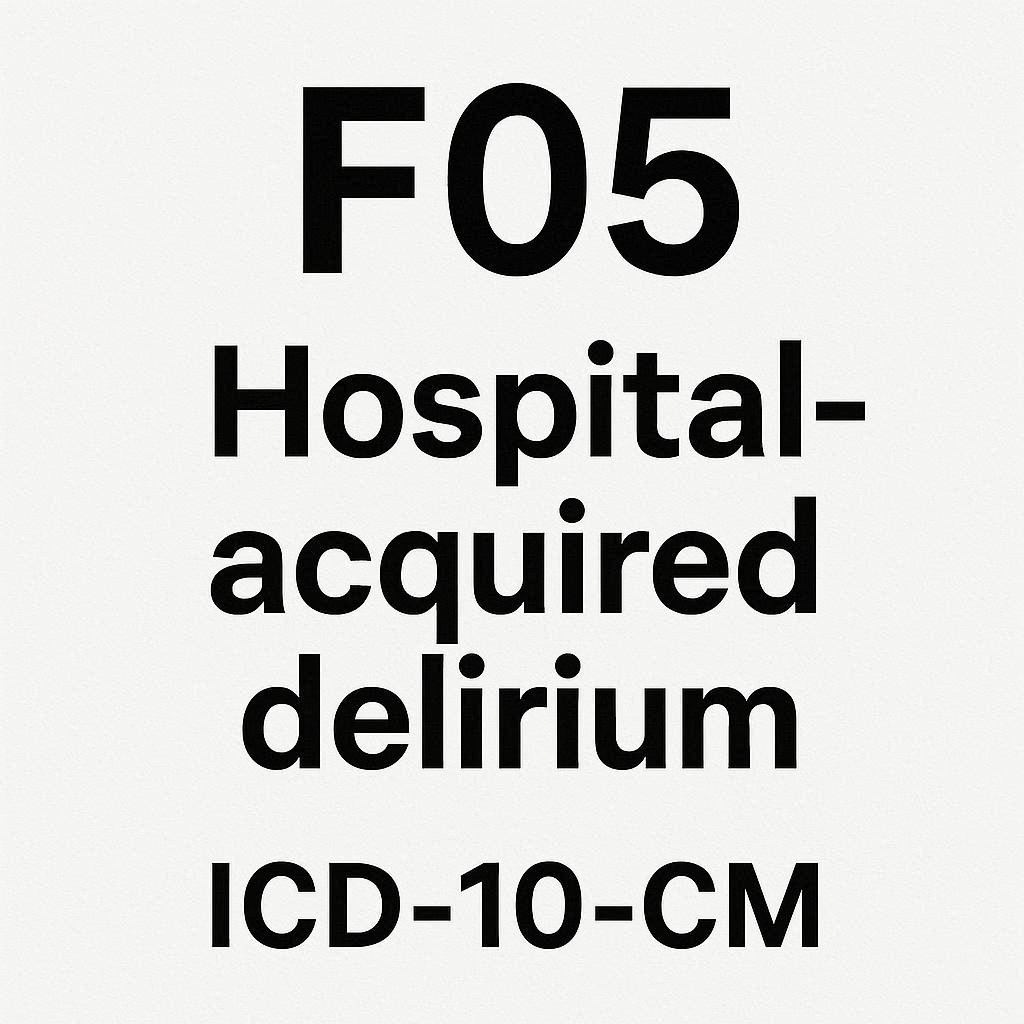
The ICD-10-CM code for hospital acquired delirium is F05.
This code falls under the category “Delirium, not induced by alcohol or other psychoactive substances.”
Here is the official description from the ICD-10 manual:
F05 – Delirium, not induced by alcohol or other psychoactive substances
This code includes:
- Acute or subacute brain syndrome
- Acute or subacute confusional state (nonalcoholic)
- Acute or subacute infectious psychosis
- Acute or subacute organic reaction
- Acute or subacute psycho-organic syndrome
Is There a Separate Code for “Hospital Acquired”?
No. The ICD-10 system does not have a specific code that says “hospital acquired delirium” in those exact words.
However, coders and clinicians use F05 to capture delirium that develops during a hospital stay. The “acquired” part comes from the clinical documentation, not from a unique code.
You will need to document clearly in the medical record that:
- Delirium was not present on admission
- Delirium developed after admission
- The delirium is not caused by alcohol or drugs
What About Other Delirium Codes?
The ICD-10 manual has a few other codes related to delirium. Here is a quick comparison:
| Condition | ICD-10 Code | Key Difference |
|---|---|---|
| Delirium not induced by alcohol/substances | F05 | Most common code for hospital acquired delirium |
| Delirium induced by alcohol | F10.231 | Patient has alcohol intoxication with delirium |
| Delirium induced by other substances | F1x.921 | Caused by drugs, medications, or toxins |
| Delirium due to known physiological condition | F05 (with additional code) | Use an extra code for the underlying cause |
| Dementia with delirium | F02.80 or F03 (with delirium specifier) | Pre-existing dementia plus new delirium |
For most cases of hospital acquired delirium that are not related to alcohol or illegal drugs, F05 is your correct choice.
How to Document Hospital Acquired Delirium for Coding
Accurate coding starts with good documentation. If the medical record does not show clear evidence of delirium, you cannot assign code F05.
Here is what your documentation should include:
1. Present on Admission (POA) Status
You must state clearly whether delirium was present when the patient arrived.
- POA = N (No – not present on admission) for hospital acquired delirium
- POA = Y (Yes – present on admission) if delirium was already there
Hospital acquired delirium requires POA = N.
2. Clinical Features
Describe the patient’s mental status using specific terms. For example:
- “Patient developed acute confusion on post-op day 2”
- “Fluctuating alertness and disorientation noted since admission day 3”
- “Hallucinations started last night; patient did not have these symptoms before”
3. Underlying Cause (When Known)
Delirium is a symptom of an underlying problem. Whenever possible, document the cause. Then assign a second code for that condition.
Example documentation:
“Patient admitted for pneumonia. On day 2, developed acute confusional state with disorientation and agitation. Diagnosis: delirium due to hypoxemia from pneumonia.”
Codes assigned:
- F05 – Delirium
- J15.0 – Pneumonia due to Klebsiella pneumoniae
4. Ruling Out Other Causes
Mention that you considered and ruled out:
- Dementia (if not present)
- Primary psychiatric conditions
- Alcohol or substance withdrawal
This supports the use of F05 instead of other delirium codes.
5. Severity and Course
Delirium can be:
- Hyperactive (agitated, restless)
- Hypoactive (lethargic, withdrawn – often missed)
- Mixed (fluctuating between both)
Documenting the type helps with treatment planning. The ICD-10 code does not change, but the clinical picture matters for patient care.
Important note: Hypoactive delirium is easy to miss. A quiet, sleepy patient may be dismissed as “tired” when they actually have delirium. Documenting this protects the patient and supports the diagnosis.
Common Mistakes When Coding Hospital Acquired Delirium
Even experienced coders sometimes make errors. Here are the most frequent pitfalls and how to avoid them.
Mistake #1: Using a Dementia Code by Mistake
Delirium and dementia are not the same. But they can look similar, especially in older adults.
If a patient has dementia and then develops new, sudden confusion, do not just code the dementia. Code the delirium as well.
Correct: F05 + dementia code (F01–F03)
Incorrect: Dementia code alone
Mistake #2: Forgetting the POA Status
Hospital acquired delirium requires “not present on admission” documentation. If the record is silent on POA, coders cannot assume it was hospital acquired.
Always state the POA status explicitly.
Mistake #3: Missing the Underlying Cause
Delirium is a manifestation code. Payers and quality reviewers expect to see a cause.
If you only code F05 without a second code for the underlying condition, the record looks incomplete. It may also affect reimbursement under certain payment models.
Mistake #4: Using F05 for Alcohol Withdrawal Delirium
Alcohol withdrawal delirium (delirium tremens) has its own code: F10.231. Do not use F05 for these patients.
The same applies to delirium caused by cocaine, opioids, or other substances. Use the F1x.921 codes instead.
Mistake #5: Coding Delirium When It Is Not Documented
Never assign F05 based on nursing notes alone unless a provider has documented the diagnosis. The official diagnosis must come from a physician, nurse practitioner, or physician assistant.
You can query the provider if the clinical picture strongly suggests delirium but no diagnosis has been written.
Why Accurate Coding Matters
You might wonder: why go through all this trouble for one code?
Accurate coding of hospital acquired delirium affects three important areas.
Patient Safety
When delirium is coded correctly, the care team knows to look for causes. They will check for infections, adjust medications, and take steps to protect the patient from falls or self-harm.
Coding drives awareness. An uncoded delirium is an invisible delirium.
Hospital Reimbursement
Under systems like MS-DRG (Medicare Severity Diagnosis Related Groups), delirium can affect payment. A patient with delirium often has a longer stay and more complex care.
Some payers also use hospital acquired conditions (HAC) rules. If delirium develops during the stay and is not documented properly, the hospital may not receive additional reimbursement for the extra care days.
Quality Measurement
Delirium is a focus of several quality initiatives. Hospitals track rates of hospital acquired delirium to measure the effectiveness of prevention programs.
Without accurate coding, these numbers are wrong. A hospital might think it has a low delirium rate when the real rate is much higher. That leads to missed opportunities for improvement.
Quote from a hospital coder: “I see so many records where the nurses describe classic delirium symptoms for three days, but no one ever writes the diagnosis. That means no code, no tracking, and no extra attention to the patient’s needs. It is a missed chance to help.”
Clinical Tips for Preventing Hospital Acquired Delirium
The best code is the one you never have to use. Prevention is better than documentation.
Hospitals that reduce delirium rates use simple, low-cost strategies. Here are the most effective ones.
The Hospital Elder Life Program (HELP) Approach
This program focuses on six key areas:
- Orientation – Provide clocks, calendars, and frequent reminders of where the patient is
- Early mobility – Get patients out of bed and walking as soon as possible
- Sleep protocols – Reduce nighttime noise and light; avoid waking patients for non-essential tasks
- Hydration and nutrition – Encourage fluids and regular meals
- Vision and hearing aids – Make sure patients have their glasses and hearing devices
- Medication review – Stop or reduce high-risk drugs like benzodiazepines and anticholinergics
Quick Prevention Checklist for Nurses and Doctors
| Intervention | Why It Helps |
|---|---|
| Daily orientation (date, place, person) | Reduces confusion from sensory deprivation |
| Remove urinary catheters early | Prevents infections that trigger delirium |
| Use non-drug sleep aids (eye masks, earplugs) | Avoids sedating medications |
| Check vision and hearing on admission | Addresses sensory deficits that worsen confusion |
| Review the medication list daily | Catches risky drugs before they cause problems |
| Involve family members | Familiar faces reduce anxiety and disorientation |
Real-World Examples of Coding Hospital Acquired Delirium
Let us look at three patient scenarios. Each one shows how to apply code F05 correctly.
Example 1: Post-Surgical Delirium in an Older Adult
Case: An 82-year-old man with no history of dementia undergoes hip replacement surgery. On post-op day 2, he becomes agitated, pulls at his IV line, and does not recognize his daughter. The surgeon documents: “Acute postoperative delirium, likely due to anesthesia and pain medication.”
Correct coding:
- F05 – Delirium
- G89.18 – Other acute postprocedural pain
- Z98.890 – Other postprocedural states
POA status: N (delirium not present on admission)
Example 2: Delirium from Urinary Tract Infection
Case: A 75-year-old woman is admitted for dehydration. On day 3, she becomes lethargic and confused. Urinalysis shows a urinary tract infection. The hospitalist writes: “Delirium secondary to UTI.”
Correct coding:
- F05 – Delirium
- N39.0 – Urinary tract infection, site not specified
POA status: N
Example 3: Dementia Patient with New Delirium
Case: A 79-year-old man with known Alzheimer’s disease is admitted for a fall. On day 2, his confusion worsens suddenly. He starts seeing bugs on the walls. The team finds that a new antibiotic triggered the change. They document: “Delirium superimposed on dementia due to levofloxacin.”
Correct coding:
- F05 – Delirium
- G30.9 – Alzheimer’s disease, unspecified
- T36.1x5A – Adverse effect of cephalosporins/other antibacterials, initial encounter
POA status: N (the delirium is new, even though dementia was present on admission)
Example 4: Alcohol Withdrawal – Do Not Use F05
Case: A 55-year-old man with alcohol use disorder stops drinking after admission. On day 2, he develops tremors, confusion, and visual hallucinations. He is diagnosed with delirium tremens.
Correct coding:
- F10.231 – Alcohol withdrawal with perceptual disturbances, delirium
Incorrect coding:
- F05 – (Do not use this for alcohol-induced delirium)
Frequently Asked Questions (FAQ)
1. Can I use code F05 for delirium that started before the hospital stay?
No. F05 does not specify “hospital acquired” on its own. But you must document the POA status. If delirium was present on admission, assign F05 with POA = Y. If it developed during the stay, assign F05 with POA = N.
2. What is the difference between F05 and R41.82 (Altered mental status)?
R41.82 is a symptom code for altered mental status. F05 is a diagnosis code for delirium.
Use R41.82 when the provider has not yet determined the cause of the confusion. Use F05 when the provider has made a specific diagnosis of delirium.
Do not use both for the same encounter.
3. Is hospital acquired delirium always coded as a complication?
Not exactly. Under Medicare’s Hospital Acquired Condition (HAC) program, certain types of delirium may be tracked, but F05 itself is not automatically a “complication” code. The key is accurate documentation of the timeline (present on admission or not).
4. What if the patient has both dementia and new delirium?
Code both. Use F05 for the delirium and the appropriate dementia code (F01–F03) for the dementia. This tells payers and clinicians that the patient has a new, acute change on top of a chronic condition.
5. Does F05 require an additional code for the cause?
In most cases, yes. Delirium is a manifestation of an underlying condition. Best practice is to assign a second code for the cause (infection, metabolic problem, medication effect, etc.). Some payers may not require it, but complete documentation is always safer.
6. Can a nurse practitioner or physician assistant assign code F05?
Yes. Any qualified healthcare provider who can document a diagnosis in the medical record can support the use of F05. In many hospitals, hospitalists, geriatricians, and psychiatric consultants are the most common providers diagnosing delirium.
7. What is the difference between delirium and encephalopathy?
In clinical practice, the terms are sometimes used interchangeably. In ICD-10 coding, encephalopathy codes (G93.4, G92, etc.) are for more specific neurological conditions. For typical hospital acquired delirium without a specific encephalopathy diagnosis, F05 is usually correct. If the provider documents “metabolic encephalopathy” or “hypoxic encephalopathy,” use the G codes instead.
Additional Resources for Readers
For more detailed information on hospital acquired delirium, coding guidelines, and prevention strategies, visit:
The American Delirium Society – https://americandeliriumsociety.org
This organization offers free toolkits, assessment scales (like the CAM-ICU), and training videos for healthcare professionals. It is an excellent, evidence-based resource.
Important Notes for Daily Practice
Keep these key points in mind every time you document or code hospital acquired delirium:
- F05 is the correct ICD-10 code for delirium not caused by alcohol or substances.
- Document POA status clearly. Without it, you cannot prove the delirium was hospital acquired.
- Do not confuse delirium with dementia. If both are present, code both.
- Always look for the underlying cause. Code it separately.
- Do not use F05 for alcohol or drug withdrawal delirium. Use the F10–F19 codes instead.
- Hypoactive delirium is still delirium. Document it even if the patient is quiet.
- Query the provider if the clinical signs are clear but no diagnosis has been written.
Final reminder from a coding educator: “The medical record is a legal document. If you did not write it down, it did not happen. Take two extra seconds to type ‘delirium not present on admission’ or ‘patient developed acute confusion on day 2.’ That small phrase makes all the difference for coding, quality, and patient care.”
Conclusion
The icd 10 code hospital acquired delirium is F05. Use it for acute confusion that develops during a hospital stay and is not caused by alcohol or other substances. Always document the timeline, underlying cause, and present on admission status. Accurate coding protects patients, supports hospital reimbursement, and improves quality tracking.
Disclaimer: This article is for educational purposes only and does not constitute medical advice, legal advice, or official coding guidance. Always refer to the current ICD-10-CM Official Guidelines for Coding and Reporting and consult with certified medical coders or clinical documentation integrity specialists for specific cases.
Author: Professional Medical Writing Team
Date: APRIL 13, 2026