In the vast and intricate architecture of medical coding, where every disease, injury, and procedure is assigned a unique alphanumeric identifier, some codes carry more weight than others. ICD-10-CM code Q87, “Other specified congenital malformation syndromes affecting multiple systems,” is one such code. It is not merely a billing tool or a statistical entry; it is a gateway to understanding a diverse group of complex conditions that shape human lives from the moment of conception. This code encompasses a collection of rare, often genetic, disorders where a single underlying cause leads to a cascade of effects across different organ systems. Unlike a code for a simple fracture or an infection, Q87 tells a story of a unique biological blueprint that has unfolded in a distinct way, presenting challenges and triumphs that are as individual as the people who live with them.
This article will embark on a detailed exploration of Q87, dissecting its subcategories, unraveling the clinical tapestry of the syndromes it represents, and illuminating the journey of diagnosis, management, and life for affected individuals and their families. We will move beyond the dry language of the classification manual and into the real world of medicine, genetics, and human resilience. Our goal is to provide a resource that is not only comprehensive for healthcare professionals, students, and coders but also accessible and enlightening for patients, families, and anyone seeking to understand the profound complexity of congenital syndromes.
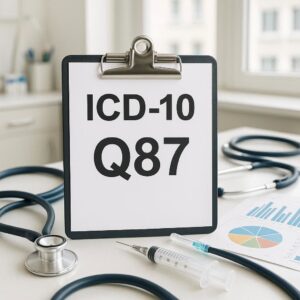
ICD-10 Code Q87
2. Understanding the ICD-10 Framework: Where Does Q87 Fit?
The International Classification of Diseases, Tenth Revision, Clinical Modification (ICD-10-CM) is the standard system used in the United States to classify and code all diagnoses, symptoms, and procedures. Chapter 17 of this system is dedicated to “Congenital Malformations, Deformations, and Chromosomal Abnormalities” (codes Q00-Q99). This chapter is crucial for tracking the prevalence of birth defects, guiding public health initiatives, and facilitating research.
Within Chapter 17, codes are organized logically. Code Q87 falls under the broader category of “Other congenital malformations” (Q80-Q89). It is specifically designed for syndromes—patterns of multiple, co-occurring anomalies—that are well-defined but do not have their own unique code elsewhere in the classification. It is a “catch-all” for specific, multi-system syndromes that are named and recognized.
Crucially, Q87 is not used for:
-
Single, isolated congenital malformations (e.g., a cleft palate alone would be coded Q35-Q37).
-
Chromosomal abnormalities that have their own codes (e.g., Down Syndrome is Q90, Trisomy 18 is Q91.0-Q91.3).
-
Unspecified or multiple congenital malformations that do not constitute a recognized syndrome (these are coded under Q89.7).
The structure of Q87 is broken down into several fourth and fifth-character subcategories, each pointing to the predominant feature of the syndrome. This allows for greater specificity in coding and data collection.
ICD-10-CM Code Q87 – Subcategory Breakdown
| ICD-10 Code | Description |
|---|---|
| Q87.0 | Congenital malformation syndromes predominantly affecting facial appearance |
| Q87.1 | Congenital malformation syndromes predominantly associated with short stature |
| Q87.2 | Congenital malformation syndromes predominantly involving limbs |
| Q87.3 | Congenital malformation syndromes involving early neurological development |
| Q87.4 | Marfan syndrome |
| Q87.5 | Other congenital malformation syndromes with other skeletal changes |
| Q87.8 | Other specified congenital malformation syndromes, not elsewhere classified |
The following sections will delve into each of these subcategories, with a particular focus on the most prominent and well-understood conditions.
3. Deep Dive into Q87.0: Congenital Malformation Syndromes Predominantly Affecting Facial Appearance
The human face is a masterpiece of complex embryological development. When genetic or teratogenic disruptions occur, they can lead to distinct patterns of facial features that are recognizable to a trained clinician. Q87.0 is used for syndromes where the facial gestalt is a primary and defining characteristic, often providing the first clue to the underlying diagnosis.
Q87.0 and the Spectrum of Conditions
This code includes a range of conditions, such as:
-
Apert Syndrome (Acrocephalosyndactyly): Caused by a mutation in the FGFR2 gene, Apert syndrome is characterized by craniosynostosis (premature fusion of skull sutures) leading to a tall, prominent forehead and underdeveloped midface, and syndactyly (fusion) of the fingers and toes. The facial features are distinctive, with wide-set, bulging eyes and a beaked nose.
-
Crouzon Syndrome: Also caused by mutations in FGFR2, Crouzon syndrome involves craniosynostosis but typically does not include severe syndactyly of the hands and feet. The facial features include wide-set, protruding eyes due to shallow eye sockets (proptosis), an underdeveloped upper jaw, and a beaked nose.
-
Treacher Collins Syndrome (Mandibulofacial Dysostosis): This condition, often caused by mutations in the TCOF1 gene, affects the development of the bones and tissues of the face. Key features include downward-slanting eyes, notches in the lower eyelids, underdeveloped cheekbones and jaw, and malformed ears which can lead to hearing loss.
The management of these syndromes requires a highly specialized craniofacial team, including plastic surgeons, neurosurgeons, ophthalmologists, otolaryngologists, and dentists, to address the functional and cosmetic challenges through staged surgical interventions and therapies.
4. Deep Dive into Q87.1: Congenital Malformation Syndromes Involving Predominantly the Limbs
This subcategory captures syndromes where limb abnormalities are a central feature. These can range from reductions (e.g., missing bones) to duplications (e.g., extra digits) or malformations of shape and structure.
Q87.1 and Associated Syndromes
-
Holt-Oram Syndrome: This is a heart-hand syndrome caused by mutations in the TBX5 gene. It is characterized by upper limb abnormalities, most commonly affecting the thumbs and radial side of the forearm (e.g., triphalangeal thumbs, radial ray defects), alongside congenital heart defects, typically atrial or ventricular septal defects.
-
Thrombocytopenia-Absent Radius (TAR) Syndrome: This syndrome presents with bilateral absence of the radius bones in the forearms, leading to shortened, bowed arms, but with the presence of thumbs. A key feature is thrombocytopenia (low platelet count) at birth, which can be life-threatening but often improves with age.
The focus of care for these individuals involves orthopedic surgeons to improve limb function, cardiologists to manage heart defects, and hematologists to monitor and treat blood abnormalities.
5. Deep Dive into Q87.2: Congenital Malformation Syndromes Involving Predominantly Pre- and Postnatal Growth
Syndromes in this category are defined by significant deviations from normal growth patterns, which can manifest as both pre- and postnatal growth deficiency or, less commonly, overgrowth.
Q87.2 and the Intricacies of Growth
-
Russell-Silver Syndrome (RSS): This is a classic example of a growth restriction syndrome. It is genetically heterogeneous, with some cases involving epigenetic changes on chromosome 11. Features include severe intrauterine growth restriction (IUGR), poor postnatal growth, a characteristic triangular face with a broad forehead and a small, pointed chin, body asymmetry, and feeding difficulties in infancy.
-
Sotos Syndrome (Cerebral Gigantism): In contrast, Sotos syndrome is an overgrowth disorder, often caused by mutations in the NSD1 gene. It is characterized by excessive growth before and after birth, a distinctive facial appearance (long, narrow head; prominent forehead; down-slanting eyes), advanced bone age, and various degrees of intellectual disability.
Management is tailored to the specific growth disorder, involving endocrinologists for growth hormone therapy (in some cases of RSS), nutritional support, and early intervention services for developmental delays.
6. Deep Dive into Q87.3: Congenital Malformation Syndromes Involving Early Onset Neurological Dysfunction
This code is used for syndromes where neurological impairment is a primary and early manifestation, often presenting in the neonatal period or infancy with seizures, hypotonia (low muscle tone), or developmental delay.
Q87.3 and Neurological Complexity
-
Rett Syndrome: Almost exclusively affecting females, Rett syndrome is caused by mutations in the MECP2 gene. After a period of apparently normal development for 6-18 months, affected girls experience a regression, losing purposeful hand skills and spoken language. They develop characteristic hand-wringing or washing movements, gait abnormalities, seizures, and autonomic nervous system dysfunction.
-
Angelman Syndrome: Caused by the loss of function of the UBE3A gene on chromosome 15, Angelman syndrome is characterized by severe developmental delay, absence of speech, a happy and excitable demeanor with frequent laughter, ataxia (gait imbalance), and seizures.
Care for these individuals is lifelong and focuses on multidisciplinary support, including neurologists, physical and occupational therapists, and communication specialists to maximize quality of life and functional abilities.
7. Deep Dive into Q87.4: Marfan Syndrome
Marfan syndrome is one of the most well-known and specific conditions assigned its own code under Q87. It serves as a paradigm for understanding connective tissue disorders.
The Genetics of Marfan Syndrome
Marfan syndrome is an autosomal dominant disorder, meaning an affected person has a 50% chance of passing it on to each child. However, about 25% of cases result from a de novo (new) mutation. It is caused by mutations in the FBN1 gene on chromosome 15, which provides instructions for making fibrillin-1, a critical protein in the formation of microfibrils. These microfibrils are essential components of the extracellular matrix, providing strength and elasticity to connective tissue throughout the body. The defective fibrillin-1 leads to instability in multiple systems, most notably the skeletal, ocular, and cardiovascular systems.
Clinical Manifestations and Diagnostic Criteria (Ghent II)
The presentation of Marfan syndrome is highly variable. Diagnosis is made using the Revised Ghent Nosology, which emphasizes the cardinal features:
-
Cardiovascular: The most life-threatening manifestation is progressive dilation of the aorta at the sinuses of Valsalva, which can lead to aortic dissection or rupture. Mitral valve prolapse is also common.
-
Ocular: Ectopia lentis (dislocation of the lens of the eye) is a hallmark finding. Severe myopia (nearsightedness) and an increased risk of retinal detachment are also present.
-
Skeletal: Features include tall stature with an arm span greater than height, arachnodactyly (long, slender fingers), pectus excavatum (funnel chest) or carinatum (pigeon chest), scoliosis, and joint hypermobility.
-
Other: Dural ectasia (widening of the dural sac surrounding the spinal cord) and striae atrophicae (stretch marks not related to weight changes) are other systemic features.
The diagnosis is established in the presence of aortic root dilation plus ectopia lentis, or a confirmed FBN1 mutation plus a systemic score based on the other features.
Management and Treatment of Marfan Syndrome
Management is proactive and lifelong, centered on preventing complications.
-
Cardiovascular Monitoring: Regular echocardiograms or other cardiac imaging are mandatory to monitor aortic root diameter. Beta-blockers or Losartan (an ARB) are used to reduce stress on the aortic wall.
-
Surgical Intervention: Prophylactic aortic root replacement is recommended when the diameter reaches a critical size to prevent dissection.
-
Ocular Care: Regular ophthalmologic examinations are essential.
-
Orthopedic Management: Bracing or surgery may be required for significant scoliosis or pectus deformities.
-
Lifestyle Modifications: Avoidance of contact sports, isometric exercises, and competitive athletics is crucial to reduce aortic stress.
8. Deep Dive into Q87.5: Other Congenital Malformation Syndromes with Other Skeletal Changes
This subcategory is a broad one, capturing syndromes with significant skeletal involvement that don’t fit into the other limb or facial categories. The most prominent group here is the Ehlers-Danlos Syndromes.
Ehlers-Danlos Syndromes (EDS)
EDS is a heterogeneous group of heritable connective tissue disorders characterized by joint hypermobility, skin hyperextensibility, and tissue fragility. The 2017 international classification recognizes 13 subtypes, each with distinct genetic causes and clinical features.
-
Hypermobile EDS (hEDS): The most common subtype, diagnosed primarily on clinical criteria (generalized joint hypermobility, skin involvement, and the absence of features suggestive of other subtypes). Its genetic basis is not yet fully identified.
-
Classical EDS (cEDS): Caused by mutations in COL5A1 or COL5A2 genes. It is marked by extremely stretchy, velvety skin that is fragile and splits easily, leading to significant scarring (“cigarette-paper” scars), and joint hypermobility.
-
Vascular EDS (vEDS): The most serious subtype, caused by mutations in COL3A1. It is characterized by a high risk of spontaneous rupture of arteries (e.g., the aorta, splenic artery) and hollow organs (e.g., colon, uterus). Facial features can include a thin nose, thin lips, and prominent eyes.
Management of EDS is symptomatic and focuses on physical therapy to stabilize joints, pain management, and, for vEDS, aggressive cardiovascular monitoring and avoidance of risky activities.
9. Deep Dive into Q87.8: Other Specified Congenital Malformation Syndromes, Not Elsewhere Classified
This is the “catch-all within the catch-all.” Q87.8 is used for well-defined multi-system syndromes that do not have a more specific code elsewhere in Q87. Two key examples are VACTERL and CHARGE associations.
VACTERL Association
VACTERL is an association, not a syndrome, meaning it is a non-random co-occurrence of features without a known, unifying genetic cause. The acronym stands for:
-
V = Vertebral defects
-
A = Anal atresia
-
C = Cardiac defects
-
T = Tracheo-Esophageal fistula
-
R = Renal (kidney) anomalies
-
L = Limb abnormalities (typically radial ray)
A diagnosis is typically considered when at least three of these features are present. Management is entirely surgical and medical, addressing each specific anomaly by the relevant specialist (orthopedics, cardiology, urology, general surgery).
CHARGE Syndrome
CHARGE is now recognized as a specific genetic syndrome, most often caused by mutations in the CHD7 gene. The acronym stands for:
-
C = Coloboma (a defect in the eye structure)
-
H = Heart defects
-
A = Atresia of the choanae (blockage of the nasal passages)
-
R = Retardation of growth and development
-
G = Genital and/or urinary abnormalities
-
E = Ear abnormalities and deafness
The clinical presentation is complex, often involving cranial nerve dysfunction leading to swallowing and breathing difficulties. Management requires a highly coordinated, multidisciplinary team from birth.
10. The Diagnostic Odyssey: From Clinical Suspicion to Genetic Confirmation
For many families, receiving a diagnosis for a Q87 syndrome is a long and arduous journey known as the “diagnostic odyssey.” It often begins with a clinician—a neonatologist, geneticist, or pediatrician—noting a pattern of anomalies. The process involves:
-
Detailed Clinical Evaluation: A thorough physical examination, including anthropometric measurements and assessment of dysmorphic features.
-
Family History: A three-generation pedigree to identify any patterns of inheritance.
-
Imaging Studies: X-rays, echocardiograms, renal ultrasounds, and MRIs to characterize internal anomalies.
-
Genetic Testing: This is the cornerstone of modern diagnosis. It may start with a chromosomal microarray to look for microdeletions/duplications, followed by targeted single-gene testing, multi-gene panels, or whole exome/genome sequencing.
A confirmed genetic diagnosis ends the odyssey, provides a clear recurrence risk for family planning, connects families with specific support groups, and in some cases, guides management.
11. A Multidisciplinary Approach to Management and Care
There is no cure for the vast majority of syndromes under Q87. Therefore, the goal of medicine is to manage symptoms, prevent complications, and optimize quality of life. This is impossible without a multidisciplinary team (MDT). A typical team for a complex syndrome might include:
-
Clinical Geneticist: Oversees diagnosis and coordinates care.
-
Cardiologist: Manages heart defects and aortic monitoring.
-
Orthopedist/Surgeon: Addresses skeletal and limb issues.
-
Ophthalmologist: Manages visual problems.
-
ENT/Audiologist: Addresses hearing and ear-nose-throat issues.
-
Physical & Occupational Therapists: Work on mobility, strength, and daily living skills.
-
Speech-Language Pathologist: Assists with feeding and communication.
-
Psychologist/Social Worker: Provides support for the emotional and social challenges faced by the individual and family.
This team-based model ensures that all aspects of the individual’s health are addressed in a cohesive manner.
12. The Human Experience: Living with a Q87 Syndrome
Behind every Q87 code is a person with a unique story, a family with hopes and fears, and a community navigating a world not designed for their needs. The challenges are immense: chronic pain, frequent medical appointments, surgeries, social stigma, and the psychological burden of a lifelong condition.
However, the narrative is not solely one of deficit. It is also a story of incredible resilience, adaptability, and community. Patient advocacy and support groups (e.g., The Marfan Foundation, The Ehlers-Danlos Society) provide invaluable resources, foster research, and create a sense of belonging. Individuals with these syndromes often develop profound strengths in self-advocacy, patience, and a unique perspective on life.
13. The Future: Advances in Genetics, Therapy, and Hope
The field of genetics is moving at a breathtaking pace, offering new hope for Q87 syndromes.
-
Precision Medicine: As we understand the precise molecular pathways, targeted therapies are being developed. For example, Losartan for Marfan syndrome was repurposed based on understanding its effect on TGF-β signaling.
-
Gene Therapy and Editing: While still largely experimental, technologies like CRISPR-Cas9 hold the potential to correct the underlying genetic mutations in the future.
-
Improved Diagnostics: Wider access to whole genome sequencing is shortening the diagnostic odyssey and discovering new genes.
-
Transition Medicine: There is a growing focus on smoothly transitioning care from pediatric to adult services, a critical period for individuals with chronic health conditions.
The future is one of increasing understanding, better management, and the real possibility of transformative therapies.
14. Conclusion
ICD-10-CM code Q87 represents a vast and complex landscape of human genetic diversity. It encapsulates conditions that challenge medical science, demand compassionate and coordinated care, and highlight the resilience of the human spirit. From the distinct facial features of Q87.0 to the life-threatening cardiovascular implications of Q87.4, these syndromes remind us that our genetic blueprint is profound and powerful. Understanding these codes is not just an administrative task; it is a fundamental step toward providing holistic, effective, and empathetic care for the individuals and families navigating these unique journeys.
15. Frequently Asked Questions (FAQs)
Q1: If a syndrome has its own code under Q87 (like Marfan is Q87.4), why are there other codes for its specific features, like an aortic aneurysm?
A: This is a core principle of ICD-10 coding. You code both the underlying etiology (the syndrome) and the current manifestation (the complication). So, for a Marfan patient with an aortic aneurysm, you would code both Q87.4 (Marfan syndrome) and I71.9 (Aortic aneurysm, unspecified) to give a complete clinical picture for billing, statistics, and care management.
Q2: What is the difference between an “association” (like VACTERL) and a “syndrome” (like Marfan)?
A: A syndrome has a single, known underlying cause (e.g., a specific genetic mutation) that explains all the associated features. An association is a non-random collection of anomalies that occur together more often than by chance, but without a single identified unifying cause. The cause of associations is often thought to be multifactorial or due to disruptions in early embryonic development.
Q3: Can someone have a mild form of a Q87 syndrome?
A: Absolutely. Variable expressivity is a hallmark of many genetic conditions. This means that two individuals with the same genetic mutation can have vastly different severities of the condition. One person with Marfan syndrome might have a mild aortic root dilation and only skeletal features, while another might have severe, progressive aortic disease. This makes genetic counseling and personalized medicine essential.
Q4: Where can I find support as a patient or family member diagnosed with one of these conditions?
A: Seeking out patient advocacy organizations is one of the most important steps. They provide curated medical information, connect you with experts, host conferences, and offer community support. Key examples include The Marfan Foundation, The Ehlers-Danlos Society, Genetic Alliance, and the National Organization for Rare Disorders (NORD).
16. Additional Resources
-
National Organization for Rare Disorders (NORD): https://rarediseases.org/ – A comprehensive resource for information and patient support for all rare diseases.
-
Genetic and Rare Diseases (GARD) Information Center: https://rarediseases.info.nih.gov/ – An NIH-funded program that provides accessible information about rare and genetic diseases.
-
The Marfan Foundation: https://www.marfan.org/ – Dedicated to education, research, and support for Marfan syndrome and related disorders.
-
The Ehlers-Danlos Society: https://www.ehlers-danlos.com/ – A global organization dedicated to advancing research and support for EDS and HSD (Hypermobility Spectrum Disorders).
-
OMIM (Online Mendelian Inheritance in Man): https://www.omim.org/ – A comprehensive, authoritative compendium of human genes and genetic phenotypes (requires some scientific literacy).