In the high-stakes environment of modern healthcare, two languages are constantly being spoken: the language of clinical medicine, which deals with the physiology and treatment of human disease, and the language of health information, which translates clinical events into standardized data. At the intersection of these two worlds lies the International Classification of Diseases, Tenth Revision, Clinical Modification (ICD-10-CM). More than just a billing tool, this intricate system is the backbone of epidemiology, health economics, quality measurement, and clinical research. Nowhere is the precision of this translation more critical than in coding for acute, life-threatening conditions like Acute Hypoxic Respiratory Failure (AHRF).
AHRF is not merely a diagnosis; it is a syndrome, a final common pathway for a multitude of pathological insults—from severe pneumonia and COPD exacerbations to sepsis and traumatic injury. For clinicians, the focus is rightly on rapid diagnosis and stabilization. For medical coders, clinical documentation specialists, and health information management (HIM) professionals, the focus is on accurately capturing this clinical reality within a structured framework of alphanumeric codes. This process ensures appropriate reimbursement, but its impact extends far beyond the hospital’s revenue cycle. Accurate coding for AHRF influences public health tracking of disease severity, informs hospital quality ratings, and drives allocations for research funding.
This article delves deep into the complexities of ICD-10 codes for Acute Hypoxic Respiratory Failure. We will move beyond the basic code itself to explore the essential physiological concepts, dissect the official coding guidelines, unravel the complexities of diagnosis sequencing, and analyze real-world case studies. Our goal is to provide a definitive, exhaustive resource that empowers both clinical and administrative professionals to navigate this challenging aspect of patient care documentation with confidence and accuracy.
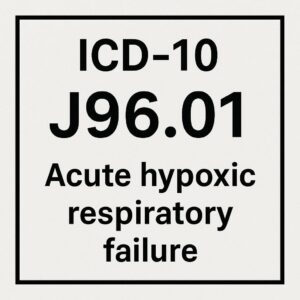
ICD-10 Codes for Acute Hypoxic Respiratory Failure
Table of Contents
Toggle2. Understanding the Physiology: What is Acute Hypoxic Respiratory Failure?
To code a condition correctly, one must first understand it. Acute Hypoxic Respiratory Failure, also known as Type I Respiratory Failure, is defined by a severe impairment in pulmonary gas exchange leading to arterial hypoxemia (a low level of oxygen in the blood) that is refractory to supplemental oxygen. The classic diagnostic threshold is an arterial partial pressure of oxygen (PaO₂) of less than 60 mmHg while the patient is breathing at sea level.
The Mechanics of Gas Exchange
Normally, oxygen from inhaled air diffuses across the delicate alveolar-capillary membrane into the bloodstream, while carbon dioxide, a waste product, diffuses out to be exhaled. AHRF occurs when this process is disrupted. The primary pathophysiology involves ventilation-perfusion (V/Q) mismatch and shunting.
-
V/Q Mismatch: This is the most common cause of hypoxemia. Ventilation (V) refers to air reaching the alveoli, and perfusion (Q) refers to blood flow reaching the pulmonary capillaries. Ideally, these are matched. In conditions like pulmonary embolism, perfusion is compromised (high V/Q ratio). In conditions like asthma or chronic bronchitis, ventilation is compromised (low V/Q ratio). Both lead to ineffective oxygenation.
-
Shunting: This occurs when blood passes through areas of the lung that are not ventilated at all (e.g., due to alveolar collapse in atelectasis or filling with fluid in pneumonia or pulmonary edema). This blood returns to the left heart deoxygenated, profoundly lowering the arterial PaO₂. Shunting is notable because hypoxemia from pure shunting is less responsive to supplemental oxygen.
-
Other Mechanisms: Diffusion limitation (e.g., in interstitial lung disease) and hypoventilation (e.g., from drug overdose or neurological disease) can also contribute.
Distinguishing Hypoxia from Hypercapnia
It is crucial to distinguish AHRF from its counterpart, Acute Hypercapnic Respiratory Failure (Type II), which is characterized by a buildup of carbon dioxide (PaCO₂ > 50 mmHg). While they can and often do coexist (as in mixed respiratory failure), their primary mechanisms differ.
-
Hypoxic (Type I) Failure: Problem is primarily oxygenation.
-
Hypercapnic (Type II) Failure: Problem is primarily ventilation.
This distinction is directly mirrored in the ICD-10-CM coding structure, making physiological understanding a prerequisite for accurate coding.
3. The ICD-10-CM Coding System: A Primer for Precision
The ICD-10-CM is a detailed, hierarchical classification system. Codes are alphanumeric and can be up to seven characters long, with each character adding a layer of specificity regarding etiology, anatomic site, severity, and other clinical details.
The chapter relevant to respiratory failure is Chapter 10: Diseases of the Respiratory System (J00-J99). Within this chapter, codes for respiratory failure are found under the category J96.- Respiratory failure, not elsewhere classified.
The structure of the J96 category highlights the importance of the hypoxic/hypercapnic distinction:
-
J96.0- Acute respiratory failure
-
J96.00 Acute respiratory failure, unspecified whether with hypoxia or hypercapnia
-
J96.01 Acute respiratory failure with hypoxia
-
J96.02 Acute respiratory failure with hypercapnia
-
-
J96.1- Chronic respiratory failure
-
J96.2- Acute and chronic respiratory failure
-
J96.9- Respiratory failure, unspecified
This structure mandates that a coder must have documentation specifying the type of failure to avoid using a nonspecific code. The use of “unspecified” codes is generally discouraged as it lacks clinical precision and can have negative repercussions for reimbursement and data quality.
4. Deconstructing the Code: J96.01 – Acute Respiratory Failure with Hypoxia
The code for Acute Hypoxic Respiratory Failure is J96.01. Let’s break down what this code represents and, just as importantly, what it does not.
-
J96: The base category for “Respiratory failure, not elsewhere classified.”
-
.0: The fourth character specifies “Acute” respiratory failure.
-
.01: The fifth character specifies “with hypoxia.”
This code is used when a physician documents a new, acute onset of respiratory failure where the primary abnormality is hypoxemia. The clinical hallmarks supporting this diagnosis typically include:
-
Documented shortness of breath (dyspnea) and tachypnea (rapid breathing).
-
Physical findings like cyanosis (bluish discoloration of the skin), confusion, or agitation.
-
Crucially: Arterial Blood Gas (ABG) results showing PaO₂ < 60 mmHg on room air.
-
The requirement for supplemental oxygen or advanced respiratory support (e.g., high-flow nasal cannula, non-invasive ventilation, or mechanical ventilation) to maintain adequate oxygen saturation.
Exclusions and Differentiations
The “not elsewhere classified” part of the category title is critical. The ICD-10-CM manual includes an Excludes1 note for category J96.
-
Excludes1: Acute respiratory distress syndrome (J80), Respiratory arrest (R09.2), Respiratory arrest of newborn (P28.81), Respiratory failure of newborn (P28.5).
An Excludes1 note means that the two conditions are mutually exclusive and should not be coded together. If a patient has Acute Respiratory Distress Syndrome (ARDS), which is a specific and severe form of acute hypoxic respiratory failure, you would code J80 instead of J96.01. ARDS has its own specific diagnostic criteria (acute onset, bilateral lung opacities, respiratory failure not fully explained by cardiac failure or fluid overload) and is considered a more precise diagnosis.
5. The Art of Documentation: What Coders Need from Clinicians
The coder’s world is built upon the foundation of clinical documentation. Ambiguous or incomplete documentation directly leads to inaccurate coding, which can impact patient care, reimbursement, and data integrity. For AHRF, specific and detailed documentation is non-negotiable.
Key Elements for Clinicians to Document:
-
The Specific Diagnosis: The physician should explicitly state “acute hypoxic respiratory failure” or “acute respiratory failure with hypoxia.” Avoid vague terms like “respiratory distress” or “low oxygen,” which are symptoms, not diagnoses.
-
Etiology/Cause: Document the underlying cause. For example: “Acute hypoxic respiratory failure due to severe community-acquired pneumonia” or “Acute hypoxic respiratory failure secondary to septic shock.”
-
Temporal Context: Specify that the failure is “acute.” If the patient has a known chronic respiratory failure (e.g., from COPD) and is experiencing an acute exacerbation, the documentation should reflect both the acute and chronic components.
-
Supporting Evidence: Reference the ABG results that confirm the hypoxemia. While the coder may not directly code the ABG, its mention in the context of the diagnosis provides crucial supporting evidence for the code assignment.
-
Severity and Treatment: Documenting the level of intervention required (e.g., “requiring intubation and mechanical ventilation”) adds clinical richness and can support higher levels of service and DRG assignment.
Poor Documentation: “Patient has respiratory failure. Started on oxygen.”
Excellent Documentation: “Patient developed acute hypoxic respiratory failure (PaO2 52 on room air) secondary to florid bilateral pneumonia. Requires intubation and mechanical ventilation for hypoxia refractory to high-flow nasal cannula.”
The latter statement allows for precise coding of J96.01 and the appropriate pneumonia code, ensuring a accurate reflection of the patient’s high level of acuity.
6. Coding Sequencing: The Principal Diagnosis Dilemma
Sequencing—determining which condition is listed as the principal diagnosis—is one of the most complex and consequential aspects of ICD-10 coding. The principal diagnosis is defined as “that condition established after study to be chiefly responsible for occasioning the admission of the patient to the hospital for care.”
The rules for sequencing respiratory failure are guided by the Official Coding Guidelines.
General Rule: If the respiratory failure is the reason the patient presented to the hospital and is the primary focus of inpatient treatment, it should be sequenced as the principal diagnosis. However, it is almost always caused by an underlying condition.
The Official Guideline (Section I.C.10.j.1): The coding hierarchy often follows the clinical logic:
-
Code first the underlying cause of the respiratory failure.
-
Code also the respiratory failure (J96.0-).
However, the guideline includes a critical exception: “Code J96.0- may be assigned as a principal diagnosis when the respiratory failure is the condition established after study to be chiefly responsible for occasioning the admission.”
This creates a nuanced decision tree for coders:
| Clinical Scenario | Principal Diagnosis | Secondary Diagnosis(es) | Rationale |
|---|---|---|---|
| A patient with known COPD presents with worsening shortness of breath and is found to have acute hypoxic and hypercapnic respiratory failure. | The underlying cause: J44.1 (COPD with acute exacerbation) | J96.21 (Acute and chronic respiratory failure with hypercapnia) | The exacerbation of the COPD is the reason for the admission; the respiratory failure is a acute manifestation of that chronic disease. |
| A patient with no lung history presents with fever, cough, and hypoxemia. Diagnosed with pneumonia and acute hypoxic respiratory failure. | The respiratory failure: J96.01 (Acute respiratory failure with hypoxia) | J18.9 (Pneumonia, unspecified organism) | The profound hypoxemia and need for intensive respiratory support (e.g., ICU admission, intubation) was the reason for admission. The pneumonia is the cause. |
| A patient is admitted for a hip replacement (Z-code). Post-op, they develop pulmonary edema and acute hypoxic respiratory failure. | The reason for the admission: Z-code for the hip replacement | The complication: J96.01 and I50.1 (Acute respiratory failure with hypoxia and Acute pulmonary edema) | The respiratory failure was not present on admission; it is a complication of the procedure or care. |
This decision requires careful review of the entire medical record, including the admission note, history and physical, and progress notes, to determine the “chief reason” for admission.
7. Comorbidities and Complications: Painting a Complete Picture
AHRF rarely exists in a vacuum. It is frequently associated with other conditions that are critical to document and code, as they significantly impact patient management, resource utilization, and DRG assignment.
Common Comorbidities and CC/MCCs:
Comorbidities and Complications (CCs) and Major Comorbidities and Complications (MCCs) are secondary diagnoses that affect the severity of the patient’s illness and, consequently, the reimbursement level within a Diagnosis-Related Group (DRG). AHRF itself is often a MCC.
Common conditions linked to AHRF include:
-
Sepsis (A41.9): A leading cause of AHRF through mechanisms like septic shock and ARDS.
-
Pneumonia (J18.-): A common direct cause of V/Q mismatch and shunting.
-
Heart Failure (I50.-): Especially acute decompensated heart failure leading to cardiogenic pulmonary edema.
-
COPD with Acute Exacerbation (J44.1): Often leads to a mixed picture of hypoxic and hypercapnic failure.
-
Pulmonary Embolism (I26.-): Causes a high V/Q mismatch and can cause acute right heart failure.
-
Acute Kidney Injury (N17.9): Often a consequence of hypoperfusion in shock states that also cause AHRF.
Coding all relevant conditions provides a holistic view of the patient’s complexity. For instance, a patient admitted with AHRF (J96.01) due to pneumonia (J18.9) who subsequently develops acute kidney injury (N17.9) and sepsis (A41.9) has a vastly different clinical picture and resource burden than a patient with AHRF from pneumonia alone. Capturing all four codes is essential for accurate data reporting and reimbursement.
8. The Official Guidelines: A Legal and Ethical Roadmap
The ICD-10-CM Official Guidelines for Coding and Reporting are the definitive rules that must be followed. They are not suggestions. Adherence is a legal and ethical requirement for accurate reporting.
Key guidelines pertinent to AHRF include:
-
Section I.A.13: Laterality: While not typically applicable to J96.01 itself, it is crucial for underlying causes like pneumonia.
-
Section I.A.19: Code Assignment and Clinical Criteria: The code assignment must be based on the provider’s documentation. However, if a diagnosis is not documented but is supported by clinical evidence (e.g., ABG results), the coder may not assume the diagnosis. They must query the provider.
-
Section I.C.10.j: Respiratory failure: This is the core guideline, discussed in depth in the sequencing section above.
-
Section III: Reporting Additional Diagnoses: This guides which other conditions (like comorbidities) should be reported.
The guideline’s emphasis on provider documentation makes the clinician-coder partnership fundamental to accurate data generation.
9. Case Studies: Applying Knowledge to Real-World Scenarios
Let’s apply the principles discussed to realistic patient cases.
Case Study 1: The Primary Pneumonia
Presentation: A 68-year-old male is brought to the ED by ambulance after 3 days of fever, productive cough, and increasing shortness of breath. In the ED, he is lethargic and cyanotic. His oxygen saturation is 82% on room air. An ABG shows PaO₂ of 55 mmHg. Chest X-ray shows a dense consolidation in the right lower lobe. He is admitted to the ICU and placed on a ventilator.
Provider Documentation: “Admitted for acute hypoxic respiratory failure requiring mechanical ventilation due to severe right lobar pneumonia.”
Coding:
-
Principal Diagnosis: J96.01 (Acute respiratory failure with hypoxia). The respiratory failure and the need for life-supporting intervention is the reason for the ICU admission.
-
Secondary Diagnosis: J18.1 (Lobar pneumonia, unspecified organism). The underlying cause.
-
DRG Impact: This will likely group to a pulmonary DRG with MCC (J96.01), reflecting high resource use.
Case Study 2: The Post-Operative Complication
Presentation: A 55-year-old female undergoes an elective laparoscopic cholecystectomy (Z51.89). On post-op day 1, she develops acute shortness of breath and tachycardia. A CT angiogram confirms a pulmonary embolism.
Provider Documentation: “Post-operative acute hypoxic respiratory failure due to acute pulmonary embolism. Patient was admitted for elective surgery, but now requires transfer to ICU for monitoring and anticoagulation.”
Coding:
-
Principal Diagnosis: Z51.89 (Encounter for other specified aftercare). The reason for the original admission.
-
Secondary Diagnoses: I26.99 (Other pulmonary embolism without acute cor pulmonale) and J96.01 (Acute respiratory failure with hypoxia). These are complications of the surgical encounter.
-
DRG Impact: This will group to a DRG for the original procedure with CC/MCC, significantly increasing the weight and reimbursement due to the serious complication.
Case Study 3: The COPD Exacerbation
Presentation: A 72-year-old male with severe COPD presents to the ED with a 5-day history of increased wheezing and sputum production. His oxygen saturation is 88% on room air. An ABG shows PaO₂ of 58 mmHg and PaCO₂ of 52 mmHg.
Provider Documentation: “Admitted for acute exacerbation of COPD with acute on chronic hypercapnic and hypoxic respiratory failure.”
Coding:
-
Principal Diagnosis: J44.1 (COPD with acute exacerbation). The exacerbation of the underlying chronic disease is the reason for admission.
-
Secondary Diagnosis: J96.21 (Acute and chronic respiratory failure with hypercapnia). This code captures both the hypoxic and hypercapnic components of the failure in the context of pre-existing chronic failure.
-
DRG Impact: This will group to a COPD DRG with CC/MCC (J96.21 is an MCC).
10. The Future of Coding: ICD-11 and Beyond
The World Health Organization (WHO) has already released ICD-11, which came into effect in January 2022. While the US is not expected to transition for several years, understanding its structure is forward-thinking.
In ICD-11, the approach to respiratory failure is more integrated. The code for Acute respiratory distress (CB00) is found under “Respiratory signs and symptoms,” while respiratory failure as a diagnosis is often combined with its etiology.
For example, a common pathway might be to code the underlying disease (e.g., pneumonia) and then add a code for “acute respiratory failure” as a “manifestation” code. This represents a more holistic and electronically-friendly structure, moving away from the sometimes-arbitrary sequencing rules of ICD-10 and towards a multi-axial coding approach that better captures clinical complexity.
11. Conclusion
Accurate ICD-10 coding for Acute Hypoxic Respiratory Failure hinges on a triad of factors: a deep understanding of its pathophysiology, meticulous review of clinical documentation, and strict adherence to official coding guidelines. The code J96.01 is a powerful descriptor of patient acuity that must be applied precisely and sequenced appropriately relative to its underlying cause. As healthcare data continues to drive quality, research, and reimbursement, the role of the skilled coder in translating clinical reality into data integrity has never been more vital. Mastery of complex conditions like AHRF is paramount to ensuring that this translation is both accurate and meaningful.
12. Frequently Asked Questions (FAQs)
Q1: Can I code J96.01 if the provider only documents ” hypoxia” or “low oxygen sats” but doesn’t use the term “respiratory failure”?
A: No. Coders cannot independently make a diagnosis. “Hypoxia” is a symptom or a finding, not a diagnosis. You must query the provider for clarification to determine if the clinical picture meets their criteria for a diagnosis of “acute hypoxic respiratory failure.”
Q2: What is the difference between J96.01 and R09.02 (Hypoxia)?
A: J96.01 represents a definitive diagnosis of a life-threatening syndrome (respiratory failure) characterized by hypoxia. R09.02 is a symptom code from Chapter 18 for “Hypoxia.” It is used when hypoxia is documented but does not meet the criteria for, or is not described as, respiratory failure. J96.01 carries much greater clinical weight and is a CC/MCC.
Q3: A patient has both hypoxemia and hypercapnia. Do I code both J96.01 and J96.02?
A: No. ICD-10-CM provides a specific code for this combined presentation: J96.02 (Acute respiratory failure with hypercapnia). The code J96.02 inherently includes the presence of hypoxia, as hypercapnia rarely exists without some degree of hypoxemia. Always use the single most specific code available.
Q4: How does the documentation of mechanical ventilation affect the coding of AHRF?
A: The use of mechanical ventilation is not coded with J96.01. Instead, the procedure of mechanical ventilation is coded from the ICD-10-PCS system (for inpatient procedures). However, the need for mechanical ventilation is strong clinical evidence supporting the severity of the respiratory failure diagnosis. The DRG system will account for the procedure and the MCC-level diagnosis, leading to a higher-weighted, more resource-intensive DRG.
Q5: When should a coder initiate a physician query regarding respiratory failure?
A: A query should be initiated whenever the documentation is ambiguous, conflicting, or incomplete but clinical evidence (e.g., ABG results, need for intubation) suggests respiratory failure. Examples include: documentation of “impending respiratory failure,” “respiratory distress,” or when a provider uses the term “respiratory failure” without specifying acute/chronic or hypoxic/hypercapnic.
13. Additional Resources
-
CDC ICD-10-CM Official Guidelines: https://www.cdc.gov/nchs/icd/icd-10-cm.htm – The absolute essential resource for all coders.
-
American Health Information Management Association (AHIMA): https://www.ahima.org/ – Provides industry news, educational materials, and best practices for coding professionals.
-
American Association for Respiratory Care (AARC): https://www.aarc.org/ – Offers clinical practice guidelines and educational content on the management of respiratory failure.
-
American Thoracic Society (ATS) Patient Education Series: https://www.thoracic.org/patients/ – Provides detailed explanations of respiratory conditions for healthcare professionals and patients.
-
ICD-11 Reference Guide: https://icd.who.int/en – To explore the future of disease classification.
Date: September 19, 2025
Disclaimer: This article is intended for informational and educational purposes only. It is not a substitute for professional medical advice, diagnosis, or treatment. Always seek the advice of your physician or other qualified health provider with any questions you may have regarding a medical condition or coding practice. The codes and guidelines referenced are subject to change; always refer to the most current official ICD-10-CM coding manuals and resources.