Acute Kidney Injury (AKI) is not merely a laboratory finding or a passive complication; it is a dynamic, serious, and often devastating clinical syndrome that signals a sudden loss of the kidney’s vital filtering capabilities. In the modern healthcare landscape, where data drives decision-making, reimbursement, and quality metrics, the accurate translation of this clinical diagnosis into an ICD-10-CM code is paramount. The code assigned for AKI does far more than justify a billing claim. It paints a picture of patient severity, influences risk-adjusted outcome measures, impacts hospital quality scores, and contributes to vital public health data tracking the epidemiology of renal disease.
Coding AKI, however, is fraught with complexity. It is a conditional diagnosis, often intertwined with other severe illnesses like sepsis, heart failure, or major surgery. The coder must be part detective and part linguist, meticulously reviewing clinical documentation to determine not just if AKI is present, but why it occurred, how severe it is, and what its relationship is to other conditions. An oversimplified or incorrect code can obscure the true burden of illness, lead to denied claims, and trigger audit flags. This comprehensive guide aims to demystify the ICD-10-CM codes for Acute Kidney Injury, providing coders, clinicians, and healthcare administrators with the deep knowledge needed to navigate this complex terrain with confidence and precision. We will move beyond the basic code assignments to explore the clinical nuances, documentation requirements, and strategic sequencing that underpin accurate and compliant coding practices.
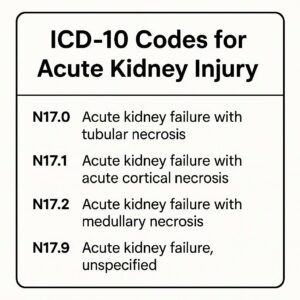
ICD-10 Codes for Acute Kidney Injury
2. Understanding the Clinical Spectrum of Acute Kidney Injury
Before a coder can accurately assign a code, they must understand what the code represents. A foundational knowledge of AKI’s clinical aspects is non-negotiable for accurate ICD-10 coding.
Defining AKI: From RIFLE to KDIGO
Clinicians no longer define AKI by a single creatinine value. Instead, they use standardized criteria established by international consensus groups. The most current and widely accepted definition comes from the KDIGO (Kidney Disease: Improving Global Outcomes) clinical practice guidelines. AKI is defined as any of the following:
-
An increase in serum creatinine by ≥0.3 mg/dL within 48 hours; OR
-
An increase in serum creatinine to ≥1.5 times baseline, which is known or presumed to have occurred within the prior 7 days; OR
-
Urine volume < 0.5 mL/kg/h for 6 hours.
This definition emphasizes the importance of a change from baseline. This is a critical concept for coders, as the documentation must support this acute change.
The Pathophysiological Triad: Prerenal, Intrinsic, and Postrenal AKI
AKI is categorized based on the point of insult in the renal system. Understanding these categories helps coders interpret physician documentation and know what etiologic codes may be needed.
-
Prerenal AKI (~50% of cases): The problem is before the kidney. There is reduced blood flow (hypoperfusion) to otherwise healthy kidneys. Common causes include:
-
Volume depletion (dehydration, hemorrhage, burns)
-
Reduced cardiac output (heart failure, myocardial infarction)
-
Systemic vasodilation (sepsis, anaphylaxis)
-
Medications affecting blood flow (NSAIDs, ACE inhibitors)
-
-
Intrinsic (or Intrarenal) AKI (~40% of cases): The problem is within the kidney itself. This involves damage to the glomeruli, tubules, interstitium, or vessels.
-
Acute Tubular Necrosis (ATN): The most common form of intrinsic AKI. Often caused by prolonged prerenal ischemia (e.g., from sepsis or shock) or direct toxins (e.g., contrast dye, aminoglycoside antibiotics, myoglobin from muscle breakdown).
-
Acute Interstitial Nephritis (AIN): Often an allergic reaction to medications (e.g., antibiotics, PPIs, NSAIDs).
-
Glomerulonephritis: Inflammation of the glomeruli.
-
Vascular disorders (e.g., vasculitis, thrombotic microangiopathy).
-
-
Postrenal AKI (~10% of cases): The problem is after the kidney. This is an obstruction of the urinary outflow tract.
-
Bladder outlet obstruction: Benign Prostatic Hyperplasia (BPH), bladder cancer, neurogenic bladder.
-
Ureteral obstruction: Kidney stones, tumors, retroperitoneal fibrosis.
-
Urethral obstruction: Strictures.
-
Staging Acute Kidney Injury: Severity Matters
KDIGO also provides a staging system (Stage 1, 2, or 3) based on the magnitude of creatinine rise or urine output. While the specific stage is not currently represented by a unique ICD-10 code, its documentation is crucial as it correlates with mortality risk, length of stay, and need for renal replacement therapy (dialysis). For coders, the documentation of a stage (e.g., “Stage 3 AKI”) reinforces the acuity and severity of the condition.
3. Navigating the ICD-10-CM Chapter Block: Diseases of the Genitourinary System
The ICD-10-CM code set is organized into chapters based on body system or disease type. AKI codes are found in:
-
Chapter 14: Diseases of the Genitourinary System (N00-N99)
-
Block (N17-N19): Kidney failure
This block includes:
-
N17: Acute kidney failure
-
N18: Chronic kidney disease (CKD)
-
N19: Unspecified kidney failure
It is vital to note that codes from this block are subject to the ICD-10-CM Official Guidelines for Coding and Reporting, which include specific instructions for coding kidney failures in conjunction with other conditions.
4. A Deep Dive into Category N17: Acute Kidney Failure
The category N17 is the home for all AKI diagnoses. Its hierarchy requires a fourth digit to specify the type of acute kidney failure, if known.
| ICD-10-CM Code | Code Description | Clinical Context & Coding Notes |
|---|---|---|
| N17.0 | Acute kidney failure with tubular necrosis | This is the code for Acute Tubular Necrosis (ATN). Assign this code when the provider specifically documents ATN. It is often linked to ischemic or toxic insults. |
| N17.1 | Acute kidney failure with acute cortical necrosis | A rare but severe form of AKI where the renal cortex undergoes necrosis, often due to obstetric catastrophes (e.g., placental abruption), severe sepsis, or poisoning. |
| N17.2 | Acute kidney failure with medullary necrosis | Also known as renal papillary necrosis. Associated with diabetes mellitus, analgesic abuse, sickle cell disease, and urinary tract obstruction. |
| N17.8 | Other acute kidney failure | A catch-all category for other specified types of intrinsic AKI not listed above. Examples: Acute kidney failure with glomerular necrosis, acute interstitial nephritis (if not specified as drug-induced, which may have its own code). |
| N17.9 | Acute kidney failure, unspecified | Use this code only when the provider documents “AKI” or “acute renal failure” without any specification of the type (e.g., no mention of tubular, cortical, prerenal, etc.). This is the least specific code and should be avoided if more detailed documentation exists. |
5. The Art of Sequencing: Primary Diagnosis, Comorbidity, or Complication?
The order in which codes are listed—their sequence—is critically important. It tells the story of the patient’s admission and determines the Diagnosis-Related Group (DRG) for inpatient claims. The sequencing of AKI depends entirely on the circumstances of admission.
-
AKI as the Principal Diagnosis: AKI should be sequenced as the principal diagnosis only if it is the condition established after study to be chiefly responsible for occasioning the admission to the hospital. This is relatively uncommon. An example would be a patient admitted for workup and management of newly discovered, symptomatic AKI (e.g., with nausea, vomiting, fluid overload) of unknown origin.
-
AKI as a Complication or Comorbidity (CC/MCC): This is the most common scenario. AKI develops after admission or is present on admission but is not the primary reason for it. The AKI is a complicating factor in the management of another more principal condition.
-
Example 1: A patient is admitted for severe community-acquired pneumonia (principal diagnosis: J18.9). They become septic and hypotensive, leading to acute tubular necrosis. The AKI (N17.0) is a complication that increases the severity of illness and resource use.
-
Example 2: A patient is admitted for an elective total hip replacement. Post-operatively, they develop AKI due to a combination of hypotension and NSAID use. The AKI is a complication of the surgical stay.
-
-
AKI as a Manifestation of another Underlying Condition: In some cases, coding guidelines instruct you to code the underlying etiology first, followed by the AKI. A classic example is hemolytic-uremic syndrome (D59.3), where the AKI is an integral feature of the disease. The code first note under D59.3 directs you to sequence D59.3 first, followed by N17.-.
6. The Crucial Link: Clinical Documentation and Physician Queries
The coder’s world is built on the foundation of clinical documentation. Vague or inconsistent documentation leads to inaccurate coding, which has financial and quality implications.
Key Documentation Elements for Precise Coding
For optimal coding, the medical record should clearly document:
-
The Diagnosis: “Acute Kidney Injury” or “Acute Renal Failure.”
-
The Type/Pathophysiology: Is it prerenal? Intrinsic (e.g., ATN, AIN)? Postrenal? The more specific, the better.
-
The Etiology/Cause: What caused the AKI? Sepsis? Dehydration? Contrast dye? Obstruction? Medication?
-
The Severity/Stage: Documentation of KDIGO Stage (1, 2, or 3) is excellent clinical practice.
-
The Temporal Relationship: Did it develop during the hospitalization? Was it present on admission?
-
Baseline Renal Function: What was the patient’s known or estimated baseline creatinine? This is essential for confirming the “acute” nature of the injury.
Crafting Effective and Compliant Queries
When documentation is unclear, conflicting, or incomplete, the coder must initiate a physician query. A query is a formal, compliant communication designed to clarify the documentation without leading the physician.
-
Bad Query (Leading): “Dr. Smith, the patient has a high creatinine. Can we code for acute tubular necrosis?”
-
Good Query (Non-Leading): “Dr. Smith, the patient’s creatinine rose from a baseline of 1.0 to 3.2 mg/dL during this admission. The note discusses possible etiologies including hypotension and vancomycin. Can you please clarify the specific type and cause of the acute kidney injury for accurate coding?”
A good query presents objective clinical facts (labs, vitals, medications) and asks the physician to make a clinical determination.
7. Coding Scenarios: Applying Knowledge to Real-World Cases
Let’s apply these principles to realistic patient cases.
Scenario 1: The Dehydrated Elderly Patient
-
Presentation: An 84-year-old female is admitted from a nursing home with weakness, lethargy, and poor oral intake for 3 days. She has a history of hypertension and CKD Stage 3 (baseline Cr ~1.4).
-
Admission Labs: Cr 2.8 mg/dL, BUN 55 mg/dL. Urine output is low. The physician documents: “Acute kidney injury likely secondary to volume depletion from dehydration. Prerenal azotemia.”
-
Treatment: IV fluids.
-
Response: After 48 hours of IV hydration, her Cr improves to 1.6.
-
Coding: The principal reason for admission is the dehydration and its effects. The AKI is a complication of that dehydration.
-
Principal Diagnosis: E86.0 (Dehydration)
-
Secondary Diagnosis: N17.9 (Acute kidney failure, unspecified) – The provider did not specify a type like tubular necrosis, so N17.9 is appropriate. The underlying CKD (N18.3) should also be reported as a comorbidity.
-
Scenario 2: Post-Operative Contrast-Induced Nephropathy
-
Presentation: A 65-year-old male with diabetes and stable CKD (baseline Cr 1.6) is admitted for an elective cardiac catheterization for stable angina. The procedure uses iodinated contrast.
-
Post-Procedure Day 1: Cr rises to 2.5.
-
Post-Procedure Day 2: Cr peaks at 3.0. The nephrology consult note states: “Contrast-induced acute kidney injury, KDIGO Stage 2. No evidence of tubular necrosis.”
-
Coding: The admission was for the catheterization. The AKI is a complication of the procedure.
-
Principal Diagnosis: I20.9 (Angina, unspecified) – This is the reason for the catheterization.
-
Secondary Diagnoses: N17.8 (Other acute kidney failure) – The provider specified a type (contrast-induced) but not tubular necrosis, so N17.8 is better than N17.9. Also code T80.89XA (Other complications of procedures, initial encounter) to indicate the iatrogenic cause. Code N18.31 (Chronic kidney disease, stage 3a) for the underlying CKD.
-
Scenario 3: Sepsis and Multisystem Organ Failure
-
Presentation: A 58-year-old female is admitted through the ER with fever, hypotension, and altered mental status. She is diagnosed with septic shock due to urosepsis.
-
Hospital Course: She requires pressors and ventilatory support. Her Cr on admission is 2.0 (no known baseline). It rises to 4.5 over 72 hours, and she becomes anuric. The intensivist documents: “Septic shock with multisystem organ failure including respiratory failure, circulatory failure, and acute kidney injury with likely ischemic acute tubular necrosis.”
-
Coding: This is a complex case of severe sepsis.
-
Principal Diagnosis: First, code the underlying infection. A41.9 (Sepsis, unspecified organism) or a more specific code if found.
-
Secondary Diagnoses: Follow with R65.21 (Severe sepsis with septic shock). Then code the specific organ failures:
-
N17.0 (Acute kidney failure with tubular necrosis)
-
J96.00 (Acute respiratory failure, unspecified whether with hypoxia or hypercapnia)
-
R57.2 (Septic shock) – Note: This is included in R65.21 but may still be required by some systems.
The AKI (N17.0) is a major complicating condition (MCC) that significantly impacts the DRG.
-
-
Scenario 4: Obstructive Uropathy from BPH
-
Presentation: A 72-year-old male presents with acute urinary retention and lower abdominal pain. He has a history of symptomatic BPH.
-
Labs: Cr is 3.0 mg/dL (baseline was 1.0 a year ago). A bladder scan shows 1000mL of retained urine.
-
Diagnosis: The urologist documents: “Post-obstructive acute kidney injury secondary to benign prostatic hyperplasia with urinary retention.”
-
Treatment: Foley catheter placed, with output of 1200mL. Cr trends down over the next few days.
-
Coding: The acute retention and its consequences are the reason for admission.
-
Principal Diagnosis: R33.9 (Retention of urine, unspecified)
-
Secondary Diagnoses: N17.9 (Acute kidney failure, unspecified) and N40.1 (Benign prostatic hyperplasia with lower urinary tract symptoms). The AKI is a direct complication of the obstruction.
-
8. Beyond the Basics: AKI in the Context of Chronic Kidney Disease
A frequent and challenging scenario is the patient with pre-existing Chronic Kidney Disease (CKD) who suffers an acute insult. This is termed “Acute on Chronic Kidney Disease.”
Coding the Axiom: “Acute on Chronic”
The ICD-10-CM official guidelines provide clear instruction for this situation. You must code both the acute kidney injury (N17.-) and the chronic kidney disease (N18.-). The acute kidney injury is not considered inherent to the CKD; it represents a new, additional problem. The sequencing, as always, depends on the reason for admission.
-
If the patient is admitted for management of the acutely worsened renal function, N17.- would be principal.
-
If the AKI develops during an admission for another reason (e.g., heart failure), the other reason is principal, and both the N17.- and N18.- are listed as secondary diagnoses.
The Importance of Baseline Creatinine
This is where clinical documentation is king. The physician must indicate that there is an acute rise above the patient’s chronic baseline. A statement like “Acute on chronic kidney disease” or “AKI superimposed on CKD Stage 3” is ideal. Without a documented baseline or clear clinical statement, it may be impossible to justify coding an acute component, and the elevated creatinine may be attributed solely to the CKD.
9. Compliance and Audit Risks: Avoiding Common Coding Pitfalls
-
Assumption Pitfall: Never assume AKI based solely on an elevated creatinine. You must have provider documentation of the diagnosis.
-
Specificity Pitfall: Defaulting to N17.9 (unspecified) when the record contains more specific information about the type of AKI (e.g., tubular necrosis, prerenal) is inaccurate and may downcode the claim.
-
Sequencing Pitfall: Automatically making AKI the principal diagnosis. Always ask: “Was this the main reason the patient needed inpatient care?”
-
Etiology Pitfall: Forgetting to code the underlying cause of the AKI (e.g., sepsis, dehydration, obstruction) when it is known. The AKI code alone often does not tell the whole story.
-
“Acute on Chronic” Pitfall: Failing to code both the N17 and N18 codes when both conditions are present and documented.
10. The Future of AKI Coding: ICD-11 and Beyond
The World Health Organization’s ICD-11 system has been implemented and offers a more detailed structure for AKI. While the US continues to use ICD-10-CM, understanding the direction of coding is valuable. ICD-11 codes for AKI are found under “GB40 Acute kidney failure” and allow for greater specificity, including combination codes that incorporate the cause (e.g., GB40.0 Acute kidney failure with specified pathology). This move towards greater specificity will continue to emphasize the need for detailed clinical documentation.
11. Conclusion
Accurate ICD-10 coding for Acute Kidney Injury is a multifaceted process that extends far beyond simple code lookup. It demands a synergistic partnership between precise clinical documentation and sophisticated coding expertise. By understanding the clinical nuances of AKI, adhering to official coding guidelines, mastering the art of sequencing, and engaging in compliant physician querying, healthcare organizations can ensure the integrity of their data, support appropriate reimbursement, and most importantly, contribute to a accurate portrait of patient acuity and quality of care. In the realm of renal medicine, where a single code can signify a life-threatening complication, precision is not just a goal—it is a necessity.
12. Frequently Asked Questions (FAQs)
Q1: Can I code AKI if the creatinine is elevated but the doctor hasn’t documented “AKI” or “acute renal failure”?
A: No. Coding must be based on provider documentation. You cannot make a clinical diagnosis based on lab values alone. If you see a rising creatinine that suggests AKI, you must initiate a query to the provider for clarification.
Q2: What is the difference between N17.9 (Unspecified AKI) and R34 (Anuria and Oliguria)?
A: N17.9 is a diagnosis of the disease (kidney failure). R34 is a symptom code for low urine output. If the provider has diagnosed AKI, you must use a code from N17.-. You may use R34 as an additional code if the symptom is documented and provides additional information, but it does not replace the AKI code.
Q3: How do I code “prerenal azotemia”?
A: “Prerenal azotemia” is a clinical term often synonymous with prerenal AKI. Unless the provider specifies a more precise type like tubular necrosis, this would be coded to N17.9 (Acute kidney failure, unspecified). Always pair it with a code for the cause, such as dehydration (E86.0) or septic shock (R65.21).
Q4: A patient with CKD is admitted. Their creatinine is higher than their last known outpatient value, but the doctor only documents “CKD exacerbation” or “worsening CKD.” Can I code AKI?
A: Not without further clarification. “Exacerbation” is vague and could be interpreted as a chronic process. You must query the provider to ask if this represents an acute decompensation ( Acute on Chronic CKD) or simply the natural progression of their chronic disease. The provider’s response will guide correct coding.
13. Additional Resources
For the most accurate and updated information, always consult these primary sources:
-
ICD-10-CM Official Guidelines for Coding and Reporting: Published annually by the CDC and CMS. This is the ultimate authority for coding rules.
-
AHA Coding Clinic for ICD-10-CM/PCS: The official source for coding advice and guidance. It provides answers to specific scenarios and is binding for coding professionals.
-
KDIGO Clinical Practice Guideline for Acute Kidney Injury: The leading clinical guideline that defines and stages AKI. Understanding this helps coders speak the same language as clinicians.
-
American Health Information Management Association (AHIMA): Provides white papers, practice briefs, and educational materials on topics like physician querying.
Date: September 18, 2025
Author: The Health Informatics Team
Disclaimer: This article is intended for informational and educational purposes only. It is not a substitute for professional medical coding advice, clinical guidance, or the official ICD-10-CM guidelines. Medical coders must always consult the most current official coding resources, payer-specific policies, and clinical documentation for accurate code assignment.