It begins with a subtle tickle in the nose, a faint itch at the back of the throat. Then comes the crescendo: an uncontrollable, rapid-fire series of sneezes, followed by the fumbling for a tissue to address the now-flowing nasal passages. For millions worldwide, this is not an occasional inconvenience; it is the daily reality of allergic rhinitis. Often dismissed as “just allergies,” this condition is a significant global health issue, impacting quality of life, productivity at work and school, and contributing to billions in healthcare costs annually. In the intricate world of modern healthcare, this common condition meets the complex language of medical classification: the International Classification of Diseases, Tenth Revision, Clinical Modification (ICD-10-CM). Accurate coding for allergic rhinitis is not a mere administrative task—it is a critical linchpin connecting patient care, reimbursement for medical services, epidemiological research, and public health planning. This comprehensive guide will delve deep into the clinical nuances of allergic rhinitis and master the precise art and science of its ICD-10 coding, ensuring that every sneeze, sniffle, and itch is accurately captured in the data that drives healthcare forward.
ICD-10 Codes for Allergic Rhinitis
Table of Contents
Toggle2. Understanding the Clinical Beast: What is Allergic Rhinitis?
Allergic rhinitis is an IgE-mediated inflammatory disorder of the nasal mucosa triggered by exposure to an allergen. In simpler terms, it’s your body’s immune system overreacting to a harmless substance in the air, mistaking pollen, dust, or dander for a dangerous pathogen and launching a full-scale defensive attack.
Pathophysiology: The Immune System’s False Alarm
The process unfolds in two phases:
-
Sensitization: Upon first exposure to an allergen (e.g., cat dander), a susceptible individual’s immune system perceives it as a threat. Specialized cells process the allergen and present it to helper T-cells, which in turn stimulate B-cells to produce allergen-specific Immunoglobulin E (IgE) antibodies. These IgE antibodies then attach themselves to the surface of mast cells and basophils, which are abundant in the nasal passages, eyes, and lungs. The individual is now “sensitized.”
-
Effector Phase (Upon Re-exposure): When the person encounters the same allergen again, it binds directly to the IgE antibodies on the mast cells. This binding acts like a key turning a lock, causing the mast cells to degranulate—exploding and releasing a potent cocktail of inflammatory mediators, most notably histamine. Histamine is the primary culprit behind the classic symptoms: it causes blood vessels to dilate (leading to congestion and runny nose), stimulates nerve endings (causing itching and sneezing), and increases mucus production.
Signs and Symptoms: The Hallmark Presentation
The symptoms of allergic rhinitis are divided into two categories:
-
Nasal Symptoms:
-
Rhinorrhea: Clear, watery nasal discharge.
-
Sneezing: Often paroxysmal (in fits and bursts).
-
Nasal Pruritus: Itching inside the nose.
-
Nasal Congestion: Blockage or stuffiness, which can be the most bothersome symptom, especially at night.
-
-
Non-Nasal Symptoms:
-
Ocular Symptoms: Itchy, red, watery eyes (allergic conjunctivitis).
-
Postnasal Drip: Mucus dripping down the back of the throat, causing throat clearing and cough.
-
Eustachian Tube Dysfunction: Feeling of ear fullness or popping.
-
Fatigue and Malaise: Often due to poor sleep from congestion.
-
“Allergic Salute”: A characteristic habit in children of wiping their itchy nose upward with the palm of their hand, which can lead to a small crease across the nose.
-
Symptoms are often classified by their timing:
-
Intermittent: Symptoms are present for less than 4 days per week or for less than 4 consecutive weeks.
-
Persistent: Symptoms are present for more than 4 days per week and for more than 4 consecutive weeks.
-
Mild: Sleep is normal; no impairment of daily activities, sport, or leisure; normal work and school; symptoms are not troublesome.
-
Moderate-Severe: One or more of the following: abnormal sleep, impairment of daily activities/sport/leisure, problems at work or school, troublesome symptoms.
Triggers and Risk Factors: From Pollen to Pets
Allergens are typically inhaled and are categorized as seasonal or perennial.
-
Seasonal Allergens:
-
Tree Pollen: Spring (e.g., birch, oak, cedar).
-
Grass Pollen: Late spring and summer (e.g., ryegrass, timothy grass).
-
Weed Pollen: Late summer and fall (e.g., ragweed).
-
-
Perennial Allergens:
-
Dust Mites: Microscopic organisms thriving in bedding, upholstery, and carpets.
-
Animal Dander: Proteins found in the skin flakes, saliva, and urine of furry pets (cats and dogs are most common).
-
Cockroaches: Their droppings and body parts can be potent allergens.
-
Indoor Mold: Found in damp areas like bathrooms and basements.
-
Risk factors include a family history of allergies (atopy), having other allergic conditions like asthma or eczema, and exposure to tobacco smoke and air pollutants early in life.
Diagnosis: Beyond the Patient’s Story
While a history is highly suggestive, diagnosis is often confirmed with testing:
-
Skin Prick Test (SPT): The most common and rapid test. Small amounts of suspected allergens are pricked into the skin. A small raised bump (wheal) and redness (flare) at the site indicate an allergy.
-
Specific IgE Blood Test (e.g., RAST or ImmunoCAP): Measures the level of allergen-specific IgE antibodies in the blood. Useful if a skin test can’t be done (e.g., due to severe skin condition or patient on antihistamines).
3. The World of ICD-10-CM: A Primer for Precision
The ICD-10-CM is a system used by physicians, coders, and healthcare organizations to classify and code all diagnoses, symptoms, and procedures recorded in conjunction with hospital care. It is essential for:
-
Reimbursement: Insurance companies (payers) use codes to determine coverage and payment for services.
-
Epidemiology and Research: Tracking the prevalence and incidence of diseases.
-
Public Health: Monitoring outbreaks and allocating resources.
-
Clinical Decision Support: Informing treatment pathways and quality measures.
Why Accurate Coding Matters: More Than Just Numbers
Using an incorrect or nonspecific code can lead to:
-
Claim Denials: If the code does not support the medical necessity of the services provided.
-
Inaccurate Data: Skews public health understanding and research.
-
Audit Risks: Using “unspecified” codes too frequently can trigger audits from payers.
-
Lower Reimbursement: Some specific codes may be linked to higher-complexity visits.
Structure of the ICD-10-CM Code
ICD-10-CM codes are alphanumeric and can be up to 7 characters long. Each character adds a layer of specificity.
-
Category (Characters 1-3): The broad disease category (e.g., J30 for Vasomotor and allergic rhinitis).
-
Etiology, Anatomic Site, Severity (Characters 4-6): Provides more detail (e.g., .1 for allergic rhinitis due to pollen).
-
Extension (Character 7): Often used for encounter type (e.g., initial, subsequent, sequela) but not always used for diagnoses like rhinitis.
4. The Core Codes: Navigating the J30 Series
The codes for allergic rhinitis fall under category J30, which is tellingly named “Vasomotor and allergic rhinitis.” This means coders must first distinguish allergic rhinitis from non-allergic types (like vasomotor rhinitis, J30.0) based on clinical documentation.
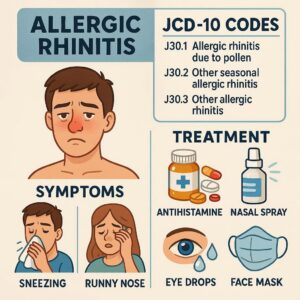
ICD-10-CM Codes for Allergic Rhinitis
| ICD-10-CM Code | Code Description | Common Triggers | Seasonality |
|---|---|---|---|
| J30.1 | Allergic rhinitis due to pollen | Trees, grasses, weeds (ragweed) | Seasonal |
| J30.2 | Other seasonal allergic rhinitis | Other seasonal allergens not pollen | Seasonal |
| J30.5 | Allergic rhinitis due to food | Various foods | Perennial (episodic) |
| J30.81 | Allergic rhinitis due to animal (cat) dander | Cat dander (and dog, by convention) | Perennial |
| J30.89 | Other allergic rhinitis | Dust mites, mold, cockroaches, other | Perennial |
| J30.9 | Allergic rhinitis, unspecified | Unknown or not specified | Varies |
J30.0: Vasomotor Rhinitis – The Non-Allergic Imposter
This code is for non-allergic, non-infectious rhinitis. Symptoms are similar (congestion, runny nose) but are triggered by environmental irritants (smoke, strong odors, changes in temperature/humidity), not an allergen-driven immune response. There is no itching or sneezing typically, and allergy testing is negative. It is crucial not to confuse this with allergic rhinitis.
J30.1: Allergic Rhinitis Due to Pollen (Hay Fever)
This is the classic “hay fever” code. It is used when the provider specifically documents that pollen is the trigger. Documentation might state “allergic rhinitis due to tree pollen,” “ragweed allergy,” or “seasonal allergies due to grass pollen.”
J30.2: Other Seasonal Allergic Rhinitis
This is a less common code for seasonal allergies that are not due to pollen. An example could be an allergy to a specific seasonal mold that appears in the fall.
J30.5: Allergic Rhinitis Due to Food
While food allergies typically cause systemic reactions (hives, anaphylaxis) or gastrointestinal symptoms, they can sometimes present with isolated or prominent rhinitis symptoms (e.g., runny nose after drinking milk). This code is only used if the provider explicitly links the rhinitis to a food allergen.
J30.81: Allergic Rhinitis Due to Animal (Cat) Dander
Despite the code title specifying “cat,” the ICD-10-CM Alphabetic Index directs you to this code for allergic rhinitis due to any animal dander (e.g., dog, horse, rabbit). Documentation is key: “allergic rhinitis due to dog exposure” is coded to J30.81.
J30.89: Other Allergic Rhinitis
This is a critical code for the most common perennial allergens. It is used for allergic rhinitis due to:
-
Dust mites
-
Mold (non-seasonal, indoor)
-
Cockroaches
-
Other specific, non-seasonal allergens not represented elsewhere.
Documentation examples: “allergic rhinitis due to dust mites,” “perennial allergic rhinitis caused by mold.”
J30.9: Allergic Rhinitis, Unspecified – The Code of Last Resort
This code should be used only when:
-
The provider’s documentation simply states “allergic rhinitis” without specifying a cause.
-
The cause is unknown and has not been investigated.
-
The record lacks the detail needed to assign a more specific code.
Best practice is to avoid this code. Coders should query the provider for more specific information if possible. Overuse of unspecified codes can lead to claim delays or denials.
5. Coding in Practice: Real-World Scenarios and Common Pitfalls
Let’s apply these codes to realistic patient encounters.
Scenario 1: The Springtime Sufferer
-
Documentation: “18-year-old patient presents for evaluation of sneezing, itchy eyes, and rhinorrhea for the past two weeks. Symptoms occur every April and May. Skin prick test positive for birch tree pollen. Assessment: Allergic rhinitis due to tree pollen.”
-
Correct Code: J30.1 (Allergic rhinitis due to pollen). The documentation specifies the cause (pollen) and the testing confirms it.
-
Incorrect Code: J30.9 or J30.2. It is pollen-related, so J30.1 is the most accurate.
Scenario 2: The Perennial Patient with a New Pet
-
Documentation: “45-year-old patient with known perennial allergic rhinitis presents with acute exacerbation of congestion and sneezing. Symptoms began two weeks after getting a new puppy. Advised patient on environmental controls for animal dander.”
-
Correct Code: J30.81 (Allergic rhinitis due to animal dander). The documentation clearly links the exacerbation to the new dog.
-
Incorrect Code: J30.9. The cause is identified.
Scenario 3: The Complex Case with Multiple Allergens
-
Documentation: “Patient with severe perennial allergic rhinitis. IgE testing shows high sensitivity to dust mites and cat dander. She lives with two cats and has wall-to-wall carpeting.”
-
Coding Guidance: ICD-10-CM coding conventions require you to code all documented diagnoses. In cases of multiple allergens, you would assign both J30.81 (for the cat dander) and J30.89 (for the dust mites). The medical record must support both causes.
Scenario 4: The Patient with Unspecified Triggers
-
Documentation: “Patient presents with runny nose, sneezing, and nasal congestion. Diagnosed with allergic rhinitis. No allergy testing performed at this time. Started on fluticasone nasal spray.”
-
Correct Code: J30.9 (Allergic rhinitis, unspecified). Since no cause is identified or documented, this is the appropriate code. A coder cannot assume a cause based on the time of year or other factors.
6. The Importance of Specificity: Linking Cause and Effect
The driving principle behind ICD-10 is specificity. The system is designed to capture not just the “what,” but the “why” and “how” of a disease.
Documentation is Key: The Physician-Coder Partnership
Accurate coding is a team effort that begins with precise clinical documentation. Physicians should be encouraged to document:
-
The specific type of rhinitis: “Allergic,” “vasomotor,” “infectious.”
-
The specific trigger: “Due to pollen,” “due to cat dander,” “due to dust mites.”
-
The temporal pattern: “Seasonal,” “perennial,” “intermittent,” “persistent.”
-
The severity: “Mild,” “moderate,” “severe.”
Phrases like “hay fever” or “seasonal allergies” are generally translated to J30.1, but “allergies” alone is vague and would likely lead to J30.9.
The Role of Allergy Testing in Code Selection
The results of skin or blood tests provide the strongest justification for using a highly specific code. A diagnosis of “allergic rhinitis” coupled with a positive test for ragweed IgE allows the coder to confidently assign J30.1.
7. Beyond J30: Related Codes and Comorbidities
Allergic rhinitis rarely exists in a vacuum. It is part of a systemic allergic response and is frequently associated with other conditions that may also need to be coded.
Allergic Asthma (J45.909-) and the Unified Airway
The “unified airway” theory posits that the upper (nose, sinuses) and lower (lungs) airways are one continuous organ system. Inflammation in the nose (rhinitis) can often trigger inflammation in the lungs (asthma). It is extremely common for a patient to have both conditions. If both are addressed during the encounter, both codes should be assigned (e.g., J30.89 and J45.909).
Allergic Conjunctivitis (H10.45) – The Itchy Eyes
The same allergens that affect the nose often affect the eyes. When a patient presents with itchy, watery, red eyes alongside rhinitis, H10.45 (Allergic conjunctivitis) should be added as an additional code.
Acute Sinusitis (J01.-) and Chronic Sinusitis (J32.-)
Nasal inflammation and congestion from allergic rhinitis can block the sinus ostia (drainage pathways), leading to secondary bacterial or viral sinus infections. If a sinus infection is diagnosed, the appropriate sinusitis code (e.g., J01.90 for acute sinusitis, unspecified) would be sequenced alongside the allergic rhinitis code.
Nasal Polyps (J33.9) – A Common Companion
Chronic inflammation from allergic rhinitis (and especially aspirin-exacerbated respiratory disease) can lead to the development of nasal polyps—soft, noncancerous growths on the lining of the nasal passages. The presence of polyps should be coded with J33.9 (Nasal polyp, unspecified).
8. The Future of Coding: A Glimpse Towards ICD-11
The World Health Organization (WHO) has already released ICD-11, which will eventually be adopted in a clinical modified form (ICD-11-CM) in the United States. In ICD-11, allergic rhinitis is found under CA08.0 Allergic rhinitis. The structure allows for greater detail, with extensions to specify:
-
The specific allergen (e.g., pollen, dust mite, animal hair).
-
The temporal pattern (intermittent, persistent).
-
The severity (mild, moderate, severe).
This continued evolution towards greater specificity will further enhance the ability to capture the full clinical picture of each patient’s condition for treatment, research, and reimbursement.
9. Conclusion: Mastering the Sneeze
Accurate ICD-10 coding for allergic rhinitis transcends mere administrative duty. It is a precise language that translates a patient’s clinical experience into actionable data. By moving beyond the unspecified J30.9 and diligently applying the specific codes within the J30 series—supported by thorough provider documentation and an understanding of related comorbidities—healthcare professionals ensure accurate reimbursement, contribute to robust public health data, and ultimately support the delivery of high-quality, personalized patient care. In the world of healthcare, every detail matters, right down to the specific trigger behind a sneeze.
10. Frequently Asked Questions (FAQs)
Q1: Can I use both an allergic rhinitis code and an asthma code on the same claim?
A: Absolutely. If the patient has both conditions and both are addressed, managed, or evaluated during the encounter, you should code both. This is crucial for accurately representing the patient’s complexity and the work done by the provider.
Q2: What is the difference between J30.2 (Other seasonal) and J30.89 (Other allergic)?
A: J30.2 is for seasonal allergies that are not caused by pollen (e.g., a specific seasonal mold). J30.89 is for perennial allergies (e.g., dust mites, mold that is present year-round, cockroaches). The key differentiator is whether the trigger is seasonally variable or present all year.
Q3: My provider documented “hay fever.” What code do I use?
A: “Hay fever” is a colloquial term for pollen-induced allergic rhinitis. According to coding guidelines and the ICD-10 index, this maps directly to J30.1 (Allergic rhinitis due to pollen).
Q4: When is it acceptable to use the unspecified code J30.9?
A: It is acceptable only when the medical record lacks any specification regarding the cause of the allergic rhinitis. It should be a temporary code until more specific information is available. Best practice is to query the provider for clarification to avoid using it whenever possible.
Q5: How do I code allergic rhinitis when the trigger is unknown but the symptoms are clearly allergic?
A: If the provider diagnoses “allergic rhinitis” but does not identify or document a trigger, you must use J30.9. The coder cannot infer a cause based on symptoms or the time of year. The code must reflect the documentation available.
11. Additional Resources
-
CDC ICD-10-CM Official Guidelines for Coding and Reporting: https://www.cdc.gov/nchs/icd/icd-10-cm.htm (The definitive source for coding rules).
-
American Academy of Allergy, Asthma & Immunology (AAAAI): https://www.aaaai.org/ (For clinical practice guidelines and patient education on allergic rhinitis).
-
American College of Allergy, Asthma & Immunology (ACAAI): https://acaai.org/ (Another excellent resource for both providers and patients).
-
ICD10Data.com: https://www.icd10data.com/ (A free, easy-to-use online tool for browsing the ICD-10-CM code set).
Date: September 18, 2025
Disclaimer: This article is intended for informational and educational purposes only. It is not a substitute for professional medical advice, diagnosis, or treatment. Always seek the advice of your physician or other qualified health provider with any questions you may have regarding a medical condition or coding practice. The author and publisher are not responsible for any errors or omissions or for any consequences from application of the information in this article.