If you are reading this, you are likely one of the millions of people who have started a journey with Mounjaro (tirzepatide). Perhaps you have seen incredible changes in your blood sugar levels, or you are using it for weight management. But once you move past the initial phases of treatment, a new set of questions arises. One of the most common, yet confusing, questions is: “What is the ICD-10 code for long-term use of Mounjaro?”
You might think a code is just a random string of numbers and letters—bureaucratic noise. But in reality, this code is the key that unlocks your continued access to the medication. It tells your insurance company a story. It says, “This isn’t a trial; this is a necessary, ongoing treatment.”
Navigating the world of medical billing can feel like trying to read a map in a foreign language. This guide is here to translate that map for you. We will walk through the specific codes used for long-term medication management, why they matter, and how they fit into the bigger picture of your health records. We will keep it simple, clear, and focused on helping you get the care you need without the headache.
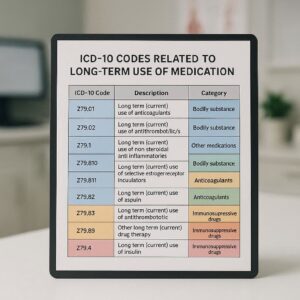
ICD-10 Codes for Long-Term Use of Mounjaro
Understanding the Basics of ICD-10
Before we dive into the specific code for Mounjaro, let us take a step back. What exactly is an ICD-10 code?
ICD-10 stands for the International Classification of Diseases, 10th Revision. It is a system used by healthcare providers and insurers to classify and code all diagnoses, symptoms, and procedures. Think of it as a universal language for health conditions.
When you visit the doctor, they translate your symptoms and health status into these codes. This does two main things:
-
It creates your medical history. It provides a snapshot of your health over time.
-
It justifies treatment to your insurance. The code explains why a service or medication is medically necessary.
When it comes to a medication like Mounjaro, the code you use changes depending on the stage of your treatment. An initial prescription for a newly diagnosed condition will use a different code than a check-up six months later.
The Primary Code: Z79.899 (Other long-term (current) drug therapy)
For the vast majority of patients who have been on Mounjaro for a while, the code you will see most often is Z79.899.
This code falls under the category of “Factors influencing health status and contact with health services.” Specifically, it lives in the section for “Persons with potential health hazards related to family and personal history and certain conditions influencing health status.”
Let’s break that down into plain English.
-
Z79: This is the parent category for “Long-term (current) drug therapy.”
-
.899: This is the specific code for “Other long-term (current) drug therapy.”
What Does Z79.899 Actually Mean?
When your doctor includes Z79.899 on your superbill or in your medical chart, they are making a specific statement. They are saying:
“This patient is currently, and for the long-term, prescribed a medication that does not fall into a more specific category (like long-term use of antibiotics or blood thinners). The ongoing use of this drug is a relevant part of their current health status.”
For Mounjaro, this is the most accurate and honest code to use once you are established on the therapy. It signals to the pharmacy and the insurance company that this is not a one-off prescription. It is a maintenance medication.
Why Z79.899 Matters for Mounjaro Users
Insurance companies look for consistency. If they see a pattern of Z79.899 appearing on claims every month or every three months, it reinforces the idea that you are under a physician’s care for a chronic condition requiring this medication. It helps prevent the dreaded “refill too soon” denials or flags that might occur if the diagnosis code seems temporary or acute.
Important Note: While Z79.899 is the code for the long-term use of the drug itself, it is almost always used in conjunction with the code for the condition being treated. It is very rare to see Z79.899 alone. It works best as a supporting code.
The “Why” Codes: Pairing Z79.899 with Underlying Conditions
To get a prescription for Mounjaro filled—especially for long-term maintenance—you need two types of codes. You need the “what” (Z79.899 for the drug therapy) and the “why” (the diagnosis code for the condition).
Mounjaro is primarily prescribed for two reasons, and the coding differs slightly for each.
For Type 2 Diabetes Management (E11.9)
This is the most straightforward and widely accepted use case. Mounjaro’s primary FDA-approved indication is to improve blood sugar control in adults with type 2 diabetes.
If you are taking Mounjaro for diabetes, your chart will prominently feature codes from the E11 category.
-
Primary Code: E11.9 (Type 2 diabetes mellitus without complications)
-
This is the most common code for patients whose diabetes is being managed without major complications like kidney disease or eye problems.
-
-
Secondary Code: Z79.899
-
This code is added to specify that the patient is on long-term drug therapy. It tells the story: “This patient has type 2 diabetes, and they are managing it with long-term medication.”
-
Sometimes, you might see more specific codes like E11.65 (Type 2 diabetes with hyperglycemia) if your blood sugar has been running high, or E11.22 (Type 2 diabetes with diabetic chronic kidney disease) if there are complications. The key is that the primary diagnosis remains diabetes, and the Z79.899 code supports the ongoing need for the drug.
For Weight Management and Obesity (E66.9)
This is where coding becomes a bit trickier, but it is equally important for long-term use. As of early 2026, Mounjaro is widely prescribed off-label for weight loss, and its sister medication, Zepbound (which is the same drug, tirzepatide), is approved specifically for chronic weight management.
If you are using Mounjaro long-term for weight loss, the “why” code is typically from the E66 category.
-
Primary Code: E66.9 (Obesity, unspecified)
-
This is a very common code used when the primary diagnosis is obesity. It indicates that the patient’s BMI is in the obese range.
-
-
Secondary Code: Z79.899
-
Just like with diabetes, this code is appended to indicate that the treatment for this condition is long-term drug therapy.
-
You might also see more specific codes like E66.3 (Overweight) or E66.01 (Morbid obesity due to excess calories) depending on the patient’s specific BMI and health profile. The presence of Z79.899 is crucial here because it distinguishes between a patient who is simply advised to diet and exercise and one who is actively undergoing a long-term pharmaceutical intervention.
A Quick Reference Table
To make this clearer, here is how the codes typically pair up for long-term maintenance.
| Primary Condition | Common ICD-10 Code (The “Why”) | Supporting Code (The “What”) | Scenario |
|---|---|---|---|
| Type 2 Diabetes | E11.9 (Type 2 diabetes without complications) | Z79.899 (Long-term drug therapy) | A patient with well-managed diabetes using Mounjaro to maintain blood sugar control. |
| Type 2 Diabetes with Complications | E11.65 (Type 2 diabetes with hyperglycemia) | Z79.899 (Long-term drug therapy) | A patient whose blood sugar is spiking, justifying the need for continued GLP-1 therapy. |
| Obesity | E66.9 (Obesity, unspecified) | Z79.899 (Long-term drug therapy) | A patient using Mounjaro for weight management under a doctor’s care. |
| Morbid Obesity | E66.01 (Morbid obesity due to excess calories) | Z79.899 (Long-term drug therapy) | A patient with a very high BMI using medication as part of a comprehensive treatment plan. |
| Screening/Check-up | Z00.00 (Encounter for general adult medical exam) | Z79.899 (Long-term drug therapy) | A patient comes in for a physical, and the doctor notes they are still on Mounjaro as part of their history. |
Other Relevant Z-Codes for Your Health Journey
Beyond Z79.899, there are other “Z-codes” that might appear in your medical records as you continue on Mounjaro long-term. These codes help create a holistic view of your health.
-
Z68.30 – Z68.45 (Body Mass Index – BMI)
These codes are frequently used in conjunction with obesity and diabetes diagnoses. They provide a numerical snapshot. For example, a patient with a BMI of 32 might have the code Z68.32 alongside their E66.9. Tracking these codes over time can objectively show the progress you are making. -
Z71.3 (Dietary counseling and surveillance)
If you are seeing a nutritionist or your doctor is providing detailed dietary advice, this code might pop up. It shows that your treatment is multi-faceted, which is something insurers like to see. -
Z23 (Encounter for immunization)
Not directly related, but it is common for a doctor to update all aspects of your health during a visit. If you get your flu shot while discussing your Mounjaro prescription, this code will be on the record.
A Day in the Life: How These Codes Are Used
To understand how this all works in the real world, let’s look at a typical scenario for a patient named Sarah.
Sarah’s Situation:
Sarah has been on Mounjaro for 14 months. She started it for type 2 diabetes, and it has worked wonders. Her A1C is down, and she has lost 30 pounds. She has a follow-up appointment with her endocrinologist.
The Doctor’s Visit:
The doctor checks Sarah’s blood pressure, reviews her latest blood work, and asks how she is tolerating the medication. She says she feels great and has no side effects. The doctor writes a new prescription for the next three months.
The Coding (Behind the Scenes):
The medical coder looks at the doctor’s notes. They see:
-
The patient has type 2 diabetes (still an active problem).
-
The patient is responding well to Mounjaro.
-
The plan is to continue the medication.
The coder will likely submit the following codes to the insurance company:
-
E11.9 (Type 2 diabetes without complications) – This is the primary reason for the visit.
-
Z79.899 (Long-term drug therapy) – This indicates the diabetes treatment involves a maintenance drug.
-
Z68.32 (BMI 32.0-32.9) – This provides additional data on her current health status.
The Result:
The insurance company sees a clear story. Sarah has a chronic condition (E11.9) that is being managed with long-term medication (Z79.899). The claim is processed, and her prescription is approved for refill.
Common Questions About Long-Term Mounjaro Coding
Navigating this process can feel overwhelming. Here are some of the most common questions we hear, answered simply.
Why can’t I just use the diabetes code alone?
You can, but it doesn’t tell the whole story. Using Z79.899 adds specificity. It tells the insurer, “This isn’t just a diagnosis; it’s a diagnosis requiring an expensive, long-term medication.” This level of detail can prevent claims from being rejected for “lack of medical necessity.” It creates a clearer picture of your ongoing treatment plan.
Does the code change if my dosage goes up?
No. The ICD-10 codes are for diagnoses and health status, not for the specific drug or dosage. Whether you are on 2.5 mg or 15 mg, the code remains Z79.899 paired with your condition code (E11.9, E66.9, etc.). The dosage is recorded elsewhere in the prescription details.
I am using Mounjaro for weight loss. Will Z79.899 help my insurance cover it?
This is a complicated question. The code Z79.899 is honest—it states you are on long-term therapy. However, insurance coverage for weight loss medications varies wildly. While the code accurately reflects your treatment, coverage depends on your specific plan’s formulary. Some plans explicitly exclude weight loss drugs. Using the correct codes (E66.9 and Z79.899) gives you the best possible chance, but it does not guarantee coverage if your plan doesn’t include that benefit.
How long does “long-term” mean in coding terms?
In the world of ICD-10, “long-term” generally refers to a medication that is intended to be taken for a prolonged period, often years or indefinitely, to manage a chronic condition. It usually applies after the initial treatment phase. If you have been on the medication for more than a few months and the plan is to continue, it is considered long-term.
How to Prepare for Your Appointment
You are your own best advocate. While you don’t need to be a coding expert, a little preparation can make your doctor’s visit more productive.
-
Bring a List: Write down any questions you have about side effects, progress, or future goals.
-
Be Honest: Tell your doctor exactly how you are doing. If you missed doses, say so. If you are struggling with side effects, say so. Accurate notes lead to accurate coding.
-
Ask About Your Progress: Inquire about your objective data. “How is my A1C compared to last time?” or “Has my BMI changed?” This engages your doctor in the conversation about your long-term success.
The Future of Mounjaro and Coding
As we move further into 2026, the landscape for these medications continues to evolve. We may see more specific ICD-10 codes emerge for metabolic conditions or for complications related to obesity. There is always a possibility that a new, more specific code for “long-term use of incretin mimetics” could be introduced, but as of now, Z79.899 remains the standard.
The most important trend is the increasing recognition of obesity as a chronic disease, not a lifestyle choice. As this recognition grows, insurance coverage and coding practices will likely become more standardized and supportive of long-term pharmacotherapy.
Conclusion: The Code is a Key
In the end, understanding the ICD-10 code for long-term use of Mounjaro—Z79.899—is about empowerment. It transforms a confusing piece of medical bureaucracy into a tool. It is the key that, when used correctly alongside your primary diagnosis code, helps unlock continued access to a medication that is making a difference in your life.
Remember, it is not just a random number. It is a testament to your commitment to a treatment plan and your doctor’s belief in its necessity. By understanding these codes, you can be a more informed and active participant in your own healthcare journey. Keep the conversation going with your provider, stay consistent with your treatment, and let the codes do the talking in the background.
Frequently Asked Questions (FAQ)
Q1: Is Z79.899 the only code for long-term Mounjaro use?
A: It is the most common and accurate code for the drug therapy itself. However, it is almost always used alongside a primary code for the condition being treated, such as E11.9 for type 2 diabetes or E66.9 for obesity.
Q2: Will my insurance deny my claim if the wrong code is used?
A: Possibly. Using an incorrect or vague code can lead to delays or denials. For example, using a code for a temporary condition when you need a long-term medication might raise a red flag. This is why accurate coding from your provider is so important.
Q3: What if I am taking Mounjaro for both diabetes and weight loss?
A: The primary diagnosis is diabetes (E11.9), as that is the FDA-approved indication. The weight loss is considered a positive side effect. The coding would focus on the diabetes management with the Z79.899 code supporting it.
Q4: How often should I see my doctor to maintain the Z79.899 code?
A: The code itself doesn’t expire, but it is attached to each visit or prescription refill. Most insurance companies and doctors recommend follow-up visits every 3 to 6 months to monitor your progress and ensure the medication is still appropriate and effective.
Q5: Can I look up my own codes in my patient portal?
A: Yes. Most patient portals list the diagnoses associated with your visits. You can often find the ICD-10 codes listed in the “Visit Summary” or “Health Record” sections. It can be interesting to see exactly how your care is being documented.
Author: American Web Writer
Date: FEBRUARY 28, 2026
Disclaimer: This article is for informational purposes only and does not constitute medical advice. Coding practices and insurance requirements vary. You should always consult with a qualified healthcare provider or certified professional coder for guidance on your specific situation.