Nausea and vomiting are among the most universal human experiences. They are not diseases in themselves but powerful, distressing signals from the body that something is amiss. For patients, an episode can range from a minor inconvenience to a debilitating crisis leading to dehydration, electrolyte imbalances, and malnutrition. For clinicians, these symptoms are crucial diagnostic clues, pointing toward a vast differential diagnosis that spans nearly every organ system. But for the medical coder, nausea and vomiting represent a complex puzzle—a challenge in precision, context, and clinical nuance. The simple act of assigning a code for these symptoms is a deceptively intricate task, one that sits at the intersection of clinical medicine, administrative policy, and data science. This article delves deep into the world of ICD-10 code for nausea and vomiting, moving beyond the basic R11 codes to explore the critical thinking, guidelines, and clinical knowledge required to code accurately, ethically, and effectively. We will unravel the scenarios where these symptoms take center stage and, more often, where they play a supporting role to a more definitive diagnosis, ensuring that the patient’s story is accurately told within the constraints of a standardized code set.
ICD-10 Codes for Nausea and Vomiting
Chapter 1: Understanding the Basics – The R11 Code Family
The ICD-10-CM code set categorizes nausea and vomiting under Chapter 18: Symptoms, Signs, and Abnormal Clinical and Laboratory Findings, Not Elsewhere Classified (R00-R99). Specifically, they are found under the subcategory R11: Nausea and vomiting.
It is vital to understand that these codes are “symptom codes.” According to the ICD-10-CM Official Guidelines, symptom codes are not to be used if a definitive diagnosis is known. The R11 codes are reserved for encounters where nausea and vomiting are the reason for the medical visit, and a more specific diagnosis cannot be made at that time.
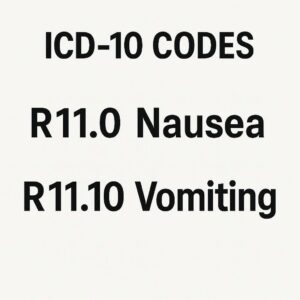
The R11 category is broken down into three specific codes:
-
R11.0 – Nausea: This code is used when the patient’s primary complaint is nausea alone, without vomiting. It’s important for coders to review the clinical documentation carefully. A physician might note “patient reports nausea” but later, upon further questioning, document that the patient did indeed vomit. The code must reflect the full clinical picture.
-
R11.1 – Vomiting: This code is used for episodes of vomiting where nausea may or may not be explicitly mentioned but is typically implied. There are several exclusion notes for this code. For instance, vomiting specifically tied to pregnancy (hyperemesis gravidarum) is coded elsewhere in Chapter 15 (O21.-). Similarly, cyclical vomiting syndrome is coded with R11.15, and vomiting associated with bulimia nervosa is coded under F50.2.
-
R11.2 – Nausea with vomiting: This is the most commonly used code from this family when both symptoms are present and are the reason for the encounter. However, it should not be a default. If the documentation specifies both symptoms, this is the appropriate code.
The R11 Code Family at a Glance
| ICD-10-CM Code | Code Description | Clinical Use Case | Key Exclusions |
|---|---|---|---|
| R11.0 | Nausea | Patient presents feeling nauseated but has not vomited. | Vomiting (R11.1-), psychogenic nausea (F45.8) |
| R11.1 | Vomiting | Patient presents after one or more episodes of vomiting. | Nausea with vomiting (R11.2), cyclical vomiting (R11.15), vomiting in pregnancy (O21.-) |
| R11.2 | Nausea with vomiting | Patient presents with both symptoms, and they are the reason for the visit. | If a definitive cause is known, that cause should be coded instead. |
Chapter 2: The Critical Importance of Specificity in Medical Coding
Assigning the correct code is not an academic exercise; it has real-world consequences for patients, providers, and the healthcare system at large.
Clinical Significance: Accurate coding creates a precise medical record. If a patient with chronic migraines is consistently coded with just R11.2 instead of G43.919 (Migraine, unspecified, intractable, without status migrainosus) and R11.2, their record does not accurately reflect their true health status. This can impact future treatment decisions and care coordination.
Financial and Reimbursement Implications: Insurance payers use ICD-10 codes to determine medical necessity. A code for unspecified nausea and vomiting (R11.2) may be reimbursed at a lower rate than a code for a specific condition like acute pancreatitis (K85.90). If the provider has documented a definitive diagnosis but the coder uses a symptom code, the claim may be downcoded or denied altogether, resulting in significant financial loss for the healthcare facility.
Data Analytics and Public Health: ICD-10 codes are the primary data source for public health tracking and medical research. Imagine a foodborne illness outbreak. If cases are all coded as R11.2, health authorities cannot identify the cluster. However, if they are correctly coded as A05.9 (Food poisoning, unspecified), this data can be mined to find the source and prevent further illness. Specific codes power epidemiology, resource allocation, and the development of new treatments.
Chapter 3: The Primary Code – When Nausea and Vomiting are the Reason for the Encounter
There are specific scenarios where the R11 codes are the appropriate first-listed or primary diagnosis.
Coding for Acute Gastroenteritis (AGE): This is a classic example. AGE is a diagnosis based on symptoms. The ICD-10-CM code for “Gastroenteritis and colitis of unspecified origin” is A09. The coding guideline for this code is explicit: “In cases of gastroenteritis in which the organism is not identified, assign code A09.” However, many providers will document “viral gastroenteritis” or “acute gastroenteritis.” In this case, A09 is the correct code, not R11.2. The R11.2 code would be added as a secondary code to specify the major symptoms, but A09 is primary because it is the definitive diagnosis provided.
Coding for Cyclical Vomiting Syndrome (CVS): CVS is a distinct functional disorder characterized by recurrent, stereotypical episodes of severe vomiting separated by intervals of normal health. It has its own specific code: R11.15. This code should be used instead of the nonspecific R11.2 when this diagnosis has been established.
Coding for Post-Operative Nausea and Vomiting (PONV): PONV is a common complication after anesthesia. The ICD-10-CM code is R11.12 (Postoperative vomiting). There is no specific code for postoperative nausea alone; that would be coded as R11.0. It is crucial to link this code to the procedure performed using an external cause code from the Y80-Y82 range (e.g., Y83.0 – Surgical operation with transplant of whole organ as the cause of abnormal reaction of the patient, or of later complication, without mention of misadventure at the time of operation) to indicate the association with the surgery.
Chapter 4: The Conquering Code – When Nausea and Vomiting are Symptoms of an Underlying Condition
This is the most critical concept for coders to master. In the vast majority of medical encounters, nausea and vomiting are symptoms of a larger, underlying condition. In these cases, the underlying condition is coded as the primary diagnosis, and the R11 code is assigned as a secondary code to provide additional detail about the patient’s presentation.
Infectious Diseases: A patient with influenza may present with fever, cough, and vomiting. The primary code would be J11.1 (Influenza due to unidentified influenza virus with other respiratory manifestations), and R11.2 would be a secondary code. Similarly, for COVID-19 with gastrointestinal symptoms, the primary code is U07.1 (COVID-19), followed by R11.2. In severe cases like sepsis, the primary code would be from the A41.- series, with R11.2 as a secondary symptom.
Gastrointestinal Disorders: This is a very common category.
-
Acute Pancreatitis (K85.90): Severe nausea and vomiting are hallmark symptoms. K85.90 is primary.
-
Acute Cholecystitis (K81.0): Often presents with right upper quadrant pain, fever, and vomiting. K81.0 is primary.
-
Bowel Obstruction (K56.609): Vomiting is a key symptom. The specific type of obstruction (e.g., paralytic ileus, mechanical) is coded primarily.
Neurological Disorders:
-
Migraines (G43.-): Nausea and vomiting are diagnostic criteria for migraines. The specific migraine code (e.g., G43.719 – Chronic migraine without aura, intractable) is primary, with R11.2 as secondary.
-
Increased Intracranial Pressure (G93.2): Can cause projectile vomiting. G93.2 is the primary code.
Metabolic and Endocrine Disorders:
-
Diabetic Ketoacidosis (E10.10/E11.10, etc.): Nausea and vomiting are common and serious symptoms. The DKA code is always primary.
-
Addison’s Disease (E27.1): Can present with gastrointestinal crises. E27.1 is primary.
Pregnancy: Nausea and vomiting of pregnancy (NVP) is common in the first trimester and is coded as O21.0 (Mild hyperemesis gravidarum) or O21.1 (Hyperemesis gravidarum with metabolic disturbance). The more severe form, hyperemesis gravidarum, is a serious condition and is always the primary diagnosis.
Adverse Effects of Medication and Chemotherapy: This is a crucial area with specific coding rules.
-
If a medication is known to cause nausea and vomiting as a side effect (e.g., chemotherapy), the primary code is for the neoplasm (e.g., C18.9 – Malignant neoplasm of colon). The adverse effect is coded with the T-code for the drug (e.g., T45.1X5A – Adverse effect of antineoplastic and immunosuppressive drugs, initial encounter) and R11.2.
-
The sequencing depends on the reason for the encounter. If the encounter is for the chemotherapy administration, the cancer code is primary. If the encounter is specifically to manage the adverse reaction (e.g., in the ER for dehydration from vomiting), the T-code may be sequenced first, followed by the cancer code and R11.2. Always follow coding guidelines for adverse effects.
Psychological Disorders: Bulimia nervosa (F50.2) includes vomiting as a core behavior. The mental health diagnosis F50.2 is primary; an R11 code is not additionally assigned as the vomiting is integral to the diagnosis.
Chapter 5: Mastering the Alphabetic Index and Tabular List
A professional coder never guesses a code. They always use a two-step process: first the Alphabetic Index, then the Tabular List.
Step-by-Step Coding Exercise:
-
Scenario: A patient presents to the ER with severe abdominal pain and vomiting. The physician diagnoses acute appendicitis.
-
Step 1: Alphabetic Index. Look up “Vomiting.” You are directed to see also Nausea and vomiting. Under “Vomiting,” you might also find “associated with appendicitis K35.90.” This gives you a potential code, but you must verify in the Tabular List.
-
Step 2: Tabular List.
-
Navigate to the K35.90 code: “Acute appendicitis without perforation or abscess without peritonitis.”
-
Read the Excludes1 and Excludes2 notes. They do not preclude using this code.
-
Read the Code also note. There is no note instructing you to code the symptom of vomiting.
-
Conclusion: The primary diagnosis is K35.90. While vomiting is a symptom, the definitive diagnosis is known. Therefore, R11.2 is not assigned. The code K35.90 fully captures the condition.
-
Chapter 6: Adhering to Official Coding Guidelines
The ICD-10-CM Official Guidelines for Coding and Reporting are the coder’s bible. Key guidelines relevant to our topic include:
-
Section I.B.4: Symptoms, Signs, and Ill-Defined Conditions: “Codes that describe symptoms and signs, as opposed to diagnoses, are acceptable for reporting purposes when a related definitive diagnosis has not been established (confirmed) by the provider.”
-
Section II: Selection of Principal Diagnosis: The principal diagnosis is “that condition established after study to be chiefly responsible for occasioning the admission of the patient to the hospital for care.” In an outpatient setting, it is the reason for the encounter.
-
Section I.C.18: Chapter 18 Guidelines: Reinforces that symptom codes from Chapter 18 should be used when no definitive diagnosis can be made.
Chapter 7: Common Coding Pitfalls and How to Avoid Them
-
Pitfall: Defaulting to R11.2 for every patient who feels sick.
-
Solution: Scrutinize the documentation for a definitive diagnosis. Query the physician if the documentation is unclear.
-
-
Pitfall: Misapplying “Code Also” notes. A “code also” note means you should assign an additional code if applicable to provide a more complete picture. For example, under many infectious disease codes, a “code also” note may suggest adding a code for associated manifestations like vomiting.
-
Solution: Read the Tabular List carefully for all instructional notes.
-
-
Pitfall: Overlooking External Cause Codes. For vomiting due to a known external cause like a medication adverse effect or postoperative state, failing to assign the appropriate T-code or Y-code.
-
Solution: Always ask “why?” Why is the patient vomiting? If the answer is an external factor, find the correct external cause code.
-
-
Pitfall: Ignoring Laterality and Specificity. While not directly related to R11 codes, this applies to the underlying conditions. Coding acute cholecystitis as K81.9 instead of the more specific K81.0 (acute) or K81.1 (chronic) is an error.
-
Solution: Always code to the highest level of specificity documented.
-
Chapter 8: The Future of Coding – ICD-11 and Beyond
The World Health Organization’s ICD-11 came into effect in 2022 and offers even greater specificity. In ICD-11, nausea and vomiting are found under “Symptoms, signs or clinical findings of the digestive system or abdomen” (MD90). The codes are:
-
MD90.0: Nausea
-
MD90.1: Vomiting
-
MD90.2: Nausea and vomiting
ICD-11 allows for more sophisticated clustering of codes, making it easier to link symptoms directly to their causes and associated factors within a single electronic health record framework. While the US has not yet set a date for transitioning to ICD-11, understanding its structure is essential for future-ready coders.
Conclusion
Accurately coding nausea and vomiting transcends simple code lookup; it demands a deep understanding of pathophysiology, meticulous attention to clinical documentation, and strict adherence to official guidelines. The coder’s role is to translate the patient’s story of illness into a precise data point that accurately reflects clinical intent, ensures appropriate reimbursement, and contributes to valuable health data. Moving beyond the basic R11 code to identify the underlying cause is not just a coding rule—it is the cornerstone of ethical, effective, and professional medical coding practice.
Frequently Asked Questions (FAQs)
Q1: Can I use both a code for gastroenteritis (A09) and a code for nausea and vomiting (R11.2)?
A: Yes. In this case, A09 is the definitive diagnosis and would be sequenced first. R11.2 can be added as a secondary code to provide additional detail about the patient’s specific symptoms, as A09 can also present with diarrhea alone.
Q2: A patient is admitted for dehydration due to vomiting from a known medication side effect. What is the primary diagnosis?
A: The reason for the admission is the dehydration and vomiting. The primary diagnosis would be the adverse effect code (T-code) for the drug. You would also code the dehydration (E86.0) and the vomiting (R11.2). The condition for which the drug was prescribed (e.g., a cancer code) would be listed as an additional diagnosis.
Q3: What is the difference between “excludes1” and “excludes2” notes in the Tabular List?
A: Excludes1 means “NOT CODED HERE!” The two conditions cannot occur together, so the excluded code cannot be used with the code above the note. Excludes2 means “not included here,” but the two conditions can occur together. You may use both codes if the patient has both conditions.
Q4: When is it appropriate to query a physician regarding nausea and vomiting?
A: You should query a physician when the documentation is conflicting (e.g., “patient vomits” in nursing notes but no mention in MD note), unclear, or lacks specificity needed for coding (e.g., “patient has vomiting, likely viral,” but no definitive diagnosis is stated).
Additional Resources
-
The Official ICD-10-CM Guidelines: https://www.cms.gov/medicare/icd-10/2024-icd-10-cm (Check for the most current year)
-
Centers for Disease Control and Prevention (CDC) – ICD-10-CM: https://www.cdc.gov/nchs/icd/icd-10-cm.htm
-
American Health Information Management Association (AHIMA): https://www.ahima.org/ (Provides educational resources, webinars, and coding best practices)
-
American Academy of Professional Coders (AAPC): https://www.aapc.com/ (Offers certification, training, and industry news for medical coders)
-
World Health Organization (WHO) ICD-11 Implementation Toolbox: https://www.who.int/standards/classifications/classification-of-diseases
Date: September 18, 2025
Author: The Medical Coding Specialist Team
Disclaimer: This article is intended for informational and educational purposes only. It is not a substitute for professional medical coding advice, official coding guidelines, or clinical judgment. Medical coders must always consult the most current official ICD-10-CM coding manuals, guidelines, and payer-specific policies for accurate code assignment. The author and publisher assume no liability for errors or omissions or for any damages resulting from the use of the information contained herein.