In the intricate world of healthcare, where every clinical detail holds significance, the language of medicine extends far beyond the spoken word. It is encoded, categorized, and standardized to create a universal understanding of disease, treatment, and outcome. At the heart of this system lies the International Classification of Diseases, Tenth Revision, Clinical Modification (ICD-10-CM). For a condition like neutropenia—a potentially life-threatening reduction in a specific type of white blood cell—the correct application of an ICD-10 code is not merely an administrative task. It is a critical act of clinical translation that bridges the gap between a patient’s lived experience and the data-driven engines of modern healthcare.
A code for neutropenia can tell a story. It can indicate a temporary side effect of a life-saving chemotherapy drug, a congenital disorder present from birth, an autoimmune malfunction, or a consequence of a common viral infection. The difference between a generic, unspecified code and a precise, etiology-driven one can impact patient safety, influence treatment pathways, determine hospital reimbursement, and shape national health statistics. This article is designed to be the definitive guide for medical coders, healthcare providers, students, and administrators seeking to master the nuanced and precise world of ICD-10 codes for neutropenia. We will move beyond simple code lookup and delve into the pathophysiology, clinical documentation requirements, and complex scenarios that define excellence in this field. By the end of this exploration, you will understand that assigning the code D70.9 is not a failure, but understanding why it is sometimes necessary, and how to avoid it, is the true mark of expertise.
ICD-10 codes for neutropenia
2. Understanding the Clinical Landscape: What is Neutropenia?
Before a single code can be assigned, a fundamental grasp of the clinical condition is paramount. Neutropenia is not a disease in itself but rather a laboratory finding and a clinical sign that points to an underlying pathology.
The Vital Role of Neutrophils
Neutrophils are the most abundant type of granulocyte, a class of white blood cells that form the cornerstone of the body’s innate immune system, our first line of defense against infection. Produced in the bone marrow, these short-lived cells are constantly being generated and released into the bloodstream. Their primary function is phagocytosis—the process of engulfing and destroying invading pathogens, particularly bacteria and fungi. Imagine neutrophils as the rapid-response infantry of your immune system, deployed en masse to the site of any breach, such as a cut, a pneumonia, or a bacterial infection. When their numbers fall critically low, the body’s defenses are compromised, leaving it vulnerable to severe and recurrent infections.
Defining Neutropenia: Absolute Neutrophil Count (ANC) as the Gold Standard
The diagnosis of neutropenia is quantifiable and hinges on the calculation of the Absolute Neutrophil Count (ANC). The ANC is not a direct measurement but is derived from the results of a complete blood count (CBC) with differential.
The Formula: ANC = White Blood Cell (WBC) count (cells/µL) × (% Neutrophils + % Bands)
-
Segmented Neutrophils (“Segs”): Mature, fully functional neutrophils.
-
Band Neutrophils (“Bands”): Immature neutrophils, released during times of high demand.
The severity of neutropenia is stratified based on the ANC, which directly correlates with the risk of infection:
Severity Stratification of Neutropenia
| ANC (cells/µL) | Severity | Risk of Infection |
|---|---|---|
| 1,000 – 1,500 | Mild | Minimal risk |
| 500 – 999 | Moderate | Moderate risk |
| < 500 | Severe | High risk |
| < 100 | Profound (Agranulocytosis) | Very high risk of severe, life-threatening infection |
Note: Ranges may vary slightly between different laboratories and clinical guidelines.
Clinical Manifestations: From Silent to Sepsis
The clinical presentation of neutropenia is as variable as its causes. A patient with mild or chronic neutropenia may be entirely asymptomatic, with the condition being discovered incidentally on a routine blood test. However, as the ANC drops into the severe or profound range, the risk of infection escalates dramatically.
Symptoms are often related to the infections that occur due to the lack of neutrophils. These can include:
-
Fever (Febrile Neutropenia): This is a medical emergency, often the first and only sign of a serious underlying infection.
-
Frequent or unusual infections (e.g., bacterial, fungal).
-
Ulcers or sores in the mouth (stomatitis) or throat (pharyngitis).
-
Skin abscesses or cellulitis.
-
Symptoms of pneumonia (e.g., cough, shortness of breath).
-
Fatigue and general malaise.
Understanding this clinical spectrum is the first step in accurate coding, as the documentation of these symptoms and their severity will guide the coder toward the most specific code.
3. The ICD-10-CM Coding System: A Primer for Precision
The transition from ICD-9-CM to ICD-10-CM in 2015 represented a quantum leap in the detail and specificity of medical coding. This enhanced granularity is particularly important for conditions like neutropenia.
From ICD-9 to ICD-10: A Leap in Specificity
In ICD-9-CM, neutropenia was primarily captured under a single code, 288.0, “Neutropenia,” with limited subcategories. This lack of detail was a significant hindrance to clinical tracking and reimbursement accuracy. ICD-10-CM, with its expanded code set, introduced category D70, which provides distinct codes for the underlying cause of the neutropenia, such as congenital, cyclic, drug-induced, or autoimmune. This allows for a much richer and more meaningful data set.
The Structure of an ICD-10-CM Code
An ICD-10-CM code is alphanumeric and can be anywhere from three to seven characters long. Its structure is hierarchical:
-
Chapter: The first character is a letter. All codes for neutropenia fall under Chapter 3 (D50-D89), “Diseases of the blood and blood-forming organs and certain disorders involving the immune mechanism.”
-
Category: The first three characters (e.g., D70) define the general category of the disease.
-
Subcategory and Etiology: Characters four through six (and sometimes seven) provide increasing levels of detail regarding etiology, anatomic site, severity, and other clinical specifics. For example, D70.1 specifies “Neutropenia, cyclic.”
This structured approach forces a level of clinical inquiry that was not required under the previous system.
4. Deconstructing the ICD-10-CM Chapter for Diseases of the Blood and Blood-Forming Organs (Chapter 3)
Chapter 3 of ICD-10-CM (D50-D89) encompasses a wide range of conditions, from nutritional anemias to coagulation defects and disorders of the immune system. Neutropenia finds its home within this chapter, specifically in the code block D70-D77, “Other disorders of blood and blood-forming organs.”
The D70 Code Block: A Home for Neutropenia
Category D70, “Neutropenia,” is the central focus of our discussion. It is meticulously organized to capture the etiology of the condition, which is the single most important factor in code selection.
5. A Deep Dive into the ICD-10 Codes for Neutropenia (Category D70)
Let us now dissect each code within the D70 category, exploring its clinical meaning, documentation requirements, and appropriate use cases.
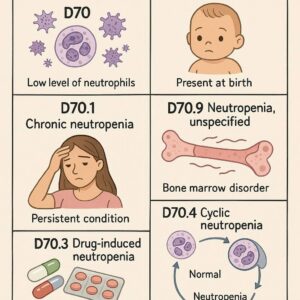
D70.0 – Neutropenia, Congenital: Agranulocytosis and Kostmann’s Syndrome
This code is used for neutropenia that is present at birth. It encompasses a group of rare genetic disorders.
-
Clinical Context: This includes severe congenital neutropenia (SCN), historically known as Kostmann’s syndrome, which is characterized by profound neutropenia and severe infections from infancy. “Infantile genetic agranulocytosis” is also included here. “Agranulocytosis” is a term often used interchangeably with profound neutropenia (ANC <100), but in this context, it specifies the congenital form.
-
Documentation Clue: The medical record must explicitly state “congenital neutropenia,” or reference a specific genetic syndrome like Kostmann’s. A diagnosis of neutropenia in a newborn without a specified cause may initially be coded here, but further investigation is often needed.
D70.1 – Neutropenia, Cyclic: The Rhythmic Ebb and Flow of Neutrophils
Cyclic neutropenia is a rare autosomal dominant disorder characterized by regular, periodic oscillations in the neutrophil count.
-
Clinical Context: Approximately every 21 days, the neutrophil count drops precipitously into the severe range for 3-5 days, leading to a predictable pattern of fever, mouth ulcers, and infections. Between these cycles, the neutrophil count normalizes. It is caused by a mutation in the ELANE gene, which affects neutrophil elastase production.
-
Documentation Clue: The diagnosis is typically made by plotting serial ANC measurements over several weeks to demonstrate the clear cyclical pattern. The record should state “cyclic neutropenia.”
D70.2 – Neutropenia, Drug-Induced: An Iatrogenic Consequence
This is one of the most common causes of neutropenia in clinical practice. It occurs when a medication directly suppresses bone marrow production or triggers immune-mediated destruction of neutrophils.
-
Clinical Context: A vast number of drugs can cause neutropenia. Common culprits include:
-
Chemotherapy agents: The most classic example; this is a predictable, dose-dependent side effect.
-
Antipsychotics: Clozapine requires mandatory ANC monitoring due to its high risk of causing agranulocytosis.
-
Antithyroid drugs: Carbimazole, propylthiouracil.
-
Antibiotics: Chloramphenicol, sulfa drugs, penicillin derivatives.
-
Other: Some anticonvulsants, antiarrhythmics, and NSAIDs.
-
-
Documentation Clue: This is critical. The physician’s note must clearly link the neutropenia to a specific drug. Phrases like “neutropenia likely secondary to [Drug Name]” or “[Drug Name]-induced agranulocytosis” are ideal. The coder should never assume a drug cause without explicit documentation.
D70.3 – Neutropenia, Due to Infection: A Transient State
Many acute infections can cause a transient drop in neutrophil count. This is often a result of the neutrophils marginating (adhering to blood vessel walls) or being consumed at the site of infection faster than the bone marrow can produce them.
-
Clinical Context: Viral infections are the most frequent cause (e.g., influenza, hepatitis, HIV, Epstein-Barr virus, parvovirus B19). Severe bacterial infections (e.g., sepsis, typhoid fever) and certain parasitic infections (e.g., malaria) can also cause neutropenia.
-
Documentation Clue: The record should document both the active infection and the associated neutropenia. The coder will assign D70.3 for the neutropenia and an additional code from Chapter 1 (A00-B99) to identify the specific infection (e.g., B20 for HIV).
D70.4 – Neutropenia, Autoimmune: When the Body Turns on Itself
In this condition, the body’s own immune system produces antibodies that attack and destroy neutrophils.
-
Clinical Context: It can be a primary disorder or secondary to other autoimmune conditions like Systemic Lupus Erythematosus (SLE), Rheumatoid Arthritis, or Felty’s Syndrome (a triad of Rheumatoid Arthritis, splenomegaly, and neutropenia).
-
Documentation Clue: The record should state “autoimmune neutropenia.” If it is secondary to another autoimmune disease, both codes are assigned. For example, for Felty’s syndrome, the coder would assign M05.10 (Rheumatoid arthritis with rheumatoid lung disease, unspecified site) as the underlying condition. It’s important to note that ICD-10 does not have a separate code for Felty’s syndrome; it is coded with the rheumatoid arthritis code.
D70.8 – Other Neutropenia: Capturing the Unspecified and Miscellaneous Cases
This is a residual category for other specified types of neutropenia that do not fit into the previous categories.
-
Clinical Context: This can include chronic benign neutropenia of childhood, idiopathic neutropenia (when the cause is unknown but the condition is well-documented), and neutropenia associated with metabolic diseases.
-
Documentation Clue: Terms like “chronic idiopathic neutropenia” or “benign familial neutropenia” would be assigned here. It is more specific than D70.9 because it implies that a cause has been sought but not found, and the condition is chronic.
D70.9 – Neutropenia, Unspecified: A Code of Last Resort
This code should be used only when the medical record provides a diagnosis of neutropenia but offers no information regarding its cause, type, or association.
-
Clinical Context: This is often a temporary code used at the initial encounter while diagnostic workup is pending. For example, an emergency room note may state “neutropenia” based on a CBC, but without a known history or immediate cause, this code is appropriate.
-
Documentation Clue: The documentation simply says “neutropenia” with no further qualification. This code should be avoided whenever possible. Its overuse indicates a failure in the clinical documentation process and leads to poor-quality data.
6. The Art and Science of Code Assignment: A Step-by-Step Guide
Assigning the correct code is a systematic process that blends analytical thinking with a thorough understanding of coding guidelines.
Step 1: Confirm the Diagnosis and Severity
Review the CBC report to confirm the ANC calculation and the diagnosis of neutropenia. Note the severity, as this may be relevant for certain clinical scenarios (e.g., febrile neutropenia).
Step 2: Identify the Underlying Cause (Etiology)
This is the most critical step. Scrutinize the entire medical record—the history and physical, progress notes, consultation reports, and discharge summary—for any mention of the cause. Is there a history of chemotherapy? A new medication? A recent infection? An autoimmune disease? A family history?
Step 3: Consult the Alphabetic Index and Tabular List
-
Alphabetic Index (Look-up): Start by looking up the main term “Neutropenia.” The index will direct you to subterms based on the etiology (e.g., “due to,” “drug-induced,” “cyclic”).
-
Tabular List (Verification): Never code directly from the index. Always verify the code in the Tabular List. This is where you will find includes, excludes, use additional code, and code first notes that are essential for accurate coding.
Step 4: Apply Coding Guidelines and Conventions
Adhere strictly to the official ICD-10-CM Coding Guidelines. Pay close attention to:
-
“Code first” notes: These instruct you to sequence the underlying disease first. For example, for neutropenia due to an infection, you would code the infection first, followed by D70.3.
-
“Use additional code” notes: These instruct you to add a code to provide further detail, such as an adverse effect code for a drug.
-
“Excludes1” and “Excludes2” notes: These prevent the assignment of two codes that are mutually exclusive or, conversely, indicate when two codes can be used together.
7. Complex Coding Scenarios: Navigating the Gray Areas
Real-world coding is rarely straightforward. Let’s apply our knowledge to some common complex scenarios.
Scenario 1: Chemotherapy-Induced Neutropenia with Fever
A 58-year-old patient with breast cancer (C50.912) is admitted with fever (R50.81) and an ANC of 200. The oncologist documents “febrile neutropenia due to current cycle of doxorubicin chemotherapy.”
-
Coding:
-
T45.1X5A: Adverse effect of antineoplastic and immunosuppressive drugs, initial encounter. (This captures the drug cause from the poisoning chapter).
-
D70.2: Neutropenia, drug-induced.
-
R50.81: Fever presenting with conditions classified elsewhere.
-
C50.912: Malignant neoplasm of unspecified site of left female breast. (The underlying cancer).
-
-
Rationale: The febrile neutropenia is a direct consequence of the chemotherapy. The adverse effect code (T45.1X5A) is sequenced first, followed by the manifestation (D70.2). The fever code is added, and the underlying cancer is also coded.
Scenario 2: HIV with Associated Neutropenia
A 35-year-old patient with a known history of HIV (B20) presents for a routine follow-up. A CBC reveals a persistent neutropenia with an ANC of 800. The physician documents “chronic neutropenia, likely related to HIV.”
-
Coding:
-
B20: Human immunodeficiency virus [HIV] disease.
-
D70.3: Neutropenia due to infection.
-
-
Rationale: The HIV is the underlying infectious cause of the neutropenia. Following the “code first” note under D70.3, the HIV code (B20) is sequenced first.
Scenario 3: Post-Infectious Neutropenia in a Pediatric Patient
A 4-year-old child is seen in the pediatrician’s office one week after a diagnosed influenza A infection. A follow-up CBC shows an ANC of 600. The note states “post-viral neutropenia following influenza.”
-
Coding:
-
D70.3: Neutropenia due to infection.
-
B97.12: Influenza A virus as the cause of diseases classified elsewhere.
-
-
Rationale: The neutropenia is a lingering effect of the recent infection. D70.3 is used for the neutropenia. Since the active infection has resolved, we do not use a code from J09-J11 for influenza. Instead, we use a code from B95-B97 to identify the viral agent that caused the neutropenia.
Scenario 4: Chronic Idiopathic Neutropenia
A 40-year-old otherwise healthy patient has had a stable ANC between 800-1000 for several years. Extensive workup has revealed no cause. The hematologist’s diagnosis is “chronic idiopathic neutropenia.”
-
Coding:
-
D70.8: Other neutropenia.
-
-
Rationale: The condition is chronic and of unknown cause, but it has been specifically diagnosed as “idiopathic.” This fits the “other specified” category better than the “unspecified” (D70.9) category, as it implies a concluded, albeit negative, workup.
8. The Crucial Role of Documentation: A Partnership Between Clinician and Coder
The accuracy of the final code is entirely dependent on the quality of the clinical documentation. Coders are not permitted to infer or assume a diagnosis. A strong partnership between providers and coders is essential.
What Physicians Need to Document for Optimal Coding
To ensure the most specific and accurate code for neutropenia is assigned, physicians should:
-
Specify the Etiology: Don’t just write “neutropenia.” State the cause: “chemotherapy-induced,” “autoimmune,” “post-viral,” “due to SLE,” “likely secondary to clozapine.”
-
Link to the Condition: Use clear connecting language like “due to,” “secondary to,” or “associated with.”
-
Avoid “Rule Out” as a Diagnosis: Code only confirmed diagnoses. A “rule out” neutropenia is not coded unless it is confirmed.
-
Provide Context in the History: A good history of present illness that includes recent medications, illnesses, and underlying conditions provides invaluable context for the coder.
9. Beyond D70: Related Codes and Their Applications
Neutropenia often does not exist in a vacuum. It is crucial to understand and assign related codes to paint a complete picture of the patient’s condition.
-
Codes for Adverse Effects of Drugs (T36-T50 with fifth or sixth character 5): As seen in Scenario 1, when a drug is correctly prescribed but causes neutropenia as an adverse effect, a code from this range must be used in conjunction with D70.2. The drug code is sequenced first.
-
Codes for Underlying Malignancies (C00-D49): If the neutropenia is due to bone marrow infiltration by a cancer (e.g., leukemia), the malignancy code is sequenced first. Chemotherapy-induced neutropenia is different; the cancer is the reason for treatment, but the drug is the direct cause of the low count.
-
Codes for Infectious Agents (B95-B97): When the active infection has resolved but the neutropenia persists as a consequence, these codes are used to identify the causative organism, as in Scenario 3.
10. The Impact of Accurate Coding: Clinical, Financial, and Epidemiological Significance
Precise coding for neutropenia is not a bureaucratic exercise; it has far-reaching implications.
-
Driving Patient Care and Safety: Accurate data allows for better tracking of patient outcomes, especially for conditions like febrile neutropenia. It helps identify patients at high risk for infections and facilitates quality improvement initiatives.
-
Ensuring Appropriate Reimbursement: Different DRGs (Diagnosis-Related Groups) and APCs (Ambulatory Payment Classifications) are assigned based on the complexity and cause of a condition. A case of “unspecified neutropenia” (D70.9) will typically reimburse at a lower rate than a complex case of “febrile neutropenia due to chemotherapy” with multiple codes that accurately reflect the resource intensity required for care.
-
Informing Public Health and Research: High-quality coded data is the bedrock of epidemiology. Researchers rely on this data to study the prevalence of drug-induced agranulocytosis, the outcomes of congenital neutropenia syndromes, and the effectiveness of treatments. Poor coding with an overreliance on D70.9 obscures these patterns and hinders medical progress.
11. Common Pitfalls and How to Avoid Them
-
Pitfall 1: Automatically defaulting to D70.9.
-
Solution: Always perform a thorough chart review to find a more specific cause. Query the physician if the documentation is unclear.
-
-
Pitfall 2: Confusing D70.2 (Drug-Induced) with a neutropenia caused by the underlying disease.
-
Solution: Determine the direct cause. If it’s a prescribed medication, it’s D70.2. If it’s from bone marrow failure due to leukemia, it’s the leukemia code.
-
-
Pitfall 3: Incorrectly sequencing codes, especially with adverse effects and underlying conditions.
-
Solution: Religiously follow the “code first” and “use additional code” notes in the Tabular List.
-
-
Pitfall 4: Coding “probable” or “suspected” neutropenia as confirmed.
-
Solution: Code only what is definitively documented. A “probable” diagnosis is not coded.
-
12. Conclusion: Mastering the Nuances for Excellence in Healthcare Data
The journey through the ICD-10 coding for neutropenia reveals a system of remarkable depth and specificity, designed to transform clinical narrative into structured, actionable data. Mastering the nuances of category D70—from the rhythmic patterns of cyclic neutropenia to the iatrogenic challenge of drug-induced agranulocytosis—empowers healthcare professionals to ensure that every coded entry accurately reflects the patient’s story. This precision is the cornerstone of high-quality patient care, fair financial reimbursement, and the advancement of medical science. It is a professional responsibility that demands diligence, continuous learning, and a collaborative spirit between those who provide care and those who document its essence.
13. Frequently Asked Questions (FAQs)
Q1: What is the difference between D70.8 and D70.9?
A: D70.8 (Other neutropenia) is used when the type of neutropenia is specified but doesn’t have its own code (e.g., “chronic idiopathic neutropenia,” “benign familial neutropenia”). It implies a known, chronic condition. D70.9 (Neutropenia, unspecified) is a nonspecific code used when the medical record provides no information about the cause or type. It is a code of last resort.
Q2: How do I code febrile neutropenia?
A: “Febrile neutropenia” is not a single code. You must code both the neutropenia and the fever. First, assign the appropriate neutropenia code based on its cause (e.g., D70.2 for drug-induced). Then, assign R50.81 (Fever presenting with conditions classified elsewhere). You must also code the underlying cause, such as the cancer and the adverse effect of the chemotherapy drug.
Q3: A patient has rheumatoid arthritis and neutropenia (Felty’s syndrome). How is this coded?
A: Felty’s syndrome is coded to the underlying rheumatoid arthritis. You would assign a code from the M05.- series (Rheumatoid arthritis with rheumatoid factor) to represent the Felty’s syndrome. You would not assign an additional code from D70.4 for the neutropenia, as it is an inherent component of the Felty’s syndrome diagnosis.
Q4: When a drug causes neutropenia, why do I need two codes?
A: The code from the T36-T50 series (with 5th/6th character ‘5’) identifies the drug responsible and the fact that it was an adverse effect. The code D70.2 describes the specific condition that resulted from that adverse effect. This two-code combination provides a complete picture for drug safety monitoring and accurate billing.
Q5: Can I use D70.3 for a patient with HIV and neutropenia even if they are on antiretroviral therapy?
A: Yes. The neutropenia is still considered a manifestation of the HIV infection itself, regardless of treatment. The relationship is well-established. Therefore, you would code B20 first, followed by D70.3.
14. Additional Resources
-
The Official ICD-10-CM Guidelines for Coding and Reporting: Published annually by the Centers for Disease Control and Prevention (CDC) and the Centers for Medicare & Medicaid Services (CMS). This is the primary authority for all coding decisions.
-
American Health Information Management Association (AHIMA): Provides a wealth of resources, including practice briefs, webinars, and certification materials related to ICD-10-CM coding.
-
American Academy of Professional Coders (AAPC): Offers training, certification, and ongoing education for medical coders, with specific modules on hematology and oncology coding.
-
National Center for Biotechnology Information (NCBI) – PubMed: A database of medical literature useful for understanding the clinical details of rare causes of neutropenia, which can aid in correct code assignment.
-
The Neutropenia Support Association Inc.: A patient-focused organization that provides information on various types of neutropenia, which can offer valuable clinical context for coders.
Date: October 15, 2025
Author: The Medical Coding Specialist Team
Disclaimer: The information contained in this article is for educational and informational purposes only and is not intended as a substitute for professional medical advice, diagnosis, or treatment. Always seek the advice of your physician or other qualified health provider with any questions you may have regarding a medical condition or treatment, and before undertaking a new health care regimen. Never disregard professional medical advice or delay in seeking it because of something you have read in this publication. The authors and publishers are not responsible for any errors or omissions or for any consequences from the application of the information provided.