Imagine a mind trapped in a labyrinth of its own creation, where a single, intrusive thought can trigger a cascade of relentless mental rituals and repetitive behaviors. This is the daily reality for millions of individuals living with Obsessive-Compulsive Disorder (OCD), a chronic and often debilitating mental health condition. For them, the path to recovery begins with a accurate diagnosis—a diagnosis that, in the modern healthcare system, is encapsulated by a deceptively simple string of characters: an ICD-10 code.
To the uninitiated, “F42.2” might seem like bureaucratic shorthand, a mere administrative necessity for insurance billing. But this code, and its specific variations, represent a profound and critical convergence of clinical science, patient experience, and healthcare infrastructure. It is the key that unlocks access to evidence-based treatments like Cognitive Behavioral Therapy (CBT) and medication management. It is the common language that allows clinicians, researchers, and insurers to communicate about a patient’s condition with precision. It is the fundamental data point that shapes our understanding of the prevalence and impact of OCD on a global scale.
This article will serve as your definitive guide to the ICD-10 codes for Obsessive-Compulsive Disorder. We will move beyond the basic code to explore its clinical significance, its role in ensuring patients receive appropriate care, and its impact on the entire healthcare ecosystem. We will dissect the nuances of each sub-code, clarify common points of confusion with related disorders, and provide a clear, practical framework for understanding how this critical diagnostic tool functions in the real world. This is not just about learning a code; it is about understanding the bridge between a patient’s suffering and their pathway to healing.
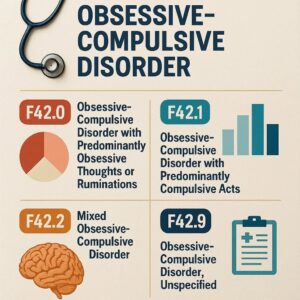
ICD-10 Codes for Obsessive-Compulsive Disorder
Understanding the ICD-10 Framework: A Global Language for Health {#understanding-icd10}
Before we delve into the specifics of OCD, it is essential to understand the system that houses its code. The International Classification of Diseases, 10th Revision (ICD-10) is a medical classification system created and maintained by the World Health Organization (WHO). It is the global standard for diagnosing, managing, and researching all diseases, disorders, and injuries. Think of it as a vast, meticulously organized dictionary for human illness, where every known health condition has its own unique alphanumeric “word.”
The primary purpose of the ICD is multifold:
-
Standardization: It provides a common language that enables health professionals from different countries, specialties, and languages to share and compare health information reliably.
-
Epidemiology and Public Health: By tracking the codes assigned to patients, public health officials can monitor the incidence and prevalence of diseases, identify outbreaks, and allocate resources effectively. For instance, seeing a rise in F42 codes in a specific region could signal a need for increased mental health services.
-
Health Insurance and Reimbursement: In most healthcare systems, including the United States (which uses a clinical modification called ICD-10-CM), ICD codes are the foundation of the billing process. A clinician must assign an accurate code to justify the medical necessity of their services to an insurance provider. An incorrect code can lead to claim denials, delaying or preventing a patient from receiving care.
-
Clinical Research: Researchers use ICD codes to identify potential participants for clinical trials, to study the natural history of diseases, and to evaluate the effectiveness of treatments.
The structure of an ICD-10 code is logical and hierarchical. The first character is always a letter, which corresponds to a broad chapter of diseases. For example, Chapter V (codes F01-F99) covers “Mental, Behavioral and Neurodevelopmental disorders.” This is where we find the code for OCD. The following digits provide increasing levels of specificity, detailing the exact type, manifestation, and sometimes even the etiology of the condition.
The Clinical Face of OCD: Beyond Stereotypes {#clinical-face-of-ocd}
Popular culture often reduces OCD to a caricature of excessive handwashing or a quirky desire for neatness. In clinical reality, OCD is a serious anxiety disorder characterized by a distinct two-part cycle that causes significant distress and impairs daily functioning.
Obsessions are the first component. They are defined as:
-
Recurrent and persistent thoughts, urges, or images that are experienced as intrusive and unwanted.
-
Cause marked anxiety or distress.
-
The individual attempts to ignore, suppress, or neutralize these thoughts, urges, or images with some other thought or action (i.e., by performing a compulsion).
Compulsions are the second component. They are defined as:
-
Repetitive behaviors or mental acts that the individual feels driven to perform in response to an obsession or according to rigid rules.
-
The behaviors or acts are aimed at preventing or reducing anxiety or distress, or preventing some dreaded event or situation; however, these behaviors or acts are not connected in a realistic way with what they are designed to neutralize or prevent, or are clearly excessive.
It is crucial to understand that the compulsions are not performed for pleasure or gratification. They are a desperate, often futile, attempt to quell the overwhelming anxiety generated by the obsessions. The relief they provide is, at best, temporary, reinforcing the cycle and trapping the individual in a time-consuming and exhausting loop.
The themes of OCD are highly varied. Common obsessions include fears of contamination, causing harm to oneself or others, needing symmetry or exactness, and intrusive taboo thoughts involving sex, religion, or violence. Corresponding compulsions can be behavioral (washing, checking, arranging, counting) or mental (praying, repeating words silently, “undoing” a thought with a “good” thought).
Navigating the ICD-10-CM Code for OCD: F42 {#navigating-f42}
Within the ICD-10-CM system, the core category for Obsessive-Compulsive Disorder is F42. This code requires a fifth digit to specify the predominant clinical presentation, making it essential for clinicians to assess the patient’s symptoms accurately. The choice of fifth digit is not merely academic; it can influence treatment planning and provide a more precise clinical picture.
The following table outlines the complete set of ICD-10-CM codes for OCD:
ICD-10-CM Codes for Obsessive-Compulsive Disorder (F42)
| ICD-10-CM Code | Code Description | Clinical Presentation & Examples |
|---|---|---|
| F42.0 | Predominantly obsessional thoughts or ruminations | The clinical picture is dominated by intrusive, unwanted mental experiences without overt physical compulsions. The compulsions, if present, are primarily cognitive. Examples: Mental obsessions about blasphemy (religious scrupulosity) without outward rituals; intrusive violent or sexual thoughts; relentless philosophical or metaphysical ruminations; mental reviewing of past events to prevent harm. |
| F42.1 | Predominantly compulsive acts | The clinical picture is dominated by overt, physical compulsive behaviors. The obsessions that drive them are typically related to themes of contamination, symmetry, or a need for things to feel “just right.” Examples: Extensive, ritualized hand-washing driven by contamination fears; repetitive checking of locks, appliances, or that one hasn’t caused an accident; counting rituals; arranging and rearranging objects until they feel symmetrical or perfect. |
| F42.2 | Mixed obsessional thoughts and acts | This is the most common presentation. Both obsessional thoughts and compulsive behaviors are present and equally prominent in the clinical picture. Examples: A patient has intrusive thoughts of causing a house fire (obsession) and performs elaborate checking rituals on stoves and electrical outlets (compulsion). Another has intrusive thoughts of being contaminated by germs (obsession) and engages in prolonged washing and cleaning rituals (compulsion). |
| F42.8 | Other obsessive-compulsive disorder | This code is used for disorders that are clearly consistent with OCD but do not fit neatly into the above categories. Examples: This could include conditions like compulsive nail-biting, skin-picking (excoriation), or other body-focused repetitive behaviors that are not better explained by another disorder, provided they meet the full diagnostic criteria for OCD (i.e., are driven by an obsession and aimed at reducing distress). *Note: In practice, many of these now have their own specific codes in ICD-10 or ICD-11.* |
| F42.9 | Obsessive-Compulsive Disorder, Unspecified | This code should be used sparingly and only when there is insufficient information to determine the predominant symptom type, or in general medical settings where a full psychiatric assessment is not possible. It is a non-specific code and is generally less preferred for specialist care. |
F42.0 – Predominantly Obsessional Thoughts or Ruminations {#f420}
This subtype, often called “Pure O” (a bit of a misnomer, as mental compulsions are usually present), can be particularly distressing and isolating. The suffering is entirely internal. A person might be tormented by repetitive, horrific mental images of harming a loved one, despite having no desire to do so. Their compulsion is not a physical act but a mental one: they may mentally repeat a “safe” word, pray incessantly, or analytically review their entire day to prove to themselves they could not have caused harm. Because there are no visible rituals, this form of OCD is often missed or misdiagnosed as generalized anxiety or depression.
F42.1 – Predominantly Compulsive Acts {#f421}
This presentation is what many people traditionally associate with OCD. The compulsive behaviors are overt and can be severely disabling. For example, washing compulsions can lead to raw, damaged skin. Checking compulsions can cause a person to be late for work or unable to leave their home. Ordering and arranging rituals can consume hours each day. While the obsessions driving these behaviors are real, the clinical focus and the most visible impairment stem from the time-consuming nature of the physical acts themselves.
F42.2 – Mixed Obsessional Thoughts and Acts {#f422}
As the most frequently diagnosed code, F42.2 captures the classic, synergistic cycle of OCD. The obsession and compulsion are clearly linked. The thought creates unbearable anxiety, and the act is the attempted solution. Treating this presentation often involves directly targeting this cycle, for instance, through Exposure and Response Prevention (ERP), where a patient is gradually exposed to the source of their obsession and learns to resist the urge to perform the compulsion, thereby breaking the associative link.
The Critical Role of Specificity: Why the Fifth Digit Matters {#role-of-specificity}
Selecting the correct fifth digit for code F42 is a critical component of ethical and effective clinical practice. The move from a non-specific code like F42.9 to a specific one like F42.2 is a move from ambiguity to clarity, with tangible consequences.
-
Clinical Justification for Treatment: An insurance reviewer is more likely to approve a course of specialized therapy like ERP for a code of F42.2 (Mixed) than for F42.9 (Unspecified). The specific code demonstrates that the clinician has conducted a thorough assessment and has a clear rationale for the proposed treatment plan. For F42.0, a treatment plan might focus more on cognitive techniques for managing intrusive thoughts, while for F42.1, it might heavily emphasize behavioral interventions to block compulsions.
-
Data Integrity for Research: When researchers analyze data to understand OCD, the use of specific codes allows them to ask more nuanced questions. They can study whether certain subtypes respond better to specific medications or therapies. They can investigate the neurobiological correlates of different presentations. Widespread use of unspecified codes muddies this data, making it harder to advance the field.
-
Patient-Centric Care: Accurate coding reflects an accurate understanding of the patient’s unique suffering. It tells the patient, “I see not just that you have OCD, but I understand the specific form it takes and how it is impacting you.” This validation is a powerful first step in the therapeutic alliance.
Differential Diagnosis: Separating OCD from Its Lookalikes {#differential-diagnosis}
One of the most challenging aspects of diagnosing OCD is distinguishing it from other conditions that share overlapping features. Accurate ICD-10 coding depends entirely on this clinical discernment.
OCD vs. Obsessive-Compulsive Personality Disorder (OCPD) {#ocd-vs-ocpd}
This is a common source of confusion. While they share similar names, OCD and OCPD are fundamentally different.
-
OCD is an ego-dystonic anxiety disorder. The symptoms (obsessions and compulsions) are experienced as alien, intrusive, and unwanted. They are inconsistent with the person’s self-identity and cause distress.
-
OCPD is an ego-syntonic personality disorder. The traits (perfectionism, preoccupation with orderliness, mental and interpersonal control) are experienced as consistent with the self. The individual typically believes their way is the “right and best” way and the problem lies with others who are not meeting their standards. They do not generally perceive their rigidity as a source of distress for themselves.
A patient with OCPD might meticulously organize their desk because it feels right and efficient (ego-syntonic). A patient with OCD might meticulously organize their desk to neutralize an intrusive thought that something terrible will happen if it’s not perfectly aligned (ego-dystonic). The ICD-10 code for OCPD is F60.5.
OCD vs. Illness Anxiety Disorder {#ocd-vs-illness-anxiety}
Both can involve preoccupations with health, but the nature of the preoccupation differs.
-
In Illness Anxiety Disorder (F45.21), the core fear is of having a disease. The preoccupation is with the meaning of somatic sensations (e.g., “This headache must be a brain tumor”).
-
In OCD, health-related obsessions are typically about the fear of contracting a disease in the future (e.g., contamination obsessions). The compulsions are aimed at preventing this future occurrence through washing, avoiding, or seeking reassurance. The focus is on prevention, not on the conviction of having a current illness.
OCD vs. Body Dysmorphic Disorder {#ocd-vs-bdd}
Body Dysmorphic Disorder (BDD) is now understood to be closely related to OCD. In fact, its ICD-10 code, F45.22, falls within the same “Somatoform Disorders” category, but it shares a similar cycle of obsession (preoccupation with a perceived flaw in appearance) and compulsion (mirror checking, seeking reassurance, comparing to others). The key differentiator is the specific content of the obsession—focused exclusively on physical appearance. Many experts argue that BDD belongs within the OCD spectrum.
OCD vs. Tic Disorders {#ocd-vs-tic}
Tics (sudden, rapid, non-rhythmic movements or vocalizations) can be difficult to distinguish from compulsions. The key difference often lies in the motivation.
-
Compulsions are driven by an obsession and are performed to reduce anxiety or prevent a dreaded event.
-
Tics are often preceded by a premonitory urge—a physical sensation or tension that is relieved by performing the tic. They are not typically linked to a complex obsessive thought. The ICD-10 code for a chronic motor or vocal tic disorder is F95.1. It is also important to note that OCD and tic disorders are highly comorbid, particularly in a specific subtype sometimes referred to as “Tic-Related OCD.”
The Coding Process in Practice: A Step-by-Step Walkthrough {#coding-process}
Let’s follow a hypothetical patient, “Sarah,” through the diagnostic and coding journey.
-
Presenting Problem: Sarah, a 28-year-old lawyer, presents to a psychiatrist reporting that her life “is being taken over by routines.” She spends 3-4 hours each night checking that the doors and windows are locked and the stove is off. She reports intrusive, unwanted thoughts that her negligence will lead to a burglar breaking in and harming her family.
-
Clinical Assessment: The psychiatrist conducts a detailed clinical interview using structured diagnostic criteria. She determines that Sarah’s intrusive thoughts about harm are obsessions: they are recurrent, persistent, intrusive, and cause massive anxiety. Her checking behaviors are compulsions: they are repetitive, driven by the obsessions, and aimed at neutralizing the anxiety and preventing a dreaded event. The psychiatrist also rules out other disorders like Generalized Anxiety Disorder (her worry is specific and ritualized) and Psychosis (she has insight that her fears are excessive).
-
Symptom Quantification and Functional Impairment: The clinician notes that the rituals are time-consuming (exceeding 1 hour per day) and are causing Sarah significant distress, sleep deprivation, and making her late for work.
-
Code Selection: The clinician determines that both obsessional thoughts (of harm) and compulsive acts (checking) are prominent features of Sarah’s presentation. Referring to the ICD-10-CM manual, the clinician selects the most specific code: F42.2 – Mixed obsessional thoughts and acts.
-
Documentation: In the clinical note, the psychiatrist documents not just the final code, but the clinical rationale: “Patient meets DSM-5 and ICD-10 criteria for OCD, with prominent harm-related obsessions and checking compulsions, causing significant functional impairment. Code F42.2 assigned.”
-
Application: The code F42.2 is used on insurance claims for Sarah’s psychotherapy (ERP) and medication management sessions, justifying their medical necessity. It is also entered into her electronic health record, creating a data point that contributes to the clinic’s understanding of their patient population.
The Impact of Accurate Coding: From Clinical Care to Public Health {#impact-of-coding}
The ripple effects of a single, accurately assigned ICD-10 code extend far beyond the clinician’s office.
-
For the Patient: It is the gateway to care. An accurate code minimizes bureaucratic delays, ensuring timely access to life-changing treatment. It also contributes to a correct clinical understanding of their condition, which is empowering.
-
For the Clinician: It supports appropriate reimbursement for their specialized skills and time. It also facilitates clear communication with other providers involved in the patient’s care.
-
For Researchers: Accurate, specific codes are the building blocks of high-quality data. This data is used to secure funding for OCD research, to track treatment outcomes across large populations, and to ultimately develop more effective interventions.
-
For Public Health and Advocacy: Organizations like the International OCD Foundation use prevalence data, derived from ICD codes, to advocate for policy changes, fight stigma, and increase public awareness. They can demonstrate the significant burden of OCD to policymakers, arguing for parity in mental health coverage and increased funding for services.
The Future is Now: ICD-11 and Its Refinements for OCD {#icd11-future}
The World Health Organization’s ICD-11, which is being progressively implemented globally, introduces important refinements to the classification of OCD and related disorders. Understanding these changes highlights the evolving nature of diagnostic precision.
In ICD-11, Obsessive-Compulsive and Related Disorders (OCRDs) are grouped together in a dedicated chapter (6B2), separating them from other anxiety disorders. This reflects the growing evidence of their shared neurobiology, family history, and clinical features. The code for OCD itself is 6B20.0.
Key changes and specifications in ICD-11 include:
-
Tic-Related Specifier: ICD-11 allows clinicians to specify if the OCD is “tic-related” (6B20.1), acknowledging this important clinical subtype which may have implications for treatment (e.g., better response to certain antipsychotic medications).
-
Poor Insight Specifier: It includes specifiers for degree of insight (e.g., with poor insight), which helps capture the spectrum of the disorder, from good recognition that beliefs are false to a delusional-level conviction.
-
Body-Focused Repetitive Behaviors (BFRBs): Disorders like trichotillomania (hair-pulling disorder) and excoriation (skin-picking) disorder are now explicitly included within the OCRD chapter with their own distinct codes (6B2B and 6B2C, respectively), providing greater clarity than the “Other” category in ICD-10.
The transition to ICD-11 represents a more nuanced, clinically useful, and scientifically valid way of categorizing these complex conditions, ultimately aiming to improve diagnosis and treatment outcomes.
Conclusion {#conclusion}
The ICD-10 code for OCD, F42, and its specific subtypes, is far more than an administrative cipher. It is a critical linchpin connecting a patient’s internal suffering to the external systems of healing and support. Precision in its application is a professional and ethical imperative, ensuring accurate diagnosis, facilitating access to evidence-based care, and generating the robust data necessary to advance our understanding of this challenging disorder. As we move into the era of ICD-11, this commitment to diagnostic clarity will only become more profound, continuing to illuminate the path toward recovery for those living with OCD.
Frequently Asked Questions (FAQs) {#faqs}
1. What is the difference between ICD-10 and DSM-5 codes for OCD?
The ICD-10 (and ICD-11) are international standard diagnostic tools used for all health conditions, including mental disorders, and are required for billing and public health reporting. The DSM-5 (Diagnostic and Statistical Manual of Mental Disorders, 5th Edition) is a diagnostic manual published by the American Psychiatric Association used primarily by clinicians in the United States to diagnose mental disorders based on specific criteria. A clinician will use the DSM-5 criteria to make a diagnosis and then translate that diagnosis into the corresponding ICD-10-CM code for billing and records. For OCD, the core diagnosis is consistent between the two systems.
2. Can a person’s ICD-10 code for OCD change over time?
Yes, it can. While the core diagnosis of OCD may remain, the predominant symptom presentation can shift. For example, a patient initially diagnosed with F42.1 (Predominantly Compulsive Acts) like washing, might, after successful treatment of those behaviors, still struggle significantly with F42.0 (Predominantly Obsessional Thoughts). In such a case, the clinician would update the code to reflect the current clinical picture.
3. Why would a clinician use the “unspecified” code F42.9?
The “unspecified” code is typically used in situations where there is insufficient information to make a more precise determination. This might occur in a primary care or emergency room setting where a full psychiatric evaluation is not feasible. In a specialist mental health setting, its use should be minimal and temporary, until a comprehensive assessment can be completed.
4. How does accurate ICD coding affect my insurance coverage for therapy?
Insurance companies use ICD codes to determine “medical necessity.” An accurate and specific code like F42.2 provides a clear justification for why a specialized, and often costly, treatment like Exposure and Response Prevention (ERP) therapy is needed. A vague or incorrect code can lead to a claim denial, stating that the treatment was not medically necessary for the diagnosed condition.
5. Is “Pure O” OCD a real ICD-10 diagnosis?
“Pure O” is a common term used to describe what is coded in ICD-10 as F42.0 – Predominantly obsessional thoughts or ruminations. It is a recognized and valid presentation of OCD. The term “Pure O” can be slightly misleading, as individuals with this presentation usually do have covert mental compulsions (ruminating, mental checking, neutralizing), even if they lack visible physical rituals.
Additional Resources {#additional-resources}
-
International OCD Foundation (IOCDF): https://iocdf.org/ – A comprehensive resource for patients, families, and professionals, including a provider search tool.
-
World Health Organization (WHO) ICD-10 Online Browser: https://icd.who.int/browse10/2019/en – The official repository for ICD-10 codes and descriptions.
-
National Institute of Mental Health (NIMH) – Obsessive-Compulsive Disorder: https://www.nimh.nih.gov/health/topics/obsessive-compulsive-disorder-ocd – Provides research updates and basic information on OCD.
-
Anxiety & Depression Association of America (ADAA): https://adaa.org/understanding-anxiety/obsessive-compulsive-disorder-ocd – Offers information on symptoms, treatment, and support for OCD and related anxiety disorders.
Date: October 18, 2025
Author: Dr. Anya Sharma, PhD, Clinical Psychology & Health Informatics
Disclaimer: The information contained in this article is for educational and informational purposes only and is not intended as a substitute for professional medical advice, diagnosis, or treatment. Always seek the advice of your physician or other qualified health provider with any questions you may have regarding a medical condition. The codes and guidelines referenced are based on the ICD-10-CM as of October 2025 and are subject to change.