Imagine the structural integrity of a grand, historical building. Over decades, unseen environmental factors, the natural settling of foundations, and minor, unaddressed stresses can slowly erode its core strength. From the outside, it appears as majestic as ever, but its internal framework has become fragile, vulnerable to a collapse from a shock that a younger, sturdier structure could easily withstand. This is the silent, insidious reality of osteopenia. It is not a disease in the dramatic, symptomatic sense, but a preclinical condition—a warning sign written in the very architecture of our skeleton. For millions of adults, particularly women over 50, this diagnosis, often delivered as a mere footnote on a DXA scan report, can be confusing and anxiety-inducing. What does it mean? What should be done?
For healthcare providers, radiologists, and medical coders, osteopenia is far more than a clinical curiosity; it is a precise diagnostic entity that must be accurately captured, documented, and coded. The International Classification of Diseases, Tenth Revision, Clinical Modification (ICD-10-CM) provides the specific language for this communication. In the intricate ecosystem of modern healthcare, an ICD-10 code is not just a label; it is a critical piece of data that drives patient care decisions, justifies diagnostic testing, ensures appropriate reimbursement, and contributes to population health analytics. This article delves deep into the world of osteopenia, demystifying its clinical essence and providing an exhaustive guide to its correct representation within the ICD-10-CM framework. We will move beyond a simple code lookup and embark on a comprehensive journey from bone biology to billing accuracy, ensuring that this “silent thief” is properly identified, managed, and documented.
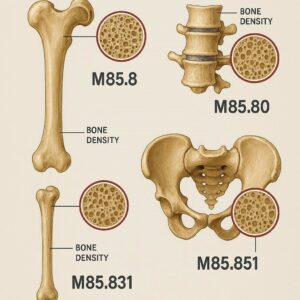
ICD-10 codes for osteopenia
2. Understanding the Foundation: What is Osteopenia?
To accurately code for a condition, one must first fundamentally understand it. Osteopenia is defined as a reduction in bone mineral density (BMD) below normal reference values but not yet severe enough to be classified as osteoporosis. It represents a state of low bone mass, placing an individual at an increased risk for developing osteoporosis and, consequently, fragility fractures.
The Bone Remodeling Cycle: A Delicate Balance
Bone is not a static, calcified structure. It is a dynamic, living tissue constantly undergoing a process called remodeling. This cycle consists of two primary phases:
-
Resorption: Specialized cells called osteoclasts break down and remove old or damaged bone tissue.
-
Formation: Cells called osteoblasts then lay down a protein matrix (osteoid) that subsequently becomes mineralized, forming new bone.
In youth and early adulthood, formation outpaces resorption, leading to net bone gain and peak bone mass, typically achieved by the mid-20s to early 30s. After this peak, the balance slowly shifts. For most adults, bone resorption begins to very slightly exceed bone formation, leading to a gradual, age-related bone loss of approximately 0.3-0.5% per year. Osteopenia occurs when this balance is disrupted, accelerating bone loss. This can happen due to hormonal changes (e.g., menopause), nutritional deficiencies (e.g., Calcium, Vitamin D), sedentary lifestyle, certain medications (e.g., long-term corticosteroid use), or other medical conditions.
Osteopenia vs. Osteoporosis: A Continuum of Risk
It is crucial to understand that osteopenia and osteoporosis exist on a spectrum of bone health, not as distinct, unrelated conditions.
-
Normal Bone Density: BMD is within 1 standard deviation (SD) of the average young adult reference mean.
-
Osteopenia (Low Bone Mass): BMD is between 1 and 2.5 SD below the young adult mean (T-score between -1.0 and -2.5).
-
Osteoporosis: BMD is 2.5 SD or more below the young adult mean (T-score of -2.5 or lower).
Think of it as a continuum from strong, dense bone to severely porous and fragile bone. Osteopenia is the “yellow light”—a cautionary state indicating that bone strength is compromised and the risk of progressing to the “red light” of osteoporosis is significantly elevated. A person with osteopenia has a higher fracture risk than someone with normal BMD, but a lower risk than someone with osteoporosis.
The Clinical Significance: Why Diagnosing Osteopenia Matters
Some may question the importance of diagnosing a condition that is, by definition, “pre-disease.” This perspective is dangerously short-sighted. Identifying osteopenia is a powerful opportunity for primary prevention. It is a window in which lifestyle and, in some cases, pharmacological interventions can be implemented to:
-
Slow down or halt further bone loss.
-
Potentially modestly increase bone density.
-
Most importantly, prevent the progression to osteoporosis and significantly reduce the lifetime risk of debilitating fractures of the hip, spine, and wrist.
A fragility fracture, particularly in older adults, can be a catastrophic event, leading to chronic pain, loss of independence, decreased quality of life, and increased mortality. Diagnosing and addressing osteopenia is a cornerstone of proactive, preventive medicine.
3. The Diagnostic Pathway: From Suspicion to Confirmation
The journey to an osteopenia diagnosis and its subsequent coding begins long before the ICD-10 code is assigned.
Risk Factors and Clinical Presentation
Osteopenia itself is asymptomatic. A patient does not feel their bones becoming less dense. Therefore, clinicians must rely on identifying risk factors:
-
Non-Modifiable: Advanced age, female sex, family history of osteoporosis or fracture, Caucasian or Asian ethnicity, petite body frame.
-
Modifiable/Lifestyle: Low calcium/vitamin D intake, physical inactivity, smoking, excessive alcohol consumption, being underweight.
-
Medical Conditions: Rheumatoid arthritis, malabsorption syndromes (Celiac disease, IBD), hyperthyroidism, chronic kidney disease.
-
Medications: Prolonged use of glucocorticoids (e.g., prednisone), certain anticonvulsants, aromatase inhibitors for breast cancer.
A patient may present after a minor fall resulting in a fracture, prompting further investigation, or they may be identified through routine screening.
The Gold Standard: Dual-Energy X-ray Absorptiometry (DXA/DEXA)
The diagnosis of osteopenia is confirmed through bone density testing. The DXA scan is the universally accepted gold standard. It is a low-radiation, highly precise test that measures BMD at clinically relevant sites: typically the lumbar spine and the proximal femur (hip). The radius (forearm) may also be scanned in certain situations.
Interpreting the T-Score: The Language of Bone Density
The primary result of a DXA scan is the T-score. This statistical value compares the patient’s BMD to the average BMD of a healthy, young, sex-matched adult population.
World Health Organization (WHO) Diagnostic Categories Based on T-score
| T-score Range | WHO Classification | Clinical Interpretation |
|---|---|---|
| -1.0 and above | Normal | Bone density is within the expected range for a young adult. |
| Between -1.0 and -2.5 | Osteopenia (Low Bone Mass) | Bone density is below normal and indicates an increased risk for osteoporosis and fractures. |
| -2.5 and below | Osteoporosis | Bone density is significantly low, conferring a high risk of fractures. |
| -2.5 and below with one or more fragility fractures | Severe (Established) Osteoporosis | The disease is present and has already resulted in a fracture. |
It is this T-score, specifically one falling within the -1.0 to -2.5 range, that forms the clinical basis for assigning an osteopenia code.
The Role of FRAX®: Calculating Fracture Risk
The T-score alone does not tell the whole story. The World Health Organization’s FRAX® tool is a critical adjunct to the DXA result. It is a computer-based algorithm that calculates a patient’s 10-year probability of a major osteoporotic fracture (spine, forearm, hip, or shoulder) and a 10-year probability of a hip fracture. It incorporates the femoral neck BMD T-score along with clinical risk factors like age, sex, BMI, prior fracture, parental hip fracture, smoking, steroid use, rheumatoid arthritis, secondary causes, and alcohol use. A patient with osteopenia but a high FRAX® score may be a candidate for pharmacological treatment, similar to a patient with osteoporosis.
4. Navigating the ICD-10-CM Code Set for Osteopenia
Now we arrive at the core of our discussion: the accurate application of ICD-10-CM codes for osteopenia. The system is designed for specificity, and osteopenia coding is a prime example of this principle.
The central code category for osteopenia is found within Chapter 13 of ICD-10-CM: Diseases of the Musculoskeletal System and Connective Tissue (M00-M99). More specifically, it is located under the block of “Disorders of bone density and structure” (M80-M85).
M85.8 – Other specified disorders of bone density and structure
This is the parent code for osteopenia. The official ICD-10-CM coding guideline instructs that osteopenia is classified to this code. It is critical to note that you cannot code M85.8 alone; it requires a 5th digit to specify the site involved.
-
M85.80 – Other specified disorders of bone density and structure, unspecified site
-
Usage: This code should be used sparingly and only when the medical documentation explicitly states a diagnosis of osteopenia but does not specify the anatomical site(s) involved. In modern practice, a DXA scan almost always reports the specific sites measured (e.g., lumbar spine, left femoral neck). Therefore, the opportunity to use this “unspecified” code is limited. Its use may be flagged by payers as lacking medical necessity.
-
-
M85.88 – Other specified disorders of bone density and structure, multiple sites
-
Usage: This is the most commonly used and appropriate code for osteopenia. It is used when the DXA scan report confirms low bone mass (T-score between -1.0 and -2.5) at more than one of the measured sites. For example, if a patient has a T-score of -1.8 at the lumbar spine and -2.0 at the left femoral neck, this code is applicable. It captures the systemic nature of the condition as identified by the standard diagnostic test.
-
The Importance of Specificity: Why Site Matters
While M85.88 is the workhorse code, ICD-10-CM offers even greater specificity with codes for individual sites, such as:
-
M85.81 – Other specified disorders of bone density and structure, shoulder
-
M85.82 – Other specified disorders of bone density and structure, upper arm
-
M85.83 – … forearm
-
M85.84 – … hand
-
M85.85 – … thigh
-
M85.86 – … lower leg
-
M85.87 – … ankle and foot
However, these codes are rarely used for systemic osteopenia diagnosed via DXA. They are more applicable for localized disorders of bone density, such as those identified on a routine X-ray for a different purpose (e.g., spot osteopenia in a specific bone). For a formal DXA-confirmed diagnosis, M85.88 is almost always the correct choice.
Commonly Confused Codes: A Coder’s Minefield
Accurate coding hinges on distinguishing osteopenia from other, similar-sounding conditions.
-
Osteoporosis (M80-M81) vs. Osteopenia (M85.8-)
-
This is the most critical distinction. Osteoporosis (M81.0) is used for patients with a T-score of -2.5 or below and no history of fragility fractures. Osteopenia (M85.88) is strictly for T-scores between -1.0 and -2.5. Coding osteoporosis when the diagnosis is osteopenia is a serious error that can affect treatment decisions, insurance eligibility, and life insurance premiums. Conversely, coding osteopenia for a patient with osteoporosis represents a significant under-coding that can impact reimbursement and risk adjustment.
-
-
Other Bone Disorders (M89.8-) vs. Osteopenia
-
Codes from the M89.8- category (Other disorders of bone) are for conditions not elsewhere classified. They are not a substitute for osteopenia. For instance, a diagnosis of “demineralization of bone” could be vague, but if it is quantified by a DXA scan as a T-score in the osteopenic range, M85.8- is the correct code, not M89.8-.
-
5. Clinical Scenarios and Coding Applications: Putting Theory into Practice
Let’s translate these rules into practical, real-world examples.
Scenario 1: Routine Screening with Incidental Finding
-
Patient: A 55-year-old healthy postmenopausal woman with no significant risk factors.
-
Procedure: Routine screening DXA scan.
-
DXA Result: Lumbar spine T-score: -1.8; Left Femoral Neck T-score: -1.5.
-
Radiologist’s Impression: Osteopenia of the lumbar spine and left hip.
-
Correct ICD-10 Code: M85.88 (Other specified disorders of bone density and structure, multiple sites).
-
Rationale: The DXA confirms osteopenia at two distinct anatomical sites, making M85.88 the specific and accurate code.
Scenario 2: Patient with History of Fragility Fracture
-
Patient: A 68-year-old man who slipped on ice and sustained a Colles’ fracture (wrist).
-
Procedure: DXA scan ordered to assess for underlying bone disease.
-
DXA Result: Lumbar spine T-score: -2.2; Left Femoral Neck T-score: -1.9.
-
Impression: Osteopenia. The wrist fracture is considered a fragility fracture in the context of low bone mass.
-
Correct ICD-10 Codes:
-
M85.88 (Osteopenia, multiple sites)
-
S52.531A (Colles’ fracture of right radius, initial encounter)
-
-
Rationale: The osteopenia is coded as the underlying condition. The fracture is coded separately as an acute injury. The FRAX® score for this patient would likely be high, potentially warranting pharmacological treatment.
Scenario 3: Osteopenia Due to a Secondary Cause
-
Patient: A 40-year-old man with a 5-year history of Crohn’s disease, on long-term, low-dose prednisone.
-
Procedure: DXA scan for monitoring bone health.
-
DXA Result: Lumbar spine T-score: -2.1; Left Femoral Neck T-score: -1.7.
-
Impression: Osteopenia, likely secondary to glucocorticoid use and malabsorption.
-
Correct ICD-10 Codes:
-
M85.88 (Osteopenia, multiple sites)
-
K50.90 (Crohn’s disease, unspecified, without complications)
-
T38.0X5A (Adverse effect of glucocorticoids and synthetic analogues, initial encounter) – Note: The appropriate code for the steroid use must be selected based on the documentation (adverse effect vs. long-term use).
-
-
Rationale: This is a classic case of secondary osteopenia. Coding all contributing conditions provides a complete clinical picture and is crucial for risk adjustment.
6. Beyond the Code: The Financial and Administrative Impact
The accuracy of the ICD-10 code for osteopenia has tangible consequences beyond clinical records.
Medical Necessity and Coverage for DXA Scans
Medicare and other insurers have specific coverage criteria for DXA scans. A diagnosis of osteopenia itself is often not sufficient to justify a follow-up scan. Coverage is typically granted for:
-
Screening: Women over 65, men over 70, or younger adults with specific risk factors.
-
Monitoring: Patients on long-term glucocorticoid therapy (e.g., ≥ 5 mg prednisone daily for ≥ 3 months).
-
Diagnosis: Following a fragility fracture or in the presence of diseases known to cause bone loss.
Using an incorrect or unspecified code (like M85.80 when M85.88 is supported) can lead to claim denials for lack of medical necessity.
The Impact of Accurate Coding on Reimbursement
For providers, correct coding ensures that the work involved in diagnosing and managing osteopenia is appropriately reimbursed. While osteopenia may not carry the same weight as osteoporosis in some payment models, under-coding it (or using an unspecified code) can result in lower reimbursement than deserved for the complexity of care. Over-coding (using an osteoporosis code) is fraudulent.
Risk Adjustment and Hierarchical Condition Categories (HCCs)
In value-based care and Medicare Advantage plans, patient conditions are mapped to HCCs, which are used to calculate risk scores and adjust capitated payments. While osteopenia (M85.88) is not a mapped HCC, osteoporosis (M80-M81) is. This makes the distinction between the two codes critically important from a financial perspective for health plans and provider groups. Accurately coding osteopenia prevents the inappropriate inflation of risk scores and associated payments.
7. A Proactive Approach: Management and Treatment of Osteopenia
Receiving a diagnosis of osteopenia is a call to action, not a reason for despair. Management is multifaceted.
Lifestyle Modifications: Nutrition, Exercise, and Fall Prevention
-
Nutrition: Ensure adequate intake of Calcium (1,000-1,200 mg/day from diet and supplements if needed) and Vitamin D (600-800 IU/day, often more is needed and should be guided by blood levels).
-
Exercise: Weight-bearing exercises (walking, jogging, dancing) and muscle-strengthening exercises (lifting weights, resistance bands) are essential for stimulating bone formation and improving balance.
-
Lifestyle: Smoking cessation, limiting alcohol to moderate levels.
-
Fall Prevention: Home safety assessments, vision checks, and balance training (e.g., Tai Chi).
Pharmacological Interventions: When are Medications Considered?
Medications are not first-line treatment for most patients with osteopenia. The decision is based on a combination of the T-score, FRAX® score, and other risk factors. The U.S. National Osteoporosis Foundation (NOF) recommends pharmacologic treatment for:
-
Postmenopausal women and men over 50 with a hip or vertebral fracture.
-
Those with T-scores ≤ -2.5 at the femoral neck or spine.
-
Those with osteopenia (T-score between -1.0 and -2.5) and a 10-year FRAX® probability of a major osteoporotic fracture ≥ 20% or of a hip fracture ≥ 3%.
Common medications include oral bisphosphonates (alendronate, risedronate), intravenous bisphosphonates (zoledronic acid), and other agents like denosumab.
Monitoring and Follow-up: The Role of Subsequent DXA Scans
For patients with osteopenia not on medication, a follow-up DXA scan is typically recommended in 2-5 years to monitor for progression, depending on the initial T-score and risk factors. For patients on treatment, a follow-up scan is usually performed after 1-2 years to assess response.
8. The Future of Bone Health Coding: ICD-11 and Beyond
The World Health Organization has already released ICD-11, which will eventually be adopted in the U.S. (as ICD-11-CM). In ICD-11, the coding for osteopenia becomes more logically consolidated. The code FB83.0 is designated for “Osteopenia,” a subcategory under “Disorders of bone density and structure.” This simplified structure may reduce confusion compared to the “other specified disorders” categorization in ICD-10. However, the principles of accurate documentation and linkage to diagnostic findings will remain paramount.
9. Conclusion: Synthesizing the Science and the Code
Osteopenia is a critical, identifiable stage in the continuum of bone health that demands clinical attention and precise documentation.
Accurate ICD-10 coding, primarily using M85.88, is essential for capturing this diagnosis, justifying care, and ensuring appropriate reimbursement.
The distinction between osteopenia and osteoporosis is non-negotiable, with significant implications for patient management, risk adjustment, and healthcare economics.
10. Frequently Asked Questions (FAQs)
Q1: I saw a code M85.9 (Disorder of bone density and structure, unspecified). Can I use this for osteopenia?
A: No. The ICD-10-CM Official Guidelines for Coding and Reporting explicitly direct coders to use M85.8- for osteopenia. M85.9 is a nonspecific code for an unconfirmed bone density disorder and should not be used when a definitive diagnosis of osteopenia has been made.
Q2: My doctor told me I have osteopenia in my spine, but my hip is normal. What code is used?
A: In this specific case, you would use a code for a single site. Since the spine is comprised of vertebrae, you would look for the most accurate code. While there isn’t a specific “spine” code under M85.8-, you could use M85.88 (multiple sites) as it is the standard for a systemic DXA diagnosis, or if the documentation is very specific to a single vertebral body, a coder might use a more general code based on physician guidance. In practice, M85.88 is still often applied as the DXA report itself is considered a “multiple site” study.
Q3: Is osteopenia reversible?
A: While it is often not fully “reversible” to the bone density of a 25-year-old, it is highly manageable. With appropriate lifestyle changes (diet, exercise), the progression of bone loss can be halted, and modest improvements in BMD can be achieved, potentially moving an individual back into the “normal” range or significantly reducing their risk of fracture.
Q4: If my FRAX® score is high, does my diagnosis change from osteopenia to osteoporosis?
A: No, the diagnosis itself does not change. You still have osteopenia based on your T-score. However, a high FRAX® score indicates that your fracture risk is equivalent to that of someone with osteoporosis. This is a crucial clinical nuance that often means you will be treated with medication as if you have osteoporosis, a strategy aimed at preventing a first fracture.
11. Additional Resources
-
The Official ICD-10-CM Guidelines: CDC.gov/NCHS/ICD – The definitive source for coding rules.
-
National Osteoporosis Foundation (NOF): BoneHealthandOsteoporosis.org – Excellent patient and professional resources on prevention, diagnosis, and treatment.
-
International Society for Clinical Densitometry (ISCD): ISCD.org – Sets standards for DXA scanning and interpretation.
-
WHO FRAX® Tool: Sheffield.ac.uk/FRAX/ – The direct access to the fracture risk assessment tool.
Date: October 18, 2025
Author: Dr. Anya Sharma, MD, Endocrinology & Metabolic Bone Disease
Disclaimer: The information contained in this article is for educational and informational purposes only and is not intended as medical advice. Always consult with a qualified healthcare professional for any health concerns or before making any decisions related to your treatment or diagnosis. Medical coding is complex and subject to change; coders should always refer to the most current official coding guidelines and resources.