If you work in healthcare—whether as a physician, a nurse, a medical coder, or a biller—you know that pain is more than just a symptom. It is the primary reason most patients walk through the door. However, capturing that pain correctly on a claim form is a challenge all its own. The difference between a denied claim and a paid one often comes down to a single digit.
Navigating the International Classification of Diseases, 10th Revision (ICD-10) can feel like learning a new language. But when it comes to pain management, specificity is everything. It is no longer enough to simply code for “pain.” We must now document where it hurts, how long it has been hurting, and what is causing it.
This guide is designed to demystify the process. We will walk through the most common categories, the critical differences between acute and chronic codes, and how to avoid the pitfalls that lead to rejected claims. Whether you are just starting out or need a quick refresher, consider this your roadmap to accurate pain management coding.
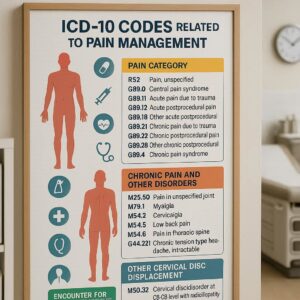
ICD-10 Codes for Pain Management
The Golden Rule of Pain Coding: Specificity is Key
Before we dive into the specific codes, we need to address the core philosophy of ICD-10. In the past, medical coding allowed for a certain level of vagueness. Those days are over. ICD-10 rewards detail.
Think of it like giving someone directions. You wouldn’t just say “It’s in the city.” You would give them the street, the building number, and maybe a landmark. Similarly, ICD-10 wants to know exactly where the pain is located and what type of pain it is.
For example, simply using M79.605 (Pain in right leg) is a start, but it leaves a lot of questions unanswered. Is it nerve pain? Is it post-surgical? Is it in the thigh or the calf?
The Hierarchy of Pain Coding:
-
Site: Where is the pain? (Neck, back, knee, abdomen).
-
Laterality: Is it on the left, right, or both sides?
-
Duration: Is it acute (new) or chronic (persistent)?
-
Etiology: What is the underlying cause? (This is usually listed first if known).
Acute vs. Chronic: Why the Timeline Matters
One of the most common mistakes in pain management coding is confusing acute and chronic pain. They are not interchangeable, and using the wrong one can misrepresent the patient’s health status and treatment plan.
Defining Acute Pain (G89.1)
Acute pain is pain that has a sudden onset. It is often the direct result of tissue damage from surgery, trauma, or an acute illness. The key here is time. Generally, acute pain is expected to last less than three months and subside as the body heals.
-
Common Scenario: A patient falls and breaks their wrist. The pain experienced while the bone is setting and healing is acute.
-
Coding Tip: Acute pain is often coded secondary to the injury code. For example, you would code the fracture first, then add G89.11 (Acute pain due to trauma) to specify the symptom.
Defining Chronic Pain (G89.2 – G89.4)
Chronic pain is persistent. It is pain that lasts beyond the normal tissue healing time, usually defined as lasting more than three to six months. It may or may not be associated with a recognizable ongoing condition.
-
Common Scenario: A patient with long-term rheumatoid arthritis who experiences daily, persistent pain in multiple joints.
-
Coding Tip: ICD-10 recognizes different types of chronic pain. G89.21 (Chronic pain due to trauma) is used for old injuries that never healed right. G89.29 (Other chronic pain) is a common catch-all for persistent pain without a specific neoplasm or trauma link. G89.4 (Chronic pain syndrome) is reserved for cases where the pain is associated with significant psychosocial dysfunction.
Note for Readers: When coding for a patient with an underlying disease (like diabetes or arthritis), you must code the disease first, followed by the specific pain code to show the relationship.
The G89 Category: The Heart of Pain Management Coding
The ICD-10 chapter on “Diseases of the Nervous System” contains the G89 category, which is specifically designed for pain management. This is where you will spend most of your time.
Here is a breakdown of the most commonly used codes in this section:
G89.0: Central Pain Syndrome
This refers to pain caused by damage to the central nervous system (brain, brainstem, or spinal cord). It is often seen in patients post-stroke or with multiple sclerosis. It is a specific neurological condition, not just a general ache.
G89.1: Acute Pain
As discussed, this is for new, short-term pain.
-
G89.11: Acute pain due to trauma.
-
G89.12: Acute post-thoracotomy pain (pain after chest surgery).
-
G89.18: Other acute post-procedural pain (pain after other surgeries).
-
G89.19: Other specified acute pain.
G89.2: Chronic Pain
This is the workhorse of the pain clinic.
-
G89.21: Chronic pain due to trauma.
-
G89.22: Chronic post-thoracotomy pain.
-
G89.28: Other chronic post-procedural pain.
-
G89.29: Other chronic pain (use this when the cause isn’t trauma or a procedure).
G89.3: Neoplasm Related Pain
Pain associated with cancer is coded separately due to its specific nature and treatment protocols.
-
G89.3: Neoplasm related pain (acute) (chronic). This code is used for pain due to the cancer itself or the metastatic disease. If the pain is due to the treatment (like chemotherapy), it may be coded elsewhere depending on the specific symptom.
G89.4: Chronic Pain Syndrome
This is a specific diagnosis that implies the patient suffers from pain that is accompanied by significant psychological or behavioral factors. It is more than just “hurting”; it implies the pain has taken over the patient’s life, leading to things like insomnia, anxiety, or inability to work.
Pain by Location: When to Use the M00-M99 Codes
While the G89 codes are fantastic for describing the type of pain, they are often used in tandem with site-specific codes from the “Diseases of the Musculoskeletal System and Connective Tissue” (M00-M99) chapter.
Why? If a patient comes in with chronic low back pain, you need to code the chronic nature (G89.29) and the location (M54.5).
Common Musculoskeletal Pain Codes
-
M54.2: Cervicalgia (Neck pain). Do not use this if the pain radiates into the arm (that is radiculopathy).
-
M54.5: Low back pain. This is one of the most common codes in primary care. Be specific: is it lumbago or sciatica?
-
M54.4: Lumbago with sciatica. Use this when the pain shoots down the leg.
-
M25.511 – M25.519: Pain in shoulder. (Remember laterality! Left, right, or unspecified).
-
M25.521 – M25.529: Pain in elbow.
-
M25.551 – M25.559: Pain in hip.
-
M25.561 – M25.569: Pain in knee.
-
M79.601 – M79.609: Pain in limb (Hand, foot, arm, leg).
Comparison: Acute Back Pain vs. Chronic Back Pain
To visualize how this works in practice, look at the difference in coding a new patient versus a returning patient with an old injury.
| Scenario | Patient Presentation | Primary Diagnosis | ICD-10 Code(s) |
|---|---|---|---|
| Acute Injury | Patient threw out their back lifting a heavy box yesterday. Pain is severe, but started recently. | Acute back pain | S39.012A (Strain of muscle, fascia and tendon of lower back, initial encounter) AND G89.11 (Acute pain due to trauma) |
| Chronic Condition | Patient has had persistent low back pain for two years following a work injury. | Chronic low back pain | M54.5 (Low back pain) AND G89.21 (Chronic pain due to trauma) |
The Importance of Laterality and Specificity
ICD-10 is very particular about left and right. If the patient has arthritis in their right knee, you cannot just code “knee pain.” You must specify.
Look at the difference:
-
M25.561: Pain in right knee.
-
M25.562: Pain in left knee.
-
M25.569: Pain in unspecified knee.
Using the “unspecified” code might be acceptable if the patient genuinely doesn’t know which side hurts, or if the pain is bilateral. However, overusing unspecified codes can raise red flags with auditors. They imply the documentation was not thorough enough.
List of High-Yield Laterality Reminders:
-
Hip Pain: M25.551 (Right), M25.552 (Left)
-
Shoulder Pain: M25.511 (Right), M25.512 (Left)
-
Knee Pain: M25.561 (Right), M25.562 (Left)
-
Foot Pain: M79.671 (Right), M79.672 (Left)
Headaches and Facial Pain: Beyond “Migraine”
Headaches are a massive part of pain management. Coding them correctly requires distinguishing between migraines, tension headaches, and neuralgias.
Migraine Variants
-
G43.0: Migraine without aura (common migraine).
-
G43.1: Migraine with aura (classic migraine).
-
G43.4: Hemiplegic migraine.
-
G43.8: Other migraine.
-
G43.9: Migraine, unspecified.
Other Head and Face Pain
-
G44.1: Vascular headache, not elsewhere classified.
-
G44.2: Tension-type headache.
-
G44.3: Post-traumatic headache.
-
G50.1: Atypical facial pain (This is a specific diagnosis for persistent facial pain that doesn’t fit the typical nerve patterns).
-
G50.0: Trigeminal neuralgia (A severe, shooting pain condition affecting the face).
Abdominal and Pelvic Pain
Coding abdominal pain is tricky because it is a symptom of so many different conditions. The rule here is: if you know the cause (like appendicitis or diverticulitis), code that. If the cause is unknown, you code the symptom.
Common Abdominal Codes
-
R10.0: Acute abdomen (severe, generalized pain requiring urgent diagnosis).
-
R10.30: Lower abdominal pain, unspecified.
-
R10.31: Right lower quadrant pain.
-
R10.32: Left lower quadrant pain.
-
R10.33: Periumbilical pain (pain around the belly button).
-
R10.84: Generalized abdominal pain.
Pelvic Pain
-
R10.2: Pelvic and perineal pain. This is often used in urology and gynecology.
Coding for Specific Pain Management Procedures
Pain management isn’t just about pills; it is about procedures. Whether a patient is getting an epidural steroid injection (ESI) or a nerve block, the coding needs to reflect why the procedure is being done.
Post-Procedural and Post-Operative Pain
It is vital to distinguish between routine healing pain and chronic post-surgical pain.
-
G89.18: Other acute post-procedural pain. (Use this for the first few weeks following a surgery).
-
G89.22: Chronic post-thoracotomy pain.
-
G89.28: Other chronic post-procedural pain. (Use this for pain that persists long after a surgery, such as chronic pain following a knee replacement).
-
G89.29: Other chronic pain. (If the surgery was years ago, and the pain is now just a chronic condition).
The “Excludes1” and “Excludes2” Notes: Avoiding Coding Conflicts
ICD-10 comes with built-in logic to prevent you from coding two things that can’t happen together. These are called “Excludes” notes.
-
Excludes1: Means “Not coded here.” This condition is a type of the other condition, so you cannot code them together. For example, under R10.0 (Acute abdomen), there is an Excludes1 for “Abdominal rigidity.” If the patient has acute abdomen, you assume rigidity; you don’t code it separately.
-
Excludes2: Means “This condition is different.” The patient can have both at the same time. For example, under M54.5 (Low back pain), you might see an Excludes2 for “sciatica.” A patient can have low back pain and sciatica, so you can code both if documented.
Common Pitfalls in Pain Management Coding
Even experienced coders slip up sometimes. Here are the most frequent errors to watch out for.
-
Coding “Pain” When the Diagnosis is Known: If the physician diagnoses “Osteoarthritis of the knee,” do not code “Knee pain” as the primary diagnosis. The arthritis is the diagnosis; the pain is a symptom of it.
-
Forgetting the 7th Character: For injury codes (S00-T88), you must add a 7th character to specify the encounter type.
-
A: Initial encounter (active treatment).
-
D: Subsequent encounter (routine healing, follow-up).
-
S: Sequela (late effects, like pain from an old injury).
-
-
Mixing Up Acute and Chronic: Coding a 10-year pain condition as “acute” is a red flag for fraud and misrepresents the patient’s history.
-
Ignoring Combination Codes: Sometimes, one code does the job of two. For example, M54.4 (Lumbago with sciatica) covers both conditions. Do not split them into two separate codes unless the documentation requires it.
Frequently Asked Questions (FAQ)
Q: Can I use a G89 code and an M-code together?
A: Yes, absolutely. In fact, it is often required. The M-code (like M54.5 for back pain) tells us the location. The G89 code (like G89.29 for chronic pain) tells us the nature and duration. They work together to paint the full picture.
Q: When should I use “unspecified” pain codes?
A: Only use them when the documentation truly does not provide enough detail to specify the location or type. For example, if a patient with dementia says “I hurt” but cannot point to where, a general code might be necessary. However, if the physician has written “right shoulder” in the note, you must use the specific right shoulder code.
Q: What is the difference between G89.21 and G89.28?
A: G89.21 (Chronic pain due to trauma) is specifically for pain resulting from an injury, like a fall or a car accident. G89.28 (Other chronic post-procedural pain) is for pain resulting from a surgical or medical procedure. If a patient broke their leg in a fall and it never healed right, use G89.21. If the pain started after their hip replacement surgery, use G89.28.
Q: How do I code for a patient with cancer who is in pain?
A: First, code the cancer diagnosis (like C50.912 for malignant neoplasm of the left breast). Then, code G89.3 (Neoplasm related pain) . If the pain is specifically from the chemotherapy (like peripheral neuropathy), you would use a different code like G62.9 (Drug-induced polyneuropathy) .
Conclusion
Mastering ICD-10 codes for pain management is a journey, not a destination. The system is vast, but by focusing on the core principles—specificity, laterality, and the distinction between acute and chronic—you can navigate it successfully. Accurate coding does more than just ensure reimbursement; it tells the patient’s story clearly, supports their treatment plan, and contributes to better healthcare data for everyone.
Remember, when in doubt, go back to the chart. The documentation is your map. If it isn’t documented, it wasn’t done, and it can’t be coded.
Additional Resource
For the most up-to-date official information and the complete list of codes, you should always refer to the Centers for Medicare & Medicaid Services (CMS) website. You can access the official ICD-10 lookup tool here:
CMS.gov ICD-10 Lookup Tool
Disclaimer: This article is for informational purposes only and does not constitute legal or billing advice. Medical coding regulations and guidelines are subject to change. Always consult with a certified professional coder or your local payer for specific guidance on claim submissions.