Imagine a busy hospital floor. A patient arrives with severe abdominal pain, distention, and vomiting. The clinical team springs into action, their minds racing through a differential diagnosis: infection, inflammation, ischemia, or obstruction? Their primary goal is diagnosis and treatment. Meanwhile, in the health information management department, a medical coder is presented with the final, documented story of that patient’s admission. The coder’s critical task is to translate the complex narrative of the patient’s illness—the physician’s notes, the surgical reports, the radiology findings—into a precise, standardized alphanumeric language: the International Classification of Diseases, Tenth Revision, Clinical Modification (ICD-10-CM).
For a condition as common and potentially serious as a small bowel obstruction (SBO), this translation is far from a simple, one-code-fits-all exercise. The code assigned is not merely a statistical marker; it is a powerful data point that influences hospital reimbursement, impacts quality metrics, informs public health tracking, and contributes to medical research. An inaccurate or nonspecific code can paint an incomplete picture of the patient’s condition, leading to skewed data and potential financial repercussions for the healthcare facility.
The ICD-10-CM code set, with its dramatic expansion from its predecessor ICD-9-CM, demands a level of detail that mirrors clinical complexity. For small bowel obstruction, we are no longer confined to a single, generic code. Instead, we navigate a nuanced family of codes under the parent category K56.-, each telling a subtly different story about the etiology and nature of the obstruction. Was it a paralytic ileus following surgery? A volvulus (a twisting of the bowel)? A gallstone that migrated and caused a blockage? Or perhaps adhesions from a prior operation?
This article serves as an exhaustive guide for medical coders, students, and healthcare professionals who seek to master the intricacies of ICD-10 codes for small bowel obstruction. We will journey from the fundamental anatomy of the small intestine to the advanced application of coding guidelines through realistic scenarios. Our goal is to equip you with the knowledge and confidence to assign the most specific and accurate code possible, ensuring that the clinical reality is faithfully represented in the data. This is more than just finding a code; it’s about understanding the story behind it.
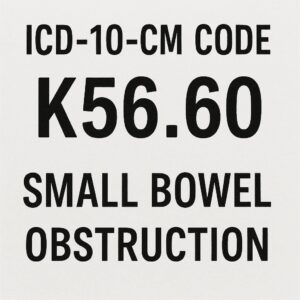
ICD-10 Codes for Small Bowel Obstruction
2. Anatomy and Physiology of the Small Bowel: A Primer for Coders
To accurately code for a pathology, one must first understand the normal structure and function of the affected organ. The small bowel, or small intestine, is a marvel of digestive engineering. It is a long, coiled tube connecting the stomach to the large intestine (colon), and it is where the vast majority of digestion and nutrient absorption occurs.
Anatomically, it is divided into three contiguous sections:
-
Duodenum: This is the first and shortest section (about 10-12 inches long), forming a C-loop around the head of the pancreas. It receives partially digested food (chyme) from the stomach, along with bile from the gallbladder and liver and enzymes from the pancreas. Its name originates from the Latin for “twelve fingers,” a rough approximation of its length.
-
Jejunum: The second section, making up about two-fifths of the remaining small intestine. It is characterized by a rich blood supply and a large surface area due to prominent circular folds (plicae circulares) and villi. Most nutrient absorption takes place here.
-
Ileum: The final and longest section, comprising the remaining three-fifths. It connects to the cecum, the first part of the large intestine, at the ileocecal valve. This valve regulates the flow of chyme into the colon and prevents backflow. The ileum is responsible for absorbing vitamin B12, bile salts, and any remaining nutrients.
Physiology: The primary functions of the small bowel are:
-
Digestion: Further breakdown of proteins, fats, and carbohydrates using pancreatic enzymes and bile.
-
Absorption: Transport of nutrients, water, and electrolytes from the lumen into the bloodstream via the villi and microvilli.
-
Motility: Through rhythmic contractions called peristalsis, the small bowel propels its contents toward the colon.
Understanding this normal flow is key to understanding obstruction. An obstruction is a blockage that prevents the normal passage of intestinal contents. This disruption leads to a cascade of events: the bowel proximal to the obstruction dilates as it fills with fluid and gas, bacterial overgrowth can occur, and if the blood supply is compromised (a “strangulating” obstruction), tissue death (gangrene) can ensue, which is a surgical emergency. From a coding perspective, while the specific anatomic segment (e.g., duodenum vs. ileum) is not specified in the K56 codes, this foundational knowledge is crucial for interpreting operative reports and radiology findings that may point to the cause of the obstruction.
3. Understanding Small Bowel Obstruction: Pathophysiology and Clinical Presentation
Small bowel obstruction occurs when there is a hindrance to the normal aboral (forward) flow of intestinal contents. This blockage can be mechanical or functional.
Mechanical Obstruction: A physical blockage of the lumen. This is the most common type and can be further classified:
-
Luminal: Obstruction from within the lumen (e.g., a large gallstone, a bezoar, a foreign body).
-
Intramural: Obstruction due to a disease of the bowel wall itself (e.g., a tumor, Crohn’s disease causing stricture, an hematoma).
-
Extramural: Obstruction from outside the bowel wall (e.g., adhesions, hernias, masses).
Functional Obstruction (Ileus): This is not a physical blockage but a failure of the bowel to function properly. Peristalsis ceases or becomes ineffective, leading to a functional obstruction. The most common form is post-operative ileus, but it can also be caused by infections, electrolyte abnormalities, medications, or intra-abdominal inflammation.
Clinical Presentation: The classic triad of symptoms for SBO is:
-
Abdominal Pain: Often described as crampy or colicky, coming in waves.
-
Vomiting: Initially may be gastric contents, progressing to bilious (green) and eventually feculent (brown, foul-smelling) if the obstruction is prolonged.
-
Abdominal Distention: The abdomen becomes swollen and tight due to the accumulation of gas and fluid.
Other key signs include absolute constipation (failure to pass flatus or stool), increased bowel sounds in early mechanical obstruction (as the bowel tries to force content past the blockage), and decreased or absent bowel sounds in late obstruction or ileus. In cases of strangulation, the patient may present with fever, tachycardia, and localized tenderness, signs of peritonitis.
Diagnosis is confirmed through imaging, most commonly an abdominal X-ray series showing dilated loops of small bowel with air-fluid levels. A CT scan of the abdomen and pelvis is the gold standard, as it can often identify the cause (e.g., a transition point where the bowel caliber changes, an adhesion, a hernia, a tumor) and assess for complications like ischemia.
This clinical picture is what the physician documents. The coder’s role is to analyze this documentation to determine the correct code from the K56.- category.
4. Navigating the ICD-10-CM Index: Your Starting Point for K56.-
The first step in code assignment is always to consult the ICD-10-CM Alphabetic Index. For small bowel obstruction, you would start with the main term Obstruction or Ileus.
-
Obstruction -> intestine -> small -> K56.699 (Note: The index often leads to an “unspecified” code as a starting point. You must then verify this in the Tabular List).
-
Ileus -> K56.7 (Again, this leads to an “unspecified” code that requires verification).
The index will also provide more specific pathways:
-
Adhesions -> intestine -> with obstruction -> K56.5
-
Volvulus -> intestine -> K56.2
-
Gallstone -> ileus -> K56.3
Crucial Point: The Alphabetic Index is a guide, not the final authority. The code must always be confirmed and selected from the Tabular List, where you will find inclusion and exclusion notes, instructional notes, and the full range of more specific codes.
5. Deconstructing the Code Block: A Deep Dive into K56.0 – K56.7
The codes for paralytic ileus and intestinal obstruction are found in Chapter 11 of ICD-10-CM, “Diseases of the Digestive System” (K00-K95). The specific category is K56 Paralytic ileus and intestinal obstruction without hernia. This “without hernia” exclusion is critical; if the obstruction is caused by a hernia, you must code from the hernia codes (K40-K46), with an additional code for the obstruction if applicable.
Let’s examine each code in detail.
K56.0 – Paralytic ileus
This code represents a functional obstruction where the bowel’s neuromuscular function is impaired, leading to a failure of peristalsis.
-
Clinical Context: Most commonly seen after abdominal or pelvic surgery (post-operative ileus). Other causes include peritonitis, electrolyte imbalances (especially hypokalemia), medications (like opioids), spinal fractures, and mesenteric ischemia.
-
Coding Guidance: If the documentation explicitly states “post-operative ileus” or “paralytic ileus,” this is the correct code. Do not use this code for a mechanical obstruction.
K56.2 – Volvulus
A volvulus is a specific type of mechanical obstruction where a loop of bowel twists around itself and its mesentery (the tissue that supplies blood), creating a closed-loop obstruction that can rapidly lead to strangulation and ischemia.
-
Clinical Context: More common in the colon (especially sigoid volvulus) but can occur in the small bowel. It can be associated with congenital malrotation or adhesions that create a point for the bowel to twist around.
-
Coding Guidance: Code only if “volvulus” is specifically documented by the physician.
K56.3 – Gallstone ileus
This is a rare but fascinating cause of mechanical obstruction. It occurs when a large gallstone erodes through the gallbladder wall into the small intestine (usually the duodenum, creating a cholecysto-enteric fistula). The stone then travels down the bowel until it becomes lodged, typically in the narrower ileum.
-
Clinical Context: Seen more often in elderly females. Rigler’s triad on imaging (pneumobilia – air in the biliary tree, small bowel obstruction, and an ectopic gallstone) is pathognomonic.
-
Coding Guidance: This is a highly specific code. Use only when the physician has confirmed this diagnosis, usually via CT scan or surgery.
K56.4 – Other Occlusion of Intestine
This is a catch-all code for mechanical obstructions that are not specified as volvulus or gallstone ileus and are not due to adhesions or a hernia.
-
Clinical Context: This could include obstructions caused by tumors (benign or malignant) of the small bowel, strictures from Crohn’s disease, intussusception (telescoping of the bowel), or a bezoar.
-
Coding Guidance: If the cause is known and is not listed elsewhere in the K56 category (e.g., “obstruction due to carcinoid tumor”), K56.4 is appropriate. You would then use an additional code to specify the cause (e.g., C7A.01 for a malignant carcinoid tumor of the small intestine).
K56.5 – Intestinal Adhesions [Bands] with Obstruction
This is one of the most frequently used codes for SBO. Adhesions are bands of scar tissue that form between abdominal structures, often as a result of previous surgery, infection, or inflammation. These bands can kink, compress, or trap loops of bowel, causing a mechanical obstruction.
-
Clinical Context: Adhesions are the leading cause of small bowel obstruction in the developed world, accounting for up to 75% of cases.
-
Coding Guidance: Code K56.5 is used only when the physician explicitly links the obstruction to adhesions. The documentation must state “small bowel obstruction due to adhesions,” “adhesive small bowel obstruction,” or similar. Do not assume adhesions are the cause based on a patient’s surgical history alone; the causal link must be documented.
K56.6 – Other and Unspecified Intestinal Obstruction
This code has two parts:
-
“Other”: Used for specified types of intestinal obstruction not covered by the other codes (e.g., “obstructive ileus” if that term is used but the cause is not specified as paralytic or mechanical).
-
“Unspecified”: Used when the medical record simply states “small bowel obstruction” or “intestinal obstruction” without any specification regarding its nature (paralytic vs. mechanical) or cause.
-
Coding Guidance: This is the default code when documentation is lacking in specificity. However, a coder should always query the physician for clarification if there is clinical evidence in the record (e.g., CT scan report mentioning a transition point) that suggests a more specific cause.
K56.7 – Ileus, unspecified
This code is for when the term “ileus” is used, but it is not specified as paralytic (K56.0) or another type.
-
Coding Guidance: If the documentation only says “ileus,” this code is assigned. However, in most clinical settings, “ileus” is synonymous with paralytic ileus. A query may be warranted to confirm if the physician means a post-operative/paralytic ileus (K56.0) or is using the term generically.
ICD-10-CM Code Summary for Small Bowel Obstruction
| ICD-10-CM Code | Code Description | Clinical Scenario | Specificity Required |
|---|---|---|---|
| K56.0 | Paralytic ileus | Patient 3 days post-op from a colectomy with abdominal distention and no bowel sounds. | Documentation of “paralytic ileus” or “post-operative ileus”. |
| K56.2 | Volvulus | CT scan shows a “whirl sign” and a twisted loop of small bowel. | Documentation of “volvulus”. |
| K56.3 | Gallstone ileus | Elderly patient with Rigler’s triad on CT. | Confirmed diagnosis of gallstone ileus. |
| K56.4 | Other occlusion of intestine | Obstruction caused by a small bowel tumor or Crohn’s stricture. | Documentation of a known cause not classifiable to K56.2, K56.3, or K56.5. |
| K56.5 | Intestinal adhesions with obstruction | Patient with a history of appendectomy presents with SBO; surgeon notes adhesions as cause. | Explicit link between adhesions and the obstruction. |
| K56.69 | Other and unspecified intestinal obstruction | Patient presents with SBO, but no cause is determined (e.g., resolved on its own). | “SBO” with no further specification. |
| K56.7 | Ileus, unspecified | Documentation only states “ileus” without clarification. | Non-specific use of the term “ileus”. |
6. The Cornerstone of Accuracy: The Critical Importance of Clinical Documentation
The single most important factor in accurate ICD-10 coding is the quality and specificity of the clinical documentation. The physician’s notes, the radiology reports, the surgical operative reports—these are the source materials. Coders cannot infer, assume, or extrapolate. They can only code what is documented.
Examples of Poor vs. Strong Documentation:
-
Poor: “Patient with SBO. Admitted for bowel rest.”
-
Coding Impact: Forces the use of an unspecified code (K56.69), which is less meaningful for data and may not reflect the true severity.
-
-
Strong: “Patient presents with clinical and CT evidence of a high-grade small bowel obstruction. Given patient’s remote history of hysterectomy, the most likely etiology is adhesive disease. Will treat conservatively with NG tube decompression.”
-
Coding Impact: Allows for the specific code K56.5 (Intestinal adhesions with obstruction).
-
The Power of the Physician Query: When documentation is unclear, contradictory, or incomplete, the coder’s most powerful tool is the physician query. A query is a formal, non-leading communication to the physician to clarify the clinical picture.
-
Example of a Query: “Dear Dr. Smith, The discharge summary for Jane Doe states ‘small bowel obstruction.’ However, the CT scan report notes a ‘transition point in the right lower quadrant consistent with an adhesive band.’ Can you please clarify the cause of the small bowel obstruction so that we may code to the highest level of specificity?”
This process of clarification is essential for clinical integrity and accurate reimbursement.
7. Coding Scenarios: Applying Knowledge to Real-World Cases
Let’s apply our knowledge to some common coding scenarios.
Scenario 1: The Post-Operative Patient
-
Documentation: A 65-year-old male is post-op day 2 from an open repair of an abdominal aortic aneurysm. He has developed nausea, vomiting, and abdominal distention. An abdominal X-ray shows diffusely dilated loops of small and large bowel. The surgeon diagnoses “post-operative ileus” and manages him with NPO status and IV fluids.
-
Analysis: The key term is “post-operative ileus,” which is a form of paralytic ileus.
-
Correct Code: K56.0 (Paralytic ileus).
Scenario 2: The Patient with a History of Abdominal Surgery
-
Documentation: A 48-year-old female presents with crampy abdominal pain and vomiting. She had a C-section 10 years ago. A CT scan reveals dilated small bowel loops proximal to a transition point in the pelvis, with a decompressed bowel distally. The radiologist’s impression is “small bowel obstruction, likely secondary to adhesions.” The attending physician’s final diagnosis is “adhesive small bowel obstruction.”
-
Analysis: The documentation explicitly links the obstruction to adhesions.
-
Correct Code: K56.5 (Intestinal adhesions with obstruction).
Scenario 3: The Complex Case of Gallstone Ileus
-
Documentation: An 82-year-old female with no surgical history presents with intermittent abdominal pain and vomiting over several days. CT abdomen/pelvis shows pneumobilia, a 3.5 cm calcified density obstructing the distal ileum, and dilated small bowel loops. The surgical consult note states: “Gallstone ileus confirmed on imaging. Patient taken to OR for enterolithotomy.”
-
Analysis: This is a classic presentation with a specific diagnosis.
-
Correct Code: K56.3 (Gallstone ileus).
Scenario 4: The Undetermined Cause
-
Documentation: A 55-year-old male presents with abdominal pain and vomiting. CT shows a small bowel obstruction. He is treated with an NG tube and IV fluids. The obstruction resolves within 48 hours without intervention. The discharge summary states “small bowel obstruction, etiology undetermined.”
-
Analysis: No specific cause is documented. The physician has explicitly stated the cause is unknown.
-
Correct Code: K56.69 (Other and unspecified intestinal obstruction).
8. Beyond the Base Code: The Essential Role of Additional Codes
ICD-10 coding rarely involves a single code. The SBO code (K56.-) is the “reason for admission,” but you must also code for all coexisting conditions and complications.
-
Coding for the Underlying Cause: If the SBO is due to a disease process, you may need to code that condition first.
-
Example: A patient with Crohn’s disease who develops a fibrotic stricture causing an obstruction.
-
Coding: K50.914 (Crohn’s disease of small intestine with obstruction) would be the principal diagnosis. You would not use K56.4 or K56.69 in this case, as the Crohn’s code includes the complication of obstruction.
-
-
Coding for Associated Conditions:
-
Dehydration: Code E86.0 (Dehydration) if documented.
-
Electrolyte Imbalances: Code imbalances like E87.6 (Hypokalemia) or E87.5 (Hyperkalemia).
-
Sepsis: If the obstruction leads to bowel ischemia, perforation, and sepsis, you must code the sepsis sequence (A41.9 Sepsis, unspecified organism, followed by R65.20 Severe sepsis without septic shock) and any associated acute organ dysfunction.
-
9. Common Pitfalls and How to Avoid Them: A Coder’s Checklist
-
Pitfall: Assuming Adhesions. Do not code K56.5 based solely on a history of surgery. The causal link must be documented.
-
Pitfall: Confusing Ileus and Obstruction. Paralytic ileus (K56.0) is functional. Mechanical obstruction (K56.2-K56.69) is a physical blockage. Know the difference.
-
Pitfall: Missing Hernia-Related Obstructions. If the cause is a hernia, the code comes from K40-K46, not K56. Check the documentation carefully for any mention of a hernia.
-
Pitfall: Ignoring Instructional Notes. Always read the “Excludes1,” “Excludes2,” “Code first,” and “Use additional code” notes in the Tabular List.
-
Pitfall: Not Querying. When in doubt, ask. A query improves documentation quality and ensures coding accuracy.
10. The Link Between Accurate Coding and Patient Care: DRGs, Reimbursement, and Quality Metrics
Accurate coding has a direct impact on healthcare finance and quality reporting. Inpatient admissions are reimbursed based on Diagnosis-Related Groups (DRGs). Each DRG has a relative weight that determines payment.
-
Example: A case of “unspecified intestinal obstruction” (K56.69) might map to a DRG with a lower weight and reimbursement than a case of “intestinal obstruction with complications/MCC” (which could be triggered by a more specific code combined with codes for sepsis or acute kidney injury). Accurate coding ensures the hospital is reimbursed fairly for the resources used.
Furthermore, coded data is used for quality metrics and outcomes research. Specific data on adhesive obstructions (K56.5) can be used to study the long-term outcomes of different surgical techniques. Data on gallstone ileus (K56.3) helps understand its epidemiology. Inaccurate coding corrupts this vital data stream.
11. Looking Ahead: The Future of Coding and Specificity
The evolution from ICD-9 to ICD-10 demonstrated a clear trend towards greater specificity. The future, likely with ICD-11, will continue this path, potentially incorporating more detail about etiology, severity, and anatomic location. The role of the coder will continue to evolve from that of a simple data-entry clerk to that of a data integrity specialist, a clinical liaison, and an expert in health information.
12. Conclusion: Mastering the Nuances of SBO Coding
Accurate ICD-10 coding for small bowel obstruction requires a firm grasp of clinical concepts and coding guidelines.
The key is to move beyond the unspecified code by meticulously reviewing documentation for the specific type and cause of the obstruction.
Always remember that precise coding is not an administrative task but a critical component of patient care, data integrity, and healthcare system sustainability.
13. Frequently Asked Questions (FAQs)
Q1: What is the default code for small bowel obstruction if the documentation isn’t specific?
A: The default code is K56.69 (Other and unspecified intestinal obstruction). This should be used when the record only states “small bowel obstruction” without specifying the cause or type.
Q2: Can I code both K56.5 (adhesions) and a code for the patient’s prior surgery (like a Z98.89 for other specified postprocedural states)?
A: Yes. You would assign K56.5 as the principal diagnosis for the current admission. You can then assign a code from category Z98 (Other postprocedural states) as a secondary code to indicate the status from the remote surgery that led to the adhesions. However, the Z98 code is not always required and depends on payer guidelines.
Q3: How do I code a small bowel obstruction caused by an incarcerated hernia?
A: You would not use a code from the K56 category. The correct coding sequence would be to use a code from K40-K46 for the hernia with obstruction. For example, K42.0 (Umbilical hernia with obstruction). The hernia is the underlying cause of the obstruction.
Q4: What is the difference between K56.69 and K56.7?
A: K56.69 is for “intestinal obstruction,” whether specified as a type not elsewhere classified or unspecified. K56.7 is specifically for “ileus” when it is unspecified. In practice, if the documentation says “obstruction,” use K56.69. If it says only “ileus,” use K56.7.
14. Additional Resources
-
The Official ICD-10-CM Guidelines for Coding and Reporting: Published annually by the CDC and CMS. This is the essential rulebook.
-
American Health Information Management Association (AHIMA): Offers a wealth of resources, articles, and practice briefs on coding topics.
-
American Academy of Professional Coders (AAPC): Provides certification, training, and networking opportunities for coders.
-
Centers for Disease Control and Prevention (CDC) ICD-10-CM Website: Provides access to the official code set and guidelines.
Date: September 23, 2025
Author: The Medical Coding Team
Disclaimer: *This article is intended for informational and educational purposes only. It is not a substitute for professional medical advice, diagnosis, or treatment. The coding information provided is based on current guidelines but is subject to change. Always consult the most current, official ICD-10-CM coding manuals, payer-specific policies, and clinical documentation for accurate code assignment. The author and publisher are not responsible for any errors or omissions or for any outcomes related to the use of this information.*