In the complex and deeply human world of behavioral health, where stories of struggle, resilience, and recovery unfold, a seemingly arcane system of letters and numbers plays a pivotal role. The International Classification of Diseases, Tenth Revision, Clinical Modification (ICD-10-CM) codes for substance-related disorders are far more than just bureaucratic requirements for billing. They are the standardized language that translates a patient’s subjective experience of addiction into a objective, universally understood clinical diagnosis. This language facilitates communication between clinicians, justifies medical necessity to insurers, informs public health strategies, and ultimately, helps shape the landscape of care for millions of individuals affected by substance use disorders.
The journey from observing a patient’s symptoms to assigning a precise ICD-10 code is one of critical thinking and meticulous documentation. An inaccurate or nonspecific code is not merely an administrative error; it can lead to claim denials, skewed health data, and a fragmented understanding of a patient’s needs. This article serves as a definitive guide for clinicians, medical coders, healthcare administrators, and students navigating the intricate details of the F10-F19 code block. We will move beyond simple code lists to explore the clinical reasoning, documentation requirements, and real-world implications of accurately classifying substance abuse, misuse, dependence, and remission. By mastering this diagnostic language, we can ensure that the systems designed to support recovery are as precise and effective as the care provided.
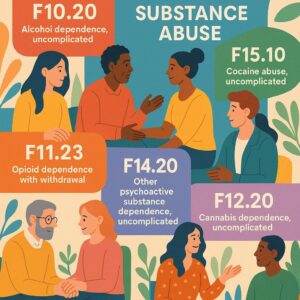
ICD-10 Codes for Substance Abuse
Chapter 1: Understanding the ICD-10 Framework
What is the ICD-10 and Why Does It Matter?
The International Classification of Diseases (ICD) is a global health information standard managed by the World Health Organization (WHO). Its primary purpose is to systematically record, report, and analyze mortality and morbidity statistics across the world. The “Tenth Revision” (ICD-10) represents a significant evolution from its predecessors, offering a much greater level of detail and specificity. In the United States, the Centers for Disease Control and Prevention (CDC) and the National Center for Health Statistics (NCHS) developed a clinical modification of this system, known as ICD-10-CM, for use in diagnosing and treating patients.
The importance of ICD-10-CM in modern healthcare cannot be overstated. It is the bedrock upon which several critical functions are built:
-
Standardized Communication: It provides a common language for physicians, nurses, therapists, and other healthcare providers to communicate about a patient’s condition unambiguously.
-
Billing and Reimbursement: Insurance companies, including Medicare and Medicaid, require specific ICD-10-CM codes to justify the medical necessity of services rendered. An incorrect code can result in delayed or denied payments.
-
Epidemiology and Public Health: Aggregated ICD-10 data allows health authorities to track the prevalence of diseases, identify emerging trends (such as the opioid epidemic), and allocate resources effectively.
-
Clinical Research: Researchers use these codes to identify patient populations for studies, track treatment outcomes, and advance medical knowledge.
-
Quality Measurement: Healthcare quality metrics and performance evaluations are often tied to specific diagnostic groups defined by ICD-10 codes.
The Structure of an ICD-10-CM Code
An ICD-10-CM code is not a random string of characters. It is a carefully structured hierarchy that conveys specific information. A typical code structure is as follows:
Format: A00.00
-
Category (Characters 1-3): The first three characters define the general category of the disease or injury. For substance abuse, this always begins with the letter ‘F’ (Mental, Behavioral and Neurodevelopmental disorders), followed by two digits specifying the substance. For example, F10 relates to Alcohol, and F11 relates to Opioids.
-
Subcategory (Character 4): The character after the decimal point provides more detail about the manifestation or stage of the disorder. This is where we specify if the diagnosis is for intoxication (.0), withdrawal (.1), a use disorder (.2), etc.
-
Extension (Characters 5-6): Many codes require a fifth or even sixth character to provide the highest level of specificity. This is crucial in the F10-F19 block. These characters indicate the severity of the disorder (e.g., mild, moderate, severe), the remission status (e.g., in early remission, in sustained remission), or whether the encounter is for medication therapy.
Understanding this structure is the first step toward accurate coding. The system is designed to be expanded, forcing the coder to choose the code that most precisely reflects the patient’s clinical presentation.
Chapter 2: The F10-F19 Code Block: A Deep Dive into Substance-Related and Addictive Disorders
The ICD-10-CM chapter on Mental, Behavioral, and Neurodevelopmental disorders (Chapter 5) contains the block of codes F10-F19, which is dedicated to “Mental and behavioral disorders due to psychoactive substance use.” This block is organized primarily by the class of substance involved.
Each category within this block follows a parallel structure, making it easier to learn once you understand the pattern for one substance. The fourth and fifth characters will consistently represent the same type of clinical presentation across different substances.
Code Categories by Substance
The following table outlines the primary substance categories within the F10-F19 block. Note that “abuse” and “dependence” from older terminologies are now largely subsumed under the umbrella of “use disorder,” with specifiers for severity.
ICD-10-CM Substance Categories (F10-F19)
| ICD-10 Code Range | Substance Class | Examples of Specific Substances |
|---|---|---|
| F10 | Alcohol | Beer, wine, spirits |
| F11 | Opioids | Heroin, oxycodone, hydrocodone, fentanyl, morphine |
| F12 | Cannabinoids | Marijuana, hashish, synthetic cannabinoids |
| F13 | Sedatives, Hypnotics, or Anxiolytics | Benzodiazepines (Xanax, Valium), barbiturates, sleep aids (Ambien, Lunesta) |
| F14 | Cocaine | Powdered cocaine, crack cocaine |
| F15 | Other Stimulants | Amphetamines (Adderall), methamphetamine, methylphenidate (Ritalin) |
| F16 | Hallucinogens | LSD, psilocybin (magic mushrooms), PCP, MDMA (Ecstasy/Molly) |
| F17 | Nicotine | Cigarettes, vaping products, cigars, chewing tobacco |
| F18 | Inhalants | Solvents, aerosols, gases, nitrites |
| F19 | Other Psychoactive Substances | Multiple drug use (polysubstance), prescription medications not elsewhere classified, unknown substances |
It is critical to select the code category that corresponds to the specific substance causing the disorder. Using a general or incorrect code can lead to clinical and administrative inaccuracies.
Chapter 3: The Fourth and Fifth Characters: Specifying the Clinical Picture
This is where the true clinical detail is captured. The fourth and fifth characters describe the specific behavioral, psychological, and physiological phenomenon the patient is experiencing.
Intoxication (x.0, x.00, x.01)
Intoxication is a clinically significant, reversible syndrome that develops during or shortly after the ingestion of a substance. It is characterized by maladaptive behavioral or psychological changes (e.g., belligerence, mood lability, impaired judgment) and specific physiological signs (e.g., slurred speech, incoordination, unsteady gait).
-
Coding: The base code is
.0for intoxication. A fifth character is required to specify the presence of a perceptual disturbance.-
F1x.00 – … without perceptual disturbance. (e.g., F10.00 for Alcohol intoxication without perceptual disturbance).
-
F1x.01 – … with perceptual disturbance. This refers to hallucinations with intact reality testing (the patient knows the hallucinations are substance-induced) or illusions. (e.g., F16.01 for Hallucinogen intoxication with perceptual disturbance).
-
Withdrawal (x.1, x.10, x.11, x.12)
Withdrawal is a substance-specific syndrome that occurs upon the cessation or reduction of heavy and prolonged substance use. The symptoms cause clinically significant distress or impairment and are not due to another medical condition.
-
Coding: The base code is
.1for withdrawal. Fifth characters provide critical detail.-
F1x.10 – … without perceptual disturbances. (e.g., F11.10 for Opioid withdrawal without perceptual disturbances).
-
F1x.11 – … with perceptual disturbances.
-
F1x.12 – … with withdrawal delirium. This is a more severe form of withdrawal involving a disturbance of consciousness and attention. The most classic example is F10.231 and F10.232 for Alcohol Withdrawal Delirium (a sixth character is used here to specify with or without perceptual disturbance).
-
The “Use” Disorders: From Mild to Severe (x.2)
This category captures the condition formerly divided into “abuse” and “dependence,” now conceptualized as a single “use disorder” on a spectrum of severity. A substance use disorder (SUD) is a pattern of use leading to clinically significant impairment or distress, as manifested by a set of 11 criteria outlined in the DSM-5-TR (e.g., failure to fulfill major role obligations, use in hazardous situations, craving, tolerance, withdrawal).
-
Coding: The base code is
.2for a use disorder. The fifth character indicates severity, which is determined by the number of met criteria:-
F1x.20 – … uncomplicated. (This is used when the severity is not specified).
-
F1x.21 – … in remission. (We will discuss the sixth character for this in the next chapter).
-
F1x.22 – … mild (2-3 criteria).
-
F1x.23 – … moderate (4-5 criteria).
-
F1x.24 – … severe (6 or more criteria).
-
For example, a diagnosis of Severe Opioid Use Disorder would be coded as F11.24.
Other Specific Manifestations (x.3 – x.9)
This range covers other substance-induced conditions. These codes are used when the substance use leads to a different primary diagnosis.
-
.x3 – Withdrawal delirium (as mentioned above, specific codes exist for alcohol).
-
.x4 – With perceptual disturbances (often used in conjunction with other codes).
-
.x5 – Psychotic disorder: With delusions (.x5) or with hallucinations (.x6). These are used when the psychotic symptoms are the predominant clinical feature and are severe enough to warrant independent clinical attention.
-
.x7 – … with amnestic disorder.
-
.x8 – … with other specified disorder.
-
.x9 – … with unspecified disorder.
Chapter 4: The Sixth Character: Documenting Remission and Therapy
The sixth character provides essential information about the patient’s current status in their recovery journey and the context of their treatment. This is vital for accurately portraying the reason for the encounter.
Understanding Remission Status (In Sustained Remission, In Early Remission)
Remission is a stage where the individual no longer meets the diagnostic criteria for the substance use disorder (except for the criterion of craving, which may persist). The ICD-10-CM makes a key distinction:
-
Early Remission: This is assigned after the full criteria for a SUD were previously met, but none of the criteria (except craving) have been met for at least 3 months but for less than 12 months.
-
Sustained Remission: This is assigned after the full criteria for a SUD were previously met, but none of the criteria (except craving) have been met at any time during a period of 12 months or longer.
Coding Examples:
-
F11.21 – Opioid use disorder, in remission. (This is the default when the provider does not specify early or sustained).
-
F10.21 – Alcohol use disorder, in remission. (The documentation must support this status).
Coding for Patients in Controlled Environments
A crucial sixth character option is used when a patient is in a setting where access to substances is restricted. This provides context for the remission status.
-
Sixth Character “1”: This indicates the patient is in a controlled environment. This includes jails, prisons, therapeutic communities, or inpatient hospitals where substance access is not possible. This specifier is important because remission in a controlled environment does not necessarily predict remission in an uncontrolled environment.
Example: A patient is in an inpatient rehab facility and has not used alcohol for 45 days. The correct code would be F10.21 for Alcohol use disorder, in early remission, in a controlled environment. The coder would assign F10.21.
Chapter 5: Documentation and Clinical Criteria
The accuracy of any ICD-10 code is entirely dependent on the quality of the clinical documentation. The clinician’s notes must provide a clear “map” for the coder to follow.
Bridging the Gap Between DSM-5-TR and ICD-10
While the DSM-5-TR (Diagnostic and Statistical Manual of Mental Disorders, Fifth Edition, Text Revision) is the primary diagnostic guide for mental health clinicians in the U.S., and the ICD-10-CM is the official coding system, they are designed to be compatible. The diagnostic criteria for Substance Use Disorders are nearly identical between the two systems. The clinician uses the DSM-5-TR criteria to make the diagnosis, and the coder uses that documented diagnosis to select the corresponding ICD-10-CM code.
The Importance of Specificity in Clinical Notes
Vague documentation like “patient struggles with alcohol” or “drug abuse” is insufficient for precise coding. Clinicians must document:
-
The Specific Substance: “Oxycodone” is better than “pain pills.” “Methamphetamine” is better than “stimulants.”
-
The Specific Disorder: State the diagnosis clearly: “Cocaine Intoxication,” “Severe Alcohol Use Disorder,” “Opioid Withdrawal.”
-
The Severity: For use disorders, the note should indicate “mild,” “moderate,” or “severe,” based on the number of criteria met.
-
The Status: For use disorders, clearly state if the patient is “in early remission,” “in sustained remission,” or “in a controlled environment.”
-
Co-occurring Conditions: Document any substance-induced conditions (e.g., “alcohol-induced depressive disorder,” which would be coded separately).
Without this level of detail, the coder is forced to assign a default, less specific code (e.g., F19.10 for an unspecified stimulant use disorder), which can impact reimbursement and data quality.
Chapter 6: Coding Scenarios and Case Studies
Let’s apply the concepts discussed to realistic patient encounters.
Case Study 1: The Emergency Department Visit
-
Scenario: A 28-year-old male is brought to the ED by friends. He is agitated, has slurred speech, and is ataxic. His breath smells of alcohol. He is aggressive and requires sedation. The physician documents “Acute Alcohol Intoxication.”
-
Coding: F10.00 – Alcohol intoxication, without perceptual disturbance. The code is specific to the acute condition being treated.
Case Study 2: Inpatient Rehabilitation Admission
-
Scenario: A 45-year-old female is admitted to an inpatient rehab facility for heroin use. Her clinical assessment notes a 10-year history of use, multiple failed attempts to quit, significant tolerance, spending a great deal of time obtaining the drug, and continued use despite losing her job and family relationships. The assessment identifies 7 of the 11 DSM-5-TR criteria.
-
Coding: F11.24 – Severe opioid use disorder. (On admission, before the controlled environment affects remission status).
Case Study 3: Outpatient Follow-up
-
Scenario: The same female from Case Study 2 now presents for her first outpatient follow-up appointment 4 months after discharge. She reports no use of heroin or any other opioids since leaving inpatient rehab. She is attending support meetings regularly. The clinician documents “Opioid Use Disorder, in early remission.”
-
Coding: F11.21 – Opioid use disorder, in remission. (The “early” specifier is included in the clinical term, but the code .21 is used for both early and sustained remission unless a sixth character is available to distinguish them; for opioids, it is not. The documentation carries the detail).
Chapter 7: The Impact of Accurate Coding: Beyond the Chart
Reimbursement and Revenue Cycle
For healthcare providers, accurate ICD-10 coding is directly tied to financial stability. Insurance payers use these codes to:
-
Determine Medical Necessity: The diagnosis code must justify the service provided. Treating “withdrawal” justifies a higher level of care than a routine therapy session for “remission.”
-
Process Claims: An incorrect or nonspecific code is a common reason for claim denials or delays, disrupting cash flow and increasing administrative costs.
-
Calculate Reimbursement: Certain diagnoses, especially those with higher complexity and severity, may be linked to higher reimbursement rates under various payment models.
Public Health Surveillance and Research
Accurate coding at the individual level aggregates into powerful public health intelligence. By analyzing data coded with F10-F19, health authorities can:
-
Track the rise and fall of epidemics (e.g., the F11 codes for the opioid crisis).
-
Identify geographic hotspots for specific substance problems.
-
Evaluate the effectiveness of public health interventions and treatment programs.
-
Allocate funding and resources to areas of greatest need.
Legal and Ethical Considerations
The diagnosis of a substance use disorder carries significant stigma and potential legal ramifications. Accurate coding is an ethical imperative. It ensures that a patient’s record correctly reflects their condition, which is crucial for:
-
Confidentiality: Substance use disorder records are protected by stringent federal regulations (42 CFR Part 2), which are even more strict than HIPAA.
-
Informed Consent: Treatment decisions must be based on an accurate diagnosis.
-
Legal Proceedings: Medical records may be subpoenaed for child custody cases, DUIs, or other legal matters. An inaccurate diagnosis could have serious consequences for the patient.
Chapter 8: Common Pitfalls and How to Avoid Them
-
Using “Unspecified” Codes as a Default: Codes like F19.90 (Unspecified psychoactive substance use, uncomplicated) should be a last resort, used only when information in the record is genuinely insufficient to assign a more specific code. Always query the provider for more detail.
-
Confusing Intoxication and Withdrawal: These are distinct physiological states. Intoxication is the direct effect of the substance; withdrawal is the effect of its absence. Code for the condition being treated.
-
Incorrectly Applying Remission Codes: Do not code “in remission” for a patient who is simply not using the substance at the moment but has not been formally diagnosed as being in remission. The clinical documentation must explicitly state the remission status.
-
Overlooking Polysubstance Use: When a patient uses multiple substances, you must code for each substance-specific disorder. The code F19. (Other psychoactive substance use) is for substances not classified elsewhere or for when the specific substance is unknown, not as a catch-all for multiple known substances.
Chapter 9: The Future: A Glimpse at ICD-11
The World Health Organization has already released the ICD-11, which came into effect in January 2022. The U.S. will eventually transition to ICD-11-CM, though a timeline has not been set. ICD-11 refines the classification of substance use disorders further, with some changes in structure and terminology. For instance, it introduces the concept of “single episode of harmful use” and “harmful pattern of use” and continues the move away from the abuse/dependence dichotomy. Staying informed about these coming changes will be essential for future-proofing clinical and coding practices.
Conclusion
The ICD-10-CM coding system for substance abuse is a detailed and powerful tool that translates complex human conditions into a structured data language. Mastery of the F10-F19 block, from the substance category to the nuanced sixth character for remission, is fundamental for clinical accuracy, financial integrity, and meaningful public health insight. Ultimately, precise coding is not an administrative burden but a critical component of providing high-quality, effective, and accountable care for individuals on the path to recovery from substance use disorders.
Frequently Asked Questions (FAQs)
Q1: What is the difference between ICD-10 code F17.210 and F17.213?
A: Both are for Nicotine Dependence. F17.210 is for Nicotine dependence, cigarettes, uncomplicated. F17.213 is for Nicotine dependence, cigarettes, with withdrawal. The correct code depends on whether the patient is experiencing withdrawal symptoms at the time of the encounter.
Q2: How do I code for polysubstance use?
A: You must assign a separate code for each specific substance use disorder that the patient has been diagnosed with. For example, if a patient has both a Severe Alcohol Use Disorder and a Severe Cocaine Use Disorder, you would assign both F10.24 and F14.24. Do not use F19.- for multiple known substances.
Q3: When should I use a code from the F10-F19 block versus a code from the T36-T50 block (Poisoning by drugs)?
A: This is a critical distinction. Use F10-F19 for diagnoses related to the mental and behavioral disorders of substance use (e.g., addiction, intoxication, withdrawal). Use T36-T50 with a fifth or sixth character to indicate “poisoning” for cases of overdose, accidental ingestion, or adverse effect where the substance was taken incorrectly or unintentionally. For example, a suicide attempt by opioid overdose would be coded as a poisoning (T40.2X2). A patient seeking treatment for opioid addiction would be coded with F11.-.
Q4: A patient has a history of alcohol use disorder but is now in long-term recovery and is seeing a therapist for an unrelated anxiety disorder. What ICD-10 code do I use?
A: If the alcohol use disorder is not a focus of treatment and the patient is in stable, long-term remission, you would typically use F10.21 (Alcohol use disorder, in remission) as a secondary or historical diagnosis. The primary code would be for the anxiety disorder (e.g., F41.1, Generalized anxiety disorder). The remission status accurately reflects that the condition is not active.
-
Disclaimer
This article is intended for informational and educational purposes only. It is not a substitute for professional medical, coding, or legal advice. The ICD-10-CM coding system is updated annually. Always consult the most current official ICD-10-CM guidelines, code sets, and clinical documentation before assigning codes for patient care or billing purposes. The author and publisher disclaim any liability arising directly or indirectly from the use of this information.
Date: October 26, 2025
Author: The Health Informatics Team