For millions of women, the annual well-woman exam is a cornerstone of their healthcare routine. It is a scheduled, dedicated time to focus exclusively on health maintenance, disease prevention, and the cultivation of a proactive partnership with a healthcare provider. Yet, behind this seemingly straightforward appointment lies a complex and critical system of medical classification that ensures its viability: the International Classification of Diseases, Tenth Revision (ICD-10) coding system. A simple pair of codes—Z00.00 and Z00.01—forms the bedrock of billing and reimbursement for these essential visits. However, their correct application is anything but simple. Misunderstanding the nuance between these codes can lead to claim denials, compliance issues, and a distorted picture of a patient’s health in their medical record. This article serves as an exhaustive guide for healthcare providers, medical coders, billers, and interested patients, delving deep into the world of ICD-10 coding for the well-woman exam. We will unravel the intricacies of proper code selection, underscore the paramount importance of precise documentation, and explore how this administrative process directly impacts the quality and sustainability of women’s preventive healthcare.
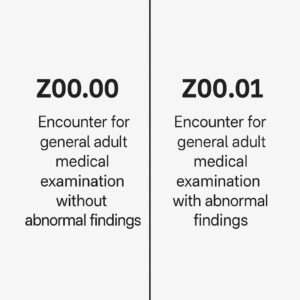
ICD-10 Codes Z00.00 and Z00.01
2. Understanding the Well-Woman Exam: A Pillar of Preventive Medicine
The well-woman exam is fundamentally different from a problem-oriented visit. It is not scheduled to address a specific complaint like a sore throat or a sprained ankle. Instead, it is a comprehensive, holistic evaluation designed to assess overall health status, identify potential risk factors for future disease, provide recommended screenings, and offer counseling on healthy lifestyle choices. The components of a well-woman exam can vary based on age, risk factors, and family history, but they generally include:
-
Review of Systems: A comprehensive overview of the patient’s bodily functions.
-
Past Medical, Family, and Social History: An updated account of previous illnesses, genetic predispositions, and lifestyle factors.
-
Physical Examination: Including vital signs, body mass index (BMI), and a physical assessment.
-
Preventive Screenings: Such as Pap smears, HPV testing, clinical breast exams, mammograms, bone density scans, and screening for cholesterol, diabetes, and hypertension.
-
Immunizations: Administration of recommended vaccines like HPV, Tdap, or influenza.
-
Counseling and Education: On topics like nutrition, exercise, sexual health, mental wellness, substance use, and safety.
-
Risk Assessment: Evaluation of individual risks for conditions like heart disease, osteoporosis, and certain cancers.
This proactive approach is proven to save lives and reduce healthcare costs by catching diseases in their earliest, most treatable stages and by empowering women with the knowledge to manage their health effectively.
3. The Critical Role of Accurate Medical Coding
Medical coding is the language of healthcare finance and epidemiology. ICD-10 codes, in particular, are alphanumeric designators that translate medical diagnoses, symptoms, and reasons for encounters into a standardized format. This system serves several vital purposes:
-
Reimbursement: Insurance companies use ICD-10 codes to determine if a service, like a well-woman exam, is medically necessary and therefore reimbursable.
-
Epidemiology and Public Health: Aggregated code data helps researchers and public health officials track disease prevalence, identify health trends, and allocate resources.
-
Quality Measurement: Codes are used to assess the quality of care provided by healthcare institutions and individual providers.
-
Clinical Decision Support: Coded data can populate patient records with critical information that aids in future care decisions.
Incorrect coding can disrupt every one of these functions, leading to financial loss for practices, skewed health data, and potential legal and compliance repercussions.
4. Deep Dive into ICD-10: The World of Z-Codes
Within the ICD-10 universe, codes that start with the letter “Z” are designated for “Factors Influencing Health Status and Contact with Health Services.” These are not codes for diseases or injuries, but rather for circumstances that bring a patient into the healthcare system when they are not, in fact, sick. This category includes encounters for examinations, screenings, contraceptive management, and other preventive services. Z-codes justify the medical necessity of a visit that is not driven by an active illness. Using a Z-code for a well-woman exam tells the payer, “This patient is here for a routine, preventive health assessment as recommended by standard medical guidelines.”
5. The Primary Codes: Z00.00 and Z00.01 Demystified
The core codes for the adult well-woman exam are found in the category Z00: General examination without complaint, suspected or reported diagnosis.
Z00.00: Encounter for General Adult Medical Examination Without Abnormal Findings
This code is used when a patient presents for a routine examination and no abnormal findings are discovered during the encounter. The key word here is “encounter.” It means that throughout the entire visit—from the review of systems and history to the physical examination and any routine screening tests performed—everything falls within normal limits for a preventive exam.
When to use Z00.00:
-
A healthy 35-year-old presents for her annual exam. Her history is unchanged, her physical exam is normal, and a screening Pap smear is collected as per protocol. All findings are documented as normal/negative.
-
A 28-year-old arrives for her well-woman visit. She feels well, has no complaints, and her clinical breast exam and vital signs are all within normal parameters.
Z00.01: Encounter for General Adult Medical Examination With Abnormal Findings
This code is used when a patient presents for a routine examination, but during the course of that encounter, an abnormal, unrelated finding is identified. The abnormality must be something newly discovered or addressed during the preventive visit that is not the primary reason for the encounter.
When to use Z00.01:
-
During a routine well-woman exam, the provider palpates a breast lump that the patient was unaware of.
-
While reviewing systems, a patient mentions a new, occasional minor symptom she hadn’t thought to schedule a separate visit for, such as mild heartburn, and the provider briefly addresses it.
-
A routine urinalysis performed as part of the preventive screen shows asymptomatic bacteriuria (bacteria in the urine without symptoms).
The Critical Nuance: The “abnormal finding” does not necessarily transform the visit into a problem-oriented one. The primary purpose remains preventive. The Z00.01 code accurately reflects that the routine exam was the driving force, but it also captures the additional clinical activity of identifying and noting the abnormality.
The Significance of the Sixth Character
The fifth character (“.0”) in both codes specifies an “adult” examination. The sixth character is what differentiates the encounter’s outcome. This level of specificity is a hallmark of ICD-10 and is crucial for data integrity. Using Z00.01 instead of Z00.00 provides a more accurate clinical picture for anyone reviewing the patient’s record in the future, indicating that while the visit was routine, it was not entirely unremarkable.
6. Documentation is King: What Your Provider’s Notes Must Include
The medical record is the sole source of truth for code selection. Ambiguous or insufficient documentation is the leading cause of coding errors and claim denials. For a well-woman exam to support code Z00.00 or Z00.01, the provider’s note must explicitly state:
-
The Reason for the Visit: The note should clearly begin with a statement like “Patient presents for her annual well-woman examination” or “Routine preventive health visit.”
-
A Comprehensive Review of Systems: Documented as either “negative” for specific systems or with a detailed list of denied symptoms.
-
A Detailed Physical Examination: Findings should be recorded for all relevant systems (e.g., “Breasts: symmetric, no masses, tenderness, or skin changes noted.” “Pelvic: normal external genitalia, no lesions”).
-
Assessment of Findings: This is the most critical part for code selection.
-
To support Z00.00, the assessment should state: “Abnormal findings: None” or “Well-woman exam without abnormal findings” or “Annual preventive exam, all findings within normal limits.”
-
To support Z00.01, the assessment must clearly list the abnormal finding and link it to the encounter. For example: “Assessment: 1. Encounter for well-woman exam with abnormal finding. 2. Palpable, mobile 1cm mass in upper outer quadrant of left breast. Patient referred for diagnostic mammogram.”
-
Example of Poor Documentation: “Patient here for annual. PE WNL. Plan: Pap.” (What does “WNL” mean? Was a breast exam done? This would not support any code robustly.)
Example of Strong Documentation: “Patient presents for scheduled annual well-woman examination. Reports feeling well. Review of systems negative for constitutional, respiratory, cardiac, gastrointestinal, neurological, and dermatological complaints. Physical exam reveals normocephalic, atraumatic head; clear lungs; regular heart rate and rhythm; soft, non-tender abdomen; no peripheral edema. Breast exam: symmetric, no skin changes, no masses palpated. Pelvic exam: normal external genitalia, no lesions. Speculum exam: cervix appears healthy. Bimanual exam: uterus anteverted, non-tender, normal size; adnexa non-tender. Assessment: Encounter for general adult medical examination without abnormal findings (Z00.00). Plan: Pap smear sent to lab per routine screening schedule.”
7. Navigating Co-morbidities and Chronic Conditions
A common point of confusion arises when a patient with a chronic condition, such as hypertension (I10) or hypothyroidism (E03.9), presents for her well-woman exam. In these cases, multiple codes are required.
-
Z00.00 or Z00.01 is listed as the first-listed diagnosis because it describes the reason for the encounter—the preventive exam.
-
The chronic condition(s) are listed as secondary diagnoses.
This coding sequence accurately tells the story: the primary reason for the visit was the routine exam, but the patient has these ongoing, stable conditions that are part of her overall health profile. The provider may briefly check on the stability of these conditions during the preventive visit, but that does not change the primary preventive nature of the appointment.
8. The Synergy of CPT and ICD-10: Building a Compliant Claim
While ICD-10 codes describe the “why” (the diagnosis or reason for the visit), Current Procedural Terminology (CPT) codes describe the “what” (the services performed). For a well-woman exam, these two systems must align perfectly.
The most common CPT codes for the well-woman exam are part of the Preventive Medicine Services series (99381-99397). The code is selected based on the patient’s age and whether it is an initial or periodic visit.
Common CPT and ICD-10 Code Pairings for the Well-Woman Exam
| Patient Age | Type of Visit | CPT Code | ICD-10 Code (Primary) | ICD-10 Code (Secondary, if applicable) |
|---|---|---|---|---|
| 18-39 years | Periodic | 99395 | Z00.00 (no abnormal findings) | – |
| 18-39 years | Periodic | 99395 | Z00.01 (with abnormal findings) | R92.0 (Mammographic microcalcification found on routine screening) |
| 40-64 years | Periodic | 99396 | Z00.00 (no abnormal findings) | – |
| 40-64 years | Periodic | 99396 | Z00.01 (with abnormal findings) | N63.0 (Unspecified lump in unspecified breast) |
| 65+ years | Periodic | 99397 | Z00.00 (no abnormal findings) | I10 (Essential hypertension) |
| Any age | Problem-Oriented | 99213 / 99214 | N64.59 (Pain in breast) | – |
Note: This table is a simplified example. Code selection must always be based on the specific clinical documentation.
It is crucial to remember that if a significant, separately identifiable problem is addressed during the visit, the provider may need to bill an additional Evaluation and Management (E/M) service code (e.g., 99212-99215) with a modifier (e.g., -25). This would require the problem (e.g., breast pain) to be the primary diagnosis for the E/M service, while the Z-code would remain for the preventive portion. The documentation must clearly support the medical necessity of both the preventive service and the separate, problem-focused service.
9. Common Pitfalls and How to Avoid Them: Denials and Audits
-
Pitfall 1: Defaulting to Z00.01. Some practices, fearing denials, use Z00.01 for every exam “just to be safe.” This is incorrect and paints an inaccurate clinical picture of the patient population. It can also raise red flags for payers.
-
Solution: Train providers to document findings clearly and coders to assign codes based strictly on the documentation. If there are no abnormal findings, Z00.00 is the correct and necessary code.
-
Pitfall 2: Using a Problem Code. Using a code for a chronic condition (like I10 for hypertension) as the primary diagnosis for a well-woman exam is a common error that will almost certainly lead to a denial, as payers reimburse preventive codes differently.
-
Solution: Always lead with the Z-code that describes the preventive nature of the encounter.
-
Pitfall 3: Insufficient Documentation for Z00.01. Using Z00.01 without the provider’s note explicitly describing the abnormal finding is a compliance risk.
-
Solution: Implement a documentation checklist for providers to ensure all elements of the preventive visit, including the final assessment, are thoroughly recorded.
10. The Patient’s Role: Understanding Their Health Journey
Patients can be empowered partners in this process. They should be encouraged to:
-
Schedule and prioritize their annual well-woman exam.
-
Come prepared with updates to their family history, medication list, and any questions or minor concerns.
-
Understand their insurance plan’s coverage for preventive services (which are often covered at 100% under the Affordable Care Act).
-
Review their Explanation of Benefits (EOB) to ensure the visit was billed correctly as preventive.
11. The Future of Preventive Care Coding
The world of medical coding is dynamic. The transition to ICD-11 is on the horizon, promising further structural changes. Furthermore, the increasing integration of artificial intelligence in coding software may help reduce errors, but the fundamental need for precise human documentation and clinical judgment will remain. The focus on value-based care also elevates the importance of accurate preventive care coding, as it is a key metric for assessing population health outcomes.
12. Conclusion
The well-woman exam is a vital, life-saving component of modern healthcare. The ICD-10 codes Z00.00 and Z00.01, while simple on the surface, require a deep understanding and meticulous application to ensure that this essential service is properly recognized, reimbursed, and recorded. By prioritizing precise documentation, mastering the nuance of code selection, and understanding the synergy between ICD-10 and CPT codes, healthcare providers and their administrative teams can safeguard the financial and clinical integrity of the preventive care they provide. Ultimately, accurate coding is not just an administrative task; it is a critical support system that sustains the entire framework of women’s preventive health, ensuring that every woman has access to the comprehensive care she deserves throughout her life.
13. Frequently Asked Questions (FAQs)
Q1: My patient came in for her well-woman exam and we also adjusted her blood pressure medication. Which code should be primary?
A: The primary diagnosis should still be Z00.00 or Z00.01 for the well-woman exam. The hypertension code (I10) should be listed as a secondary diagnosis. The medication adjustment can be considered part of managing a stable chronic condition during a preventive visit. However, if the medication adjustment was complex and required a significant amount of extra time and decision-making, your provider may need to document thoroughly to support billing a separate E/M service with the hypertension code as primary for that portion.
Q2: What if the only “abnormal finding” is that the patient is due for a mammogram? Is that Z00.01?
A: No. A screening recommendation or a patient being due for a routine test is not considered an “abnormal finding.” An abnormal finding refers to a clinical discovery, like a suspicious skin lesion, an unexplained heart murmur, or a palpable mass. A screening mammogram order is a standard part of preventive care. Z00.00 would be the appropriate code.
Q3: Can I use Z00.01 if the patient has an abnormal Pap smear result that comes back from the lab a week after the visit?
A: No. The ICD-10 code must reflect the findings and circumstances at the time of the encounter. When the patient was in the office, the Pap smear was just collected; there was no abnormal finding known during the visit itself. You would use Z00.00. The abnormal Pap result, when it arrives, would be addressed in a subsequent encounter (e.g., a phone call or follow-up visit), for which a new code (like R87.61- for abnormal cytology) would be used.
Q4: Are there different Z-codes for a well-woman exam that includes a Pap smear?
A: No. The Pap smear is a procedure, billed with a CPT code (e.g., 88141-88155 for cytopathology). The reason for performing that Pap smear is the well-woman exam, which is coded with Z00.00 or Z00.01. There is not a separate Z-code for “well-woman exam with Pap.” Some payers may require a screening code like Z12.4 (Encounter for screening for malignant neoplasm of cervix) as a secondary diagnosis to further justify the Pap smear, but Z00.00 or Z00.01 remains the primary diagnosis for the overall encounter.
Q5: What code should be used for a well-woman exam for an adolescent?
A: For patients under 18 years of age, you would use codes from the Z00.1- series: Z00.121 (Encounter for routine child health examination with abnormal findings) or Z00.129 (Encounter for routine child health examination without abnormal findings).
14. Additional Resources
-
Centers for Medicare & Medicaid Services (CMS): ICD-10-CM Official Guidelines for Coding and Reporting.
-
American College of Obstetricians and Gynecologists (ACOG): Well-Woman Visit resources and practice bulletins.
-
American Academy of Professional Coders (AAPC): Offers certifications, training, and articles on medical coding best practices.
-
World Health Organization (WHO): ICD-10 Browser for exploring the full classification system.
Date: November 04, 2025
Author: Women’s Health Coding Institute