In the high-stakes world of modern medicine, few events are as dramatic and immediately consequential as the restoration of a faltering heartbeat. When the heart’s elegant, synchronized electrical conduction goes awry, descending into a rapid, disorganized, and inefficient rhythm known as a tachyarrhythmia, the consequences can range from debilitating symptoms like palpitations and dizziness to catastrophic outcomes like stroke, heart failure, or cardiac arrest. It is at this precise clinical juncture that the procedure of cardioversion emerges as a critical therapeutic intervention—a controlled, deliberate maneuver to “reset” the heart’s rhythm and pull a patient back from the brink.
Yet, in the parallel universe of healthcare administration, revenue cycle management, and health information management (HIM), another kind of precision is required. For every clinical action, there must be an accurate and specific administrative translation. This is the domain of procedural coding, and within the complex lexicon of the International Classification of Diseases, Tenth Revision, Procedure Coding System (ICD-10-PCS), few codes carry the weight and nuance of those describing cardioversion. The assignment of the correct ICD-10-PCS code for cardioversion is not a mere clerical task; it is a fundamental process that directly impacts patient care continuity, healthcare analytics, public health tracking, and appropriate facility reimbursement.
This article is designed to be the definitive guide for medical coders, coding students, cardiovascular technicians, and health information management professionals seeking to master the art and science of coding for cardioversion. We will embark on a detailed journey, beginning with a thorough exploration of the clinical procedure itself, then delving deep into the structural logic of the ICD-10-PCS system. We will deconstruct the code character by character, illuminate the critical distinctions between electrical and chemical methods, and navigate complex coding scenarios with the aid of real-world case studies. Our goal is to transform this often-misunderstood code from a point of confusion into a model of coding clarity and accuracy, ensuring that the administrative heartbeat of the healthcare system remains as robust and reliable as the physiological one it seeks to document.
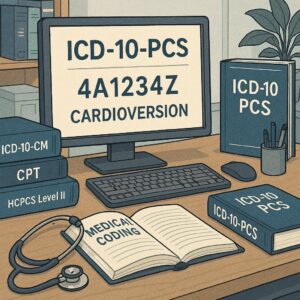
ICD-10-PCS Code for Cardioversion
2. Understanding the Clinical Procedure: What is Cardioversion?
Before a single character of a code can be assigned, a comprehensive understanding of the procedure is paramount. Cardioversion is not a single, monolithic action but a targeted therapy with specific variations, indications, and techniques.
2.1. The Electrical Storm: Tachyarrhythmias and Their Dangers
To appreciate cardioversion, one must first understand what it aims to correct: tachyarrhythmias. These are abnormal heart rhythms characterized by a fast heart rate, typically exceeding 100 beats per minute. However, the danger lies not just in the speed, but in the disorganization.
-
Atrial Fibrillation (AFib): The most common significant arrhythmia, where the atria (the heart’s upper chambers) quiver chaotically instead of contracting effectively. This stasis of blood can lead to clot formation, significantly increasing the risk of stroke.
-
Atrial Flutter: Similar to AFib but more organized; the atria beat very rapidly but in a regular pattern. It still carries a risk of inefficient pumping and clot formation.
-
Supraventricular Tachycardia (SVT): A broad term for rapid rhythms originating above the ventricles, often involving a short-circuit in the heart’s electrical system.
-
Ventricular Tachycardia (VT): A life-threatening rhythm originating in the ventricles (the lower chambers). It can degrade into Ventricular Fibrillation (VFib), which is a fatal rhythm without immediate treatment.
The goal of treating these arrhythmias is to restore sinus rhythm—the normal, coordinated rhythm set by the heart’s natural pacemaker, the sinoatrial (SA) node.
2.2. Electrical Cardioversion: Resetting the Heart’s Pacemaker
Electrical cardioversion is a controlled procedure where a synchronized direct current (DC) electrical shock is delivered to the heart through the chest wall. The term “synchronized” is crucial. The defibrillator is programmed to deliver the shock on the R-wave of the patient’s electrocardiogram (ECG) complex. This timing is essential to avoid delivering the shock during the vulnerable repolarization phase (the T-wave), which could inadvertently trigger a more dangerous arrhythmia like VFib.
The Procedure Workflow:
-
Patient Preparation: The procedure is often elective. Patients are typically sedated with short-acting anesthesia and are fasting. A critical step is ensuring anticoagulation therapy for several weeks prior if the arrhythmia (like AFib) has been present for more than 48 hours, to mitigate the risk of dislodging a clot and causing a stroke.
-
Equipment Setup: Electrode pads or paddles are placed on the patient’s chest (e.g., anterior-posterior or anterior-lateral positions). The defibrillator is connected to the patient via ECG leads.
-
Synchronization: The “sync” mode is activated on the defibrillator, which places a marker on the R-wave of the ECG display.
-
Energy Selection: The clinician selects an appropriate energy level (e.g., 50-200 joules for biphasic defibrillators, which are now standard).
-
Delivery of Shock: After confirming everyone is clear of the patient and the bed, the clinician presses the shock button. The device delivers the shock synchronized with the R-wave.
-
Assessment: The ECG is immediately assessed to see if sinus rhythm has been restored. If not, subsequent shocks with higher energy may be administered.
2.3. Chemical Cardioversion: A Pharmacological Approach
Chemical cardioversion achieves the same goal—restoring sinus rhythm—but through the administration of antiarrhythmic medications rather than an electrical shock. This can be performed in an acute setting with intravenous (IV) medications or as a planned therapy with oral medications.
Common Antiarrhythmic Drugs include:
-
Amiodarone
-
Flecainide
-
Propafenone
-
Ibutilide
-
Dofetilide
The choice between electrical and chemical cardioversion depends on various factors: the specific arrhythmia, its duration, the patient’s clinical stability, comorbidities, and potential side effects of the medications.
2.4. Key Differences: Cardioversion vs. Defibrillation
This is a critical distinction for coders, as the procedures have different codes.
Key Clinical Differences Between Cardioversion and Defibrillation
| Feature | Cardioversion | Defibrillation |
|---|---|---|
| Rhythm | Organized but undesired tachyarrhythmias (e.g., AFib, Atrial Flutter, SVT, VT with a pulse). | Disorganized, chaotic lethal rhythms (Pulseless VT, Ventricular Fibrillation, Pulseless Electrical Activity). |
| Patient Status | Patient typically has a pulse and is often (but not always) stable. | Patient is pulseless and unresponsive (cardiac arrest). |
| Synchronization | Synchronized shock (delivered on the R-wave). | Unsynchronized shock (delivered immediately). |
| Intent | To restore a normal rhythm in a beating heart. | To terminate a non-perfusing rhythm to allow a normal rhythm to restart. |
3. Navigating the ICD-10-PCS Framework: A Primer for the Procedure Section
ICD-10-PCS is a multi-axial, seven-character alphanumeric code set. Each character provides specific information about the procedure. The structure is as follows:
-
Section (1st Character): The broadest category (e.g., Medical and Surgical, Obstetrics, Measurement and Monitoring).
-
Body System (2nd Character): The general physiological system (e.g., Heart and Great Vessels, Central Nervous System).
-
Root Operation (3rd Character): The objective of the procedure—what the provider did.
-
Body Part (4th Character): The specific anatomical site.
-
Approach (5th Character): The technique used to reach the site.
-
Device (6th Character): Any device that remains after the procedure.
-
Qualifier (7th Character): A further specification of the procedure.
The medical record—the physician’s procedure note, the anesthesia record, and the nursing notes—is the sole source of truth for populating these characters.
4. Deconstructing the Code: The Root Operation “Conversion”
The cornerstone of accurately coding a cardioversion is understanding the root operation.
4.1. Official Definition and Intent
In the 2025 ICD-10-PCS Official Guidelines, the root operation Conversion is defined as: “Changing, with or without breaking the skin, the cardiac rhythm by applying electrical energy or pharmacologic therapy to restore the normal sinus rhythm of the heart.”
This definition perfectly encapsulates both electrical and chemical cardioversion. The intent is unequivocal: to restore normal sinus rhythm.
4.2. Why “Conversion” and Not “Restoration” or “Repair”?
ICD-10-PCS is built on precise definitions. While “restoration” might seem intuitive, it is not a defined root operation. “Repair” is a root operation, but it is defined as “restoring, to the extent possible, a body part to its normal anatomic structure and function,” which applies to physical repairs like a laceration, not a functional electrical issue. The system designers created “Conversion” specifically for this therapeutic intent.
5. A Step-by-Step Guide to Building the Cardioversion Code
Let’s build the code from the ground up, character by character.
5.1. Section: 5 – Measurement and Monitoring, or Section: 0 – Medical and Surgical?
This is a common point of confusion. The key is the intent and the method.
-
Section 0 – Medical and Surgical: This section is used for procedures that are therapeutic and involve either cutting, manipulation, or the use of a device to achieve a structural/functional change. Electrical cardioversion, which uses an external device to deliver a therapeutic shock, is coded here.
-
Section 5 – Measurement and Monitoring: This section is for diagnostic procedures whose sole purpose is to “determine a level, test a function, or detect an abnormality.” Since cardioversion is a therapeutic procedure, it does not belong in this section. Chemical cardioversion, while therapeutic, is also found in the Medical and Surgical section because it involves the administration of a substance to achieve a functional change, aligning with the definitions in that section.
Conclusion: For both electrical and chemical cardioversion, the 1st character is 0 (Medical and Surgical).
5.2. Body System: The Heart and Great Vessels (2)
The body system is straightforward. The procedure is performed on the heart to change its rhythm. Therefore, the 2nd character is 2 (Heart and Great Vessels).
5.3. Root Operation: Conversion (1)
As established in Section 4, the root operation is Conversion. In the table for the Medical and Surgical section and the Heart and Great Vessels body system, the 3rd character for Conversion is 1.
Our code so far is 021XXXX.
5.4. Body Part: The Specific Chamber (Atrium or Ventricle)
This character requires careful attention to the documentation of the arrhythmia.
-
Atrium: If the arrhythmia is Atrial Fibrillation or Atrial Flutter, the body part is the Atrium. The 4th character is W (Atrium, Right) or X (Atrium, Left). ICD-10-PCS does not have a bilateral atrium code. Per the ICD-10-PCS Official Guidelines, if a bilateral body part is not specified, and the procedure is performed on a non-bilateral body part (like the atria which are two distinct chambers), the body part should be assigned to the correct one if documented. If not specified, the default is often the right side, but a query may be needed. For simplicity and common practice, W (Atrium, Right) is frequently used for atrial arrhythmias.
-
Ventricle: If the arrhythmia is Ventricular Tachycardia (with a pulse), the body part is the Ventricle. The 4th character is L (Ventricle, Right) or M (Ventricle, Left). Similar to the atria, M (Ventricle, Left) is commonly used.
Examples:
-
For Atrial Fibrillation: 4th character = W
-
For Ventricular Tachycardia (with pulse): 4th character = M
Our code for AFib is now 021WXXX.
5.5. Approach: External (X)
The approach describes how the procedure was performed.
-
For electrical cardioversion, the shock is delivered through the chest wall without any internal incisions. This is the External approach.
-
For chemical cardioversion, the medication is administered intravenously or orally, which is also considered an External approach in the context of this root operation.
The 5th character for the External approach is X.
Our code is now 021WXXX.
5.6. Device: The Crucial Character (Z for Electrical, No Device for Chemical)
This is the character that definitively distinguishes between electrical and chemical cardioversion.
-
Electrical Cardioversion: The procedure involves the use of a cardioverter/defibrillator. While the machine itself is not implanted, the ICD-10-PCS table specifies that for the root operation Conversion, if the procedure is performed using an external energy source, the device character is Z (No Device). This is a specific instruction within the table for this root operation. The application of energy is temporary and no device remains.
-
Chemical Cardioversion: No device is used. The 6th character is also Z (No Device).
Therefore, for both types, the 6th character is Z.
Our code is now 021WXXZ.
5.7. Qualifier: The Goal – Restoring Normal Rhythm (Z)
The qualifier provides the final piece of specificity. For the root operation Conversion, the qualifier specifies the goal of the procedure. The only option in the table is Z (No Qualifier), which, in this context, signifies the conversion to normal sinus rhythm. There is no alternative qualifier for a failed cardioversion; the code represents the procedure performed, not the outcome.
The 7th character is Z.
The Final Code:
The complete, valid ICD-10-PCS code for an external electrical cardioversion of the atrium (for atrial fibrillation or flutter) is 021W0ZZ.
Let’s verify the characters:
-
0 – Medical and Surgical Section
-
2 – Heart and Great Vessels Body System
-
1 – Root Operation: Conversion
-
W – Body Part: Atrium, Right
-
0 – Approach: External
-
Z – Device: No Device
-
Z – Qualifier: No Qualifier
*[Image: A flowchart illustrating the step-by-step build of the ICD-10-PCS code 021W0ZZ for electrical cardioversion, with decision points for body part and approach.]*
6. Coding Scenarios and Case Studies: From Documentation to Code
Theory is best understood through application. Let’s examine several real-world scenarios.
6.1. Case Study 1: Elective Electrical Cardioversion for Atrial Fibrillation
-
Documentation: “The patient was brought to the cardiac procedure room. Under conscious sedation, defibrillator pads were placed in the anterior-posterior position. The cardioverter was placed in synchronized mode. A synchronized shock of 100 J was delivered. Post-shock, the rhythm converted to normal sinus rhythm. The patient tolerated the procedure well.”
-
Coding Analysis:
-
Procedure: Electrical Cardioversion.
-
Arrhythmia: Atrial Fibrillation (affecting the atria).
-
Body Part: Atrium. We will use
W(Atrium, Right). -
Approach: External (
X). -
Device: No Device (
Z).
-
-
ICD-10-PCS Code:
021W0ZZ(Conversion of Atrium, Right, External Approach).
6.2. Case Study 2: Chemical Cardioversion for Atrial Flutter
-
Documentation: “Patient admitted with new-onset atrial flutter with rapid ventricular response. After adequate anticoagulation was confirmed, the decision was made for chemical cardioversion. The patient was started on a IV infusion of Amiodarone. After 6 hours of infusion, a repeat ECG showed conversion to normal sinus rhythm.”
-
Coding Analysis:
-
Procedure: Chemical Cardioversion.
-
Arrhythmia: Atrial Flutter (affecting the atria).
-
Body Part: Atrium. We will use
W(Atrium, Right). -
Approach: External (
X). The administration of the drug via IV is captured by this approach in this context. -
Device: No Device (
Z).
-
-
ICD-10-PCS Code:
021W0ZZ(Conversion of Atrium, Right, External Approach).
Important Note: You will observe that the code is the same for both electrical and chemical cardioversion targeting the atrium. This is a feature of the ICD-10-PCS system for this root operation. The method (electrical vs. chemical) is not differentiated by the code itself but is implied by the clinical context and the root operation definition. The administration of the drug (Amiodarone) would also be coded separately, typically with a code from the Administration section (3E0), but the therapeutic conversion itself is coded with 021W0ZZ.
6.3. Case Study 3: Emergent Synchronized Cardioversion for Unstable SVT
-
Documentation: “Patient presented to the ED with palpitations and hypotension. ECG showed SVT at a rate of 180. The patient was alert but hypotensive (BP 80/50) and diaphoretic. Emergent synchronized cardioversion was performed with 50J, successfully converting the rhythm to sinus tachycardia.”
-
Coding Analysis:
-
Procedure: Electrical Cardioversion (synchronized).
-
Arrhythmia: Supraventricular Tachycardia (SVT), which originates from above the ventricles, implicating the atria/AV node.
-
Body Part: Atrium. We will use
W(Atrium, Right). -
Approach: External (
X). -
Device: No Device (
Z).
-
-
ICD-10-PCS Code:
021W0ZZ(Conversion of Atrium, Right, External Approach).
7. Common Pitfalls and How to Avoid Them
7.1. Confusing Cardioversion with Defibrillation
This is the most significant error. Defibrillation for cardiac arrest (pulseless VT/VFib) is coded to 5A2204Z (Performance of Cardiac Defibrillation) in the Measurement and Monitoring section. Using the cardioversion code 021W0ZZ for a cardiac arrest scenario would be clinically and administratively incorrect.
How to Avoid: Scrutinize the record for the patient’s status. Was there a pulse? The terms “synchronized” and “unsynchronized” are key indicators.
7.2. Misidentifying the Arrhythmia and Body Part
Coding cardioversion for Ventricular Tachycardia as 021W0ZZ (atrium) is wrong. It must be 021M0ZZ (ventricle).
How to Avoid: Read the ECG interpretation in the procedure note. Do not assume the body part.
7.3. Overlooking the Distinction Between Electrical and Chemical
While they share a code, understanding the distinction is vital for clinical understanding and for knowing when to assign additional codes (e.g., for IV administration). Do not use a code from the Administration section for the conversion itself.
8. The Role of Documentation and Physician Queries
Precise coding hinges on precise documentation. If the procedure note states “cardioversion” but the context suggests defibrillation for a pulseless patient, a query is mandatory. If the specific atrium (right/left) is not documented, a query may be needed to ensure accurate body part assignment, though as per guidelines, a default may be used.
9. Conclusion: The Rhythm of Accuracy in Procedural Coding
Mastering the ICD-10-PCS code for cardioversion requires a synthesis of clinical knowledge and coding expertise. The procedure, whether electrical or chemical, is definitively represented by the root operation Conversion in the Medical and Surgical section. The resulting code, such as 021W0ZZ for an atrial arrhythmia, is a precise administrative representation of a life-restoring clinical intervention. By understanding the nuances of the procedure, the logic of the coding system, and the critical importance of the medical record, healthcare professionals can ensure that this vital procedure is documented with the accuracy it demands, maintaining the integrity of the data that drives modern healthcare forward.
10. Frequently Asked Questions (FAQs)
Q1: The cardioversion was attempted but failed to restore normal sinus rhythm. Do I use a different code?
A: No. ICD-10-PCS codes represent the procedure performed, not the outcome. You would still assign 021W0ZZ for an attempted electrical cardioversion of the atrium, regardless of its success.
Q2: How do I code a cardioversion that is performed internally during an open-heart surgery (e.g., using internal paddles)?
A: The approach would change. An internal cardioversion during a sternotomy would be coded with an Open (0) approach. The code would be 021W00Z. The body system and root operation remain the same.
Q3: Is there a separate code for a transvenous cardioversion (where a catheter is threaded to the heart)?
A: This would be coded with a different approach. If the catheter is placed percutaneously, the approach would be Percutaneous (3). The code would be 021W03Z.
Q4: Why is the device character “Z” for electrical cardioversion when a defibrillator is used?
A: This is a specific instruction within the ICD-10-PCS table for the root operation Conversion. The device character represents a device that remains after the procedure. The external cardioverter/defibrillator is not left in the patient; it is an external energy source used to perform the procedure. Therefore, “No Device” is correct.
Date: November 19, 2025
Author: The Healthcare Coding Specialist
Disclaimer: This article is intended for educational and informational purposes only and is based on the ICD-10-PCS coding system as of the 2025 fiscal year. It does not constitute official coding advice. Medical coders must always consult the most current official ICD-10-PCS guidelines, code sets, and their facility’s coding policies when assigning codes for patient encounters. The author and publisher are not responsible for any errors or omissions or for any outcomes resulting from the use of this information.