In the intricate ecosystem of modern healthcare, the seamless flow of accurate information is as vital as the clinical procedures themselves. At the heart of this information system lies medical coding, a discipline that translates complex patient diagnoses and procedures into a universal, standardized language. For the procedural coder, few tasks are as deceptively simple yet fraught with potential pitfalls as accurately classifying the placement of a nasogastric (NG) tube. This slender, flexible tube, passed from the nose to the stomach, is a cornerstone of patient management across countless clinical settings—from the emergency department and intensive care unit to general medical-surgical floors. Its applications are diverse, ranging from life-saving decompression to essential nutritional support. However, this very diversity of purpose creates a significant challenge for the ICD-10-PCS coder. The system demands precision, and the choice of a single alphanumeric character can fundamentally alter the meaning, and ultimately, the financial and statistical implications of the coded data. This article serves as a definitive, exhaustive guide to navigating the nuanced landscape of ICD-10-PCS coding for NG tube procedures. We will embark on a detailed journey, dissecting the anatomy of the code, exploring the clinical scenarios that dictate code selection, and illuminating the path to coding accuracy that ensures compliance, supports appropriate reimbursement, and contributes to the integrity of invaluable healthcare data.
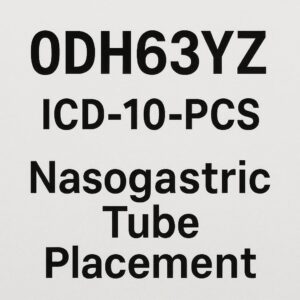
ICD-10-PCS Code for Nasogastric Tube Placement
Chapter 1: Deconstructing the Nasogastric Tube – Form, Function, and Clinical Indications
Before a coder can accurately represent a procedure in ICD-10-PCS, they must first possess a fundamental understanding of the procedure itself, the device involved, and the clinical intent behind its use. A nasogastric tube is not merely a piece of plastic; it is a therapeutic tool with specific design features tailored to its function.
Anatomy of an NG Tube: Modern NG tubes are typically made from polyurethane or silicone, materials chosen for their biocompatibility and flexibility. Key features include:
-
Length and Markings: They are long enough to traverse the distance from the nostril to the stomach (approximately 50-70 cm for adults) and are marked with incremental measurements to guide insertion depth.
-
Lumen: This is the inner channel through which substances flow. Tubes can be single-lumen or double-lumen.
-
Distal Tip and Eyes: The end of the tube placed in the stomach has openings or “eyes” to allow for the aspiration of contents or the instillation of fluids and nutrition.
-
Proximal Connectors: The external end is designed to connect to drainage bags, suction devices, or feeding pump sets.
Primary Clinical Indications: The reason for NG tube placement is the single most important factor in determining the correct ICD-10-PCS code. The two primary purposes are:
-
Decompression: This is the removal of stomach contents, including gas, fluids, and gastric secretions. It is primarily used to treat or prevent bowel obstruction, paralytic ileus, or abdominal distension, which can compromise respiratory function or lead to vomiting and aspiration. The most common tube for this purpose is the Salem Sump™ tube, which features a double lumen—a large primary lumen for drainage and a smaller blue “pigtail” lumen that serves as an air vent to prevent mucosal suctioning.
-
Clinical Scenarios: Post-operative bowel surgery, small bowel obstruction, pancreatitis, trauma.
-
-
Enteral Feeding/Nutrition: When a patient cannot meet their nutritional needs orally but has a functional gastrointestinal tract, an NG tube can serve as a conduit for liquid nutrition. Feeding tubes are often smaller in diameter and may be made of softer materials for long-term comfort.
-
Clinical Scenarios: Dysphagia following a stroke, neurological impairment, head and neck cancer, severe burns.
-
-
Other Indications: These include gastric lavage (e.g., for drug overdose or upper GI bleeding), administration of medications, or diagnostic aspiration of gastric contents.
Understanding this clinical context is not optional for the coder; it is the very foundation upon which accurate code assignment is built. The physician’s documentation of the procedure’s purpose will directly point to the correct ICD-10-PCS root operation.
Chapter 2: The Architecture of ICD-10-PCS – A Primer for the Procedural Coder
ICD-10-PCS (International Classification of Diseases, Tenth Revision, Procedure Coding System) is a multi-axial, seven-character alphanumeric system. Unlike its predecessor, which was largely based on common procedure names, ICD-10-PCS is built on a logical structure where each character has a specific meaning, providing a precise definition of the procedure performed. Let’s break down this architecture, as mastery of it is essential for coding any procedure, including NG tube placement.
-
Character 1: Section – This identifies the broad section where the code is located. For NG tube placement, this is almost always the Medical and Surgical section (value 0).
-
Character 2: Body System – This specifies the general body system on which the procedure was performed. For an NG tube terminating in the stomach, the correct body system is Gastrointestinal System (value D). If a tube is placed that goes past the stomach into the jejunum (a nasojejunal tube), the body system would be the same, as the small intestine is part of the gastrointestinal system.
-
Character 3: Root Operation – This is the cornerstone of the code and represents the objective or intent of the procedure. It is the most critical character for NG tube coding and the source of most confusion. The root operation describes what the provider did, not how they did it. We will explore the relevant root operations in immense detail in the following chapters. Key candidates include:
-
Insertion (value H)
-
Change (value W)
-
Removal (value P)
-
Drainage (value 9)
-
-
Character 4: Body Part – This character specifies the precise body part upon which the procedure was performed. For a standard NG tube, this is the Stomach (value 6). For a nasojejunal tube, it would be the Jejunum (value 8).
-
Character 5: Approach – This describes the technique used to reach the procedure site. For NG tube placement, the approach is always through a natural or artificial opening—the nose and esophagus—making the correct value Via Natural or Artificial Opening (value 7). Percutaneous and open approaches are not used for standard NG tube insertion.
-
Character 6: Device – This character specifies the type of device that remains in the patient after the procedure. For NG tubes, this is critical. The device is Monitoring Device, Drainage Device, or Feeding Device (value J). The qualifier in the 7th character will further define it.
-
Character 7: Qualifier – This character provides additional information about the procedure. In the context of an NG tube, the qualifier is used to specify the type of device that was inserted. This is where we distinguish between a drainage tube and a feeding tube. Values include:
-
Nasogastric (value 4)
-
Feeding (value 6)
-
Intraluminal Device (value Z) – Used for certain other scenarios.
-
The following table provides a visual representation of this code structure for a common scenario.
ICD-10-PCS Code Structure Breakdown for NG Tube Insertion for Decompression
| Character | Position | Value | Meaning |
|---|---|---|---|
| 1 | Section | 0 | Medical and Surgical |
| 2 | Body System | D | Gastrointestinal System |
| 3 | Root Operation | H | Insertion |
| 4 | Body Part | 6 | Stomach |
| 5 | Approach | 7 | Via Natural or Artificial Opening |
| 6 | Device | J | Monitoring, Drainage, or Feeding Device |
| 7 | Qualifier | 4 | Nasogastric |
Resulting Code: 0DH67J4 – Insertion of Feeding Device into Stomach, Via Natural or Artificial Opening, Nasogastric
Note: This code, 0DH67J4, is specifically for a feeding tube. We will clarify the distinction in Chapter 4.
Chapter 3: The Root Operation Conundrum – “Insertion,” “Change,” “Removal,” and “Drainage”
The selection of the root operation is the pivotal decision in coding an NG tube procedure. The official ICD-10-PCS guidelines provide definitions that must be applied rigorously. Let’s examine the four primary root operations in play.
1. Insertion (Root Operation H)
-
Official Definition: “Putting in a non-biological device that remains in the body after the procedure is completed.”
-
Application: This root operation is used for the initial placement of an NG tube where the intent is for the tube to remain in place for a period of time. The key concept is that a device is being placed into the body and will stay there after the procedure is over. This applies to both feeding and drainage tubes.
2. Change (Root Operation W)
-
Official Definition: “Taking out a device and putting back an identical or similar device in the same anatomical location.”
-
Application: This is used when an existing NG tube is removed and immediately replaced with a new one. The procedure involves both a removal and a new insertion, but it is bundled into the single root operation “Change.” This is common when a tube is clogged, malfunctioning, or needs to be replaced for hygiene reasons.
3. Removal (Root Operation P)
-
Official Definition: “Taking out a device from a body part.”
-
Application: This is a straightforward code used when an NG tube is taken out and is not replaced during the same procedural episode.
4. Drainage (Root Operation 9)
-
Official Definition: “Taking out fluids and/or gases from a body part.”
-
Application: This is a crucial and often misunderstood distinction. The “Drainage” root operation is used when the procedure’s sole purpose is to remove the contents of the stomach without the intent of leaving a device in place. This is a single, episodic event. The classic example is the placement of an NG tube in the Emergency Department to empty the stomach of a patient with an overdose or acute bleeding, with the tube being removed immediately after the contents are drained. If the tube is left in for ongoing decompression, it is an “Insertion,” not “Drainage.”
The coder must carefully review the procedure note to determine the physician’s intent. The question is: Was the tube placed to stay (Insertion) or was it placed only for a one-time evacuation (Drainage)?
Chapter 4: A Deep Dive into the “Insertion” Root Operation (0DH)
The “Insertion” root operation is the most commonly used for NG tube placement in an inpatient setting. Let’s construct the complete code based on the device qualifier.
Building the Code for a Drainage/Decompression Tube:
When the physician documents the placement of an NG tube for the purpose of decompression (e.g., “NG tube placed to low intermittent suction for ileus”), the correct code is:
-
0DH67J4 – Insertion of Feeding Device into Stomach, Via Natural or Artificial Opening, Nasogastric
Wait—this seems counterintuitive. The descriptor says “Feeding Device,” but we are using it for a drainage tube. This is a known point of confusion in ICD-10-PCS. The device character (6th character) is “J” for “Monitoring, Drainage, or Feeding Device.” The type of device is then specified in the qualifier (7th character). The qualifier “4” means “Nasogastric.” In the ICD-10-PCS table for the Gastrointestinal System, the qualifier “Nasogastric” is used to represent a standard NG tube, which is inherently a drainage device. The term “Feeding Device” in the code’s long descriptor is a relic of the table structure but the qualifier “Nasogastric” correctly identifies its primary decompression function.
Building the Code for a Feeding Tube:
When the physician’s documentation clearly states the tube is for enteral feeding (e.g., “Placement of Dobhoff feeding tube for nutritional support”), a different qualifier is used.
-
0DH67J6 – Insertion of Feeding Device into Stomach, Via Natural or Artificial Opening, Feeding
Here, the qualifier “6” specifically means “Feeding.” This would be used for tubes like a Dobhoff tube or other small-bore feeding tubes, even if they are placed nasogastrically.
Coding for a Nasojejunal (NJ) Tube:
If the tube is advanced past the stomach into the jejunum (the second part of the small intestine), the body part character changes.
-
0DH88J6 – Insertion of Feeding Device into Jejunum, Via Natural or Artificial Opening, Feeding
The body part is now “8” for Jejunum, and the approach remains “7.” The qualifier “6” for Feeding is typically used, as NJ tubes are almost exclusively for feeding.
Chapter 5: Navigating the “Change” Procedure (2W3)
The “Change” root operation is found in the Administration section (Section 2), not the Medical and Surgical section. This is because the procedure involves both the removal of a foreign body and the introduction of a new one for continuing treatment.
Building the Code for Changing an NG Tube:
-
Character 1 (Section): 2 – Administration
-
Character 2 (Body System): W – Anatomical Regions
-
Character 3 (Root Operation): 3 – Change
-
Character 4 (Body Region): 8 – Gastrointestinal Tract
-
Character 5 (Approach): X – External
-
Character 6 (Device): C – Tube
-
Character 7 (Qualifier): 4 – Nasogastric
Resulting Code: 2W38XC4 – Change of Tube in Gastrointestinal Tract, External Approach, Nasogastric
This code is used whether you are changing a drainage tube for another drainage tube or a feeding tube for another feeding tube, as long as the type (Nasogastric) remains the same. The “External Approach” signifies that the procedure is performed from outside the body.
Chapter 6: Understanding “Removal” (0PH) and “Drainage” (0D9)
The “Removal” Root Operation:
This is a simple code from the Medical and Surgical section, used when a tube is taken out and not replaced.
-
0PH6XJZ – Removal of Monitoring Device from Stomach, External Approach
This code is generic for the removal of any device (value J) from the stomach. The approach is “External,” and the qualifier is “No Qualifier” (Z).
The “Drainage” Root Operation:
As discussed, this is for a one-time therapeutic evacuation. The code does not include a device character because a device is not left in place.
-
0D960ZZ – Drainage of Stomach, Via Natural or Artificial Opening
-
0D963ZZ – Drainage of Stomach, Via Natural or Artificial Opening Endoscopic
This code is appropriate only when the documentation supports that the tube was placed, used for drainage, and then removed in a single episode of care. If the tube remains in place, “Insertion” is the correct root operation.
Chapter 7: The Seventh Character – Qualifiers and Devices Demystified
The 7th character, the Qualifier, is where the final layer of specificity is added. In the context of NG tubes in the Gastrointestinal system, this character is used almost exclusively to define the type of tube. Let’s clarify the common qualifiers:
-
Qualifier 4 – Nasogastric: This represents a standard, typically larger-bore tube used primarily for decompression and drainage of the stomach (e.g., Salem Sump). It is the default code for a drainage tube.
-
Qualifier 6 – Feeding: This represents a tube whose primary designated purpose is the instillation of nutritional formula. This includes both nasogastric (NG) and nasojejunal (NJ) feeding tubes.
-
Qualifier Z – No Qualifier: This is used in certain other root operations, like Removal, where the specific type of tube is not further specified.
The coder’s decision between “4” and “6” hinges entirely on the physician’s documented intent for the tube. If the note says “for decompression” or “to suction,” use the qualifier for Nasogastric (4). If it says “for feeding” or “for nutrition,” use the qualifier for Feeding (6).
Chapter 8: Complex Clinical Scenarios and Coding Challenges
Real-world medical coding is rarely textbook. Here are some complex scenarios and how to approach them.
Scenario 1: The Multi-Purpose Tube
A patient has an NG tube placed post-operatively. The note states: “NG tube to low intermittent suction. May be used for medication administration.” The primary purpose is clearly decompression. The fact that it can be used for medications does not change its primary function. The correct code is 0DH67J4.
Scenario 2: Conversion of Tube Function
A patient is admitted with a bowel obstruction, and a Salem Sump tube (0DH67J4) is placed for decompression. Three days later, the obstruction resolves, and the physician writes an order: “Clamp NG tube and begin tube feeds.” The function of the tube has changed, but the physical tube itself has not. Do you code a “Change”? No. A “Change” procedure requires physical removal and replacement of the device. Since the same tube is now being used for a different purpose, no new procedure code is assigned. The original “Insertion” code remains. The change in function is captured in the clinical documentation but does not warrant a new procedural code.
Scenario 3: Failed Placement
A physician attempts to place an NG tube but is unsuccessful due to patient intolerance or anatomical issues. According to ICD-10-PCS guidelines, if a procedure is attempted but not completed, it is not coded. Therefore, no code is assigned for the failed attempt.
Scenario 4: Placement with Fluoroscopic Guidance
If a physician uses fluoroscopic guidance to assist in placing a difficult NG or NJ tube, the guidance itself is a separate procedure. The NG tube placement would be coded as described (e.g., 0DH67J6). The fluoroscopic guidance would be coded separately from the Imaging section, typically BW23Y0Z – Fluoroscopy of Abdomen.
Chapter 9: The Impact of Accurate Coding – Compliance, Reimbursement, and Data Integrity
The consequences of inaccurate NG tube coding extend far than a simple data entry error.
-
Compliance and Audits: Miscoding can be construed as fraud and abuse. A pattern of coding “Insertion” for what was actually a “Drainage” procedure could trigger an audit from payers like Medicare Recovery Audit Contractors (RACs), resulting in financial penalties and reputational damage.
-
Reimbursement: Under the Inpatient Prospective Payment System (IPPS), procedures are grouped into Medicare Severity Diagnosis-Related Groups (MS-DRGs). While a single NG tube insertion may not be a major procedure that drives DRG assignment, the cumulative accuracy of all coded procedures affects the complexity and ultimately the reimbursement for the patient’s stay. Furthermore, for other payment models, every procedure code contributes to the overall cost picture.
-
Data Integrity and Research: Healthcare data is used for public health tracking, clinical research, and quality improvement initiatives. If NG tube placements are consistently miscoded, the data on the frequency and type of these procedures becomes unreliable. This can skew research on post-operative complications, nutritional support outcomes, and resource utilization.
Conclusion
Accurate ICD-10-PCS coding for nasogastric tube placement is a skill that blends clinical knowledge with meticulous attention to the system’s formal definitions. The journey from a physician’s procedure note to a final, valid code requires a disciplined, step-by-step analysis of the root operation, body part, and device qualifier. By anchoring code selection in the documented clinical intent—distinguishing between insertion for ongoing therapy and drainage for immediate evacuation—the professional coder ensures compliance, supports fair reimbursement, and upholds the integrity of the healthcare data ecosystem. Mastery of this seemingly simple procedure is a mark of true coding expertise.
Frequently Asked Questions (FAQs)
Q1: What is the correct ICD-10-PCS code for placing an NG tube for suction/decompression?
A: The correct code is 0DH67J4 (Insertion of Feeding Device into Stomach, Via Natural or Artificial Opening, Nasogastric). Despite the word “Feeding” in the descriptor, the qualifier “4” correctly identifies it as a nasogastric (decompression) tube.
Q2: How do I code the placement of a Dobhoff feeding tube?
A: For a nasogastric Dobhoff tube placed for feeding, the code is 0DH67J6 (Insertion of Feeding Device into Stomach, Via Natural or Artificial Opening, Feeding). If it is a nasojejunal (NJ) Dobhoff tube, the code is 0DH88J6.
Q3: What is the difference between the “Insertion” and “Drainage” root operations for an NG tube?
A: Use “Insertion” (0DH) if the tube is placed and left in the body for ongoing use (e.g., connected to suction for several days). Use “Drainage” (0D960ZZ) only if the tube is placed, used to evacuate the stomach contents immediately, and then removed in the same episode (e.g., gastric lavage for an overdose).
Q4: How do I code the replacement of an existing NG tube with a new one?
A: This is coded as a “Change” procedure. The correct code is 2W38XC4 (Change of Tube in Gastrointestinal Tract, External Approach, Nasogastric).
Q5: What code do I use if an NG tube is removed and not replaced?
A: The correct code is 0PH6XJZ (Removal of Monitoring Device from Stomach, External Approach).