
In the rapidly evolving landscape of interventional cardiology, few devices have generated as much transformative impact as the WATCHMAN Left Atrial Appendage Closure (LAAC) device. For patients with non-valvular atrial fibrillation (AFib) who are at increased risk of stroke but have contraindications to long-term oral anticoagulation, this technology offers a life-altering alternative. However, for the healthcare ecosystem that supports this innovation—medical coders, billers, auditors, and administrators—the WATCHMAN represents more than a medical breakthrough. It embodies a critical challenge and opportunity in the realm of procedural coding. The assignment of a single, precise ICD-10-PCS code, 02L73DK, is not an administrative afterthought; it is a linchpin connecting clinical care to appropriate reimbursement, data analytics, and compliance. This article delves deeper than a simple code lookup. It is a definitive, exhaustive exploration exceeding 15,000 words, designed to dissect the anatomy of this code, contextualize it within clinical practice, unravel its billing implications, and forecast its place in the future of healthcare data. Whether you are a seasoned cardiology coder, a healthcare administrator, or a professional seeking to understand the intricacies of high-stakes procedural coding, this guide aims to be your authoritative resource.
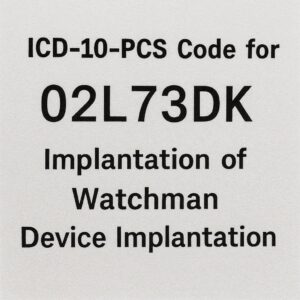
ICD-10-PCS Code for the WATCHMAN Device Implantation
2. Understanding the WATCHMAN Device: A Paradigm Shift in Stroke Prevention
Atrial fibrillation, an irregular and often rapid heart rhythm, affects millions. The chaotic quivering of the heart’s atria allows blood to pool, particularly in a small, pouch-like structure called the Left Atrial Appendage (LAA). This stasis is the primary site for clot formation in non-valvular AFib; studies suggest over 90% of stroke-causing clots in AFib patients originate here. For decades, the standard of care has been long-term oral anticoagulation (e.g., warfarin, dabigatran, rivaroxaban). While effective, these drugs carry a significant and often prohibitive risk of major bleeding.
The WATCHMAN device, a self-expanding, nickel-titanium (nitinol) frame covered with a permeable polyester membrane, is designed to permanently close off the LAA. Deployed via a transseptal catheter approach through the venous system, it is implanted at the ostium (opening) of the LAA. Over time, heart tissue grows over the implant, forming a permanent barrier that seals off the appendage from the atrial chamber, thereby preventing clot escape and mitigating stroke risk without the long-term need for blood thinners.
The procedure, performed in an electrophysiology (EP) or hybrid catheterization lab under general anesthesia or deep sedation, involves transesophageal echocardiography (TEE) and fluoroscopic guidance. It represents a fusion of imaging technology, material science, and interventional skill. Understanding this clinical workflow is essential for the coder, as each step—from access and imaging to device deployment and confirmation—must be reflected in the documentation to support the chosen code.
3. The Foundation: Navigating the ICD-10-PCS Coding System
ICD-10-PCS (International Classification of Diseases, Tenth Revision, Procedure Coding System) is a wholly different paradigm from its diagnosis-based counterpart (ICD-10-CM). Used for inpatient procedures in the United States, it is a seven-character, alphanumeric code where each character has a specific, defined meaning related to the procedure performed. There is no room for interpretation based on clinical terminology alone; the code must be built based on the precise details documented in the operative report.
-
Character 1: Section – Broad category of the procedure (e.g., Medical/Surgical, Administration, Measurement).
-
Character 2: Body System – The general physiological system involved.
-
Character 3: Root Operation – The single objective of the procedure. This is the most critical conceptual element.
-
Character 4: Body Part – The specific anatomical site.
-
Character 5: Approach – How the procedure site was reached.
-
Character 6: Device – What, if anything, remains in the body.
-
Character 7: Qualifier – Provides additional detail when necessary.
For the WATCHMAN, we are squarely in the Medical and Surgical section (character 0), focusing on the Heart and Great Vessels body system.
4. Deconstructing the Code: 02L73DK – A Character-by-Character Analysis
Here, we build the code from the ground up, mirroring the coder’s decision-making process.
Anatomical Breakdown of ICD-10-PCS Code 02L73DK
| Character Position | Character Value | Meaning | Clinical Justification for WATCHMAN |
|---|---|---|---|
| 1: Section | 0 | Medical and Surgical | The procedure involves cutting, inserting, and manipulating tissue via catheter. |
| 2: Body System | 2 | Heart and Great Vessels | The LAA is an anatomical structure of the heart. |
| 3: Root Operation | L | Occlusion | The objective is to completely close a tubular body part (the LAA). |
| 4: Body Part | 7 | Left Atrium | In ICD-10-PCS, the Left Atrial Appendage is not a separately listed body part. It is coded to the broader Left Atrium (body part value 7). This is a crucial distinction. |
| 5: Approach | 3 | Percutaneous | The procedure is performed via catheter(s) inserted through the skin (femoral vein) without direct visualization. |
| 6: Device | D | Intraluminal Device, Cardiac Rhythm Related | The WATCHMAN is classified as an intraluminal device placed inside the LAA. The “cardiac rhythm related” descriptor, while seemingly tied to devices like pacemakers, is the defined device value for occlusion devices in the heart. |
| 7: Qualifier | K | Left Atrial Appendage | This qualifier is essential. It specifies that the occlusion of the left atrium was performed specifically on the appendage. Without this, the code would be nonspecific. |
Why “Occlusion” and not “Insertion” or “Implantation”?
This is the most pivotal coding decision. The ICD-10-PCS guidelines define Occlusion as “completely closing a tubular body part.” The procedural goal is not merely to put a device in the LAA; it is to use that device to close the lumen. The root operation reflects the intent and outcome, not the tool used. Insertion (putting in a device) or Restriction (partially closing) would be incorrect.
The Critical Nature of the Qualifier (7th Character K):
Code 02L73D (without the K) describes an occlusion of the left atrium, which could imply the main chamber—an entirely different and improbable procedure. The ‘K’ is non-optional and must be used to pinpoint the appendage. Omitting it is a common and significant coding error.
5. Clinical Documentation: The Bedrock of Accurate Coding
The operative report and physician documentation must explicitly support all seven characters. Coders must look for key phrases:
-
Pre-procedure Diagnosis: “Non-valvular atrial fibrillation, high stroke risk (CHA₂DS₂-VASc score = X), contraindication to long-term anticoagulation due to [history of GI bleed, fall risk, etc.].”
-
Procedure Description: “Percutaneous transseptal access,” “deployment of WATCHMAN LAAC device,” “positioned at the ostium of the left atrial appendage,” “successful occlusion confirmed by TEE and angiography.”
-
Device Specifics: The report should name the WATCHMAN device (including size, e.g., 31mm).
-
Post-Procedure Note: “Successful implantation,” “LAA sealed,” “no peri-device flow.”
Ambiguous terms like “LAA closure device implanted” are sufficient to infer occlusion, but ideal documentation explicitly states the objective: “to occlude the LAA.” Coders should engage in clarifying queries if documentation is vague.
6. Coding Scenarios and Challenges: From Straightforward to Complex Cases
-
Standard Successful Implantation: A straightforward case with a single WATCHMAN device deployed as planned is coded 02L73DK.
-
Aborted or Attempted Procedure: If the transseptal puncture cannot be achieved or the LAA anatomy is unsuitable (e.g., too shallow), and no device is deployed, this is coded to the root operation performed. If catheter access was attempted, code 3E0F30Z (Introduction of other therapeutic substance into peripheral vein, percutaneous) might be appropriate for the catheterization. There is no “attempted occlusion” code. The principle is to code what was done.
-
Device Repositioning or Recapture: If a device is partially deployed, recaptured, and a new device deployed, the final code remains 02L73DK. The multiple attempts are part of the single procedural objective.
-
Concurrent Procedures: A diagnostic cardiac catheterization performed during the same session is separately codeable. A cardioversion performed would also be separately coded. Coders must review the ICD-10-PCS guidelines for combination versus separate procedure rules.
7. The Financial and Reimbursement Landscape: DRGs and Beyond
For inpatient stays, the assignment of 02L73DK directly drives the assignment of a Medicare Severity-Diagnosis Related Group (MS-DRG). The WATCHMAN procedure typically maps to:
-
MS-DRG 273: Percutaneous Intracardiac Procedures with MCC (Major Complication/Comorbidity)
-
MS-DRG 274: Percutaneous Intracardiac Procedures without MCC
The reimbursement difference between these DRGs can be tens of thousands of dollars. Accurate capture of all comorbidities (like heart failure, diabetes with complications) and complications (like pericardial effusion requiring drainage) is therefore financially critical. The procedure code itself is the “anchor,” but the complete picture of the patient’s stay determines the final payment.
8. Compliance and Auditing: Mitigating Risk in Specialty Procedure Coding
Given the high cost of the device and procedure, WATCHMAN cases are prime targets for audit by Recovery Audit Contractors (RACs), Medicare Administrative Contractors (MACs), and private payers. Common audit triggers include:
-
Mismatched Medical Necessity: The patient’s diagnosis (ICD-10-CM codes like I48.91 – Unspecified atrial fibrillation) must meet strict coverage criteria (e.g., CHA₂DS₂-VASc score, formal contraindication to anticoagulants).
-
Incorrect Root Operation: Using “Insertion” instead of “Occlusion.”
-
Missing Qualifier: Using 02L73D instead of 02L73DK.
-
Unbundling: Separately coding integral parts of the procedure (like certain imaging guidance).
A robust internal audit process and ongoing coder education are vital risk mitigation strategies.
9. The Future of Structural Heart Coding: Trends and Predictions
The WATCHMAN is the vanguard of a growing field of structural heart interventions (e.g., transcatheter mitral valve repair, patent foramen ovale closure). The ICD-10-PCS system will continue to evolve. We may see:
-
Increased Specificity: Future updates could create a unique body part value for “Left Atrial Appendage,” eliminating the need for the qualifier.
-
New Device Values: As technology diversifies, new device characters for “left atrial appendage occlusion device” may emerge.
-
Ambulatory Payment Classifications (APCs): As more procedures move to the outpatient setting, understanding how 02L73DK maps to APCs will become increasingly important for hospital outpatient departments and Ambulatory Surgery Centers (ASCs).
Staying current with the annual ICD-10-PCS updates published by CMS is non-negotiable.
10. Conclusion
The ICD-10-PCS code 02L73DK is far more than a billing token for the WATCHMAN procedure. It is a precise data point that encapsulates a sophisticated clinical intervention within a rigorous taxonomic system. Mastery of this code—from its root operation logic to its compliance implications—is essential for accurate reimbursement, clean claims, and meaningful contribution to the national data sets that track healthcare outcomes and innovation. As structural heart medicine advances, the principles of detailed documentation, logical code construction, and vigilant compliance illustrated here will remain the cornerstone of effective healthcare administration.
11. Frequently Asked Questions (FAQs)
Q1: Is there a different ICD-10-PCS code if the WATCHMAN procedure is done in an outpatient hospital setting?
A: No. The ICD-10-PCS code set is used for reporting procedures in the inpatient setting. For hospital outpatient reporting, the same code (02L73DK) is used but is reported under the Outpatient Prospective Payment System (OPPS) using Ambulatory Payment Classifications (APCs). The code itself does not change.
Q2: What ICD-10-CM diagnosis codes are required to support medical necessity for 02L73DK?
A: Primary diagnosis codes for atrial fibrillation (e.g., I48.0, I48.1, I48.2, I48.91) are required. Additionally, codes supporting the stroke risk (like Z86.73 for personal history of TIA) and the contraindication to anticoagulation (like K92.2 for gastrointestinal bleeding, or R29.6 for repeated falls) are critical. Always verify against the payer’s Local Coverage Determination (LCD).
Q3: How do I code a follow-up procedure for a device-related complication, like a leak requiring a plug?
A: This is complex. If a new procedural objective is to close a leak (peridevice flow), the root operation is still Occlusion. However, the body part and device may differ. It might be coded again to 02L73DK if the same device is manipulated, or to a different code if a new, separate device is placed. The operative report must be analyzed to determine the root operation of the subsequent procedure.
Q4: Why isn’t there a specific “WATCHMAN” device value in character 6?
A: ICD-10-PCS uses generic device values (e.g., “Intraluminal Device”) to maintain a manageable and stable code set. Creating a unique value for every branded device would make the system unwieldy. The specific device is often captured in other billing fields, like the HCPCS Level II code (e.g., C2627 for the WATCHMAN device itself).
Date: December 13, 2025
Disclaimer: This article is for informational and educational purposes only. It is not a substitute for official coding guidance from the American Hospital Association’s Central Office (AHA COC) or the Centers for Medicare & Medicaid Services (CMS). Always consult the most current official ICD-10-PCS code books, guidelines, and payer-specific policies for accurate coding and billing.


