In the intricate and high-stakes world of modern healthcare, a quiet revolution has been unfolding, hidden within the alphanumeric sequences of diagnostic codes. The transition to the International Classification of Diseases, Tenth Revision (ICD-10), brought with it an explosion of specificity—from approximately 14,000 codes in ICD-9 to over 70,000 in ICD-10. This granularity was promised to transform healthcare data, enabling more precise tracking of diseases, refining reimbursement models, and ultimately improving patient outcomes. Yet, nestled within this vast new lexicon is a category of codes that remains both a practical necessity and a persistent thorn in the side of administrators, clinicians, and coders alike: the “unspecified” code.
Imagine a physician diagnosing a patient with “chest pain.” In ICD-10, this could be coded as R07.9, “Chest pain, unspecified.” But what if the pain is precordial? What if it’s related to the respiratory system? Or the musculoskeletal system? The unspecified code acts as a catch-all, a digital shrug when the clinical picture lacks clarity. While sometimes unavoidable, the over-reliance on these codes has created a systemic vulnerability. It is a double-edged sword: on one side, a legitimate tool for encounters where definitive information is unavailable; on the other, a dangerous crutch that can lead to claim denials, muddy clinical data, and even raise red flags for auditors.
This article delves deep into the complex ecosystem of ICD-10 unspecified codes. We will explore their intended purpose, dissect the severe financial, clinical, and legal consequences of their misuse, and provide a actionable roadmap for healthcare organizations to transition from ambiguity to precision. This is not just a coding exercise; it is a fundamental discussion about the quality of the medical record as the cornerstone of patient care and the financial health of medical practices.
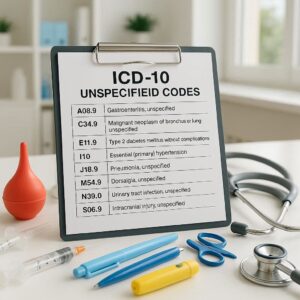
ICD-10 Unspecified Codes
Decoding the System: What Are ICD-10 Codes and Why Do They Matter? {#decoding-the-system}
Before we can understand the nuance of “unspecified,” we must first grasp the foundational role of ICD-10 codes in the global healthcare infrastructure. The International Classification of Diseases is a system, maintained by the World Health Organization (WHO), for classifying diseases and a wide variety of signs, symptoms, abnormal findings, complaints, social circumstances, and external causes of injury or disease. In the United States, the Centers for Medicare & Medicaid Services (CMS) and the National Center for Health Statistics (NCHS) oversee the clinical modification (ICD-10-CM) used for diagnostic coding.
The importance of these codes extends far beyond the medical record. They are the primary language spoken between healthcare providers and payers. Their applications are multifold:
-
Reimbursement: ICD-10 codes are the foundation of medical billing. They justify the medical necessity of services rendered, procedures performed, and devices provided. Incorrect or insufficiently specific codes can lead to claim denials or downcoding, where a payer reimburses at a lower rate than what was billed.
-
Epidemiology and Public Health: These codes are aggregated to track the incidence and prevalence of diseases, monitor outbreaks, and guide public health policy and resource allocation. The data from ICD-10 codes helped the world understand the spread of COVID-19 and continues to inform vaccination campaigns and research priorities.
-
Clinical Decision Support and Research: Specific diagnostic data fuels clinical research, helping to identify effective treatments, understand disease progression, and recruit patients for clinical trials. Electronic Health Records (EHRs) use this data to trigger alerts and provide evidence-based clinical guidelines.
-
Quality Measurement and Performance Metrics: Value-based care models, such as those promoted by CMS, tie reimbursement to quality outcomes. Codes are used to calculate performance on metrics like hospital readmission rates, complication rates, and patient safety indicators. Imprecise coding directly impacts these scores and, consequently, reimbursement.
The shift to ICD-10 was driven by the need for this very specificity. ICD-9 codes lacked the detail to describe laterality (left vs. right), the encounter type (initial vs. subsequent), the etiology of a disease, or its severity. ICD-10 filled these gaps, creating a rich, detailed dataset intended to reflect the complexity of modern medicine.
The “Unspecified” Designation: A Necessary Evil or a Coding Failure? {#unspecified-designation}
Within the detailed structure of ICD-10, the “unspecified” code serves a defined, and often misunderstood, purpose. It is not inherently incorrect or fraudulent. The ICD-10-CM Official Guidelines for Coding and Reporting state that “unspecified” codes are acceptable and should be used when the information in the medical record is insufficient to assign a more specific code.
Anatomy of an Unspecified Code {#anatomy-of-an-unspecified-code}
Unspecified codes are typically found at the end of a code category or subcategory. They are often identifiable by their descriptors, which include terms like:
-
“Unspecified”
-
“Not otherwise specified (NOS)”
-
“Other specified” (though this is a step above unspecified, it is still less ideal than a fully specific code)
For example, in the category for pneumonia (J18):
-
J18.0 is a specific code for “Bronchopneumonia, unspecified organism.”
-
J18.9 is the unspecified code for “Pneumonia, unspecified organism.”
While both lack an organism, J18.0 provides more clinical detail (bronchopneumonia) than J18.9.
The Legitimate Use Cases: When “Unspecified” is Appropriate {#legitimate-use-cases}
There are several clinically valid scenarios where an unspecified code is not only appropriate but necessary:
-
Initial Encounter with Undifferentiated Symptoms: A patient presents to the Emergency Department with acute, non-specific symptoms like generalized abdominal pain (R10.84) or dizziness (R42). Until diagnostic tests (labs, imaging) are completed, a definitive diagnosis may be impossible. Using an unspecified code for the initial encounter is clinically accurate.
-
Signs and Symptoms as Primary Diagnoses: When a patient has a sign or symptom for which a definitive cause cannot be established during that encounter, coding the symptom itself with an unspecified code is correct. For example, coding for “headache, unspecified” (R51.9) when no underlying cause is identified.
-
Pending Consultations or Test Results: A primary care physician may document a working diagnosis but is awaiting the final report from a specialist or a complex laboratory test. In this interim period, an unspecified code may be the most accurate representation of the known clinical facts.
-
Coding from Inadequate Documentation: If a physician’s documentation is vague or lacks the necessary detail to support a more specific code, the coder is obligated by coding ethics and guidelines to assign the unspecified code. They cannot assume clinical information that is not present in the record.
The key takeaway is that “unspecified” is a tool for accurately reflecting diagnostic uncertainty at a given point in the care continuum. The problem arises when this uncertainty becomes the default, rather than the exception.
The High Stakes of Imprecision: Consequences of Overusing Unspecified Codes {#high-stakes}
The habitual use of unspecified codes, when more specific information is or should be available, carries significant risks that reverberate throughout a healthcare organization.
Financial Repercussions: Denials, Downcoding, and Audits {#financial-repercussions}
Payers are increasingly sophisticated in their claims adjudication processes. They use automated systems and manual reviews to scrutinize codes for specificity.
-
Claim Denials: A claim submitted with an unspecified code for a condition that typically has a well-defined, specific alternative is a prime target for denial. Payers will argue that the code does not sufficiently justify the medical necessity of the service. For instance, billing for a costly MRI of the brain for “headache, unspecified” (R51.9) is far more likely to be denied than if it were billed for “migraine with aura” (G43.109).
-
Downcoding: Even if a claim is not fully denied, a payer may downcode it to a lower-paying Diagnosis-Related Group (DRG) in the inpatient setting or to a less complex evaluation and management (E/M) service in the outpatient setting. The lack of specificity can make a case appear less severe or complex than it actually is, directly reducing revenue.
-
Targeted Audits: A high percentage of unspecified codes in a provider’s billing pattern is a red flag for Recovery Audit Contractors (RACs), the Office of Inspector General (OIG), and other audit entities. This can trigger costly and time-consuming post-payment audits, resulting in the recoupment of funds already paid, plus potential penalties and interest.
Clinical and Quality Implications: Hindering Patient Care and Data Integrity {#clinical-quality-implications}
The impact of imprecise coding extends far beyond the finance department; it corrodes the very data used to drive clinical care.
-
Compromised Population Health Management: If a large portion of a health system’s hypertensive patients are coded simply as I10 (Essential hypertension), it becomes impossible to accurately analyze outcomes for patients with hypertensive chronic kidney disease (I12.-) or heart failure (I11.-). This flawed data leads to ineffective care management programs and poor resource allocation.
-
Ineffective Clinical Decision Support: EHR alerts and reminders are often triggered by specific diagnosis codes. A patient with “asthma, uncomplicated” (J45.909) may not trigger the same robust reminder for annual influenza vaccination or asthma action plan review as a patient with “severe persistent asthma” (J45.5-).
-
Hindered Research and Innovation: Medical research relies on clean, specific data to identify patient cohorts, understand disease patterns, and measure treatment efficacy. A clinical trial for a new drug targeting a specific type of heart failure will be severely hampered if potential participants are coded with generic “heart failure” codes instead of specifying systolic, diastolic, or combined types.
Legal and Compliance Risks: Navigating the Waters of Fraud and Abuse {#legal-compliance-risks}
In the United States, healthcare billing is governed by stringent laws such as the False Claims Act (FCA). Knowingly submitting a false or misleading claim can result in severe penalties.
-
Lack of Medical Necessity: The cornerstone of reimbursement is medical necessity. An unspecified code can be interpreted as a failure to document—and therefore prove—the medical necessity for a service. This can be construed as a false claim.
-
Pattern of Unspecified Coding: While a single unspecified code is not fraudulent, a consistent pattern can be used as evidence of “reckless disregard” for coding rules and regulations. Prosecutors may argue that the provider made no effort to document or code correctly, constituting a systematic abuse of the system.
-
Stark Law and Anti-Kickback Statute Implications: In value-based arrangements where reimbursement is tied to diagnosis codes, consistently using unspecified codes that under-represent patient acuity could be seen as a way to avoid treating more complex (and costly) patients, potentially violating fraud and abuse statutes.
Bridging the Gap: Strategies for Moving from Unspecified to Specific Codes {#bridging-the-gap}
Eradicating the overuse of unspecified codes requires a concerted, collaborative effort between clinicians, coders, and health information management (HIM) professionals. It is a cultural shift towards valuing data integrity as a clinical and financial imperative.
The Provider’s Role: The Power of Precise Documentation {#providers-role}
The physician’s documentation is the source of all truth in the coding process. A coder can only code what is documented. Therefore, the most effective strategy is to improve documentation at the source.
-
Embrace Specificity in Everyday Language: Instead of “asthma,” document “moderate persistent asthma, exacerbated.” Instead of “chest pain,” document “substernal chest pain, pressure-like, radiating to the left arm.” Instead of “UTI,” document “acute cystitis due to E. coli.”
-
Detail Laterality and Encounter Status: Always specify left, right, or bilateral. Clearly state if an encounter is for an initial injury, subsequent care, or a sequela (a chronic condition resulting from an acute injury or illness).
-
Link Etiology and Manifestations: Connect the dots. Document “hypertensive heart disease with congestive heart failure” or “diabetic polyneuropathy.” This allows coders to use combination codes that fully capture the complexity of the patient’s condition.
-
Document the “Why”: Explain the clinical rationale for tests and treatments. This not only supports medical necessity but also often provides the detail needed for a specific code.
The Coder’s Role: Querying, Educating, and Investigating {#coders-role}
Coders are not passive transcribers; they are active participants in ensuring data quality.
-
The Proactive Query Process: When documentation is unclear, contradictory, or incomplete, the coder must initiate a physician query. This is a formal, non-leading communication to the provider asking for clarification. A good query presents clinical facts from the record and asks an open-ended question, such as, “The patient was admitted with pneumonia. The radiology report confirms a right lower lobe infiltrate. Can you specify the type of pneumonia (e.g., bacterial, viral, aspiration) for coding purposes?”
-
Ongoing Provider Education: Coding professionals should work with clinical documentation integrity (CDI) specialists to provide regular feedback and education to physicians. Sharing examples of denials related to unspecified codes and demonstrating how specific documentation leads to appropriate reimbursement is a powerful tool.
-
Thorough Record Review: Coders must be trained to look beyond the discharge summary or problem list. Reviewing consultant notes, nursing assessments, and diagnostic reports can often reveal the specific information needed to avoid an unspecified code.
Leveraging Technology: EHRs and Encoder Tools {#leveraging-technology}
Modern technology can be a powerful ally in the quest for specificity.
-
Intelligent EHR Design: EHRs can be configured with “hard stops” or “soft alerts” that prompt providers for more specific information when a generic term is entered. For example, entering “asthma” could trigger a dropdown menu asking for severity and type.
-
Integrated Encoder Software: Advanced encoder tools within the EHR or as standalone applications can help coders and CDI specialists quickly identify the most specific code possible based on the available documentation and highlight when an unspecified code is being considered, suggesting potential alternatives if more detail is available.
-
Analytics and Reporting: Healthcare organizations should regularly run reports to analyze their usage of unspecified codes. Identifying high-volume unspecified codes allows for targeted education and process improvement initiatives.
Case Studies in Specificity: Common Unspecified Codes and Their Specific Alternatives {#case-studies}
Let’s examine some of the most commonly overused unspecified codes and explore how documentation and coding can be improved.
Case Study 1: Abdominal Pain (R10.9) vs. The Specific Diagnoses {#case-study-1}
-
The Unspecified Code: R10.9, “Unspecified abdominal pain.” This is one of the most common codes in emergency medicine and primary care.
-
The Problem: It provides almost no clinical or epidemiological value. It doesn’t guide public health efforts or help in researching pain management strategies.
-
Path to Specificity: ICD-10 provides a rich set of alternatives for abdominal pain based on location and characteristics. Encouraging providers to document the precise quadrant or region transforms the code.
-
Right upper quadrant pain: R10.11
-
Left lower quadrant pain: R10.32
-
Generalized abdominal pain: R10.84 (This is still a symptom code but is more specific than R10.9)
-
Acute abdomen: R10.0
-
If a definitive diagnosis is made: The code should shift from the symptom to the diagnosis (e.g., K35.80 for Unspecified acute appendicitis, or K57.30 for Diverticulosis of large intestine without perforation or abscess without bleeding).
-
Case Study 2: Essential Hypertension (I10) – A Misunderstood “Default” {#case-study-2}
-
The Unspecified Code: I10, “Essential (primary) hypertension.” While not technically labeled “unspecified,” it is often used as a default when more specific hypertensive diagnoses are applicable.
-
The Problem: It fails to capture the significant impact of hypertension on target organs, which is critical for risk stratification, care management, and accurate reimbursement in risk-adjusted payment models.
-
Path to Specificity: Providers must be diligent in screening for and documenting complications of hypertension.
-
Hypertensive chronic kidney disease: I12.-
-
Hypertensive heart disease: I11.-
-
Hypertensive heart and chronic kidney disease: I13.-
-
The Spectrum of Hypertensive Diagnoses in ICD-10
| ICD-10 Code | Code Description | Clinical Implication | Specificity Level |
|---|---|---|---|
| I10 | Essential (primary) hypertension | Uncomplicated high blood pressure | Low (Default) |
| I11.0 | Hypertensive heart disease with heart failure | High BP has caused heart failure | High |
| I12.9 | Hypertensive chronic kidney disease with stage 1-4 CKD, or unspecified CKD | High BP has damaged the kidneys | High |
| I13.0 | Hypertensive heart and chronic kidney disease with heart failure | High BP has caused both heart and kidney failure | Highest |
| I16.0 | Hypertensive urgency | Severely elevated BP without acute organ damage | Moderate |
| I16.1 | Hypertensive emergency | Severely elevated BP WITH acute organ damage | High |
Case Study 3: Unspecified Asthma (J45.909) vs. Phenotype-Driven Coding {#case-study-3}
-
The Unspecified Code: J45.909, “Unspecified asthma, uncomplicated.”
-
The Problem: Asthma is a heterogeneous disease, and this code lumps all types together, making it impossible to distinguish a mild, intermittent case from a severe, life-threatening one.
-
Path to Specificity: ICD-10 encourages coding based on the phenotype of asthma.
-
Mild intermittent asthma: J45.20-
-
Mild persistent asthma: J45.30-
-
Moderate persistent asthma: J45.40-
-
Severe persistent asthma: J45.50-
-
Additionally, coders can specify:
-
With status asthmaticus (J45.901-)
-
With acute exacerbation (J45.901-)
-
-
Laterality is not a factor, but the 5th or 6th character specifies with/without status/exacerbation.
-
Case Study 4: Unspecified Dementia (F03) vs. Etiology and Severity {#case-study-4}
-
The Unspecified Code: F03, “Unspecified dementia.”
-
The Problem: This code provides no information on the underlying cause (e.g., Alzheimer’s, vascular, Lewy body) or the behavioral and functional impact on the patient, which is crucial for care planning and family support.
-
Path to Specificity: A comprehensive neurological workup should lead to a more precise diagnosis.
-
Dementia in Alzheimer’s disease: F00.- (with further specification for with/without behavioral disturbance)
-
Vascular dementia: F01.-
-
Dementia with Lewy bodies: G31.83
-
Frontotemporal dementia: G31.09
-
The codes also allow for specification of “with behavioral disturbance” (e.g., aggression, wandering) which significantly impacts the resources required for patient care.
-
The Future of Diagnostic Coding: Beyond Unspecified {#future-of-coding}
The evolution of diagnostic coding is not slowing down. The arrival of ICD-11, which is already being adopted by some WHO member states, promises even greater granularity and a more logical, digital-friendly structure. Furthermore, the healthcare industry is moving towards integrating coded data with other data types, such as genomics, proteomics, and social determinants of health (SDOH).
In this future state, the use of an unspecified code will be even more glaringly inadequate. It will represent a failure to capture the multi-dimensional nature of a patient’s health. The push for specificity is, therefore, not just about optimizing today’s reimbursement; it is about preparing for a future of truly personalized, data-driven medicine.
Conclusion: Embracing Specificity as a Standard of Care {#conclusion}
The journey from unspecified to specific ICD-10 coding is a critical imperative for the modern healthcare organization. It is a multidisciplinary endeavor that hinges on precise clinical documentation, proactive coding practices, and the strategic use of technology. Moving beyond the “unspecified” crutch is not merely an administrative exercise; it is a fundamental commitment to data integrity that directly enhances patient care, safeguards financial stability, and ensures regulatory compliance. In an era where data is king, specificity is the currency of quality.
Frequently Asked Questions (FAQs) {#faqs}
1. Is it ever illegal to use an unspecified ICD-10 code?
No, using an unspecified code is not inherently illegal. It becomes a legal and compliance risk when it is used in a pattern that demonstrates “reckless disregard” for coding accuracy, particularly if that pattern results in the systematic submission of claims that lack medical necessity or misrepresent the patient’s condition to obtain higher reimbursement. In such cases, it can be construed as a violation of the False Claims Act.
2. As a coder, if a physician’s documentation is vague, should I just assign the unspecified code?
Initially, yes. Coders must code based on the documentation provided. However, the best practice is not to stop there. You should initiate a formal physician query to seek clarification. This proactive approach improves the accuracy of the current record and serves as an educational moment for the provider, improving future documentation.
3. Our EHR’s “favorite” or “quick-pick” diagnoses are often unspecified codes. How can we fix this?
This is a common and significant problem. Work with your EHR implementation and IT teams to revise the “favorites” lists and order sets. Replace unspecified codes with the most commonly used specific codes in your practice. You can also build clinical decision support prompts that require the provider to select a type or severity before finalizing a diagnosis.
4. What is the single most important thing a physician can do to reduce unspecified codes?
Document the diagnosis with the same specificity they use in their clinical reasoning. Instead of writing “CHF,” document “acute on chronic systolic congestive heart failure.” This small change provides all the detail a coder needs to assign a highly specific code like I50.21 (Acute systolic heart failure).
5. How does the use of unspecified codes affect value-based care and risk-adjusted payment models?
In risk-adjusted models like Medicare Advantage and ACA plans, payment is based on the “risk score” of the patient population, which is derived from diagnosis codes. Unspecified codes are typically assigned a lower, or even zero, risk weight. This means a patient with complex, multi-system diseases coded with unspecified codes will appear healthier than they are, leading to significant underpayment to the provider organization and distorting quality metrics.
Additional Resources {#additional-resources}
-
Centers for Disease Control and Prevention (CDC) – ICD-10-CM: The official source for the ICD-10-CM code set, guidelines, and updates.
-
American Health Information Management Association (AHIMA): A leading professional association for health information management. Offers a wealth of resources on clinical documentation integrity (CDI), coding best practices, and compliance.
-
American Academy of Professional Coders (AAPC): A leading organization for medical coding training, certification, and resources. Provides education on coding specificity and navigating complex coding scenarios.
-
CMS ICD-10 Provider Resources: A dedicated page from CMS with resources tailored for healthcare providers transitioning to and using ICD-10.
Date: October 31, 2025
Author: Dr. Anya Sharma, MD, MPH, CCS
Disclaimer: The information contained in this article is for educational and informational purposes only and is not intended as medical or legal advice. Always consult with a qualified healthcare provider for any health concerns and with a certified coding professional or legal expert for coding compliance matters.