If you’ve encountered the term “ICD-9 code for iron deficiency anemia,” you’re likely navigating medical bills, old health records, or historical data. While the ICD-9 system is officially retired, understanding its codes remains crucial for interpreting past medical information. This comprehensive guide will demystify the specific ICD-9 code for iron deficiency anemia, explain its context, and bridge the gap to the modern coding system used today. Our goal is to provide you with clear, reliable knowledge that empowers you to understand your health history or medical documentation.
We’ll explore not just the code itself, but its significance, its limitations, and its evolution. Whether you’re a patient reviewing an old statement, a medical student studying coding transitions, or a professional handling legacy data, this article serves as your essential reference.
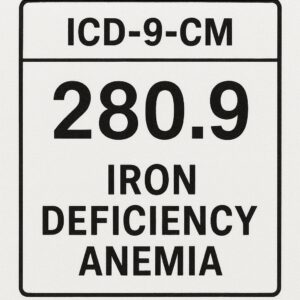
ICD-9 Code 280.9 for Iron Deficiency Anemia
Understanding the ICD-9 Coding System: A Historical Foundation
Before we zero in on the specific code, it’s vital to grasp what the ICD-9 system was and why it matters. The International Classification of Diseases, 9th Revision, Clinical Modification (ICD-9-CM) was the standard diagnostic coding framework used in the United States for decades. Healthcare providers, hospitals, and insurance companies used these codes to uniformly represent diseases, symptoms, and procedures.
Think of ICD codes as a universal language for medicine. They translate complex diagnoses into standardized, alphanumeric shorthand. This standardization is critical for:
-
Billing and Reimbursement: Insurance companies use codes to process claims.
-
Tracking Public Health: Health agencies monitor disease rates and outbreaks.
-
Clinical Research: Scientists study treatment outcomes and disease patterns.
-
Maintaining Medical Records: Codes provide a concise summary of a patient’s conditions.
The ICD-9 system was replaced by ICD-10-CM on October 1, 2015, in the U.S. This transition was necessary because ICD-9 had run out of space for new codes and lacked the specificity needed for modern medicine. However, any medical records or billing documents from before 2015 will reference ICD-9 codes.
Important Note: As of January 16, 2026, ICD-9 codes are no longer used for current medical billing or clinical documentation in the United States. This information is primarily for historical understanding, handling old records, or academic purposes.
The Specific ICD-9 Code for Iron Deficiency Anemia
Within the extensive ICD-9-CM manual, diseases of the blood and blood-forming organs are categorized in Chapter 4, which covers codes 280-289. Iron deficiency anemia falls squarely within this chapter.
The primary ICD-9 code for iron deficiency anemia is 280.9.
Let’s break this code down:
-
280: This is the parent category for “Iron deficiency anemias.”
-
.9: This fourth digit provides further specification. In this case, “.9” indicates “unspecified” iron deficiency anemia.
Here is a comparative table of the relevant ICD-9 codes within category 280:
| ICD-9 Code | Code Description | Clinical Context |
|---|---|---|
| 280.0 | Iron deficiency anemia secondary to blood loss (chronic) | Used when anemia is a direct result of long-term bleeding, e.g., from a gastric ulcer or menorrhagia. |
| 280.1 | Iron deficiency anemia secondary to inadequate dietary iron intake | Applied when the primary cause is a lack of sufficient iron in the diet. |
| 280.8 | Other specified iron deficiency anemias | A catch-all for specified causes not covered by 280.0 or 280.1. |
| 280.9 | Iron deficiency anemia, unspecified | The most commonly used code when the specific cause or context is not documented or is not the focus of care. |
Why Was 280.9 So Frequently Used?
Code 280.9 was often the default because it required less specific clinical documentation. A physician could diagnose iron deficiency anemia based on lab results (low hemoglobin, low mean corpuscular volume (MCV), low ferritin) without immediately specifying the underlying etiology (e.g., diet vs. chronic blood loss) in the billing documentation. This highlights a key limitation of ICD-9: its lack of granularity.
The Modern Transition: From ICD-9 to ICD-10-CM
The shift to ICD-10-CM brought a massive increase in specificity. Where ICD-9 had a single, often vague code, ICD-10 offers multiple, highly detailed options. This specificity improves patient care, streamlines research, and allows for more precise billing.
There is no direct, one-to-one crosswalk from ICD-9 280.9 to a single ICD-10 code. Instead, the coder must choose from several options based on detailed medical documentation.
The primary ICD-10-CM category for iron deficiency anemia is D50. The most common equivalent to the old “unspecified” code is:
D50.9 – Iron deficiency anemia, unspecified
However, ICD-10 strongly encourages more precise coding. Here are critical subcategories:
| ICD-10-CM Code | Code Description | Specificity & Notes |
|---|---|---|
| D50.0 | Iron deficiency anemia secondary to blood loss (chronic) | Requires an additional code to specify the cause of bleeding (e.g., a GI bleed code). |
| D50.8 | Other iron deficiency anemias | Includes cases due to inadequate dietary intake. |
| D50.9 | Iron deficiency anemia, unspecified | Used only when documentation does not support a more specific code. |
| D62 | Acute posthemorrhagic anemia | For anemia due to recent, acute blood loss, a distinction not easily made in ICD-9. |
| O90.81 | Anemia complicating the puerperium | Example of trimester-specific coding for anemia related to pregnancy, a huge advancement from ICD-9. |
A Comparison of Coding Philosophy
-
ICD-9 (280.9): “The patient has iron deficiency anemia.”
-
ICD-10 (e.g., D50.0): “The patient has iron deficiency anemia due to chronic blood loss from angiodysplasia of the stomach and duodenum.” This second statement would require multiple precise ICD-10 codes, painting a complete clinical picture.
Why Accurate Coding for Anemia Matters to You
You might wonder why a simple code matters. The transition from a general code like 280.9 to a specific ICD-10 code has real-world implications for patients.
-
Personalized Care: Specific codes help create a more accurate health narrative in your electronic medical record. This ensures future providers understand your full health history.
-
Research and Public Health: Accurate data on the causes of anemia (e.g., dietary vs. due to colon cancer) helps direct public health resources and research funding to where they are needed most.
-
Insurance and Billing: While complex, specific coding can sometimes justify the medical necessity of certain tests or treatments to your insurance company, reducing denials.
If you are reviewing an old document with the code 280.9, understand that it tells you the what (iron deficiency anemia) but not the why. If you are managing a chronic condition, it may be helpful to discuss with your current provider to ensure your modern records reflect the most specific and accurate diagnosis.
Navigating Old Records and Current Diagnoses
For Patients Reviewing Legacy Documents:
If you see ICD-9 code 280.9 on an old bill or medical summary from before 2015, it simply confirms you were diagnosed with iron deficiency anemia at that time. The exact cause may not have been coded. To get a complete picture:
-
Request your full medical records from that time period, not just the billing summary.
-
Discuss your full health history with your current doctor to ensure continuity of care.
For Healthcare Professionals and Coders:
When dealing with historical data or transitioning records, understanding the mapping from ICD-9 280.9 to ICD-10 is contextual. Always default to the clinical documentation. Do not automatically map 280.9 to D50.9. Review the record for clues about cause; if none exist, then D50.9 is appropriate under ICD-10 guidelines.
Conclusion
The ICD-9 code 280.9 for unspecified iron deficiency anemia represents an important chapter in medical history, offering a snapshot of past diagnostic practices. Its retirement in favor of the highly specific ICD-10-CM system marks a significant advancement in patient care, data accuracy, and clinical research. Understanding this code and its modern equivalents empowers you to better navigate your health journey, from interpreting old records to engaging with today’s more precise healthcare landscape.
FAQ
Q: I just received a bill with ICD-9 code 280.9. Is this a mistake?
A: Not necessarily. If the service was provided before October 1, 2015, the use of ICD-9 is correct. If the date of service is after that, it could be an error. Contact the billing department for clarification.
Q: What is the most accurate ICD-10 code for anemia caused by low iron intake?
A: The appropriate code would be D50.8 – Other iron deficiency anemias, which includes cases due to inadequate dietary iron intake. The documentation should support the cause.
Q: Why are there so many more codes in ICD-10?
A: ICD-10 provides greater specificity regarding cause, severity, anatomy, and context. This leads to better health statistics, more targeted treatment pathways, and improved tracking of public health issues.
Q: As a patient, do I need to know these codes?
A: Not directly. Your provider’s office handles coding. However, understanding the basics can help you be a more informed advocate, especially when reviewing explanations of benefits (EOBs) or medical records.
Additional Resources
For the most authoritative and up-to-date information on medical coding, please visit:
-
The Centers for Disease Control and Prevention (CDC) ICD-10-CM page: https://www.cdc.gov/nchs/icd/icd10cm.htm This site provides official guidelines, code sets, and updates.
Disclaimer
This article is for informational and educational purposes only. It is not a substitute for professional medical advice, diagnosis, or treatment. Always seek the advice of your physician or other qualified health provider with any questions you may have regarding a medical condition or coding inquiry. Medical coding is a complex field, and specific coding decisions must always be made by qualified professionals based on complete clinical documentation and the most current official coding guidelines. The information in this article is current as of the authoring date, January 16, 2026.