If you’re navigating old medical records, dealing with legacy billing systems, or simply studying the evolution of medical classification, you’ve likely asked: “What is the ICD-9 code for joint inflammation?” The direct answer is 719.4. But that simple code opens the door to a much richer and more important story about medical coding, patient care, and a significant shift in how we classify disease.
This article is your comprehensive, one-stop resource. We’ll dive deep into the meaning of ICD-9 code 719.4, explore its correct and incorrect applications, and, most critically, place it in the context of the modern coding world. Understanding this code is not just about memorizing a number; it’s about grasping a fundamental piece of medical documentation history and preparing for today’s more precise standards.
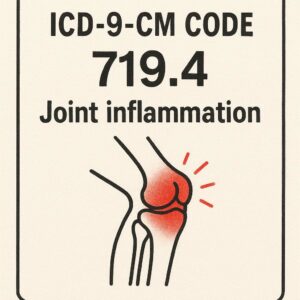
ICD-9 Code 719.4 for Joint Inflammation
Understanding the ICD-9-CM System: A Legacy Foundation
Before we focus on the specific code, let’s set the stage. The International Classification of Diseases, 9th Revision, Clinical Modification (ICD-9-CM) was the diagnostic coding standard used in the United States from 1979 until October 1, 2015. Think of it as a massive, structured dictionary that translated medical diagnoses, symptoms, and procedures into standardized numeric codes. This system was essential for:
-
Medical Billing and Reimbursement: Insurance companies used these codes to determine payment.
-
Tracking Public Health: Aggregating code data helped monitor disease outbreaks and trends (e.g., flu seasons).
-
Clinical Research: Researchers could identify patient populations by diagnosis.
However, by the 21st century, ICD-9-CM showed its age. With only about 17,000 codes, its structure was limited and often lacked the specificity modern medicine demanded.
ICD-9 Code 719.4: Pain in Joint
The specific entry for generalized joint inflammation in ICD-9-CM is:
719.4 – Pain in Joint
This code is found within a broader category:
-
Chapter 13: Diseases of the Musculoskeletal System and Connective Tissue (710-739)
-
Subcategory 719.4: Other and unspecified disorders of joint.
It’s crucial to note the official descriptor: “Pain in Joint.” While inflammation (arthritis, synovitis) is a primary cause of joint pain, the code itself is symptom-focused. This lack of etiological specificity (i.e., not stating why the joint is painful or inflamed) was a key limitation of ICD-9.
When Was 719.4 Used Correctly?
This code served as a catch-all in specific clinical scenarios:
-
Initial Encounters with Undiagnosed Pain: A patient presents with a swollen, painful knee, but diagnostic tests (like fluid analysis or imaging) are pending. 719.4 allowed for initial documentation.
-
Arthralgia (Joint Pain) Without Confirmed Arthritis: For pain where inflammation isn’t conclusively proven.
-
Unspecified Joint Disorders: When a provider hadn’t yet specified the type of arthritis or condition.
-
Billing for Symptom-Focused Visits: If the primary reason for the encounter was to address joint pain, regardless of the ultimate underlying cause.
Common Misapplications and More Specific Codes
Using 719.4 as a blanket code was discouraged when a more precise diagnosis was known. Relying on it could lead to claim denials or inaccurate health data. Here are examples of more specific ICD-9 codes that should have been used instead:
| Specific Condition | ICD-9-CM Code | Why It’s More Specific |
|---|---|---|
| Rheumatoid Arthritis | 714.0 | Identifies a specific autoimmune disease, not just a symptom. |
| Osteoarthritis | 715.xx (e.g., 715.9 for generalized OA) | Specifies degenerative, “wear-and-tear” arthritis. |
| Gouty Arthritis | 274.0 | Pinpoints a metabolic disorder causing inflammation. |
| Septic Arthritis | 711.0x | Indicates a life-threatening joint infection. |
| Ankylosing Spondylitis | 720.0 | Identifies a specific type of spinal arthritis. |
Important Note: As a historical reminder, a fifth digit was often required with these codes to specify anatomical site. For example, 716.6x was for “Unspecified monoarthritis,” where ‘x’ would be replaced to indicate the exact joint.
The Monumental Shift: From ICD-9 to ICD-10-CM
On October 1, 2015, the U.S. healthcare system underwent a mandatory transition from ICD-9-CM to ICD-10-CM. This was not a simple update; it was a revolution in specificity. ICD-10-CM contains over 70,000 codes, allowing for incredibly detailed documentation.
This shift was driven by the need for better data to:
-
Improve patient care outcomes.
-
Support value-based care models.
-
Enhance public health tracking and research.
-
Reduce coding ambiguities that lead to billing errors.
ICD-10-CM Equivalents for Joint Pain and Inflammation
The vague ICD-9 code 719.4 maps to a range of far more descriptive codes in ICD-10-CM. The translation depends entirely on the specific details of the case.
The general “catch-all” equivalent is now within the M25.5- series:
-
M25.50 – Pain in unspecified joint
-
M25.51 – Pain in shoulder
-
M25.52 – Pain in elbow
-
…and so on for each specific joint (hip, knee, ankle, etc.).
However, if the inflammation is diagnosed, a code from the “Arthritis” (M00-M19) or “Other joint disorders” (M20-M25) chapters is used. The specificity is remarkable.
Example of ICD-10-CM Specificity:
A patient has inflammation of the left knee due to rheumatoid arthritis.
-
ICD-9 (Less Specific): Likely 714.0 (RA) with a site modifier.
-
ICD-10 (Highly Specific): M05.562 – Rheumatoid arthritis of left knee with involvement of other organs and systems.
This code tells the full story: the disease (RA), the exact site (left knee), and that it’s affecting other body systems.
Comparative Table: ICD-9 vs. ICD-10 for Joint Issues
| Aspect | ICD-9-CM (Legacy) | ICD-10-CM (Current) |
|---|---|---|
| Code for Generalized Joint Pain | 719.4 (Pain in joint) | M25.50- (Pain in unspecified joint) |
| Specificity | Low. Often required additional documentation. | Extremely High. Codes specify laterality, cause, stage, and more. |
| Number of Codes | ~17,000 | ~70,000+ |
| Structure | Mostly 3-5 digits, numeric. | 3-7 characters, alphanumeric. |
| Example for Gout in Right Toe | 274.0 (Gout) | M1A.371 – Chronic gout due to renal impairment, right ankle and foot |
Practical Guide: Navigating Historical and Current Records
For Medical Professionals & Coders:
-
Reviewing Old Records: When you see 719.4, understand it was a placeholder. Look at the accompanying clinical notes, lab results, and progression of diagnoses in the record to understand the true condition.
-
Coding in the Modern Era: Never use ICD-9 codes for current encounters. Always use ICD-10-CM. Utilizing 719.4 today would be incorrect and lead to immediate claim rejection.
-
Coding Tip: “When in doubt, document it out.” ICD-10 rewards detailed clinical documentation. The more specific the doctor’s notes, the more accurate—and often more appropriate—the reimbursement code will be.
For Patients and Researchers:
-
Understanding Your Medical History: If an old record lists 719.4, it simply means you were treated for joint pain. The actual diagnosis (like osteoarthritis or tendonitis) should be clarified in the doctor’s notes from that time.
-
Conducting Retrospective Studies: Researchers must be aware of the “granularity gap” when analyzing data spanning the 2015 transition. Trends for “joint pain” (719.4) may seem to disappear post-2015, as cases are now scattered across hundreds of specific ICD-10 codes.
Why Specificity in Coding Matters: Beyond the Number
As one seasoned medical coder put it: “ICD-9 was like describing a car as ‘a red vehicle.’ ICD-10 is like specifying ‘a 2023 electric SUV, metallic red, with all-wheel drive.’ The difference in clarity is everything for patient care and health analytics.”
This specificity drives real-world benefits:
-
Improved Patient Care: Identifies patients with specific conditions for targeted treatment programs and clinical trials.
-
Accurate Reimbursement: Ensures providers are paid fairly for the complexity of care they deliver.
-
Advanced Public Health: Allows for tracking of diseases at a much finer level (e.g., which specific joints are most affected by RA in a population).
Helpful Lists for Context
Common Conditions Previously Coded Under the 719.4 “Umbrella”:
-
Arthralgia (non-inflammatory pain)
-
Inflammatory arthritis (unspecified)
-
Joint effusion (fluid) of unknown cause
-
Post-traumatic joint pain
-
Pain related to overuse
Key Differences in Coding Philosophy:
-
ICD-9: “What is the main disease?”
-
ICD-10: “What is the main disease, where is it, how severe is it, what caused it, and is this an initial or subsequent encounter?”
Conclusion
The ICD-9 code for joint inflammation, 719.4, is a snapshot of a bygone era in medical coding—a necessary but imprecise tool for its time. Its true importance today lies in understanding its role as a historical artifact and appreciating the dramatic evolution to the detailed, patient-centric world of ICD-10-CM. Mastering this transition is key to accurate documentation, proper reimbursement, and ultimately, leveraging data to improve healthcare outcomes for everyone.
Frequently Asked Questions (FAQ)
Q: Can I still use ICD-9 code 719.4?
A: No. For any medical encounter, billing, or official documentation in the United States after October 1, 2015, you must use ICD-10-CM codes. Using ICD-9 is non-compliant.
Q: I found 719.4 on an old medical bill. What does it mean?
A: It means you were billed for an evaluation or treatment related to joint pain. For the specific diagnosis, you would need to review the actual medical records from that provider at that time.
Q: What is the direct ICD-10 code for 719.4?
A: There is no 1-to-1 conversion. The closest general code is M25.50 (Pain in unspecified joint). However, a correct ICD-10 code requires more information (which joint, laterality, underlying cause).
Q: Why is ICD-10 so much more complicated?
A: It’s not complication for its own sake; it’s specificity. This detail reduces guesswork, improves treatment targeting, enhances research quality, and creates a clearer financial picture for healthcare services.
Q: Where can I find the official current codes?
A: The Centers for Medicare & Medicaid Services (CMS) and the National Center for Health Statistics (NCHS) maintain the official ICD-10-CM guidelines and code sets. Reputable medical coding websites and purchased code books from organizations like the American Medical Association (AMA) are essential tools for professionals.
Additional Resources
For the most authoritative and up-to-date information on medical coding, please visit:
-
The Centers for Disease Control and Prevention (CDC) ICD-10 Page: https://www.cdc.gov/nchs/icd/icd10cm.htm This is the primary source for official guidelines, code tables, and updates.
Date: February 05, 2026
Disclaimer: This article is for informational purposes only. ICD-9-CM is a historical coding system. For accurate medical coding and billing, always consult the latest official coding manuals and a qualified healthcare professional.