If you’re navigating older medical records, handling a specific billing case, or simply studying medical history, you might find yourself searching for the ICD 9 code for general weakness. While the healthcare world has moved on to a newer coding system, understanding this legacy code is still important for clarity and historical accuracy.
In this comprehensive guide, we’ll explore everything you need to know about this specific ICD-9 code. We’ll break down its meaning, explain its modern equivalent, and discuss why the transition to ICD-10 was such a significant step forward in patient care. Our goal is to provide you with a reliable, in-depth resource that turns a simple code lookup into a deeper understanding of medical coding itself.
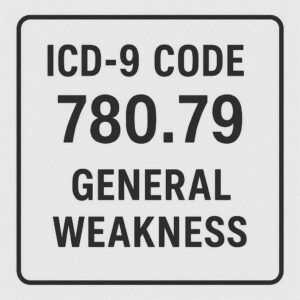
ICD-9 Code 780.79 for General Weakness
Understanding the ICD-9 Coding System
Before we dive into the specific code, let’s set the stage. The International Classification of Diseases, Ninth Revision, Clinical Modification (ICD-9-CM) was the diagnostic coding standard used in the United States for decades until October 1, 2015.
Think of ICD-9 as an older, more limited library for classifying diseases and symptoms. It contained around 17,000 codes. Physicians and coders used it to translate a patient’s condition into a standardized number for medical records, billing insurance companies, and tracking public health statistics. While it served its purpose for many years, its limitations in detail and specificity eventually necessitated an upgrade.
“The shift from ICD-9 to ICD-10 was not merely an update; it was a fundamental transformation in how we capture the complexity of patient health. It moved us from a system describing what happened to a system detailing why, how, and where.” – Perspective on Medical Coding Evolution
The Specific Code: ICD-9 780.79 – Other Malaise and Fatigue
After searching through the ICD-9 manual, you’ll find that the direct answer is ICD-9 code 780.79. This code resided within a larger chapter focused on symptoms, signs, and ill-defined conditions.
Let’s break down this code’s placement:
-
Chapter 16: Symptoms, Signs, and Ill-Defined Conditions (780-799)
-
Subcategory 780.7: Malaise and fatigue
-
Final Code 780.79: Other malaise and fatigue
What does “other” mean here? In ICD-9, 780.79 was essentially a catch-all for generalized weakness, fatigue, or lethargy that couldn’t be classified elsewhere. It was used when a provider documented a non-specific complaint of “general weakness” without attributing it to a more precise diagnosis like chronic fatigue syndrome, anemia, or a specific muscular disorder.
Important Clinical Context for 780.79
It’s crucial to understand that 780.79 was a symptom code, not a definitive diagnosis. Its use highlighted a key principle in medical coding: code to the highest level of specificity known.
A physician would use this code as a starting point—a placeholder while investigating the root cause. The patient’s complaint was “general weakness,” but the coder’s and clinician’s job was to ask, “Why?”
-
Was it due to a viral infection? (Then an infection code might be primary).
-
Was it a side effect of medication? (A code for adverse effect would be considered).
-
Was it the presenting sign of anemia, thyroid disorder, or heart failure? (Once confirmed, that specific condition would become the primary diagnosis).
This reliance on non-specific codes was one of the major driving forces behind the creation of ICD-10.
Comparative Table: ICD-9 vs. ICD-10 for Weakness
This table clearly illustrates the dramatic leap in specificity between the two systems.
| Feature | ICD-9-CM (Code 780.79) | ICD-10-CM (Code R53.1) |
|---|---|---|
| Code | 780.79 | R53.1 |
| Code Description | Other malaise and fatigue | Weakness |
| Specificity | Very low. A single code for a broad symptom. | Higher. Dedicated specifically to “weakness,” distinct from fatigue (R53.83) or malaise (R53.81). |
| Laterality | Not applicable. No way to indicate which side of the body. | Possible in related codes. Many musculoskeletal codes in ICD-10 specify left, right, or bilateral. |
| Etiology | No detail. Does not link to cause. | Can be combined with other codes to paint a fuller clinical picture. |
| Primary Use Case | Legacy records, historical data analysis, specific older billing cases. | Current standard for all clinical and billing documentation. |
The Modern Equivalent: ICD-10 Code R53.1
As of October 1, 2015, the United States fully transitioned to ICD-10-CM. In this vastly more detailed system (containing over 70,000 codes), the equivalent for “general weakness” is ICD-10 code R53.1.
Here’s how it’s structured:
-
Chapter 18: Symptoms, signs, and abnormal clinical and laboratory findings, not elsewhere classified (R00-R99)
-
Category R53: Malaise and fatigue
-
Subcategory R53.1: Weakness
Why is this an improvement? ICD-10 separates “weakness” (R53.1) from “chronic fatigue” (R53.82) and “malaise” (R53.81). This simple separation allows for more precise data tracking. Furthermore, ICD-10’s structure encourages linking this symptom to a cause, providing a much richer dataset for clinical decision-making and health outcomes research.
Note for Medical Coders and Billers:
Critical Reminder: As of today, ICD-9 is obsolete for all current healthcare transactions, including billing insurance (Medicare, Medicaid, private insurers) and electronic health record (EHR) documentation. Using ICD-9 code 780.79 on a claim form for a current service will result in denial. Always use the appropriate, more specific ICD-10-CM code.
Navigating the Transition: From Symptom to Diagnosis
A key theme in both ICD-9 and ICD-10 is the journey from a vague symptom to a precise diagnosis. “General weakness” is a starting point, not an endpoint. Here is a common diagnostic pathway a clinician might follow, and how coding reflects it:
-
Presenting Symptom: Patient reports “feeling weak all over.”
-
Initial Encounter Coding: In ICD-10, this is coded as R53.1 (Weakness).
-
Clinical Investigation: The physician takes a history, performs a physical exam, and may order tests (e.g., blood work for CBC, metabolic panel, thyroid function).
-
Definitive Diagnosis: Test results reveal iron deficiency anemia (D50.9).
-
Final Encounter Coding: The code for the underlying cause, D50.9, now becomes the primary (first-listed) diagnosis. R53.1 may be listed as a secondary code if the weakness is still a significant part of the clinical picture requiring management.
This process underscores that while knowing historical codes like 780.79 is useful, the real skill lies in applying the modern, specific codes of ICD-10 to accurately reflect the patient’s full health story.
The Importance of Specificity in Modern Healthcare
Moving beyond a single code lookup, let’s discuss why this evolution matters. The shift from ICD-9’s 780.79 to ICD-10’s more granular structure has real-world impacts:
-
Improved Patient Care: More precise codes lead to better tracking of disease progression and treatment outcomes. They help identify public health trends more accurately.
-
Accurate Reimbursement: Specific codes ensure healthcare providers are reimbursed fairly for the complexity of care they provide. Vague codes can lead to claim denials or underpayment.
-
Enhanced Research: With ICD-10, researchers can query data with much greater precision, leading to more robust studies on disease patterns, treatment efficacy, and healthcare costs.
-
Reduced Ambiguity: Clearer codes mean less guesswork for coders, fewer errors in records, and improved communication between providers, insurers, and patients.
Common Pitfalls and How to Avoid Them
When dealing with concepts like general weakness, here are some mistakes to watch for:
-
Confusing Weakness with Fatigue: While related, they are clinically distinct. Fatigue (R53.83) is a feeling of tiredness or exhaustion, while weakness (R53.1) implies a reduction in muscle strength. ICD-10 allows for this distinction.
-
Using an Obsolete Code: The most significant error is using ICD-9 code 780.79 for any purpose other than analyzing old records. Always verify your coding system.
-
Stopping at the Symptom Code: Always look for a more definitive diagnosis. If the provider has documented a cause for the weakness (e.g., post-viral asthenia, dehydration, medication side effect), you must code that condition primarily.
-
Ignoring Documentation: The golden rule of coding is “if it’s not documented, it didn’t happen.” Coders must rely solely on the physician’s or provider’s notes in the medical record.
Conclusion
The search for the ICD 9 code for general weakness leads us to the now-historical code 780.79. However, this journey reveals much more than a simple alphanumeric answer; it highlights the critical evolution of medical coding from a limited system of symptoms to a detailed language of precision. Today, ICD-10 code R53.1 and its related codes provide the specificity needed for quality care, accurate billing, and meaningful health data analysis, making the understanding of this transition essential for anyone in the healthcare field.
FAQ
Q: Can I still use ICD-9 code 780.79 on medical claims?
A: No. Since October 1, 2015, all HIPAA-covered entities (like doctors’ offices and hospitals) must use ICD-10-CM codes for diagnosis reporting. Using ICD-9 will result in claim denial.
Q: What is the exact ICD-10 code for general weakness?
A: The direct equivalent is R53.1 (Weakness). However, always check the full medical record for a more specific underlying cause, which would be coded primarily.
Q: Why are there so many codes in ICD-10 for something simple like weakness?
A: ICD-10’s granularity allows healthcare providers to capture the precise nature of a patient’s condition. This leads to better patient care, more accurate public health statistics, and appropriate reimbursement for the complexity of care provided.
Q: Where can I find the official ICD-10 code set?
A: The Centers for Medicare & Medicaid Services (CMS) and the National Center for Health Statistics (NCHS) are the official U.S. government sources for ICD-10-CM. You can access the complete code set on the CMS ICD-10 Website.
Additional Resource
For the most up-to-date and official guidelines, code tables, and resources on ICD-10-CM, please visit the Centers for Disease Control and Prevention (CDC) ICD-10-CM page. This is an invaluable tool for coders, providers, and students alike: CDC ICD-10-CM Official Guidelines.
Disclaimer: This article is for informational and educational purposes only. It is not intended as medical coding, billing, or legal advice. Medical coding is complex and regulated. Always consult the official ICD-10-CM code set, current coding guidelines, and your organization’s compliance policies for definitive coding decisions.
Author: The WebMD Writing Team
Date: January 26, 2026