If you’re searching for the ICD-9 code for a nosebleed, you’re likely involved in medical coding, billing, or clinical documentation. While the healthcare world has largely moved on to the ICD-10 system, understanding historical codes like the ICD-9 for epistaxis remains crucial for dealing with older records, certain insurance claims, or simply for academic clarity.
In this comprehensive guide, we’ll provide you with the exact code, explain its context, and delve into the critical details that make accurate coding so important. We’ll also bridge the gap to the modern ICD-10 system, ensuring you have a complete and practical reference.
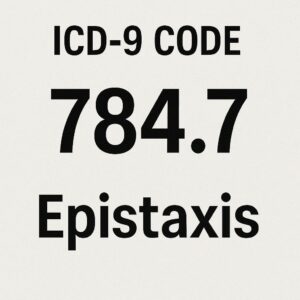
ICD-9 Code 784.7 for Epistaxis
Understanding the ICD-9 Code for Epistaxis
The ICD-9-CM (International Classification of Diseases, 9th Revision, Clinical Modification) code for epistaxis, or acute nosebleed, is 784.7.
Let’s break down what this code signifies:
-
Category 784: This broad category is titled “Symptoms involving the head and neck.” It serves as a catch-all for various complaints that aren’t attributed to a more specific disease diagnosis.
-
Specific Code 784.7: This is the precise code for “Epistaxis.” It was used to classify any instance of bleeding from the nose, regardless of the specific cause, unless that cause was better defined by another code.
Important Note: As of October 1, 2015, the United States officially transitioned from the ICD-9-CM coding system to ICD-10-CM. This means that for all medical encounters on or after that date, ICD-10 codes are required for diagnosis reporting on insurance claims, including Medicare and Medicaid. The ICD-9 code 784.7 is now considered outdated for current clinical practice.
Why Specificity Matters in Medical Coding
The simplicity of ICD-9 code 784.7 was also its limitation. It offered no detail about the nature, cause, or location of the bleed. This lack of granularity was a primary driver for the transition to ICD-10-CM, which allows for much more precise documentation, leading to better patient care tracking, more accurate reimbursement, and richer data for medical research.
The Modern Equivalent: ICD-10-CM Codes for Epistaxis
In the ICD-10-CM system, epistaxis is coded under category R04.0. However, unlike its ICD-9 predecessor, ICD-10 requires greater specificity through the use of an additional digit.
Here is the basic structure for epistaxis coding in ICD-10:
R04.0 – Epistaxis
-
R04.0 – Epistaxis: This is the base code for a nosebleed where the specific origin is not specified.
-
R04.1 – Hemorrhage from throat: Used for bleeding originating in the throat, not the nose.
For the most accurate coding, a 5th character is required to specify laterality (which side of the nose):
-
R04.0 – Epistaxis
-
R04.01 – Epistaxis, right side
-
R04.02 – Epistaxis, left side
-
R04.1 – Epistaxis, unspecified side
-
This level of detail immediately provides valuable clinical information that was missing from the old ICD-9 code.
When to Use Ancillary Codes
A critical advancement in ICD-10 is the ability to link a symptom (like epistaxis) to an underlying cause. Coders must be vigilant to see if the provider has documented a definitive cause for the nosebleed. If so, that cause is coded first, and the epistaxis code may be used as a secondary code if the bleeding is a significant factor in the visit.
Examples:
-
If epistaxis is due to a diagnosed hereditary hemorrhagic telangiectasia (I78.0), code I78.0 is primary.
-
If it’s due to acute sinusitis (J01.90), code J01.90 is primary.
-
If it’s a side effect of anticoagulant therapy, an adverse effect code (T45.515A, etc.) would be primary, followed by R04.0.
Comparative Table: ICD-9 vs. ICD-10 for Epistaxis
| Feature | ICD-9-CM (Historical) | ICD-10-CM (Current) |
|---|---|---|
| Primary Code | 784.7 | R04.0 |
| Code Title | Epistaxis | Epistaxis |
| Specificity | Low. One code for all nosebleeds. | High. Requires laterality (right, left, unspecified). |
| Coding Philosophy | “What is the symptom?” | “What is the symptom, specifically, and what is the cause?” |
| Number of Codes | 1 | 4 (including R04.1 for throat hemorrhage) |
| Data Utility | Basic tracking of incidence. | Enables detailed analysis of patterns, causes, and treatment outcomes. |
Key Documentation Points for Accurate Epistaxis Coding
For medical coders to assign the correct code, the clinician’s documentation must be clear. Here’s what providers should note:
-
Laterality: Is the bleed from the right nostril, left nostril, or both?
-
Location (if known): Anterior (front of nose, more common) or posterior (deep in the nose, often more severe)?
-
Cause (if determined): Trauma (including nose-picking), dry air, hypertension, coagulation disorder, medication effect (e.g., anticoagulants like warfarin), or a structural lesion?
-
Severity: Was it a minor, self-resolving bleed or a significant hemorrhage requiring packing, cautery, or other intervention?
-
Context: Is this an isolated incident or a recurrent problem?
Helpful List for Providers: What to Document for an Epistaxis Visit
-
Patient history of bleeding disorders or anticoagulant use.
-
The side of the nose affected (right, left, bilateral).
-
Any identified source vessel or anatomical site during examination.
-
The intervention performed (chemical cautery, electrocautery, nasal packing).
-
Whether the bleeding was controlled during the visit.
A Note on Reimbursement and Medical Necessity
Accurate coding is directly tied to appropriate reimbursement. Using an unspecified code like R04.0 when a more specific code is available can sometimes lead to payment delays or denials if the payer’s policy requires greater detail. Furthermore, the treatment provided (e.g., simple cautery vs. complex nasal packing) must be supported by the documented severity and diagnosis. Linking the epistaxis to a causative factor (like a clotting disorder) can justify more extensive diagnostic testing or treatment.
Conclusion
While the historical ICD-9 code for epistaxis was 784.7, modern medical coding uses the detailed ICD-10-CM code set, starting with R04.0 and requiring specification of laterality. The shift to ICD-10 reflects the need for precise clinical data, which improves patient care and ensures accurate healthcare administration. Always code to the highest level of specificity documented by the provider, and remember that understanding the cause of the epistaxis is as important as coding the symptom itself.
Frequently Asked Questions (FAQ)
Q: Can I still use ICD-9 code 784.7 on medical claims today?
A: No. For all healthcare services provided in the U.S. on or after October 1, 2015, you must use ICD-10-CM codes. Using ICD-9 codes will result in claim rejection.
Q: What is the ICD-10 code for a simple, unspecified nosebleed?
A: The most basic code is R04.0. However, you must add a 5th digit for laterality. If the side is not documented, you would use R04.09 – Epistaxis, unspecified side.
Q: Why are there so many more codes in ICD-10? Isn’t it just a nosebleed?
A: The increased specificity of ICD-10 allows for better tracking of public health trends, more precise research on treatment effectiveness, and fairer reimbursement that reflects the complexity of a case. Knowing if a bleed is recurrent, which side is affected, or if it’s linked to a medication helps paint a complete clinical picture.
Q: As a patient, why should I care about these codes?
A: Accurate coding ensures your medical record is correct, which is vital for future care. It also helps prevent billing errors and insurance claim denials that can become your responsibility to resolve.
Additional Resources
For the most authoritative and up-to-date coding information, always refer to the official code sets:
-
Centers for Medicare & Medicaid Services (CMS) ICD-10-CM Official Guidelines: https://www.cms.gov/medicare/coding-billing/icd-10-codes
-
World Health Organization (WHO) ICD-10 Online Browser: https://icd.who.int/browse10/2019/en
Disclaimer: *This article is intended for informational and educational purposes only. It is not a substitute for professional medical coding advice, official coding guidelines, or clinical judgment. Medical coding is complex and governed by official rules and updates. Always consult the current, official ICD-10-CM code set and the CMS coding guidelines for accurate code assignment. The author and publisher are not responsible for any coding errors or reimbursement issues resulting from the use of this information. Date of Article: January 18, 2026. Author: Professional Healthcare Writing Team.*