In the ever-evolving landscape of medical coding, understanding historical systems remains crucial for managing legacy records, comprehending past medical literature, and ensuring accurate longitudinal data analysis. While the healthcare world transitioned to ICD-10 in October 2015, the ICD-9-CM code for dyspnea is still a topic of inquiry for medical students, researchers, and professionals dealing with older documentation. This comprehensive guide will explore the ICD-9 code for dyspnea in meticulous detail, providing clarity, context, and practical knowledge that stands as an authoritative reference.
We will journey beyond a simple code lookup. We’ll delve into the clinical nuances that guided its use, compare it directly with the modern ICD-10 system, and offer insights that transform this from a mere fact into a piece of functional medical history. Whether you’re auditing old charts, studying for an exam, or simply satisfying your professional curiosity, this article is your one-stop resource.
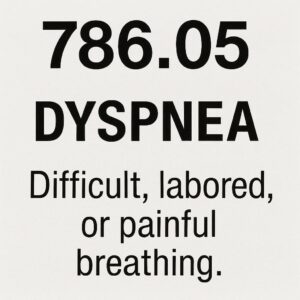
ICD-9 Code 786.05 for Dyspnea
Understanding the ICD-9 Coding System: A Brief Backdrop
Before we zero in on dyspnea, it’s essential to grasp the system that housed its code. The International Classification of Diseases, 9th Revision, Clinical Modification (ICD-9-CM) was the diagnostic coding standard used in the United States for over three decades.
Key Concept: “ICD-9-CM was a pivotal system for its time, but its structure was inherently limited by a lack of specificity compared to today’s standards,” notes a veteran medical coding consultant. “Coding for a symptom like dyspnea often felt like fitting a complex puzzle piece into a simple square hole.”
The system was organized into three volumes:
-
Volume 1: The tabular list of diseases and injuries (codes 001.0–999.9).
-
Volume 2: The alphabetic index of disease manifestations.
-
Volume 3: Procedural codes (for inpatient procedures).
Symptoms, signs, and ill-defined conditions—like dyspnea—were primarily found in Chapter 16, covering codes 780–799. This location immediately highlights a key characteristic of ICD-9: it often grouped broad symptomatic codes separately from their potential etiologies.
The Specific ICD-9 Code for Dyspnea
The precise ICD-9-CM code assigned for the symptom of dyspnea was 786.05.
Let’s deconstruct this code:
-
786: This is the parent code for “Symptoms involving respiratory system and other chest symptoms.”
-
786.0: This subcategory specifies “Dyspnea and respiratory abnormalities.”
-
786.05: This final, fifth-digit specificity pinpoints “Shortness of breath.”
It is critical to understand that 786.05 was used specifically for shortness of breath (SOB). Other related breathing difficulties had distinct codes under the same 786.0 umbrella.
Related and Often-Confused ICD-9 Codes
Coding accurately required careful distinction. Here is a comparative table of codes that were adjacent to 786.05.
| ICD-9 Code | Code Description | Clinical Differentiation from 786.05 |
|---|---|---|
| 786.05 | Shortness of breath | The primary code for the symptom of dyspnea. |
| 786.09 | Other dyspnea and respiratory abnormalities | Used for other ill-defined breathing issues not specified as SOB, like “respiratory distress” without further detail. |
| 786.1 | Stridor | A high-pitched, wheezing sound due to disrupted airflow, often from an upper airway obstruction. |
| 786.2 | Cough | Symptom of coughing alone, without specification of SOB. |
| 786.3 | Hemoptysis | Coughing up blood or blood-stained sputum. |
| 786.4 | Abnormal sputum | Changes in the amount or color of sputum. |
| 786.7 | Abnormal chest sounds | Such as wheezing, rales, or rhonchi documented as the primary issue. |
| 786.9 | Other symptoms involving respiratory system | A catch-all for symptoms not classifiable elsewhere. |
Important Note for Readers: In ICD-9, if a definitive diagnosis causing the dyspnea was established, that diagnosis code typically replaced 786.05. For example, acute bronchitis (466.0) or acute systolic heart failure (428.21) would be coded instead. Code 786.05 was reserved for encounters where shortness of breath was the primary reason for the visit, and a specific cause had not yet been determined.
Clinical Documentation and Coding Scenarios in ICD-9
The application of 786.05 was entirely dependent on physician documentation. Let’s walk through realistic scenarios to illustrate proper use.
Scenario 1: Emergency Department Visit
A patient presents to the ED with acute onset of shortness of breath. After examination and a chest X-ray, the physician diagnoses “acute bronchospasm likely due to asthma exacerbation” and treats accordingly.
-
ICD-9 Coding: The coder would assign 493.92 (Asthma, unspecified type, with (acute) exacerbation). Code 786.05 would not be used as a primary code because a definitive diagnosis was made.
Scenario 2: Primary Care Clinic Visit
A patient sees their PCP complaining of worsening shortness of breath on exertion over several weeks. The physician documents “dyspnea on exertion, etiology to be determined” and orders an echocardiogram and pulmonary function tests for a future visit.
-
ICD-9 Coding: Here, 786.05 is the appropriate primary code. It accurately reflects the documented reason for the visit—a symptom awaiting further workup.
Scenario 3: Inpatient Admission with Multiple Issues
A patient is admitted for pneumonia (485). Throughout their hospital stay, they are documented as having persistent “shortness of breath” as a significant symptom of the pneumonia.
-
ICD-9 Coding: The primary code would be for pneumonia (485). Depending on the coding guidelines in effect and the significance of the symptom, 786.05 might be listed as a secondary code to capture the full clinical picture, though the pneumonia code itself inherently includes dyspnea.
The Transition to ICD-10: A World of Specificity
The shift from ICD-9 to ICD-10-CM on October 1, 2015, was a seismic change, particularly for symptom coding. Where ICD-9 had one code for shortness of breath, ICD-10 offers a detailed array of choices that paint a precise clinical picture.
The direct equivalent to ICD-9’s 786.05 in ICD-10 is found in category R06.0: Dyspnea.
However, ICD-10 requires greater specificity through additional characters:
-
R06.00: Dyspnea, unspecified
-
R06.01: Orthopnea (shortness of breath when lying flat)
-
R06.02: Shortness of breath on exertion
-
R06.03: Acute respiratory distress
-
R06.09: Other forms of dyspnea
Furthermore, dyspnea can be coded as part of other categories, such as:
-
R06.2: Wheezing
-
R06.3: Periodic breathing (e.g., Cheyne-Stokes)
-
R06.83: Snoring
-
R06.89: Other abnormalities of breathing (e.g., tachypnea, hyperventilation)
This level of detail facilitates better patient care tracking, more accurate reimbursement, and richer data for clinical research.
Practical Implications and Modern Relevance
For Medical Coders and Billers
While you are no longer using ICD-9 for current billing, understanding 786.05 is vital for:
-
Auditing Historical Claims: Reviewing charts from before October 2015 requires fluency in ICD-9.
-
Researching Patient History: A patient’s long-term record is a blend of ICD-9 and ICD-10 codes.
-
Educational Foundation: Knowing ICD-9’s limitations helps appreciate the rationale and advantages of ICD-10’s structure.
For Healthcare Providers and Students
Grasping the old system aids in:
-
Reading Older Medical Literature: Studies published pre-2015 will reference ICD-9 codes.
-
Understanding Coding Evolution: It highlights the importance of specific documentation, a skill that is even more critical under ICD-10.
Frequently Asked Questions (FAQ)
Q: Can I still use ICD-9 code 786.05 for billing today?
A: No. For all healthcare services provided on or after October 1, 2015, in the United States, you must use ICD-10-CM codes. Using ICD-9 will result in claim denials.
Q: What is the most common ICD-10 code I would use instead of 786.05?
A: The most direct equivalent is R06.00 (Dyspnea, unspecified). However, always review the clinical documentation to see if a more specific code like R06.02 (Shortness of breath on exertion) is applicable.
Q: Why is it important to know old ICD-9 codes if they’re obsolete?
A: Medical records have a long lifespan. Professionals often need to interpret, audit, or analyze data spanning the ICD-9/ICD-10 transition. Understanding both systems is key to accurate historical analysis and continuity of care.
Q: Was 786.05 used as a primary diagnosis?
A: Yes, but only in encounters where the sole or primary reason for the visit was the investigation of shortness of breath without a confirmed cause. Once a definitive diagnosis (e.g., heart failure, COPD) was established, that condition’s code took precedence.
Conclusion
The ICD-9 code 786.05 for shortness of breath represents a specific point in medical coding history—a system that served its purpose but lacked the granularity demanded by modern healthcare. Its translation into the detailed framework of ICD-10-CM underscores the industry’s move towards precision, which enhances patient care, data analytics, and operational efficiency. Mastery of both systems, even as one retires, remains a mark of a thorough and knowledgeable healthcare professional.
Disclaimer: This article is for informational and educational purposes only. It is not a substitute for professional medical coding advice, official coding guidelines, or current code sets. For accurate, up-to-date coding, always consult the most recent editions of the ICD-10-CM code books and the official guidelines from the Centers for Medicare & Medicaid Services (CMS) and the National Center for Health Statistics (NCHS). The author and publisher disclaim any liability arising from the use or misuse of this information.
Date: January 13, 2026
Author: Professional Medical Writing Team
Additional Resource: For the official ICD-10-CM codes and guidelines, visit the CDC’s National Center for Health Statistics website at: https://www.cdc.gov/nchs/icd/icd10cm.htm