If you’re looking at an old medical bill, a research paper, or a historical health record, you might have encountered the term “ICD-9 code for atherosclerotic heart disease.” While this coding system has been replaced, understanding it is crucial for making sense of past medical information. This guide will provide a clear, thorough, and reliable explanation of this specific code, its context, and its importance.
We’ll navigate the details of the code itself, explore why it’s no longer in active use, and help you understand what you see in your records. Our goal is to demystify medical coding for patients, students, and healthcare professionals alike, using simple, accessible language.
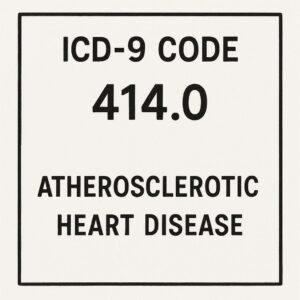
ICD-9 Code for Atherosclerotic Heart Disease
Understanding Medical Coding: What is ICD-9?
Before we dive into the specific code, let’s set the stage. The International Classification of Diseases, 9th Revision, Clinical Modification (ICD-9-CM) was a system used for over three decades in the United States to categorize diseases, symptoms, and medical procedures. Think of it as a vast, standardized dictionary for medicine. Every possible health condition had a corresponding numeric code.
Doctors used these codes on billing forms and medical records to communicate precisely about a patient’s diagnosis. Insurance companies used them to determine coverage and process claims. Researchers used them to track disease trends. The system aimed to create a common language in a complex field.
“ICD-9 was the lingua franca of healthcare administration for a generation. It structured how we recorded, billed for, and studied disease from 1979 to 2015.”
However, by the 2010s, ICD-9 had run out of room for new diseases and modern procedures. Its structure was considered outdated. This led to a monumental shift in October 2015, when the U.S. healthcare system officially transitioned to ICD-10-CM, a much more detailed and expansive system. While ICD-9 is now historical, millions of records containing its codes are still active and relevant for ongoing patient care and historical analysis.
The Specific Code: 414.0 for Atherosclerotic Heart Disease
In the ICD-9-CM system, the code for the most common form of coronary artery disease is 414.0.
Let’s break down exactly what this code represents:
-
Category 414: This broader category is titled “Other forms of chronic ischemic heart disease.” It acts as a chapter heading for various long-term heart conditions caused by inadequate blood supply.
-
Sub-code .0: This specifies the exact condition under category 414: “Coronary atherosclerosis.”
Therefore, ICD-9 code 414.0 specifically stands for Coronary Atherosclerosis. It refers to the buildup of fatty plaques (atherosclerosis) within the arteries that supply blood to the heart muscle (the coronary arteries). This is the foundational process behind conditions like angina (chest pain) and heart attacks.
What Conditions Did 414.0 Cover?
This code was used for a range of clinical presentations involving atherosclerotic coronary arteries. It included:
-
Atherosclerotic cardiovascular disease
-
Atherosclerosis of coronary artery bypass grafts
-
Atherosclerosis of a transplanted heart
-
Chronic coronary insufficiency (when due to atherosclerosis)
-
It did not include conditions where an active, acute event was occurring, such as a heart attack (those had separate codes in the 410 series).
Key Differences Between ICD-9 and ICD-10 for Heart Disease
The transition to ICD-10-CM wasn’t just a simple code swap; it was a move to a far more precise language. The code for atherosclerotic heart disease is a perfect example of this evolution.
| Feature | ICD-9-CM (Code 414.0) | ICD-10-CM (Code I25.1-) |
|---|---|---|
| Code Format | Simple, 3-5 digits | Alphanumeric, up to 7 characters |
| Specificity | Very broad. One code for all coronary atherosclerosis. | Highly specific. Requires additional details. |
| Required Details | None beyond the basic diagnosis. | Must specify: 1. The type of vessel(s) affected. 2. The presence of angina pectoris (chest pain). |
| Example Code | 414.0 (Coronary atherosclerosis) | I25.110 (Athscl heart disease of native corny art w unstable angina pectoris) |
| Number of Possible Codes | Essentially 1 primary code. | Dozens of possible combinations, painting a complete clinical picture. |
As you can see, ICD-10 requires clinicians to be much more descriptive. This specificity improves patient care, data quality for research, and the accuracy of billing.
Navigating Related and Similar ICD-9 Codes
Code 414.0 did not exist in isolation. To fully understand a historical record, it’s helpful to know the codes that were used alongside it or for related conditions.
Codes Within the Same Category (414):
-
414.00: Coronary atherosclerosis, unspecified vessel. This was often used interchangeably with 414.0.
-
414.01: Coronary atherosclerosis of native coronary artery.
-
414.02: Coronary atherosclerosis of autologous vein bypass graft.
-
414.03: Coronary atherosclerosis of nonautologous biological bypass graft.
-
414.04: Coronary atherosclerosis of artery bypass graft.
-
414.05: Coronary atherosclerosis of transplanted heart.
-
414.06: Coronary atherosclerosis of coronary artery bypass graft (unspecified type).
Codes for Acute Events (The 410 Series):
These were used for active heart attacks, not chronic disease.
-
410.xx: Acute myocardial infarction (heart attack). The “xx” provided further detail on location.
Codes for Other Heart Conditions:
-
411.xx: Other acute and subacute forms of ischemic heart disease (e.g., unstable angina).
-
413.xx: Angina pectoris (chest pain syndromes).
-
412: Old myocardial infarction (history of a past heart attack).
-
429.2: Cardiovascular disease, unspecified.
Important Note for Readers: If you are reviewing a personal medical record or bill with an ICD-9 code, remember it is a snapshot of your diagnosis at that time. Always discuss your complete medical history with your current doctor, who uses the modern ICD-10 system.
Why Knowing About ICD-9 Code 414.0 Still Matters
You might wonder why we’re discussing a retired code. Here are several practical reasons this knowledge is valuable:
-
Understanding Your Medical History: If you were diagnosed with or treated for heart disease before October 2015, your records will contain ICD-9 codes. Knowing that 414.0 refers to your coronary atherosclerosis helps you decode your own health journey.
-
Research and Data Analysis: A vast amount of medical research spanning decades is built on ICD-9 data. Scientists studying long-term trends in heart disease must be fluent in these codes to interpret historical studies accurately.
-
Billing and Insurance Clarification: Old insurance claims or disputes may reference these codes. Understanding them can empower you to have informed conversations with insurers or healthcare administrators.
-
Professional Knowledge: For medical coders, billers, and administrators, understanding ICD-9 is essential for handling legacy records, appeals, and audits related to past services.
The Transition to ICD-10: A Necessary Evolution
The shift from ICD-9 to ICD-10 was driven by necessity. ICD-9’s limited structure couldn’t accommodate new diseases, modern technologies, or the demand for detailed patient data. The transition, while challenging, brought significant benefits:
-
Improved Patient Care: More specific codes lead to better tracking of patient outcomes and complications.
-
Enhanced Public Health Tracking: Health officials can now monitor diseases and disease subtypes with much greater precision.
-
Modernized Terminology: ICD-10 includes current medical terminology and procedures absent from the older system.
-
Global Alignment: It moves the U.S. closer to the coding systems used by other countries, facilitating international health research.
Common ICD-10 Codes for Atherosclerotic Heart Disease
To give you a sense of the modern coding landscape, here are a few examples of how the old 414.0 translates into ICD-10-CM:
-
I25.10: Atherosclerotic heart disease of native coronary artery without angina pectoris.
-
I25.110: Atherosclerotic heart disease of native coronary artery with unstable angina pectoris.
-
I25.118: Atherosclerotic heart disease of native coronary artery with other forms of angina pectoris.
-
I25.700: Atherosclerosis of coronary artery bypass graft(s), unspecified, with unstable angina pectoris.
Each of these codes provides a clear, immediate picture of the patient’s specific condition to anyone reading the chart.
Conclusion
The ICD-9 code 414.0 for atherosclerotic heart disease is a key piece of medical history, representing the standard way chronic coronary artery disease was documented for decades. While the healthcare world has moved to the more precise ICD-10 system, understanding 414.0 remains essential for interpreting past medical records, conducting long-term research, and managing historical billing data. By bridging the knowledge gap between these two systems, patients and professionals alike can better navigate the complete story of heart health.
Frequently Asked Questions (FAQ)
Q: I saw “ICD-9 414.0” on an old medical bill. What should I do now?
A: Don’t be alarmed. This simply confirms you had a diagnosis of coronary atherosclerosis at that time. For current care, ensure your present doctor has your full history. All new diagnoses and billing will use ICD-10 codes.
Q: Can a doctor still use ICD-9 codes today?
A: No. As of October 1, 2015, all HIPAA-covered entities (hospitals, doctors, insurers) in the U.S. are required to use ICD-10-CM for diagnosis coding. Using ICD-9 would result in rejected claims.
Q: How can I find the modern equivalent of an old ICD-9 code?
A: The Centers for Medicare & Medicaid Services (CMS) and the CDC provide general equivalence mappings (GEMs). However, the translation is often not one-to-one due to ICD-10’s greater specificity. A qualified medical coder or your healthcare provider can give you the most accurate translation for your specific case.
Q: Does the change in coding affect my diagnosis or treatment?
A: Your actual medical condition doesn’t change. However, the more detailed ICD-10 code allows your care team to document your health status with greater accuracy, which can support more personalized treatment planning.
Additional Resources
For those seeking official information on medical coding, we recommend visiting the Centers for Disease Control and Prevention (CDC) ICD-10 webpage. It provides authoritative code browsers, guidelines, and updates: CDC ICD-10-CM
Disclaimer: This article is for informational purposes only and is based on historical coding data. It is not a substitute for professional medical advice, diagnosis, or treatment. Always seek the advice of your physician or other qualified health provider with any questions you may have regarding a medical condition or the interpretation of your medical records. Medical coding guidelines are complex and subject to change; always refer to the most current official code sets for definitive information.
Date: January 07, 2026
Author: The Web Health Guide Team