Understanding medical codes is crucial for patients, healthcare providers, and medical billing specialists. If you’re dealing with medical records, insurance forms, or historical health data, you might encounter the question: what was the ICD-9 code for atopic dermatitis? While the healthcare world has moved to a newer coding system, knowledge of ICD-9 remains essential for interpreting older documents.
This comprehensive guide will explore the specific ICD-9 code for atopic dermatitis, explain its components, and place it within the broader context of medical classification. We’ll demystify the code, discuss its clinical relevance, and guide you through the important transition to the current ICD-10 system.
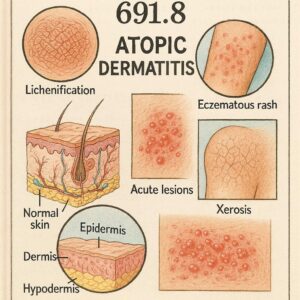
ICD-9 Code for Atopic Dermatitis
Understanding the ICD-9 Coding System
Before we pinpoint the specific code, let’s understand the system it belongs to. The International Classification of Diseases, Ninth Revision, Clinical Modification (ICD-9-CM) was the standard diagnostic coding system used in the United States for decades until October 1, 2015.
“ICD-9-CM served as the foundational language for morbidity statistics and healthcare reimbursement for over 30 years. It transformed patient diagnoses into standardized data points,” notes a medical coding historian.
Its primary purposes were:
-
Standardization: Creating a common language for diseases, symptoms, and procedures.
-
Billing and Reimbursement: Enabling healthcare providers to submit claims to insurance companies.
-
Epidemiology and Tracking: Helping public health officials track the incidence and prevalence of diseases.
The system was hierarchical, with codes becoming more specific as digits were added. The structure typically looked like this:
-
Category (3 digits): The broad disease group.
-
Subcategory (1 digit): Adds detail about etiology, site, or severity.
-
Subclassification (1 digit): Provides the highest level of detail available in ICD-9-CM.
The Specific ICD-9 Code for Atopic Dermatitis
The dedicated ICD-9-CM code for atopic dermatitis was 691.8.
Let’s break down what this code signifies:
-
691: This is the category for “Other atopic dermatitis and related conditions.” It sits within the larger chapter of “Diseases of the skin and subcutaneous tissue.”
-
.8: This fourth digit specifies “Other atopic dermatitis and related conditions.” This subcategory explicitly includes atopic dermatitis itself, along with related terms like flexural eczema, infantile eczema, and intrinsic (allergic) eczema.
Important Note for Readers: Code 691.8 was a “parent” code that required a fifth digit for maximum specificity in some coding scenarios, though in many clinical and billing contexts, 691.8 was used as-is for general atopic dermatitis.
Comparative Table: Atopic Dermatitis in ICD-9 vs. Related Codes
| ICD-9 Code | Code Description | Clinical Notes & Differentiation |
|---|---|---|
| 691.8 | Other atopic dermatitis and related conditions | The primary code for classic atopic dermatitis. Includes flexural, infantile, and intrinsic allergic eczema. |
| 692.9 | Contact dermatitis and other eczema, unspecified | Used for eczema caused by an external irritant or allergen (e.g., poison ivy, nickel allergy), not the chronic, internal predisposition of atopic dermatitis. |
| 698.3 | Lichenification and lichen simplex chronicus | Represents thick, leathery skin resulting from chronic scratching, which can be a complication of atopic dermatitis but is not the primary diagnosis. |
| 692.xx | Other contact dermatitis (series) | A family of codes specifying the causative agent (e.g., 692.0 for detergents, 692.4 for chemicals). |
| 706.2 | Sebaceous cyst | Often confused by patients; this is a benign skin cyst, fundamentally different from an eczematous condition. |
Why Accuracy in Coding Atopic Dermatitis Matters
Using the correct code, even in a historical system like ICD-9, was never just a clerical task. It had real-world implications.
-
For Patient Care: Accurate coding ensured a patient’s medical history clearly reflected their chronic condition, informing future treatment decisions.
-
For Insurance Reimbursement: Insurance companies used these codes to adjudicate claims. An incorrect code could lead to claim denials or delays, directly impacting a clinic’s revenue and potentially creating financial confusion for patients.
-
For Public Health: Aggregated coded data helped researchers understand the prevalence of atopic dermatitis, study its comorbidities, and allocate resources for treatment and awareness.
A dermatology practice manager explains the practical impact: “Before ICD-10, we lived by codes like 691.8. Ensuring every chart and claim had it correctly was the difference between a smooth revenue cycle and a backlog of denied claims that needed costly rework.”
Common Clinical Scenarios and ICD-9 Coding
-
Scenario 1: A 4-year-old patient presents with classic itchy, red patches in the elbow and knee creases. The pediatrician diagnoses atopic dermatitis. Code: 691.8
-
Scenario 2: An adult with a known history of atopic dermatitis (691.8) presents with a severe flare and secondary bacterial infection (impetiginized eczema). Both codes would be used, with the infection code (e.g., 686.8 for other local skin infections) potentially listed first.
-
Scenario 3: A patient develops a red, itchy rash on their wrist under a new watch. This is diagnosed as allergic contact dermatitis. Code: 692.9 or a more specific 692.8x code, not 691.8.
The Transition from ICD-9 to ICD-10-CM
On October 1, 2015, the United States mandated a transition from ICD-9-CM to ICD-10-CM. This was a monumental shift in healthcare administration, moving from approximately 14,000 codes to over 68,000. The change was driven by the need for greater specificity in describing diagnoses, which improves care quality, enhances data for research, and streamlines modern billing processes.
Mapping the Code: From ICD-9 to ICD-10 for Atopic Dermatitis
The old code 691.8 does not have a single, direct crosswalk in ICD-10. Instead, it maps to a more detailed set of codes in the L20 family. This illustrates the core philosophy of ICD-10: increased specificity.
The primary ICD-10-CM codes for Atopic Dermatitis are:
-
L20.0: Besnier’s prurigo (a specific severe form)
-
L20.81: Atopic neurodermatitis
-
L20.82: Flexural eczema
-
L20.83: Infantile (acute) (chronic) eczema
-
L20.84: Intrinsic (allergic) eczema
-
L20.89: Other atopic dermatitis
-
L20.9: Atopic dermatitis, unspecified
Key Differences in a Nutshell:
-
ICD-9 (691.8): One code covered all the variations listed under L20.81 through L20.89.
-
ICD-10 (L20.xx): Requires the coder to choose a specific code based on the provider’s documentation of the type or manifestation of atopic dermatitis.
Working with Historical ICD-9 Codes Today
You might be dealing with ICD-9 code 691.8 for several reasons:
-
Reviewing Old Medical Records: Patient charts from before late 2015 will use ICD-9 codes.
-
Handling Legacy Data: Research studies or historical health trend analyses may be based on ICD-9 data.
-
Addressing Older Claims: Resolving inquiries or audits on pre-2015 insurance claims.
Helpful Tip: When you see 691.8 in an old record, you can confidently interpret it as “Atopic Dermatitis.” For modern purposes, such as submitting a new claim for ongoing treatment, this must be translated into the appropriate, specific ICD-10-CM code based on the patient’s current clinical presentation.
Checklist for Interpreting an Old ICD-9 Code (691.8)
-
Confirm the date of the document is from before October 1, 2015.
-
Understand that “691.8” represents the general diagnosis of atopic dermatitis.
-
Check the medical documentation for any specifics (e.g., “infantile eczema,” “flexural dermatitis”) that could inform a more precise ICD-10 code if needed for current use.
-
Do not use 691.8 on any current healthcare claim or form; always use ICD-10.
The Bigger Picture: Atopic Dermatitis as a Chronic Condition
Beyond the code, it’s vital to see atopic dermatitis for what it is: a common, chronic, inflammatory skin condition characterized by dry, itchy skin and rashes. It often follows a relapsing and remitting course and is frequently associated with other atopic conditions like asthma and allergic rhinitis (hay fever).
Accurate coding, whether in the past with ICD-9 or now with ICD-10, helps paint an accurate picture of a patient’s lifelong health journey, ensuring continuity of care and appropriate management strategies.
Additional Resources for Patients and Professionals
-
For Patients: The National Eczema Association (www.nationaleczema.org) provides excellent educational materials, support networks, and the latest treatment information.
-
For Coders: The Centers for Medicare & Medicaid Services (CMS) website offers official code sets and general equivalency mapping (GEM) files to navigate between ICD-9 and ICD-10.
-
For Clinical Reference: UpToDate or similar evidence-based clinical decision support resources provide detailed medical information that informs accurate diagnosis and, by extension, accurate coding.
Conclusion
The ICD-9 code for atopic dermatitis, 691.8, served as a critical standardized identifier for this common skin condition for decades. While the healthcare system has progressed to the more detailed ICD-10 system, understanding historical codes remains key for interpreting past medical records and appreciating the evolution of medical data. Accurate diagnosis and coding are the bedrock of effective patient care, correct billing, and meaningful health statistics.
FAQ: ICD-9 Code for Atopic Dermatitis
Q1: I found “691.8” on an old medical bill from 2012. What does it mean?
A1: It means your diagnosis for that visit or service was atopic dermatitis, also known as eczema. This was the standard diagnostic code used for billing and records in the United States until October 2015.
Q2: Can I still use the ICD-9 code 691.8 on insurance forms today?
A2: No. Since October 1, 2015, all healthcare providers and insurers in the U.S. are required to use the ICD-10-CM system. Using an ICD-9 code on a current claim will result in a rejection. You must use a corresponding ICD-10 code from the L20 series (e.g., L20.9, L20.83).
Q3: What is the closest ICD-10 code to the old 691.8?
A3: There isn’t a one-to-one match due to increased specificity in ICD-10. The most general equivalent is L20.9, “Atopic dermatitis, unspecified.” However, your provider should choose a more specific code if your documentation supports it (e.g., L20.83 for infantile eczema).
Q4: Why did the code system change from ICD-9 to ICD-10?
A4: ICD-9 became outdated. ICD-10 offers vastly more detail and specificity, which improves the quality of health data for patient care, public health tracking, and medical research. It better accommodates modern medical knowledge and technology.
Q5: My child has eczema. Was their condition coded as 691.8 in the past?
A5: Almost certainly, yes. Before late 2015, childhood eczema, infantile eczema, and atopic dermatitis were all typically coded under ICD-9 code 691.8.
Disclaimer: This article is for informational and educational purposes only. It is not intended as medical advice or as a substitute for professional coding guidance. Medical coding is complex and governed by official guidelines. For specific coding questions, always consult the current official ICD-10-CM code set and associated guidelines, or a certified professional coder. For medical concerns, consult a qualified healthcare provider.
Date: January 06, 2026
Author: The Web Health Writer Team