In the intricate world of medical documentation and billing, precision is paramount. For decades, the International Classification of Diseases, Ninth Revision (ICD-9) served as the foundational language for this system. For healthcare professionals, coders, and billers who navigated that era, or for those seeking historical records, understanding the specific codes is crucial. Atrial fibrillation, a common and significant cardiac arrhythmia, had its own distinct place in the ICD-9 framework.
This guide provides a deep, reliable, and original exploration of the ICD-9 code for atrial fibrillation. We will move beyond a simple number to understand its clinical context, its role in the now-obsolete ICD-9 system, and the critical reasons for its replacement. Our goal is to create a lasting reference that offers genuine insight, not just a quick lookup.
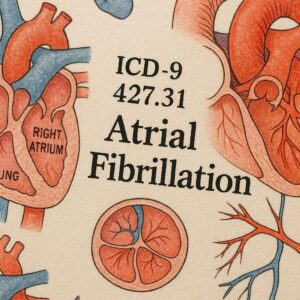
ICD-9 Code for Atrial Fibrillation
Understanding ICD-9 and Its Historical Role
Before we dive into the specific code, let’s establish what ICD-9 was and why it matters, even today. The ICD is a global health information standard published by the World Health Organization (WHO). The ICD-9-CM (Clinical Modification) was the U.S. adaptation used to classify diseases and a wide array of health conditions for morbidity (sickness) and mortality (death) statistics.
More importantly for the daily function of the U.S. healthcare system, ICD-9-CM codes were the backbone of medical billing and insurance reimbursement from the late 1970s until October 1, 2015. Every diagnosis, procedure, and symptom had a corresponding code. These codes communicated patient conditions to payers (like insurance companies and Medicare) to justify services, procedures, and hospital stays.
“The transition from ICD-9 to ICD-10 was not merely an update; it was a necessary evolution from a system bursting at the seams to one capable of describing the complexity of modern medicine.” — Healthcare Informatics Perspective
Key Functions of ICD-9-CM:
-
Billing and Reimbursement: The primary driver for its use in the U.S.
-
Epidemiological Tracking: Monitoring the incidence and prevalence of diseases like atrial fibrillation.
-
Clinical Research: Grouping patients by condition for studies.
-
Quality Measurement: Assessing healthcare outcomes and hospital performance.
The Structure of an ICD-9 Code
ICD-9 codes were typically 3 to 5 digits long. The structure was hierarchical:
-
First three digits: The “category” describing the general disease or group of diseases (e.g., 427 for cardiac dysrhythmias).
-
Fourth digit: A subcategory providing more specificity about the site or type of disease.
-
Fifth digit: Often indicated the most specific detail, such as acuity or anatomical detail.
This limited structure, with its maximum of ~13,000 codes, ultimately became a major limitation, leading to a lack of specificity that hampered clinical detail and billing accuracy.
The Specific ICD-9 Code for Atrial Fibrillation
Within the ICD-9-CM system, atrial fibrillation was classified under the broader category of “Cardiac Dysrhythmias.” The precise code was:
ICD-9 Code 427.31: Atrial Fibrillation
Let’s break down this code’s placement in the ICD-9 universe:
-
Category 427: Cardiac dysrhythmias
-
Subcategory 427.3: Atrial fibrillation and flutter
-
Final Code 427.31: Atrial fibrillation
It is vital to note that ICD-9 code 427.31 was a “parent code” with no further subclassifications. This was one of the critical shortcomings of ICD-9 in managing this condition. The code did not distinguish between:
-
New-onset vs. persistent vs. permanent atrial fibrillation
-
Paroxysmal vs. chronic forms
-
Atrial fibrillation with or without accompanying heart failure
-
The presence of valvular vs. non-valvular origins
All patients with a diagnosis of atrial fibrillation received the same 427.31 code. This lack of granularity had implications for clinical data collection, reimbursement accuracy, and quality reporting.
Comparative Table: Atrial Fibrillation in ICD-9 vs. ICD-10
This table highlights the dramatic shift in specificity between the two coding systems.
| Feature | ICD-9-CM (Code 427.31) | ICD-10-CM (I48 Series) |
|---|---|---|
| Specific Code | 427.31 (Only one code) | Over 20 possible codes (e.g., I48.0, I48.1, I48.2, I48.91) |
| Specificity | Low. One code for all types of AFib. | High. Specifies type, duration, and associated conditions. |
| Distinguishes | No distinction between types. | Paroxysmal, persistent, chronic, permanent, and unspecified. |
| Associated Conditions | Not captured in the code. | Includes separate codes for atrial fibrillation in heart failure (I48.91) and other conditions. |
| Laterality | Not applicable (heart is a single organ). | Not applicable. |
| Coding Impact | Simple but clinically imprecise. | Complex but enables precise clinical documentation and data analytics. |
Clinical Context of Atrial Fibrillation in the ICD-9 Era
During the time ICD-9 was active, the clinical understanding and treatment of atrial fibrillation evolved significantly. However, the coding system could not keep pace. Physicians would diagnose and document the specific type of AFib in their notes, but this nuance was lost when translated to the mandatory 427.31 code for billing purposes.
Common Documentation Paired with Code 427.31:
-
“Chronic atrial fibrillation”
-
“Paroxysmal atrial fibrillation”
-
“AFib with rapid ventricular response”
-
“Lone atrial fibrillation”
While these descriptors were in the medical record, the single billing code limited the ability of health systems to analyze outcomes or costs for these distinct patient subgroups with precision.
Billing and Reimbursement Implications
For medical coders and billers, 427.31 was a frequently used code. Its correct application was essential for claims to be processed. It was often listed alongside:
-
Procedure codes (CPT/HCPCS): For cardioversions, ablations, or implantable monitor placements.
-
Other diagnosis codes: Such as 401.9 (Hypertension) or 428.0 (Heart failure), to paint a complete picture of the patient’s comorbidities and justify the medical necessity of treatments.
A Note on Specificity: Because 427.31 was not specific, insurers could not easily use the code itself to determine the medical necessity of certain expensive treatments (like newer anticoagulants or ablation) without extensive manual review of the clinical notes. This often led to more frequent claim denials and requests for additional documentation.
The Transition to ICD-10 and Why It Mattered
The U.S. transitioned to ICD-10-CM on October 1, 2015. This move was mandated because ICD-9 was fundamentally outdated. It ran out of space for new codes, lacked the detail needed for modern medicine, and hindered international health data comparisons.
For atrial fibrillation, the change was revolutionary. The single code 427.31 was replaced by a sophisticated family of codes under category I48.
Overview of Key ICD-10 Codes for Atrial Fibrillation
-
I48.0: Paroxysmal atrial fibrillation
-
I48.1: Persistent atrial fibrillation
-
I48.2: Chronic atrial fibrillation
-
I48.3: Typical atrial flutter
-
I48.4: Atypical atrial flutter
-
I48.91: Atrial fibrillation with heart failure
-
I48.92: Atrial flutter with heart failure
This shift allows for vastly improved data quality. Researchers can now track outcomes for paroxysmal AFib separately from permanent AFib. Hospitals can better understand the resource utilization of different AFib subtypes. Payers can create more nuanced coverage policies.
Why Knowing ICD-9 Code 427.31 Still Matters
You might wonder why we are discussing an obsolete code. The relevance remains in several key areas:
-
Historical Medical Records: All patient records dated before October 1, 2015, will use ICD-9 codes. Healthcare professionals, researchers, and legal teams must understand these codes to accurately interpret old records.
-
Ongoing Litigation and Disability Claims: Cases involving long-term conditions like AFib that originated before 2015 will rely on ICD-9 codes in their documentation.
-
Understanding Coding Evolution: For students and new medical coders, understanding the limitations of ICD-9 provides critical context for appreciating the power and necessity of ICD-10 and the upcoming ICD-11.
-
Data Migration and Analysis: Health systems merging data over long periods need to map old ICD-9 codes to new ICD-10 codes for consistent longitudinal analysis.
Mapping ICD-9 427.31 to ICD-10
There is no perfect one-to-one mapping due to the increase in specificity. However, the general “crosswalk” or “GEMs” (General Equivalence Mappings) defined by the Centers for Medicare & Medicaid Services (CMS) often direct 427.31 to I48.91, Atrial fibrillation, unspecified. This is the default when more specific information from the medical record is not available for a historical conversion.
Important Notes for Readers
-
For Current Billing: As of October 1, 2015, the use of ICD-9 codes for billing or reporting is no longer acceptable for U.S. healthcare services. Always use ICD-10-CM codes.
-
Accuracy in Documentation: The clinical detail in the physician’s note has always been king. Even with ICD-9, good documentation supported proper coding. With ICD-10, that detail is now fully leveraged.
-
Seeking Current Advice: If you are handling medical coding today, always refer to the most current annual version of the ICD-10-CM code set and official coding guidelines. This article provides historical and educational context.
-
Not a Substitute for Professional Guidance: This guide is for informational purposes. It does not constitute official coding advice. Always consult with a certified professional coder (CPC) or current coding manuals for specific cases.
Frequently Asked Questions (FAQ)
Q: What is the ICD-9 code for atrial flutter?
A: Atrial flutter was coded as ICD-9 427.32. It was a sibling code to 427.31, both residing under the 427.3 subcategory.
Q: Can I still use ICD-9 code 427.31 on a claim form today?
A: No. Since October 1, 2015, all claims for services provided in the United States must use ICD-10-CM codes. Using an ICD-9 code will result in an immediate rejection of the claim.
Q: How do I find out what type of atrial fibrillation a patient had in an old record that only shows 427.31?
A: You must review the original physician’s notes and reports from that encounter. The specific type (paroxysmal, chronic, etc.) would have been documented in the narrative text but was not captured in the billing code itself.
Q: Was there an ICD-9 code for “A-fib with RVR” (rapid ventricular response)?
A: No, there was not a unique code. The condition “atrial fibrillation with rapid ventricular response” was still assigned code 427.31. The “RVR” was a clinical descriptor in the notes.
Q: Why did the healthcare system switch from the simpler ICD-9 to the complex ICD-10?
A: The primary drivers were the lack of specificity and room for new codes in ICD-9. ICD-10’s complexity allows for precise descriptions of diagnoses, which improves patient care coordination, public health tracking, and the accuracy of reimbursement based on the true severity of a patient’s condition.
Additional Resources
For those seeking to delve deeper into the past and present of medical coding for cardiac conditions, consider exploring these authoritative sources:
-
Centers for Medicare & Medicaid Services (CMS): The official source for ICD-10-CM codes, guidelines, and the ICD-10 to ICD-9 crosswalk files (GEMs).
-
American Health Information Management Association (AHIMA): A premier association for health information professionals, offering resources on coding best practices and the history of classification systems.
-
American College of Cardiology (ACC): Provides clinical documents and coding updates specific to cardiology, bridging the gap between clinical practice and administrative coding.
-
National Center for Health Statistics (NCHS): The U.S. government agency responsible for the development of the ICD-10-CM.
Conclusion
The ICD-9 code for atrial fibrillation, 427.31, represents a bygone era of medical coding characterized by simplicity but also by significant clinical limitation. Its replacement by the detailed ICD-10-CM system marks a fundamental advancement in healthcare data, enabling precision in billing, research, and quality improvement. While 427.31 is now a historical artifact, understanding it remains key to interpreting legacy records and appreciating the evolution of modern healthcare informatics.
Disclaimer: This article is for educational and informational purposes only. It is based on historical coding data and does not represent current coding advice for active medical billing. Medical coding is complex and governed by official guidelines that are updated annually. Always consult the most current ICD-10-CM code set and seek guidance from a certified medical coder or billing specialist for any specific patient or claim-related decisions. The author and publisher are not responsible for any coding or billing decisions made based on this historical information.