If you’re looking for information on the ICD-9 code for basal cell carcinoma, you’ve likely encountered an older medical document, an insurance record, or a piece of historical data. It’s crucial to understand that the ICD-9 coding system is no longer in active use for medical billing or diagnostic reporting in the United States and many other countries.
This article serves as a comprehensive, reliable guide to the historical ICD-9 code for basal cell carcinoma. We’ll explain what the code was, why it mattered, and where the coding system stands today. Our goal is to provide you with clear, accurate information to help you navigate medical records, understand billing history, or simply satisfy your curiosity about this common form of skin cancer and its place in medical coding history.
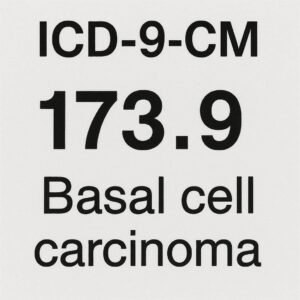
ICD-9 Code for Basal Cell Carcinoma
What Was the ICD-9 Code for Basal Cell Carcinoma?
The International Classification of Diseases, 9th Revision (ICD-9) was the standard diagnostic tool for epidemiology, health management, and clinical purposes for decades. It was officially replaced by ICD-10 on October 1, 2015, in the United States.
For basal cell carcinoma (BCC), the most common form of skin cancer, the primary ICD-9 code was:
ICD-9-CM 173.31
Let’s break down what this code signified:
-
173: This is the parent category for “Other and unspecified malignant neoplasm of skin.” It covered various skin cancers.
-
.3: This fourth digit further specifies the site as “Skin of other and unspecified parts of face.”
-
.31: This fifth and final digit pinpoints the diagnosis to “Basal cell carcinoma of skin of other and unspecified parts of face.”
It’s important to note that ICD-9 coding often required additional specificity based on the tumor’s location. Code 173.31 was a commonly used catch-all for facial BCCs, but other codes existed for other specific sites.
Common ICD-9 Codes for Basal Cell Carcinoma by Location
The table below illustrates how ICD-9 codes for BCC varied by anatomical site, demonstrating the system’s structure.
| Tumor Location | ICD-9-CM Code | Code Description |
|---|---|---|
| Eyelid | 173.11 | Basal cell carcinoma of skin of eyelid, including canthus |
| Ear & Auricular Canal | 173.21 | Basal cell carcinoma of skin of ear and external auditory canal |
| Other/Unspecified Parts of Face | 173.31 | Basal cell carcinoma of skin of other and unspecified parts of face |
| Scalp & Neck | 173.41 | Basal cell carcinoma of skin of scalp and neck |
| Trunk (Chest, Back, Abdomen) | 173.51 | Basal cell carcinoma of skin of trunk |
| Arm & Shoulder | 173.61 | Basal cell carcinoma of skin of upper limb, including shoulder |
| Leg & Hip | 173.71 | Basal cell carcinoma of skin of lower limb, including hip |
| Other Specified Sites | 173.81 | Basal cell carcinoma of other specified sites of skin |
| Site Unspecified | 173.91 | Basal cell carcinoma of skin, site unspecified |
A Note on Specificity: “The ICD-9-CM system, while foundational, was limited in its specificity compared to modern standards. A code like 173.31 told you the patient had a basal cell carcinoma on the face, but not whether it was on the nose, cheek, or forehead. This lack of granularity was a primary driver for the transition to ICD-10,” explains a medical coding specialist.
Why Knowing the Old ICD-9 Code Still Matters
You might wonder why we’re discussing a retired coding system. There are several practical reasons why this historical knowledge remains relevant:
-
Understanding Old Medical Records: Your personal health history or a family member’s records may contain references to ICD-9 codes. Understanding them helps you interpret past diagnoses.
-
Researching Historical Data: Epidemiological studies tracking cancer rates over long periods often need to reconcile data from both ICD-9 and ICD-10 eras.
-
Resolving Legacy Billing Issues: In rare cases, you might need to reference an old claim or billing dispute that originated before the 2015 transition.
-
Educational Context: For students of medicine, healthcare administration, or medical coding, understanding the evolution of diagnostic coding is essential.
Key Differences Between ICD-9 and ICD-10 for Basal Cell Carcinoma
The shift to ICD-10 represented a massive expansion in detail. The table below highlights the fundamental differences in how these two systems handle the same diagnosis.
| Feature | ICD-9-CM (Retired) | ICD-10-CM (Current) |
|---|---|---|
| Primary Code for Facial BCC | 173.31 | C44.30 |
| Coding Structure | 3-5 digits, mostly numeric | 3-7 characters, alphanumeric |
| Specificity | Limited. Site was somewhat general (e.g., “face”). | Highly detailed. Requires laterality (left, right, unspecified) and specific site (e.g., nose, cheek). |
| Number of Codes for BCC | Approximately a dozen relevant codes | Dozens of possible codes, allowing for precise location and laterality. |
| Example of Specificity | 173.31 = Basal cell carcinoma of face. | C44.311 = Basal cell carcinoma of skin of right eyelid, including canthus. |
The Modern Standard: ICD-10 Codes for Basal Cell Carcinoma
Today, healthcare providers use ICD-10-CM. For basal cell carcinoma, the codes fall under the C44 category (Other and unspecified malignant neoplasm of skin). The codes are vastly more descriptive.
For example, the modern equivalent to the old ICD-9 code 173.31 would be in the C44.3 series for “Malignant neoplasm of skin of other and unspecified parts of face,” but it must be further specified:
-
C44.30: Unspecified malignant neoplasm of skin of other and unspecified parts of face
-
C44.31: Basal cell carcinoma of skin of other and unspecified parts of face
-
C44.310: Basal cell carcinoma of skin of unspecified parts of face
-
C44.311: Basal cell carcinoma of skin of right eyelid, including canthus
-
C44.319: Basal cell carcinoma of skin of other parts of face
As you can see, ICD-10 requires the coder to specify the exact location and laterality, providing a clearer clinical picture.
Steps to Take if You Encounter an ICD-9 Code Today
-
Confirm the Date: Check the date of the document. Any record from a healthcare encounter in the U.S. after October 1, 2015, should use ICD-10 codes.
-
Do Not Use for Current Billing: Never submit an ICD-9 code on a current insurance claim. It will be rejected.
-
Cross-Reference for Understanding: Use reputable online tools or code conversion guides to understand what the old ICD-9 code translates to in modern terms, but remember it’s not a 1-to-1 match.
-
Consult a Professional: For billing or legal matters involving old codes, consult a medical billing specialist or your healthcare provider’s records department.
A Closer Look: Basal Cell Carcinoma and Its Significance
Basal cell carcinoma arises from the basal cells in the deepest layer of the epidermis. It is almost always caused by cumulative, long-term exposure to ultraviolet (UV) radiation from sunlight or tanning beds.
Key characteristics of BCC include:
-
High Prevalence: It is the most common cancer worldwide.
-
Slow Growth: It rarely spreads (metastasizes) to other parts of the body.
-
Local Damage: If left untreated, it can grow locally and cause significant disfigurement or damage to surrounding tissues.
-
High Treatability: When detected early, BCC has a near 100% cure rate with various surgical and non-surgical treatments.
The accurate coding of BCC—whether in the past with ICD-9 or today with ICD-10—is critical for tracking its incidence, allocating research resources, and understanding public health trends related to sun exposure.
Important Reader Note: This article provides historical and educational information about medical coding. It is not a substitute for professional medical advice, diagnosis, or treatment. Always seek the advice of your physician or other qualified health provider with any questions you may have regarding a medical condition or the interpretation of your medical records. For current billing and diagnostic purposes, always rely on the official ICD-10-CM codes provided by your healthcare provider.
Conclusion
The ICD-9 code for basal cell carcinoma, primarily 173.31, is a piece of medical history that played a vital role in patient care and health statistics for decades. While it has been superseded by the more detailed ICD-10 system, understanding it helps us interpret past records and appreciate the evolution of medical data. Today, the focus is on precise ICD-10 coding, which allows for better patient care tracking and more nuanced health outcomes research for this common skin cancer.
Frequently Asked Questions (FAQ)
Q: Can I still use the ICD-9 code 173.31 on a medical claim?
A: No. As of October 1, 2015, the United States and many other countries mandate the use of ICD-10-CM codes for all healthcare billing and reporting. Submitting an ICD-9 code will result in claim denial.
Q: I found “ICD-9 173.31” on an old biopsy report. What does that mean?
A: It means you were diagnosed with a basal cell carcinoma located on your face (excluding the specific eyelid or ear). It confirms a historical diagnosis of this common skin cancer.
Q: How do I find out what my current ICD-10 code is for basal cell carcinoma?
A: Your current diagnosis code will be listed on recent medical bills, explanation of benefits (EOB) statements from your insurer, or clinical summaries from your doctor’s office. You can also ask your healthcare provider’s billing department for clarification.
Q: Why did the coding system change from ICD-9 to ICD-10?
A: The change was made to accommodate advances in medicine and technology. ICD-10 provides greater specificity, detail, and clinical data, which improves disease tracking, treatment outcomes analysis, and billing accuracy.
Q: Are there different codes for different types of basal cell carcinoma (e.g., nodular, superficial)?
A: In both ICD-9 and ICD-10, the histologic subtype (like nodular or superficial) is not specified in the primary diagnosis code. That histological information is contained in the pathology report itself, using a separate nomenclature system (SNOMED CT or specific pathology terms). The ICD codes primarily specify the location and the fact that it is a basal cell carcinoma.
Additional Resources
For the most current and official information on medical coding, please visit the Centers for Disease Control and Prevention (CDC) ICD-10 page: https://www.cdc.gov/nchs/icd/icd10.htm
Disclaimer: This article is for informational purposes only and reflects coding standards as of its publication date (January 12, 2026). Medical coding guidelines are subject to change. Always refer to the most current official code sets and consult with a qualified medical coding professional for specific coding advice. The author is a professional writer and not a certified medical coder.