If you’re dealing with older medical records, insurance forms, or historical data, you might need to find the ICD-9 code for benign prostatic hyperplasia. While the healthcare world has moved on to a newer coding system, understanding ICD-9 is crucial for navigating past documents. This guide will provide you with a comprehensive, clear, and reliable look at the specific codes used for BPH under the ICD-9 system, why it matters, and how it fits into today’s medical landscape.
Let’s start with a straightforward answer: The primary ICD-9 code for benign prostatic hyperplasia was 600.xx. This wasn’t just a single number but a family of codes that allowed for more precise documentation. The “xx” represents additional digits that specified the exact type or associated condition of the prostate enlargement.
Important Note: The International Classification of Diseases, 9th Revision (ICD-9) was officially replaced by ICD-10 on October 1, 2015, in the United States. All medical coding for services provided after this date must use ICD-10-CM codes. This article focuses on ICD-9 for historical, educational, and archival reference purposes.
ICD-9 Code for Benign Prostatic Hyperplasia
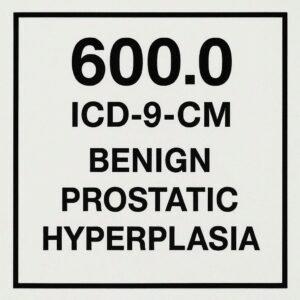
Table of Contents
ToggleThe Core ICD-9 Codes for BPH: Breaking Down 600.xx
The 600 series in ICD-9 was dedicated to “Hyperplasia of prostate.” Here is the detailed breakdown of the codes you would have encountered:
| ICD-9 Code | Code Description | Clinical Scenario |
|---|---|---|
| 600.0 | Hypertrophy (benign) of prostate | Used for a general, uncomplicated diagnosis of BPH without mention of obstruction or other symptoms. |
| 600.1 | Nodular prostate | Specifically indicated when the enlargement was described as nodular in nature. |
| 600.2 | Benign localized hyperplasia of prostate | A more specific term for localized overgrowth. |
| 600.3 | Cyst of prostate | Used when a cyst was identified in conjunction with BPH. |
| 600.9 | Hyperplasia of prostate, unspecified | A catch-all code when the documentation wasn’t specific enough to assign 600.0, 600.1, or 600.2. |
| 600.00 | …without obstruction | A more specific fifth-digit subclassification added later to denote absence of urinary obstruction. |
| 600.01 | …with obstruction | The fifth-digit subclassification to explicitly state that urinary obstruction was present. |
Why This Specificity Mattered
The progression from a general 600.0 to codes with fifth digits (600.00, 600.01) highlights a key principle in medical coding: specificity drives appropriate care and reimbursement. Distinguishing between BPH with or without obstruction was clinically and administratively significant:
-
Clinical Care: It informed the urgency and type of treatment.
-
Billing & Reimbursement: Insurance payers used this detail to determine if a procedure or treatment was medically necessary.
-
Data Tracking: It allowed public health officials to track the prevalence and impact of obstructive uropathy.
A Necessary Evolution: The Transition from ICD-9 to ICD-10-CM
The shift from ICD-9 to ICD-10-CM wasn’t just an update; it was a revolution in medical classification. ICD-9 had become outdated, with limited space for new codes and a lack of clinical detail. For conditions like BPH, ICD-10 offers a dramatic increase in precision.
A Comparative Look: ICD-9 vs. ICD-10 for BPH
| Feature | ICD-9-CM (Legacy System) | ICD-10-CM (Current System) |
|---|---|---|
| Primary Code Family | 600.xx | N40.x |
| Number of Characters | 3-5 digits | 3-7 characters (letters & numbers) |
| Detail Level | Moderate. Specified type (nodular, cystic) and obstruction. | High. Specifies with/without lower urinary tract symptoms (LUTS), severity, and other associated conditions. |
| Example Code | 600.01 (BPH with obstruction) | N40.1 (Benign prostatic hyperplasia with lower urinary tract symptoms) |
| Specificity | What it told you: “There’s an enlargement, and it’s causing a blockage.” | What it tells you: “There’s an enlargement, it’s causing lower urinary tract symptoms (like frequency, urgency, weak stream), and we’ve specified the clinical presentation.” |
This table illustrates why the transition was essential. ICD-10 paints a much clearer picture of the patient’s health status, leading to better patient care, more accurate billing, and richer data for research.
How to Handle ICD-9 Codes Today
You will primarily interact with ICD-9 codes for BPH in three scenarios:
-
Reviewing Historical Medical Records: Patient charts from before October 2015.
-
Processing Old Insurance Claims: Dealing with legacy billing issues.
-
Conducting Longitudinal Research: Studying disease trends over decades that span the coding transition.
If you are coding a current diagnosis, treatment, or procedure, you must use ICD-10-CM. Using an ICD-9 code for a current service will result in a claim rejection.
Practical Guidance: Finding and Using the Right Code
For medical coders, historians, or patients deciphering old bills, here’s a step-by-step approach to using the ICD-9 code for benign prostatic hyperplasia correctly in a historical context.
-
Locate the Physician’s Diagnosis: Start with the doctor’s notes. Look for terms like “BPH,” “benign prostatic hypertrophy,” “nodular prostate,” or “prostatic enlargement.”
-
Identify Specifics: Did the documentation mention “obstruction,” “retention,” “lower urinary tract symptoms (LUTS),” “nodules,” or “cysts”?
-
Map to the Code:
-
General BPH without specifics -> 600.00
-
BPH with mention of obstruction -> 600.01
-
Nodular prostate -> 600.1
-
Prostate cyst -> 600.3
-
-
Verify in a Legacy ICD-9 Manual: Always cross-reference with an official 2014 or earlier ICD-9-CM code book or a trusted digital archive to ensure accuracy.
Quotation from a Medical Coding Expert: “While ICD-9 is retired, understanding its structure is like knowing Latin in medicine. It provides the foundation. A coder who can navigate ICD-9 for historical data demonstrates a deep understanding of diagnostic evolution and clinical specificity.” – Sarah Jennings, CPC, CCS-P.
Beyond the Code: Understanding Benign Prostatic Hyperplasia
To fully appreciate why coding for BPH is so detailed, it helps to understand the condition itself.
What is BPH?
Benign Prostatic Hyperplasia is a non-cancerous enlargement of the prostate gland, common in men as they age. The growing prostate can squeeze the urethra, leading to troublesome urinary symptoms.
Common Symptoms Include:
-
Frequent or urgent need to urinate
-
Increased frequency at night (nocturia)
-
Difficulty starting urination
-
Weak or interrupted urine stream
-
Dribbling at the end of urination
-
Inability to completely empty the bladder
Diagnosis and Treatment: Diagnosis typically involves a patient history, a physical exam (including a digital rectal exam), a PSA blood test, and possibly urine flow tests or imaging. Treatment ranges from lifestyle changes and medication to minimally invasive procedures or surgery, depending on severity.
Conclusion
The ICD-9 code for benign prostatic hyperplasia, centered on the 600.xx family, served as a critical tool for decades, allowing healthcare providers to classify and track this common condition with increasing specificity. While now a historical artifact, its logic paved the way for the vastly more detailed ICD-10 system used today. Whether you’re archiving old records or simply satisfying curiosity, understanding this code provides valuable insight into the intersection of clinical medicine, administration, and the ongoing pursuit of precise healthcare documentation.
Frequently Asked Questions (FAQ)
Q: What is the most common ICD-9 code for BPH?
A: The most commonly used code was 600.01, “Hyperplasia of prostate with obstruction,” as urinary obstruction is a frequent and clinically significant feature of symptomatic BPH.
Q: Can I use an ICD-9 code on a medical bill today?
A: No. For any healthcare service provided on or after October 1, 2015, in the U.S., you must use ICD-10-CM codes. Using an ICD-9 code will result in immediate denial of the claim by insurers and Medicare/Medicaid.
Q: Where can I find an official list of old ICD-9 codes?
A: The U.S. Centers for Medicare & Medicaid Services (CMS) maintains archives. You can find the full ICD-9-CM code set for 2014 (the last active year) on the CMS website or through the National Center for Health Statistics (NCHS).
Q: What is the equivalent ICD-10 code for the old 600.01?
A: There isn’t a direct 1-to-1 match due to increased specificity. The closest equivalent is often N40.1 (Benign prostatic hyperplasia with lower urinary tract symptoms). However, a coder must review the full clinical documentation to choose the most accurate ICD-10 code from the N40 series.
Q: Why did the coding system change?
A: ICD-9 was over 30 years old, ran out of space for new codes, and lacked the clinical detail needed for modern medicine, value-based care, and advanced data analytics. ICD-10 provides greater specificity, improving patient care, reimbursement accuracy, and public health tracking.
Additional Resources
-
Centers for Disease Control and Prevention (CDC) – ICD-10 Transition Page: Provides official history, tools, and guidance on the ICD-9 to ICD-10 transition. https://www.cdc.gov/nchs/icd/icd10cm.htm
-
American Urological Association (AUA) – BPH Guidelines: For the latest clinical information on the diagnosis and management of Benign Prostatic Hyperplasia. https://www.auanet.org/guidelines/guidelines/benign-prostatic-hyperplasia-(bph)-guideline
Disclaimer: This article is for informational and educational purposes only. It is not a substitute for professional medical coding advice, clinical guidance, or official coding resources. Always consult current ICD-10-CM code sets and the latest official guidelines for accurate medical coding. For medical advice, consult a qualified healthcare provider.
Date: January 12, 2026
Author: WebWriter Health Guides