If you’re researching medical codes for back pain, you’ve likely encountered the term “dorsalgia” and its corresponding ICD-9 code. While this classification system is a legacy of the past, understanding its structure and context remains crucial for historical record review, certain insurance claims, and appreciating the evolution of medical coding.
This guide will provide a complete, clear, and authoritative look at the ICD-9 code for dorsalgia. We’ll explore what it meant, why it was used, and—most importantly—how its modern successor in the ICD-10 system offers a more detailed and useful framework for diagnosing and treating back pain today.
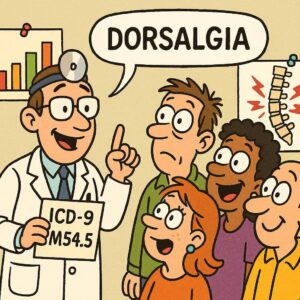
ICD-9 Code for Dorsalgia
Understanding the Core Concepts: ICD-9 and Dorsalgia
Before we delve into the specific code, let’s establish what we’re talking about. These two terms form the foundation of our discussion.
What is ICD-9?
The International Classification of Diseases, 9th Revision, Clinical Modification (ICD-9-CM) was the standard system used in the United States to code diagnoses, symptoms, and procedures for medical billing and statistical tracking for decades. It was officially replaced by ICD-10-CM on October 1, 2015. However, familiarity with ICD-9 is still necessary for healthcare professionals dealing with older patient records or certain long-term disability cases.
A Note on Timelines: “While ICD-9 is historical, its shadow is long in medicine. We still reference it to understand past diagnoses and ensure continuity of care when reviewing a patient’s full history.” — Common sentiment in medical administration.
What is Dorsalgia?
“Dorsalgia” is a clinical term derived from Latin (dorsum meaning “back” and -algia meaning “pain”). In simple terms, it means pain in the back. It is a nonspecific term that does not indicate the cause, severity, or precise mechanism of the pain—only its location. It serves as a broad umbrella for any back pain not otherwise specified.
The Specific ICD-9 Code for Dorsalgia
In the ICD-9-CM system, the code for dorsalgia was:
724.5
This code resided within a larger chapter focused on diseases of the musculoskeletal system and connective tissue.
Breaking Down the Code 724.5
The structure of ICD-9 codes is hierarchical. Here’s what “724.5” represented:
-
720-724: This range covered “Arthropathies and related disorders” (720-721.9) and “Other and unspecified disorders of the back” (722-724).
-
724: This broader category was specifically for “Other and unspecified disorders of the back.“
-
724.5: This was the precise code for “Backache, unspecified” or “Dorsalgia, unspecified.“
Important Distinction: It is vital to understand that 724.5 was a nonspecific code. It was used when a more precise diagnosis (e.g., herniated disc, spinal stenosis, radiculopathy) was not confirmed or documented.
Why the Transition to ICD-10 Was Necessary
The shift from ICD-9 to ICD-10-CM was not merely an update; it was a transformation in precision. ICD-9’s 724.5 code was a classic example of the system’s limitations—it told you what (back pain) but little else.
The move to ICD-10 was driven by the need for:
-
Greater Specificity: More detailed codes lead to better patient records.
-
Improved Quality Tracking: Identifying specific conditions helps track public health trends.
-
Accurate Reimbursement: Precise codes ensure fair payment for the complexity of care provided.
The Modern Equivalent: Dorsalgia in ICD-10-CM
Today, dorsalgia is coded under ICD-10-CM, which offers a dramatic increase in detail. The general category is M54.
However, unlike ICD-9’s single 724.5 code, ICD-10 requires and allows for much more granularity. The correct code depends on several clinical factors documented by the provider.
ICD-9 to ICD-10 Crosswalk for Dorsalgia
The table below shows how the old, broad code translates into multiple specific options in the new system.
| ICD-9 Code & Description | Primary ICD-10 Equivalent(s) & Description | Key Difference / Advancement |
|---|---|---|
| 724.5 – Backache, unspecified | M54.50 – Low back pain, unspecified | Location Specified: Now distinguishes between low back (lumbar) and mid-back (thoracic) pain. |
| M54.51 – Vertebrogenic low back pain | Etiology Specified: Identifies pain originating from the vertebral structures themselves. | |
| M54.59 – Other low back pain | ||
| M54.6 – Pain in thoracic spine | ||
| M54.9 – Dorsalgia, unspecified (Used only when location cannot be determined) |
How to Select the Correct ICD-10 Code for Back Pain
Choosing the right code now involves a clinical decision tree. Here is a simplified guide to the logic:
-
Determine the Spinal Region:
-
Cervical (Neck): Codes start with M54.2.
-
Thoracic (Mid-back): M54.6.
-
Lumbar (Low back): M54.5-.
-
-
Identify Laterality (if applicable): Many related codes (e.g., for radiculopathy) specify right, left, or bilateral.
-
Specify the Etiology or Type: Is it:
-
Mechanical? (M54.5-)
-
Due to a disc disorder? (M51.-)
-
Associated with radiculopathy? (M54.1-)
-
Postural? (M53.2-)
-
A Critical Reminder for Readers: This article provides educational information. Always rely on the provider’s final documented diagnosis and the official ICD-10-CM coding guidelines for selecting a code. Medical coding is complex and has direct legal and financial implications.
The Practical Impact: From Diagnosis to Billing
Why does this coding evolution matter to patients and practitioners? Accurate coding is the linchpin of modern healthcare communication.
-
For Patient Care: Specific codes create a clearer medical history. “M54.51 Vertebrogenic low back pain” on your record is more informative for future providers than “724.5 Backache.”
-
For Treatment Planning: Physical therapists and specialists design different interventions for thoracic vs. lumbar pain, or for pain with vs. without nerve involvement.
-
For Insurance Billing: Insurance companies use diagnosis codes to determine medical necessity. A vague code like the old 724.5 was more likely to trigger reviews or denials than a precise ICD-10 code that justifies the specific treatment provided.
Common Related and Differential Diagnoses
Dorsalgia is often a starting point. A comprehensive assessment seeks to rule in or rule out more specific conditions. Here are common related codes in both systems:
| Condition | ICD-9 Code | ICD-10 Code |
|---|---|---|
| Lumbar Radiculopathy (Sciatica) | 724.4 | M54.16, M54.17, M54.18 |
| Herniated Lumbar Disc | 722.10 | M51.26, M51.27 |
| Spinal Stenosis, Lumbar | 724.02 | M48.06 |
| Spondylosis without Myelopathy (Arthritis of spine) | 721.3 | M47.816, M47.817 |
| Myofascial Pain Syndrome | 729.1 | M79.1 |
Conclusion
The journey from the ICD-9 code 724.5 for dorsalgia to the detailed landscape of ICD-10-CM codes like M54.50 or M54.6 reflects healthcare’s move toward precision. While 724.5 served its purpose as a broad container for unspecified back pain, its modern equivalents empower better documentation, targeted treatment, and clearer communication among all stakeholders in a patient’s health journey.
Frequently Asked Questions (FAQ)
Q1: Can I still use the ICD-9 code 724.5 on a medical claim today?
A: No. As of October 1, 2015, all HIPAA-covered entities (like doctors’ offices and hospitals) in the U.S. are required to use ICD-10-CM for diagnosis coding. Using ICD-9 will result in claim rejection.
Q2: My old medical record from 2010 says “724.5.” What does that mean for my care now?
A: It simply means you were diagnosed with unspecified back pain at that time. When reviewing your history, a current provider will understand this as a generic entry. They will conduct a new evaluation to establish a specific, current diagnosis using ICD-10 criteria.
Q3: What is the most common ICD-10 code for general lower back pain?
A: M54.50 (Low back pain, unspecified) is frequently used as an initial diagnosis when a more specific cause has not yet been determined through examination and testing.
Q4: Why are there so many codes for back pain now? Isn’t it overcomplicating things?
A: While it seems complex, the specificity improves care. It allows researchers to study treatments for specific types of back pain, helps insurers understand the reason for specific therapies, and ensures your medical record accurately reflects your unique condition.
Additional Resources
For the most authoritative and up-to-date information on medical coding, please refer to these official sources:
-
The Centers for Medicare & Medicaid Services (CMS) ICD-10-CM Official Guidelines: https://www.cms.gov/medicare/coding-billing/icd-10-codes
-
The World Health Organization (WHO) ICD-10 Online Browser: https://icd.who.int/browse10/2019/en
Disclaimer: This article is for informational and educational purposes only. It is not a substitute for professional medical advice, diagnosis, or treatment. Always seek the advice of your physician or other qualified health provider with any questions you may have regarding a medical condition or treatment. The author and publisher are not responsible for any errors or omissions or for any consequences from application of the information presented.
Date: January 15, 2026
Author: Professional Medical Writing Team