As a professional navigating the world of medical billing, coding, or patient records, you might occasionally encounter the older ICD-9-CM system. Even though the healthcare industry transitioned to ICD-10-CM years ago, understanding historical codes like the ICd 9 code for dysphagia remains essential for working with older records, audits, and certain insurance claims. This guide provides a comprehensive, original, and reliable look at this specific code to serve as your definitive reference.
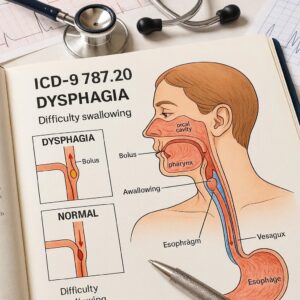
ICD-9 Code for Dysphagia
What Is the ICD-9 Code for Dysphagia?
In the International Classification of Diseases, Ninth Revision, Clinical Modification (ICD-9-CM), the general diagnostic code for swallowing difficulties is 787.2.
However, to code accurately, more specificity is required. The complete, most commonly used icd 9 code for dysphagia is:
787.20 – Dysphagia, unspecified.
This code is used when a patient presents with swallowing difficulties, but the precise type (oropharyngeal vs. esophageal) or cause is not yet determined or specified in the documentation.
The Need for Specificity: A Closer Look at Code 787.2
Code 787.2 required a fourth digit for proper classification. This structure highlights how ICD-9, while less detailed than ICD-10, still encouraged specific reporting. Here’s a breakdown of the sub-codes under the dysphagia umbrella.
| ICD-9 Code | Description | Clinical Context |
|---|---|---|
| 787.20 | Dysphagia, unspecified | The default code when the type is not documented. Common in initial encounters. |
| 787.21 | Dysphagia, oral phase | Difficulty in the voluntary phase; forming the bolus and moving it to the back of the mouth. Often neurological (e.g., post-stroke). |
| 787.22 | Dysphagia, oropharyngeal phase | Difficulty initiating the swallow reflex, transferring food from the mouth to the esophagus. Risk of aspiration. |
| 787.23 | Dysphagia, pharyngeal phase | Specifically impaired in the pharynx. Can be related to structural issues or nerve damage. |
| 787.24 | Dysphagia, pharyngoesophageal phase | Difficulty at the transition zone between the pharynx and esophagus (e.g., cricopharyngeal dysfunction). |
| 787.29 | Other dysphagia | A catch-all for other specified types, like “dysphagia, esophageal phase,” which did not have its own unique fourth digit. |
As noted by one veteran medical coder: *“Working with ICD-9 was about finding the right ‘bucket.’ With dysphagia, 787.20 was often the starting point, but digging into the physician’s notes for clues about the phase of swallow could lead you to a more precise, and sometimes more justified, code.”*
Why Knowing This Historical Code Still Matters
You might wonder why we’re discussing a retired coding system. The reasons are practical and ongoing.
-
Historical Record Analysis: Research studies, longitudinal patient histories, and audits of pre-2015 records all rely on accurate interpretation of ICD-9 codes.
-
Ongoing Insurance and Legal Cases: Some older disability, workers’ compensation, or liability claims that originated before the ICD-10 transition still reference ICD-9 codes in their documentation.
-
Understanding Coding Evolution: Seeing the limited specificity of ICD-9’s 787.2x series helps appreciate the granular detail required by ICD-10, making you a more knowledgeable professional.
Important Note for Readers: If you are coding for a current healthcare service in the United States (after October 1, 2015), you must use ICD-10-CM codes. This information on ICD-9 is for historical, educational, and archival purposes only. Using ICD-9 for current billing will result in claim rejection.
A Direct Comparison: ICD-9 vs. ICD-10 for Dysphagia
The transition to ICD-10-CM was a significant leap in specificity. Where ICD-9 had fewer than 10 codes for dysphagia, ICD-10 has over 70. This table illustrates the dramatic shift in detail.
| Feature | ICD-9-CM (787.2x) | ICD-10-CM (R13.x) |
|---|---|---|
| Code Structure | 3-5 digits, with a required 4th digit for type. | 3-7 characters, allowing for extreme detail. |
| Specificity | Moderate. Specified the phase of swallowing affected. | High. Specifies phase, cause, associated conditions, and laterality. |
| Example General Code | 787.20 (Dysphagia, unspecified) | R13.10 (Dysphagia, unspecified) |
| Example Specific Code | 787.22 (Dysphagia, oropharyngeal phase) | R13.12 (Dysphagia, oropharyngeal phase) *Note: This is just the category root; ICD-10 often requires additional characters for cause.* |
| Key Differentiator | Focused on the “where” in the swallowing pathway. | Focuses on “where,” “why,” and “what else.” For instance, dysphagia due to previous cerebrovascular disease is coded to I69.91 with R13.1- as an additional code. |
How Dysphagia Was Coded in the ICD-9 Era: A Practical Walkthrough
Let’s visualize how a coder would have approached a dysphagia case before October 2015.
-
Identify the Main Term: The coder would look up “Dysphagia” in the ICD-9-CM alphabetic index.
-
Review Subterms: The index would list options like:
-
oral phase 787.21
-
oropharyngeal phase 787.22
-
unspecified 787.20
-
etc.
-
-
Verify in Tabular List: The coder would then go to the numeric tabular list, Volume 1, to confirm code 787.20 (or the chosen sub-code) and check for any exclusion notes.
-
Ensure Documentation Support: The physician’s note had to support the chosen fourth digit. A note simply stating “patient complains of trouble swallowing” would lead to 787.20. A note stating “difficulty initiating a swallow, concern for aspiration” would justify 787.22.
Crucial Considerations and Common Pitfalls with ICD-9 Code 787.2x
Even as a historical code, certain nuances were critical for accurate application.
-
Exclusions: In ICD-9, code 787.2 had important exclusions. For example, psychogenic dysphagia was coded to 306.4, and dysphagia specifically linked to esophageal disorders (like achalasia, code 530.0) was coded to the underlying disorder first, with 787.2 as a secondary code if appropriate.
-
The “Unspecified” Dilemma: While 787.20 was common, it was often a target for audit if a more specific code could have been used based on available clinical information. Payers viewed unspecified codes as representing incomplete documentation.
-
Coding for Causation: Unlike ICD-10, ICD-9 did not have a straightforward way to link the dysphagia symptom directly to an established cause (like Parkinson’s disease) through a single code. This was done through multiple codes and sometimes payer-specific rules.
FAQs on the ICD-9 Code for Dysphagia
Q: Can I use ICD-9 code 787.20 on a medical bill today?
A: No. For all healthcare services provided in the U.S. after October 1, 2015, you must use ICD-10-CM codes. Using ICD-9 will result in immediate denial of your claim.
Q: What is the most direct equivalent ICD-10 code for 787.20?
A: The most direct equivalent is R13.10 – Dysphagia, unspecified. However, ICD-10 provides many more specific options that should be used if the documentation supports them.
Q: Why are there so many fourth-digit options under 787.2?
A: ICD-9-CM recognized that dysphagia is a symptom with different anatomical and functional implications. The phase of swallow affected (oral, pharyngeal, etc.) guides diagnosis, treatment (like speech therapy targeting a specific phase), and, historically, billing.
Q: Where can I find official, archival ICD-9-CM guidelines?
A: The U.S. Centers for Medicare & Medicaid Services (CMS) and the National Center for Health Statistics (NCHS) maintain archives of official ICD-9-CM guidelines. These can be found in the “Publications & Products” sections of their websites.
Additional Resources
-
CDC’s ICD-9-CM Archive: The Centers for Disease Control and Prevention maintains an official archive of ICD-9-CM codes and guidelines for historical reference. https://www.cdc.gov/nchs/icd/icd9cm.htm
-
ICD-10-CM Official Guidelines: To understand current coding practices, always refer to the latest ICD-10-CM guidelines from CMS and NCHS.
Conclusion
The ICD-9 code for dysphagia, 787.20, and its more specific sub-codes, represent an important chapter in medical classification. While now retired for active billing, understanding its structure and application is key for interpreting decades of medical data. The transition to ICD-10’s highly specific codes underscores the healthcare industry’s move toward greater precision in documenting patient conditions, ultimately aiming to improve care quality and data analytics.
Disclaimer: This article is intended for educational and historical reference purposes only. It is not a substitute for official coding guidelines, advice from a certified medical coder, or current professional practice standards. For all active medical coding, billing, and record-keeping, you must consult and apply the current ICD-10-CM code set and its official guidelines.
Date: January 13, 2026
Author: The Web Health Archives Team