For patients reviewing old medical bills or medical coders navigating historical records, understanding the ICD-9 code for ear pain is a common task. The International Classification of Diseases, 9th Revision, Clinical Modification (ICD-9-CM) was the standard diagnostic coding system in the United States for decades until its replacement in 2015.
In this detailed guide, we will explore the specific code used for ear pain, its nuances, and why it’s crucial to understand this system in a historical context. We’ll break down complex coding information into clear, accessible language, providing you with a reliable reference.
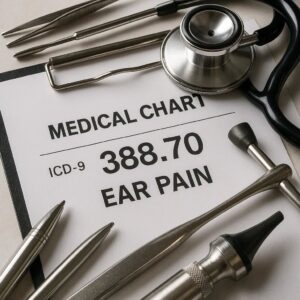
ICD-9 Code for Ear Pain
Understanding ICD-9-CM and Its Legacy
Before we dive into the specific code, let’s set the stage. The ICD-9-CM system was more than just a list of numbers; it was the backbone of medical billing, epidemiology, and healthcare data analysis for over 30 years. Each code represented a specific diagnosis, symptom, or procedure.
“While ICD-9 served its purpose well, its structure eventually became a limiting factor for a modern healthcare system requiring greater detail and specificity.” – Common observation in health informatics.
The system grouped related conditions together, but its simplicity compared to today’s standards could sometimes lead to less precise documentation. For symptoms like ear pain, this lack of specificity was a known challenge.
The Specific ICD-9 Code for Ear Pain
The primary ICD-9-CM code used for the general symptom of ear pain was:
388.70 – Otalgia, unspecified
Let’s decode this:
-
388: This is the chapter code for “Diseases of the ear and mastoid process.”
-
.70: This extension specifies “Otalgia,” which is the medical term for ear pain.
-
Unspecified: This is a critical part of the code. It indicates that the documentation did not specify whether the pain was in the left ear, right ear, or both, nor did it pinpoint an underlying cause.
This code was a classic example of a “symptom code.” It described what the patient felt (pain) rather than a definitive disease diagnosis (like an infection or injury). In the ICD-9 framework, this was often the starting point before further investigation.
Important Notes on Using Historical Codes
-
Archival Use Only: As of October 1, 2015, the U.S. healthcare system mandated the use of ICD-10-CM. ICD-9 codes are not valid for current patient encounters, billing, or reporting.
-
Specificity Was Limited: Code 388.70 did not convey laterality (which ear). More specific codes did exist for related conditions (like 380.10 for Infective otitis externa, which includes pain), but for the isolated symptom, 388.70 was common.
-
Always Contextualize: When seeing this code on an old record, it simply means the patient presented with ear pain. The final, causative diagnosis would often have a different, more specific code.
Why Specificity Mattered: Related ICD-9 Codes for Ear Conditions
Ear pain is rarely a diagnosis in itself; it’s a messenger. In ICD-9, numerous codes surrounded 388.70 to describe the probable causes. A coder would always review the physician’s full documentation to select the most accurate code.
Here is a comparative table of common ICD-9 codes related to ear pain:
| ICD-9 Code | Code Description | Clinical Context & Relation to Ear Pain |
|---|---|---|
| 388.70 | Otalgia, unspecified | The primary symptom code for general, unexplained ear pain. |
| 382.9 | Otitis media, unspecified | A very common cause of ear pain, especially in children. This code was for middle ear inflammation/infection. |
| 380.10 | Infective otitis externa | “Swimmer’s ear” – infection of the outer ear canal, a frequent cause of pain. |
| 388.72 | Otogenic pain | Pain specifically originating from structures within the ear itself. |
| 388.71 | Otic barotrauma | Ear pain due to pressure changes (e.g., from flying or diving). |
| 388.69 | Fullness in ear | A sensation often accompanying pain or preceding it. |
| 784.1 | Throat pain | Important because referred pain from throat issues (like tonsillitis) can manifest as ear pain. |
The Significant Transition: From ICD-9 to ICD-10-CM
The shift from ICD-9 to ICD-10-CM wasn’t just an update; it was a revolution in medical coding. ICD-10 offers exponentially greater detail, which directly addresses the shortcomings of codes like 388.70.
Key Differences in How Ear Pain is Coded:
-
Laterality (Side Specificity): ICD-10 always requires specifying left, right, or bilateral.
-
Greater Etiologic Detail: There are many more codes to link pain to a specific cause or type.
-
Expanded Terminology: The classification is more clinically granular.
ICD-9 to ICD-10 Crosswalk for Ear Pain
To understand the difference, here’s how the general “otalgia” code translates into the modern system:
| ICD-9 Code (& Era) | ICD-10-CM Code (Current) | Description & Critical Differences |
|---|---|---|
| 388.70 (Historical) | H92.09 | Otalgia, unspecified ear. This is the closest direct equivalent. |
| 388.70 | H92.01 | Otalgia, right ear. |
| 388.70 | H92.02 | Otalgia, left ear. |
| 388.70 | H92.03 | Otalgia, bilateral. |
| *N/A in ICD-9* | H92.8X- (Series) | Other otalgia. This series allows coding for post-procedural ear pain, requiring additional characters for specificity. |
“The transition to ICD-10 was like moving from a street map to a topographical satellite map. The detail allows for better tracking of outcomes, public health trends, and resource allocation.”
This comparison clearly shows the mandatory specificity of ICD-10. An old record with “388.70” leaves you guessing; a new record with “H92.02” immediately tells you the pain is in the left ear.
Practical Guide for Patients and Professionals
For Patients Reviewing Old Documents
If you see “ICD-9 Code 388.70” on an old explanation of benefits (EOB) or medical record:
-
Don’t be alarmed. It simply means your visit was primarily for the complaint of ear pain.
-
Look for other codes. The definitive diagnosis (e.g., ear infection) would likely be listed with a different, more specific code elsewhere on the document.
-
Understand it’s historical. This code reflects the standard of its time. For any current concerns, your provider uses the much more detailed ICD-10 system.
For Medical Coders and Historians
When dealing with legacy records:
-
Context is king. Code 388.70 was often a placeholder. Always review the entire record for a more definitive diagnosis to understand the full clinical picture.
-
Use General Equivalence Mappings (GEMs) cautiously. Automated tools to convert ICD-9 to ICD-10 can be helpful, but they are not perfect. The mapping from 388.70 often defaults to H92.09, but if the record indicates laterality, a manual, more specific code is better.
-
Appreciate the evolution. Studying ICD-9 highlights the advances in health data management and the increased clinical demand for specificity that drove the creation of ICD-10.
Helpful List: Common Causes of Ear Pain and Their Modern Codes
To tie history to the present, here are common causes of ear pain and their current (ICD-10-CM) codes, illustrating the modern specificity.
-
Acute Otitis Media (Middle Ear Infection):
-
Right: H66.91
-
Left: H66.92
-
Bilateral: H66.93
-
-
Otitis Externa (Swimmer’s Ear):
-
Right: H60.91
-
Left: H60.92
-
Bilateral: H60.93
-
-
Earwax Blockage (Impacted Cerumen):
-
Right: H61.21
-
Left: H61.22
-
Bilateral: H61.23
-
-
Referred Pain from Throat (E.g., Tonsillitis):
-
J03.90 (Acute tonsillitis, unspecified)
-
Conclusion
The ICD-9 code 388.70 for unspecified otalgia represents an important chapter in the history of medical documentation, serving as the standard code for general ear pain for decades. Its primary legacy is to highlight the critical evolution towards greater specificity in healthcare coding, a need fully addressed by the detailed, laterality-driven ICD-10-CM system. Understanding this code today is most valuable for interpreting historical records, appreciating the progress in health data, and ensuring accurate analysis of past medical information.
Frequently Asked Questions (FAQ)
Q: Is ICD-9 code 388.70 still used today?
A: No. As of October 1, 2015, the ICD-10-CM system replaced ICD-9-CM for all diagnostic reporting in the United States. 388.70 is only relevant for historical record review.
Q: What is the current ICD-10 code for ear pain?
A: There are several, depending on which ear is affected. The most direct equivalents are H92.01 (right ear), H92.02 (left ear), H92.03 (bilateral), and H92.09 (unspecified ear).
Q: Why was my ear infection coded as 388.70 on an old bill instead of an infection code?
A: This could happen if the physician’s documentation at the time only supported the symptom (pain) rather than a confirmed diagnostic statement of “infection.” Coding rules strictly follow the provider’s documented diagnosis.
Q: As a patient, do I need to know these codes?
A: Not typically. However, a basic understanding can empower you to read your own medical bills and records more effectively, ask informed questions, and ensure the accuracy of your personal health history.
Q: Where can I find official, current coding information?
A: The Centers for Medicare & Medicaid Services (CMS) and the National Center for Health Statistics (NCHS) are the official U.S. government sources for ICD-10-CM guidelines and updates.
Additional Resources
For the most authoritative and up-to-date information on medical coding, please visit the official Centers for Disease Control and Prevention (CDC) ICD-10-CM page: https://www.cdc.gov/nchs/icd/icd-10-cm.htm. This site provides guidelines, updates, and official resources for the current coding system.
Date: January 17, 2026
Author: The Web Writer Team at HealthCode History