Navigating the world of medical coding can feel like deciphering an ancient language. For patients reviewing old records, medical historians, or professionals handling legacy data, understanding the ICD-9 code for elevated blood pressure is a common task. While the healthcare industry has fully transitioned to ICD-10, knowledge of ICD-9 remains crucial for interpreting historical medical information accurately.
This guide will serve as your definitive reference. We’ll explore the specific ICD-9 code for elevated blood pressure, explain its context, and clarify the critical differences between various blood pressure diagnoses. Our goal is to provide you with clear, reliable information that turns confusion into clarity.
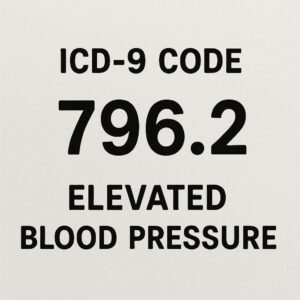
ICD-9 Code for Elevated Blood Pressure
A Brief Introduction to the ICD-9 System
Before we pinpoint the specific code, let’s establish what ICD-9 is. The International Classification of Diseases, 9th Revision (ICD-9), was a standardized system used by healthcare providers and coders to classify and code all diagnoses, symptoms, and procedures. It was the cornerstone of medical billing, epidemiology, and health records in the United States from 1979 until October 1, 2015, when it was replaced by the vastly more detailed ICD-10-CM.
Key Historical Note: “ICD-9 was a monumental step in standardizing health data, but its simplicity compared to ICD-10 often led to less precise clinical documentation,” reflects a medical coding historian. “Understanding its codes requires a grasp of mid-20th-century medical terminology.”
The Specific ICD-9 Code for Elevated Blood Pressure
In the ICD-9-CM (Clinical Modification), the code for a diagnosis of elevated blood pressure, without a formal diagnosis of hypertension, was:
ICD-9 Code: 796.2 – Elevated blood pressure reading without diagnosis of hypertension
This code was essential for documenting instances where a patient presented with a high blood pressure reading during a visit, but the provider had not yet established a permanent or recurring diagnosis of essential (primary) or secondary hypertension.
When Was ICD-9 Code 796.2 Used?
This code was not a catch-all for high blood pressure. Its application was specific. Here are the typical scenarios where 796.2 would appear on a record:
-
Initial Patient Encounter: A patient comes in for a routine check-up or an unrelated issue, and a high blood pressure reading is recorded. Without a prior history of hypertension, the provider would use 796.2 to document this isolated finding.
-
“White Coat Hypertension”: This phenomenon, where a patient’s BP is elevated in a clinical setting but normal elsewhere, was often documented with this code pending further investigation (e.g., home monitoring).
-
Follow-up of Borderline Readings: For patients being monitored for borderline high readings, before a formal hypertension diagnosis (401.x) was confirmed.
-
Post-Diagnosis: Interestingly, it was not to be used if the patient had an established diagnosis of hypertension. In that case, a code from the 401.x series was mandatory.
Critical Distinction: Elevated BP vs. Hypertension
This is the most important concept to grasp. ICD-9 made a clear distinction, and it’s one that remains medically relevant.
| Feature | Elevated Blood Pressure (796.2) | Hypertension (401.x series) |
|---|---|---|
| ICD-9 Code | 796.2 | 401.0 (Malignant), 401.1 (Benign), 401.9 (Unspecified) |
| Nature | A symptom or a single finding. | A confirmed, chronic medical diagnosis (condition). |
| Duration | Episodic or based on a single reading. | Persistent, requiring ongoing management. |
| Clinical Implication | “Your blood pressure is high today.” It prompts investigation. | “You have high blood pressure.” It requires a treatment plan. |
| Coding Rule | Used in the absence of a hypertension diagnosis. | Used for the established disease. 796.2 is explicitly excluded. |
The ICD-9 Hypertension Code Family (401.x)
To fully understand code 796.2, you must see what it was not. The hypertension codes in ICD-9 were more definitive:
-
401.0 – Malignant hypertension: A severe, rapidly progressing form.
-
401.1 – Benign essential hypertension: The most common form of chronic, primary high blood pressure.
-
401.9 – Unspecified essential hypertension: Used when the type was not specified as benign or malignant.
Important Note for Readers: If you see a 401.x code on an old record, it indicates a formal diagnosis of hypertension was made. Code 796.2 was a temporary marker; 401.x was a chronic condition label.
Why This Historical Knowledge Still Matters
You might wonder why we’re discussing a retired coding system.
-
Understanding Old Medical Records: Patients researching their health history or attorneys handling long-term disability cases frequently encounter ICD-9 codes. Knowing that 796.2 indicated an observation, not a chronic disease, can be significant.
-
Research and Data Analysis: Epidemiological studies tracking long-term health trends rely on historical ICD-9 data. Accurate interpretation is key.
-
Billing and Legal Audits: Claims or records from before October 2015 are governed by ICD-9 rules. Understanding the proper use of 796.2 vs. 401.x can be critical in audits.
The Transition to ICD-10: A New Era of Specificity
On October 1, 2015, the U.S. implemented ICD-10-CM. This system brought immense specificity. The single ICD-9 code 796.2 was replaced, and the distinction between elevated BP and hypertension was refined further.
-
ICD-10-CM Code for Elevated BP: R03.0 – Elevated blood-pressure reading, without diagnosis of hypertension. This is the direct descendant of ICD-9’s 796.2.
-
ICD-10-CM for Hypertension: The 401.x series was replaced by a much broader range of codes under category I10-I16. For example, I10 – Essential (primary) hypertension is now the standard code for most cases.
The transition underscored a move from simplistic classification to detailed clinical documentation, capturing stage, cause, and complications.
Practical Scenarios: Decoding Real-World Examples
Let’s apply this knowledge to realistic situations.
-
Scenario 1 (1995): John, 45, sees his doctor for a back strain. His BP is 150/92. He has no prior history of high BP. The doctor notes “elevated BP, will recheck in 1 month.”
-
Correct ICD-9 Code: 796.2
-
-
Scenario 2 (2005): Maria, 60, has her annual physical. Her chart lists a long-standing diagnosis of “HTN,” managed with medication. Today’s reading is 138/88.
-
Correct ICD-9 Code: 401.1 (Benign essential hypertension). Code 796.2 is incorrect here, as a hypertension diagnosis is established.
-
-
Scenario 3 (2010): David, 50, is monitored for borderline high readings. His home log shows normal values, but in-office readings are high. The doctor documents “probable white coat hypertension, continue monitoring.”
-
Likely ICD-9 Code: 796.2, as a formal hypertension diagnosis is not yet confirmed.
-
FAQs: Your Questions Answered
Q: I found “ICD-9 796.2” on an old bill from 2010. Does this mean I was diagnosed with hypertension?
A: Not necessarily. Code 796.2 specifically indicates an elevated reading without a hypertension diagnosis. It was a red flag for your doctor to investigate further, not a confirmation of a chronic condition.
Q: What is the current, active code for elevated blood pressure?
A: In the currently used ICD-10-CM system, the equivalent code is R03.0.
Q: Why did ICD-9 separate “elevated BP” from “hypertension”?
A: This separation is clinically sound. A single high reading is a symptom; hypertension is a diagnosed disease requiring long-term management. The distinction prevents patients from being incorrectly labeled with a chronic condition prematurely.
Q: Can I use ICD-9 codes for medical billing today?
A: No. As of October 1, 2015, all HIPAA-covered entities (like doctors and hospitals) in the U.S. must use ICD-10-CM codes for diagnosis coding. ICD-9 is obsolete for billing.
Q: Where can I find an official, full list of old ICD-9 codes?
A: The U.S. Centers for Disease Control and Prevention (CDC) maintains an archive of the official ICD-9-CM guidelines and codes.
Conclusion
The ICD-9 code for elevated blood pressure, 796.2, served as a crucial placeholder in medical documentation, capturing a vital sign anomaly without assigning a chronic diagnosis. Its careful distinction from the hypertension codes (401.x) highlighted an important clinical principle that remains true today: not every high reading signifies a permanent disease. While modern coding with ICD-10 offers greater detail, understanding these historical codes remains key to accurately interpreting the medical past, ensuring clarity for patients, researchers, and professionals alike.
Additional Resource: For the official archive of ICD-9-CM guidelines and codes, visit the Centers for Disease Control and Prevention (CDC) National Center for Health Statistics page on ICD-9: CDC ICD-9-CM Archive. This is the authoritative source for historical code information.
Date: January 19, 2026
Author: The Medical History Writer