If you’re searching for the “ICD-9 code for elevated liver enzymes,” you’re likely navigating older medical records, historical data, or specific billing requirements. While the ICD-9 system is no longer in active use for diagnosis coding in the United States, understanding its codes remains crucial for medical professionals, researchers, and patients dealing with past records.
This guide will provide you with a clear, comprehensive, and accurate explanation. We’ll cover the specific ICD-9 code, its meaning, the critical importance of clinical context, and how the transition to ICD-10 changed the landscape. Our goal is to make this technical topic accessible and actionable.
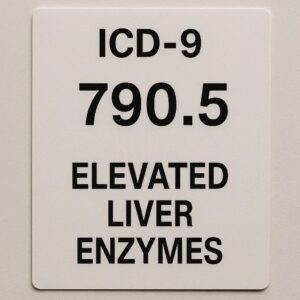
ICD-9 Code for Elevated Liver Enzymes
The Specific ICD-9 Code: 790.4
The ICD-9-CM (International Classification of Diseases, 9th Revision, Clinical Modification) code for elevated liver enzymes is 790.4.
-
Category: This code falls under Chapter 16: “Symptoms, Signs, and Ill-Defined Conditions.”
-
Official Description: The full descriptor for ICD-9-CM code 790.4 is “Nonspecific elevation of levels of transaminase or lactic acid dehydrogenase (LDH).”
This is a vital point to understand. Code 790.4 is not a diagnosis. It is a sign or a finding. It tells us that a blood test revealed higher-than-normal levels of certain liver enzymes—most commonly Alanine Transaminase (ALT) and Aspartate Transaminase (AST)—but it does not explain why.
Important Note: “The assignment of code 790.4 signifies an abnormal lab result awaiting clinical interpretation. It is the starting point for an investigation, not the conclusion of one.” – This reflects standard clinical coding guidance.
What Does “Elevated Liver Enzymes” Mean?
When liver cells are damaged or inflamed, they leak enzymes into the bloodstream. Common tests check for:
-
ALT (Alanine Aminotransferase): Highly specific to the liver.
-
AST (Aspartate Aminotransferase): Found in the liver, heart, and muscles.
-
ALP (Alkaline Phosphatase): Often elevated in bile duct issues.
-
GGT (Gamma-Glutamyl Transferase): Sensitive for bile duct and alcohol-related liver issues.
A finding coded as 790.4 prompts the crucial question: What is the underlying cause?
Why Context is Everything: 790.4 is a Sign, Not a Diagnosis
Using 790.4 correctly requires understanding its place in medical documentation. It is a placeholder or an alert code. The true diagnostic coding effort focuses on identifying the root cause.
Common Underlying Diagnoses (and Their Old ICD-9 Codes)
When elevated liver enzymes are confirmed, physicians investigate conditions such as:
| Underlying Condition | Example ICD-9-CM Code | Clinical Context |
|---|---|---|
| Non-alcoholic Fatty Liver Disease (NAFLD) | 571.8 | Most common cause in the US; linked to metabolic syndrome. |
| Alcoholic Liver Disease | 571.1 | History of excessive alcohol consumption. |
| Viral Hepatitis (e.g., Hepatitis B, C) | 070.xx | Specific viral serology testing is positive. |
| Medication-Induced Liver Injury | 573.3 | Temporal link to starting a new drug (e.g., certain antibiotics, statins). |
| Autoimmune Hepatitis | 571.49 | Body’s immune system attacks the liver. |
| Biliary Tract Disease | 575.x (e.g., 575.0 for cholecystitis) | Often with elevated ALP & GGT; may involve gallstones. |
Coding Priority: If the cause is known, the code for the specific disease (e.g., 571.1 for alcoholic liver disease) is used as the primary diagnosis. Code 790.4 might be listed as a secondary code if relevant to the reason for the encounter, but often it is replaced entirely by the definitive diagnosis.
The Modern Equivalent: The Transition to ICD-10-CM
The US healthcare system transitioned from ICD-9-CM to ICD-10-CM on October 1, 2015. This newer system offers significantly greater detail.
There is no direct, single equivalent to ICD-9’s 790.4 in ICD-10. Instead, the finding is coded with more precision based on the specific enzyme(s) elevated.
ICD-10-CM Codes for Elevated Liver Enzymes
The primary category in ICD-10 is R74.0. Here is the more granular breakdown:
| ICD-10-CM Code | Description | Specificity |
|---|---|---|
| R74.0 | Nonspecific elevation of levels of transaminase and lactic acid dehydrogenase (LDH) | Most direct equivalent to 790.4. |
| R74.8 | Abnormal levels of other serum enzymes | Used for elevations of enzymes not listed elsewhere (e.g., isolated elevated GGT might be considered here). |
| R74.9 | Abnormal serum enzyme level, unspecified | Used when the documentation is vague. |
Key Advancement of ICD-10: The system allows for laterality and much more detailed codes for the underlying cause. For example, alcoholic liver disease has multiple codes (K70.0, K70.10, K70.30, etc.) specifying acute, chronic, with or without ascites, making documentation and billing more accurate.
Practical Scenarios: How These Codes Are Applied
Let’s look at how coding works in real-world patient encounters.
Scenario 1: Routine Physical with Unexpected Finding
-
Patient Presentation: Asymptomatic patient has routine blood work.
-
Lab Result: ALT 150 U/L (normal range ~7-56 U/L).
-
Clinical Action: Physician notes “elevated transaminases, etiology to be determined.” Plans follow-up tests.
-
Appropriate Coding (ICD-9 era): 790.4 would be the correct code for this encounter, as no definitive cause is established yet.
Scenario 2: Patient with Known History
-
Patient Presentation: Patient with known NAFLD presents for follow-up of abnormal LFTs.
-
Lab Result: Persistently elevated AST/ALT.
-
Clinical Action: Management of the known, chronic condition.
-
Appropriate Coding (ICD-9 era): 571.8 (Fatty liver) would be the primary code. 790.4 would likely not be used, as the underlying cause is already known and managed.
Scenario 3: Acute Presentation
-
Patient Presentation: Patient presents with jaundice, fatigue, and right upper quadrant pain.
-
Lab Result: Markedly elevated AST, ALT, ALP.
-
Clinical Action: Workup leads to diagnosis of acute cholecystitis (inflamed gallbladder).
-
Appropriate Coding (ICD-9 era): 575.0 (Acute cholecystitis) is the primary diagnosis. The elevated enzymes are a symptom of this condition.
The Critical Importance of Accurate Documentation and Coding
Why does getting this right matter so much? It extends far beyond mere bureaucracy.
-
Patient Care: Accurate coding creates a precise medical history. Knowing a patient had “790.4” versus “571.1” in their past records provides completely different clinical stories for future providers.
-
Billing and Reimbursement: Insurance companies require specific, justified diagnosis codes to process claims. Using a nonspecific code like 790.4 when a more definitive code exists can lead to claim denials or audits.
-
Public Health and Research: Aggregated coded data is used to track disease prevalence, allocate resources, and conduct epidemiological studies. Accurate coding ensures this data reflects reality.
-
Legal and Compliance: Medical records are legal documents. Precise coding supports the level of care documented and is essential for compliance with regulations.
Frequently Asked Questions (FAQ)
Q: Can I still use the ICD-9 code 790.4 today?
A: For most purposes in the United States, no. Since October 1, 2015, ICD-10-CM is mandatory for all diagnosis coding in clinical and billing settings. ICD-9 is only used for referencing historical records from before that date.
Q: What is the most accurate ICD-10 code for high ALT and AST?
A: The most accurate code is R74.0 (Nonspecific elevation of levels of transaminase and LDH). Always review the full clinical documentation to ensure no more specific cause is identified.
Q: My doctor said my liver enzymes are high but didn’t say why. What code is used?
A: In the absence of a confirmed diagnosis, your medical record would likely be coded with R74.0 (or 790.4 in older records). This code effectively communicates “abnormal finding, under investigation.”
Q: How do I find old medical records that use ICD-9 codes?
A: You can request your complete medical records from your healthcare provider or the medical records department of the hospital where you were treated. The diagnosis codes will be listed, often on the “face sheet” or billing summary.
Q: Does a high liver enzyme code mean I have serious liver disease?
A: Not necessarily. While it requires medical evaluation, elevated liver enzymes can be caused by many temporary or mild conditions, such as certain medications, mild fatty liver, or even strenuous exercise. The code itself does not indicate severity.
Conclusion
The ICD-9 code for elevated liver enzymes, 790.4, served as a crucial placeholder for an important clinical sign. Its modern ICD-10 counterpart, R74.0, continues this function but within a more detailed coding system. The core principle remains unchanged: these codes represent the beginning of a diagnostic journey, not the end. Accurate coding hinges on thorough clinical documentation to uncover and specify the true underlying cause, ensuring optimal patient care, correct billing, and reliable health data.
Disclaimer: This article is for informational and educational purposes only. It is not a substitute for professional medical coding advice, clinical guidance, or treatment. Always consult with a qualified healthcare provider for any health concerns and with a certified medical coder for specific coding questions. The information reflects standards as of the article date.
Additional Resources
-
Centers for Medicare & Medicaid Services (CMS) ICD-10-CM Official Guidelines: https://www.cms.gov/medicare/coding/icd10 (The authoritative source for coding rules and updates).
-
American Liver Foundation: https://liverfoundation.org/ (Provides excellent patient-friendly information on liver health and diseases).
-
National Institute of Diabetes and Digestive and Kidney Diseases (NIDDK) – Liver Disease Information: https://www.niddk.nih.gov/health-information/liver-disease (A trusted source for clinical and research information).
Date: January 20, 2026
Author: The WebMD Coding & Patient Education Team