If you’re navigating older medical records, insurance claims, or conducting retrospective research, you’ve likely encountered the term “ICD-9 code for failure to thrive.” While the healthcare world has fully transitioned to the ICD-10 system, understanding the legacy ICD-9 codes remains crucial for historical data analysis, continuing care for long-term patients, and comprehending past medical literature.
This guide will provide you with a thorough, reliable, and detailed exploration of the ICD-9 code for Failure to Thrive (FTT). We’ll delve into the specific code, its clinical meaning, how it was used, and why the transition to ICD-10 offered a more nuanced way to document this complex condition. Whether you’re a medical coder, a healthcare provider, a student, or a patient’s family member reviewing old documents, this article aims to be your definitive reference.
ICD-9 Code for Failure to Thrive
Understanding the Medical Concept: What is Failure to Thrive?
Before we discuss the code itself, it’s essential to grasp what “Failure to Thrive” (FTT) represents clinically. It is not a single disease but a descriptive term for a significant delay or interruption in the expected pattern of growth and development, most commonly applied to infants and young children.
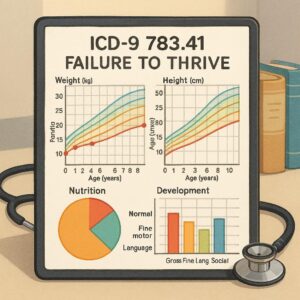
A child diagnosed with FTT is not meeting standard growth benchmarks for their age and sex. This is typically assessed using standardized growth charts, where weight, length/height, and head circumference are plotted over time. FTT is often suspected when a child’s weight falls below the 3rd or 5th percentile for their age or if they cross two major percentile lines downward on the growth chart over time.
The implications are serious, as inadequate growth can signal underlying medical, nutritional, or psychosocial problems and, if unaddressed, can lead to long-term developmental delays, cognitive deficits, and chronic health issues.
Key Indicators of Failure to Thrive
-
Consistently low weight-for-age and weight-for-length.
-
Lack of appropriate weight gain or actual weight loss.
-
Delayed achievement of developmental milestones (e.g., rolling over, sitting, babbling).
-
Observable signs like listlessness, decreased responsiveness, or excessive irritability.
-
In older adults (where the term is also applied), it involves weight loss, decreased appetite, poor nutrition, and inactivity.
The Specific ICD-9-CM Code for Failure to Thrive
In the International Classification of Diseases, Ninth Revision, Clinical Modification (ICD-9-CM), Failure to Thrive had its own distinct code.
The primary ICD-9-CM code for Failure to Thrive was 783.41.
Let’s break down this code structure:
-
783: This is the parent category for “Symptoms concerning nutrition, metabolism, and development.”
-
.41: This fourth and fifth digit extension specifically denotes “Failure to thrive.” This level of detail was critical for accurate billing and statistical tracking.
It is vital to note that this code was used for patients of all ages, though its most frequent application was in pediatric care.
Clinical Context and Usage of Code 783.41
Physicians and coders used 783.41 when the documentation clearly indicated a diagnosis of FTT, but a more specific underlying cause had not yet been identified, or when FTT itself was the primary focus of treatment. The diagnosis typically followed a thorough evaluation that might include:
-
Detailed dietary history.
-
Psychosocial assessment of the home environment.
-
Physical examination for signs of organic disease.
-
Laboratory tests to rule out infections, malabsorption, metabolic disorders, or other conditions.
As one pediatric textbook notes, “Failure to thrive is often the presenting symptom of a wider problem. The code 783.41 served as an initial flag, prompting deeper investigation into the ‘why’ behind the poor growth.”
Comparative Table: ICD-9 vs. ICD-10 for Failure to Thrive
The transition to ICD-10-CM on October 1, 2015, brought significant specificity to the coding of FTT. The single ICD-9 code was replaced by a more detailed set of codes in ICD-10. The table below highlights the key differences.
| Feature | ICD-9-CM (Historical) | ICD-10-CM (Current) |
|---|---|---|
| Primary Code | 783.41 (Failure to thrive) | R62.51 (Failure to thrive in childhood) |
| Specificity | Low. One code for all ages and contexts. | High. Different codes for children vs. adults, and further specificity for adult FTT. |
| Pediatric Code | 783.41 used for all. | R62.51 – Failure to thrive in childhood. |
| Adult Code | 783.41 used for all. | R62.7 – Adult failure to thrive. |
| Additional Details | None inherent to the code. | Allows for laterality and combination with codes for associated conditions (e.g., malnutrition). |
| Advantage | Simplicity. | Clinical precision, better data for research and resource allocation. |
A Closer Look at the ICD-10 Equivalents
-
R62.51 – Failure to thrive in childhood: This is the direct equivalent for pediatric cases. It falls under the chapter for Symptoms, Signs, and Abnormal Clinical and Laboratory Findings.
-
R62.7 – Adult failure to thrive: This was a new, distinct code created in ICD-10 to address the specific context of weight loss, functional decline, and malnutrition in the elderly population, often due to a combination of medical, social, and psychological factors.
Common Associated ICD-9 Codes and Differential Diagnoses
FTT is rarely an isolated finding. In medical records, code 783.41 was often listed alongside other codes that pointed to a suspected or confirmed underlying cause. Accurate coding required a careful review of the physician’s assessment.
Frequent Co-Occurring or Alternative ICD-9 Codes
-
263.x – Malnutrition: Codes like 263.0 (Malnutrition of moderate degree) or 263.1 (Malnutrition of mild degree) were commonly used if nutritional deficiency was quantified.
-
579.x – Intestinal malabsorption: For conditions like Celiac disease (579.0) or cystic fibrosis-related malabsorption.
-
783.1 – Abnormal weight gain: Used in differential assessment.
-
783.3 – Feeding difficulties and mismanagement: A crucial code when behavioral or caregiver-related feeding issues were identified.
-
Codes for Gastroesophageal Reflux (530.81), Congenital Heart Defects (745-747), or Chronic Infections. The range was vast, reflecting the myriad potential causes of FTT.
Important Note for Readers: When analyzing historical records with code 783.41, always review the listed secondary or adjunct codes. They provide essential context for why the patient was failing to thrive. The presence of a code like 783.3 alongside 783.41 tells a very different story than 783.41 alongside a code for a congenital metabolic disorder.
The Diagnostic Journey: From Symptom to Code
How did a child’s slow weight gain in a doctor’s office become the code 783.41 in a medical record? The process was systematic.
-
Identification: A pediatrician notes a concerning pattern on the growth chart during a well-child visit.
-
Documentation: The physician documents their clinical findings in the patient’s chart using the term “Failure to Thrive” and notes any associated observations (e.g., “parent seems overwhelmed,” “poor feeding mechanics”).
-
Diagnostic Statement: The physician formally lists “Failure to Thrive” as a diagnosis, either as a definitive diagnosis or as a presenting problem.
-
Coding Translation: A medical coder (or the provider themselves in smaller practices) reviews the chart, locates the confirmed diagnosis, and translates it into the appropriate numerical code—in this case, 783.41.
-
Application: This code is then used for billing insurance, hospital statistics, and population health tracking.
Why ICD-9 Was Replaced: The Limitations of Code 783.41
The shift to ICD-10 was driven by the need for greater clinical detail. The ICD-9 code 783.41 had several key limitations:
-
Lack of Age Specificity: Using the same code for a 2-month-old infant and an 85-year-old frail adult hindered specific data analysis for these vastly different patient populations.
-
Etiological Blindness: The code gave no indication of cause. A case of FTT due to neglect and a case due to a complex genetic syndrome were coded identically.
-
Data Granularity: For researchers and public health officials, the single code provided limited insight into the epidemiology and specific risk factors associated with FTT in different demographics.
The creation of R62.51 and R62.7 in ICD-10 directly addressed these shortcomings, allowing for better tracking, more targeted research, and more informed public health interventions.
Helpful List: Reasons for Coding Inaccuracies with Historical ICD-9 Data
-
Coder Error: Misinterpretation of physician notes.
-
Physician Documentation: Use of synonyms like “growth failure” or “weight faltering” without stating the precise term “failure to thrive,” leading to potential miscoding.
-
Over-reliance on the Code: Using 783.41 as a catch-all before a full workup was complete, potentially obscuring the true underlying cause in the data.
-
Software Limitations: Early electronic health records may have had limited or cumbersome search functions for ICD-9 codes.
Navigating Historical Records and Modern Transitions
For professionals dealing with records spanning the 2015 transition date, understanding the mapping between ICD-9 and ICD-10 is crucial. While general equivalence mappings (GEMs) exist, they are guides, not direct one-to-one conversions.
-
For Retrospective Research: When querying a database for cases of FTT before October 2015, you must search for ICD-9 code 783.41. For cases after that date, you would search for R62.51 and R62.7.
-
For Continuing Care: A patient diagnosed with FTT (783.41) in 2014 would, if the condition persisted into the ICD-10 era, need to be re-evaluated and documented under the new, more specific codes for ongoing treatment and billing.
A Key Consideration: “The move from ICD-9 to ICD-10 for conditions like Failure to Thrive was not merely a clerical update. It represented a fundamental shift towards coding that captures the complexity of patient presentation, leading to richer data that can ultimately improve clinical care pathways and outcomes.” – Health Information Management Perspective.
Conclusion
The ICD-9 code for Failure to Thrive, 783.41, served as an important but blunt instrument for identifying a critical pediatric and geriatric condition for decades. Its historical use is embedded in millions of medical records, making it essential knowledge for anyone working with legacy healthcare data. The transition to ICD-10’s more precise codes, R62.51 for childhood and R62.7 for adult failure to thrive, reflects medicine’s ongoing evolution towards greater specificity, enabling better patient care, more accurate billing, and more powerful clinical research. Understanding both systems provides a complete picture of this important diagnostic concept across time.
FAQ
Q1: Can I still use the ICD-9 code 783.41 for billing today?
A: No. As of October 1, 2015, all HIPAA-covered entities (like hospitals, doctors’ offices, and insurance companies) in the United States were required to use ICD-10-CM for diagnosis coding. Using ICD-9 codes on current claims will result in rejection.
Q2: My child’s old medical record from 2012 lists code 783.41. What does that mean for their care now?
A: It means they were diagnosed with Failure to Thrive at that time. Your current healthcare provider should be made aware of this history, as it can be relevant to ongoing growth, development, or nutritional assessments. The old code itself does not dictate current care but is part of the patient’s medical history.
Q3: Was there a different ICD-9 code for “adult failure to thrive”?
A: No, there was not. The single code 783.41 was used for patients of all ages, which was a recognized limitation of the ICD-9 system. The specific code for Adult Failure to Thrive (R62.7) was introduced with ICD-10-CM.
Q4: Where can I find official, archived information on ICD-9 codes?
A: The U.S. Centers for Medicare & Medicaid Services (CMS) and the National Center for Health Statistics (NCHS) maintain archives of the official ICD-9-CM guidelines and code sets. These are authoritative sources for historical reference.
Additional Resource
For those seeking to understand the full clinical picture of Failure to Thrive beyond coding, the American Academy of Pediatrics (AAP) provides excellent guidelines for the evaluation and management of pediatric FTT. Their resources detail the step-by-step medical, nutritional, and psychosocial assessment necessary to identify and treat the root causes, emphasizing that coding is just one part of a much larger, patient-centered care process.
Date: December 31, 2025
Author: The Medical Coding Reference Team
Disclaimer: This article is for informational and educational purposes only. It is not a substitute for professional medical coding advice, clinical guidance, or official coding manuals. Always refer to the current ICD-10-CM Official Guidelines for Coding and Reporting and consult with certified medical coders and healthcare providers for specific patient or coding situations.