If you’re navigating the complex journey of fertility, you might have encountered a string of numbers and letters on a medical bill or an old record: the ICD 9 code for female infertility. While this coding system is no longer the standard, understanding what these codes mean, why they were used, and how they relate to today’s medical system is crucial for managing your health history and insurance. This guide will demystify the ICD-9 code for infertility, placing it in context and empowering you with knowledge for your path forward.
Let’s start with the direct answer: The primary ICD-9 code for female infertility was 628.9 – “Unspecified female infertility.” However, that simple code is just the tip of the iceberg. The ICD-9 system, which was retired in the United States in 2015, offered a range of more specific codes to describe different causes of infertility. This article will explore that legacy system, explain the critical transition to the modern ICD-10, and provide you with the tools to understand your own medical coding.
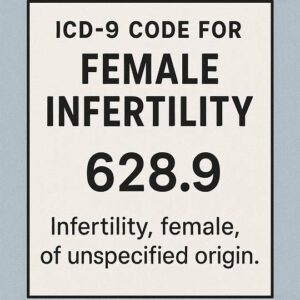
ICD-9 Code for Female Infertility
Understanding Medical Coding: ICD-9 and Its Purpose
Before we dive into the specific codes, it’s essential to grasp why these codes exist. ICD stands for International Classification of Diseases. It’s a universal system created and maintained by the World Health Organization (WHO) to standardize how diseases, conditions, and reasons for patient visits are recorded.
“Medical coding is the language of healthcare. It translates a patient’s diagnosis, symptoms, and procedures into universal alphanumeric codes that are used for everything from insurance reimbursement to tracking public health trends.”
The ICD-9-CM (Clinical Modification) was the version used in the U.S. for decades. Every time you visited a doctor, the reason for your visit—be it a cough, a check-up, or a fertility consultation—was assigned a corresponding code. These codes served three primary purposes:
-
Billing and Reimbursement: Insurance companies require standardized codes to process claims.
-
Tracking and Statistics: Public health organizations use coded data to monitor disease prevalence and outcomes.
-
Clinical Documentation: Codes provide a shorthand for recording a patient’s medical history.
The Specific ICD-9 Codes for Female Infertility
While 628.9 was a catch-all, the ICD-9 system provided a more detailed structure under the parent category “628 – Infertility, female.” This allowed clinicians to specify the suspected or diagnosed cause.
Here is a comparative table of the key ICD-9 codes related to female infertility:
| ICD-9 Code | Code Description | What It Typically Meant |
|---|---|---|
| 628.0 | Anovulation | Infertility linked to the failure of the ovaries to release an egg (ovulate). This is common in conditions like Polycystic Ovary Syndrome (PCOS). |
| 628.1 | Infertility of pituitary-hypothalamic origin | Infertility caused by imbalances in the pituitary gland or hypothalamus, which are the brain’s primary hormone regulators. |
| 628.2 | Infertility of tubal origin | Infertility due to blocked or damaged fallopian tubes, often from pelvic inflammatory disease (PID) or endometriosis. |
| 628.3 | Infertility of uterine origin | Infertility related to abnormalities of the uterus, such as fibroids, polyps, adhesions (Asherman’s syndrome), or congenital malformations. |
| 628.4 | Infertility of cervical or vaginal origin | Infertility where cervical mucus is hostile to sperm or there are anatomical issues with the vagina or cervix. |
| 628.8 | Infertility of other specified origin | Used for causes that didn’t fit the above categories, such as certain immunological factors. |
| 628.9 | Unspecified female infertility | Used when the cause was unknown, not yet investigated, or not specified in the documentation. |
Important Note for Readers: If you are reviewing old medical records or bills from before October 2015, you may see these codes. They are a historical snapshot of your diagnosis at that time. However, for any current treatment or billing, your healthcare providers will be using the ICD-10 system.
The Modern Era: Transitioning from ICD-9 to ICD-10 for Infertility
On October 1, 2015, the U.S. healthcare system underwent a massive change by adopting ICD-10-CM. This was not just an update; it was a complete overhaul. ICD-9 had about 13,000 codes. ICD-10 has over 68,000. This dramatic increase allows for incredible specificity in describing a patient’s condition.
For female infertility, this means the single code “628.9” has been replaced by a much more detailed and descriptive set of codes.
Key Differences Between ICD-9 and ICD-10 for Infertility Coding
-
Specificity: ICD-10 requires a cause to be specified. There is no direct, unspecific equivalent to “628.9.”
-
Laterality: ICD-10 can specify if a tubal or ovarian issue is on the left, right, or both sides.
-
Detail: Codes can now indicate the type of anovulation, the specific uterine anomaly, and more.
Primary ICD-10 Codes for Female Infertility
The main category for female infertility in ICD-10 is N97 – “Female infertility.” Here are some of the most relevant codes:
-
N97.0 – Female infertility associated with anovulation
-
N97.1 – Female infertility of tubal origin
-
N97.11 – With blockage of the fallopian tube (bilateral)
-
N97.12 – With adhesions of the fallopian tube (bilateral)
-
-
N97.2 – Female infertility of uterine origin
-
N97.8 – Female infertility of other origin
-
N97.9 – Female infertility, unspecified (The closest, but not identical, successor to ICD-9’s 628.9)
Why This Matters for You: The increased specificity of ICD-10 leads to more accurate medical records. For insurance, it provides clearer justification for specific tests and treatments. For example, code N97.11 (bilateral tubal blockage) strongly supports the medical necessity for treatments like IVF, whereas a vague code might not.
Why Accurate Coding for Infertility Matters to You
Understanding these codes isn’t just an academic exercise. It has real-world implications for your care and finances.
-
Insurance Claims and Prior Authorizations: The correct code is the foundation of every insurance claim. An inaccurate or unspecific code can lead to claim denials or delays. Knowing the general code family (like N97) can help you better understand your Explanation of Benefits (EOB) statements.
-
Clear Communication: Codes ensure that all your healthcare providers—your OB/GYN, reproductive endocrinologist, acupuncturist, etc.—have a precise, standardized understanding of your diagnosis.
-
Tracking Your Journey: Your coded medical record is the story of your health. Accurate codes create a clear timeline of your diagnosis and treatment.
A Helpful Checklist: What to Do If You See an Old ICD-9 Code
-
✅ Don’t panic. It simply means that record is from before October 2015.
-
✅ Ask for a translation. If you need current records for a new doctor, request an updated summary with ICD-10 codes.
-
✅ Verify current codes. For any ongoing treatment, confirm with your provider’s billing office that they are using the appropriate, specific ICD-10 code.
-
✅ Use it as a conversation starter. Ask your doctor: “My old record says 628.2 (tubal origin). What would the corresponding, more specific ICD-10 code be for my condition now?”
Navigating the Emotional and Practical Path of an Infertility Diagnosis
A diagnosis of infertility, represented by those clinical codes, is often accompanied by a wave of emotions. While the codes are technical, your experience is deeply personal. Here’s how to navigate the practical next steps:
1. Seek a Specialist: If you have been trying to conceive for 12 months (or 6 months if you’re over 35), consider consulting a Reproductive Endocrinologist (RE). These specialists are experts in diagnosing the specific cause behind the code.
2. Understand Your Diagnostic Testing: The code is the result of investigation. Common tests to determine the cause include:
* Day 3 hormone blood work (FSH, LH, Estradiol)
* Hysterosalpingogram (HSG) to check tubal patency
* Transvaginal ultrasound to examine the uterus and ovaries
* Semen analysis for your partner
3. Advocate for Yourself: You have a right to understand your medical records. Don’t hesitate to ask, “Can you explain what this diagnosis code means for my treatment plan?”
“An infertility code is a starting point for investigation, not an ending point for hope. It directs the clinical pathway towards the most effective and personalized treatment.”
Conclusion
The journey through infertility involves navigating both emotional landscapes and complex administrative systems. The ICD 9 code for female infertility, 628.9, and its more specific counterparts, are legacy markers from a less detailed era of medical coding. Today, the ICD-10 system, with codes under category N97, provides the precision needed for modern diagnosis, treatment, and insurance justification. Understanding this evolution empowers you to better manage your health records, communicate with providers, and advocate for the care you deserve on your path to building a family.
Frequently Asked Questions (FAQ)
Q: I just saw “628.9” on an old bill. Does this mean my diagnosis is “unspecified” forever?
A: Not at all. That code only reflects what was documented at that specific point in time. As you undergo more testing, your diagnosis will become more specific. Current records should use a precise ICD-10 code.
Q: Can I use an ICD-9 code for a current insurance claim?
A: No. As of October 1, 2015, all claims submitted to U.S. health insurers must use ICD-10 codes. Using an ICD-9 code will result in an automatic rejection.
Q: Where can I find a complete, official list of ICD-10 codes?
A: The official source is the Centers for Medicare & Medicaid Services (CMS). You can browse the ICD-10-CM files on their website: CDC ICD-10-CM Browser. For a more patient-friendly guide to fertility codes, the American Society for Reproductive Medicine (ASRM) provides excellent resources.
Q: Does having an infertility diagnosis code affect my future insurance premiums?
A: Under the Affordable Care Act (ACA), health insurers cannot charge you higher premiums or deny you coverage based on a pre-existing condition, which includes infertility.
Additional Resources
-
Resolve: The National Infertility Association: https://resolve.org/ – Provides support, advocacy, and education for people facing infertility.
-
American Society for Reproductive Medicine (ASRM): https://www.asrm.org/ – A leading professional organization with detailed patient education fact sheets on all aspects of infertility.
-
CDC Fertility Clinic Success Rates Report: https://www.cdc.gov/art/artdata/index.html – A valuable tool for researching clinic outcomes.
Disclaimer: This article is for informational purposes only and is not a substitute for professional medical advice, diagnosis, or treatment. Always seek the advice of your physician or other qualified health provider with any questions you may have regarding a medical condition. Medical coding is complex and subject to change; always rely on your healthcare provider and their billing specialists for accurate coding related to your specific care.
Date: January 22, 2026
Author: The Health Navigation Team