If you’re navigating medical billing, historical records, or older insurance forms, you’ve likely encountered the term “ICD-9 code.” For the specific issue of foot pain, the journey leads to one primary code. However, using it correctly requires understanding its context, limitations, and, most importantly, the coding system that has replaced it.
This comprehensive guide is designed to be your authoritative resource. We’ll demystify the ICD-9 code for foot pain, explain its proper application, and provide crucial information about the modern medical coding landscape. Whether you’re a patient reviewing an old statement, a student of healthcare administration, or a professional dealing with legacy data, this article offers the clarity you need.
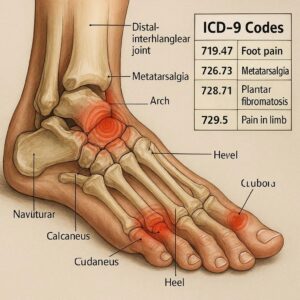
ICD-9 Code for Foot Pain
Understanding the ICD-9 Coding System: A Legacy Framework
Before we dive into the specific code, let’s establish what ICD-9 was. The International Classification of Diseases, 9th Revision, Clinical Modification (ICD-9-CM) was the standard system used in the United States to classify and code all diagnoses, symptoms, and procedures for medical billing and statistical tracking.
It was officially retired on October 1, 2015, and replaced by ICD-10-CM. This is the most critical point to remember. While you may encounter ICD-9 codes on older documents, all current medical billing and healthcare reporting in the U.S. must use ICD-10.
Why the Change? As one healthcare policy analyst noted, “The transition from ICD-9 to ICD-10 was a necessary leap from a system bursting at the seams. ICD-9’s ~14,000 codes couldn’t adequately describe the complexity of modern medicine, leading to vague billing and imprecise data. ICD-10, with over 68,000 codes, allows for remarkable specificity in describing diagnoses, including location, severity, and etiology.”
The Primary ICD-9 Code for Foot Pain: 729.5
Within the ICD-9-CM system, the code most commonly used for foot pain was:
729.5 – Pain in limb
This code is found in Chapter 13: Diseases of the Musculoskeletal System and Connective Tissue, under the category “Other disorders of soft tissues.”
Important Nuances of Code 729.5
This code was not exclusive to the foot. Its descriptor, “Pain in limb,” meant it served as a catch-all for pain in any limb (arm, hand, leg, foot) when a more specific diagnosis wasn’t documented or applicable. Therefore, simply using 729.5 provided limited clinical information. Its use for the foot was implied based on the clinician’s documentation (e.g., “patient presents with pain in the right foot”).
Common scenarios where 729.5 was applicable included:
-
Non-specific foot pain without a determined cause (e.g., “foot pain, unspecified”).
-
Pain as the primary symptom before a definitive diagnosis like plantar fasciitis or a stress fracture was confirmed.
-
General aches and pains in the foot not attributed to a specific injury or disease.
Why Specificity Was a Challenge in ICD-9
The limitation of 729.5 highlights a key shortcoming of the ICD-9 system: a lack of specificity. This vagueness could lead to challenges in billing, treatment planning, and health data analysis.
For example: Two patients with “foot pain” could have vastly different conditions. One might have diabetic neuropathy, while another has a sports injury. Under ICD-9, both might have been coded with 729.5, masking important public health trends and potentially affecting reimbursement.
Comparative Table: ICD-9 vs. ICD-10 for Foot Pain
This table illustrates the dramatic shift in specificity between the two coding systems.
| Feature | ICD-9-CM (Legacy) | ICD-10-CM (Current) |
|---|---|---|
| Primary Code | 729.5 – Pain in limb | M79.67- Pain in foot and toes (This is a category, not a single code) |
| Specificity | Low. One code for pain in any limb. | Extremely High. Requires additional digits to specify laterality and detail. |
| Laterality | Not specified. | Must be specified: M79.671 (Right foot), M79.672 (Left foot), M79.673 (Unspecified foot). |
| Example of Detail | Only indicates the symptom of “pain.” | Can specify pain type (e.g., M79.674 for pain in limb, hand, foot, fingers, and toes). More specific conditions have their own codes (see below). |
| Number of Codes | ~14,000 total codes. | Over 68,000 total codes. |
Common Foot Pain Conditions and Their ICD-9/ICD-10 Equivalents
To fully grasp the evolution, here’s how specific foot pain diagnoses transitioned from ICD-9 to ICD-10.
| Condition | ICD-9-CM Code | ICD-10-CM Code (Example) |
|---|---|---|
| Plantar Fasciitis | 728.71 (Plantar fascial fibromatosis) | M72.2 – Plantar fascial fibromatosis (with laterality: M72.21 Right foot, M72.22 Left foot) |
| Metatarsalgia | 726.70 (Enthesopathy of ankle and tarsus, unspecified) | M77.4- – Metatarsalgia (M77.41 Right foot, M77.42 Left foot) |
| Hallux Valgus (Bunion) | 727.1 | M21.61- – Bunion of right foot / M21.62- – Bunion of left foot |
| Painful Peroneal Tendonitis | 726.79 (Other enthesopathy of ankle and tarsus) | M76.81- – Other specified enthesopathies of right lower limb, excluding foot / M76.82- – Left. (Tendon-specific codes offer more detail). |
| Generalized Foot Pain | 729.5 – Pain in limb | M79.671 – Pain in right foot / M79.672 – Pain in left foot |
Important Note for Readers: This table is for educational comparison. Medical coding is complex and must always be based on the provider’s final diagnosis and documentation. Never self-assign a medical code for billing purposes.
Navigating Legacy Documents and Understanding Your Records
If you’re looking at an old medical bill or record and see “729.5,” you now know it was a general code for limb pain. To better understand what it represented, you would need to refer to the written description from your provider on the same document, such as “foot pain,” “heel pain,” etc.
The Critical Importance of ICD-10 Today
For any current medical encounter related to foot pain, ICD-10-CM is the required standard. Its granularity ensures:
-
Accurate Billing: Prevents claim denials due to vague coding.
-
Improved Patient Care: Allows for better tracking of disease patterns and treatment outcomes.
-
Detailed Health Statistics: Provides public health officials with precise data for research and resource allocation.
A Step-by-Step Look at ICD-10 Specificity for Foot Pain:
-
Category: The provider diagnoses “pain in foot.”
-
Code Selection: The coder goes to category M79.6- Pain in limb, hand, foot, fingers and toes.
-
Specific Site: They narrow it to M79.67- Pain in foot and toes.
-
Laterality: The medical record states “left foot pain,” so the final code is M79.672 – Pain in left foot.
This process illustrates the precision that is now mandatory.
Conclusion
The ICD-9 code 729.5 served as the general designation for foot pain in a legacy system prized for brevity over detail. Its retirement in 2015 marked a necessary shift to the highly specific ICD-10 system, which now uses codes like M79.671-M79.673 to precisely describe foot pain by location. Understanding this transition is key to accurately interpreting past medical records and appreciating the clarity demanded in modern healthcare coding, where specificity directly impacts billing, treatment, and health data analytics.
FAQ: ICD-9 Code for Foot Pain
Q: I just received a bill with ICD-9 code 729.5. Is that wrong?
A: Not necessarily. If the medical service was provided before October 1, 2015, the use of ICD-9 code 729.5 could be correct for that time. For services after that date, only ICD-10 codes should be used.
Q: Can I still use ICD-9 codes for billing today?
A: No. As of October 1, 2015, all HIPAA-covered entities (healthcare providers, insurers, etc.) in the U.S. are required to use ICD-10-CM for diagnosis coding. Claims submitted with ICD-9 codes for current services will be rejected.
Q: My doctor wrote “plantar fasciitis,” but the old bill shows 729.5. Why wasn’t a more specific code used?
A: In the ICD-9 system, even with a diagnosis like plantar fasciitis, billing guidelines sometimes required listing the symptom (pain) code first, followed by the cause. Furthermore, the specificity for many foot conditions in ICD-9 was poor, and 729.5 was often used as a default for various types of foot pain.
Q: Where can I find the official, current ICD-10 codes?
A: The official resource is the Centers for Disease Control and Prevention (CDC) website, which houses the ICD-10-CM files. The CMS (Centers for Medicare & Medicaid Services) website also provides extensive coding guidelines and resources for healthcare professionals.
Additional Resource
For the most up-to-date and official ICD-10-CM codes and guidelines, please visit the CDC’s ICD-10-CM page: https://www.cdc.gov/nchs/icd/icd10cm.htm
Disclaimer: This article is for informational and educational purposes only. It is not a substitute for professional medical coding advice. Medical coding is a complex field that requires certification and must be performed based on a healthcare provider’s complete clinical documentation. Always consult with a qualified medical coder or billing specialist for specific coding questions. The author and publisher disclaim any liability for errors or omissions or for any outcomes related to the use of this information.
Date: January 21, 2026
Author: The Editorial Team at HealthCode Insights