If you’re searching for the ICD-9 code for frozen shoulder, you’re likely navigating medical bills, old records, or trying to understand a past diagnosis. While the healthcare world has moved on to a newer coding system, knowing about ICD-9 codes remains crucial for historical clarity and accurate record-keeping. This guide will not only provide you with the specific code but will also explain its context, its replacement, and everything you need to know about adhesive capsulitis—the clinical name for frozen shoulder.
We’ll walk through the history, the transition to modern coding, and what this all means for your care. Whether you’re a patient seeking understanding or a medical professional brushing up on coding history, this article serves as your definitive reference.
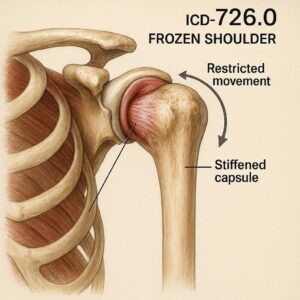
ICD-9 Code for Frozen Shoulder
What is the ICD-9 Code for Frozen Shoulder?
The ICD-9-CM (International Classification of Diseases, 9th Revision, Clinical Modification) code for frozen shoulder is 726.0.
Let’s break down what this code signifies:
-
726: This is the broader category for “Adhesive capsulitis of shoulder.” The “726” series covers disorders of the bursae, tendons, and other soft tissue conditions in the shoulder region.
-
.0: This fourth digit specifies the exact condition within that category—in this case, adhesive capsulitis.
For over three decades, this simple numerical code was the universal medical language used by physicians, physical therapists, insurance companies, and hospitals in the United States to identify, track, and bill for the treatment of frozen shoulder.
Important Note: As of October 1, 2015, the U.S. healthcare system officially transitioned from ICD-9-CM to ICD-10-CM. The ICD-9 code 726.0 is now considered obsolete for all current diagnostic and billing purposes. It is primarily used today for referencing historical patient data or analyzing older medical records.
Clinical Context: What is Frozen Shoulder (Adhesive Capsulitis)?
Before diving deeper into coding, it’s vital to understand the condition itself. Frozen shoulder is a painful and debilitating condition characterized by stiffness and loss of motion in the shoulder joint. The term “adhesive capsulitis” refers to the inflammation and thickening of the shoulder capsule—the flexible connective tissue surrounding the joint—which becomes tight and restrictive.
The condition typically progresses through three overlapping stages:
-
Freezing (Painful) Stage: Gradual onset of pain with any movement. Range of motion begins to decrease.
-
Frozen (Adhesive) Stage: Pain may begin to subside, but stiffness worsens significantly. Using the arm becomes very difficult.
-
Thawing Stage: Range of motion slowly begins to improve over months.
Understanding this clinical picture is key because medical coding is not just about numbers; it’s about accurately capturing the patient’s health story.
The Transition from ICD-9 to ICD-10: Why It Matters
The shift from ICD-9 to ICD-10 was a monumental change in healthcare administration. ICD-9, with its approximately 14,000 codes, had become outdated and lacked the specificity needed for modern medicine. ICD-10-CM expanded to over 68,000 codes, allowing for much greater detail regarding the cause, location, and severity of a condition.
This transition directly affects how frozen shoulder is coded today.
ICD-9 vs. ICD-10: A Comparative Table
| Feature | ICD-9-CM (Obsolete) | ICD-10-CM (Current) |
|---|---|---|
| Code for Frozen Shoulder | 726.0 (Adhesive capsulitis of shoulder) | M75.00 (Adhesive capsulitis of unspecified shoulder) |
| Specificity | Low. One code for all cases. | High. Requires laterality (left, right, bilateral). |
| Code Structure | 3-5 digits, mostly numeric. | 3-7 characters, alphanumeric. |
| Number of Codes | ~14,000 | ~68,000 |
| Laterality | Not specified. | Must be specified: – M75.01 (Adhesive capsulitis of right shoulder) – M75.02 (Adhesive capsulitis of left shoulder) – M75.03 (Adhesive capsulitis of unspecified shoulder) |
As the table shows, the modern ICD-10 code provides a clearer, more precise picture. The code M75.00 is the direct descendant of 726.0, but it’s just the starting point. Accurate coding now requires knowing which shoulder is affected.
Navigating Historical Records with ICD-9 Code 726.0
You might encounter the old ICD-9 code 726.0 in several situations. Here’s what to do:
-
Reviewing Old Medical Bills or Insurance Statements: If you see 726.0 on a document from before October 2015, it correctly identifies your diagnosis of frozen shoulder at that time.
-
Transferring Medical History to a New Provider: When providing your history, you can mention you were diagnosed with adhesive capsulitis (ICD-9 726.0). Your new provider will translate this into the modern ICD-10 equivalent for their records.
-
Medical Research or Data Analysis: Researchers studying trends in musculoskeletal disorders over long periods must be fluent in both coding systems to interpret historical data correctly.
A Helpful List: Common Treatments Often Coded Alongside 726.0
When a provider used the diagnosis code 726.0, they would also use procedure codes (from the CPT system) to bill for the care provided. Common associated treatments included:
-
Physical therapy evaluation and therapeutic exercises.
-
Corticosteroid injections into the shoulder joint.
-
Manipulation under anesthesia (MUA).
-
Arthroscopic capsular release surgery.
Key Differences Between ICD-9 and ICD-10 for Musculoskeletal Conditions
The transition wasn’t just a code swap; it represented a fundamental change in medical documentation philosophy.
-
Specificity is King: ICD-10 demands detail. For frozen shoulder, this means specifying laterality. For other conditions, it might mean specifying the episode of care (initial encounter, subsequent encounter, sequela) or the underlying cause.
-
Anatomic Detail: ICD-10 codes often provide more precise information about the exact anatomical site.
-
Etiology: There is a stronger link in ICD-10 between the cause of a condition and its code.
This level of detail improves patient care by ensuring everyone on the care team has a precise understanding of the condition. It also enhances public health tracking and the accuracy of insurance reimbursement.
FAQ: Frequently Asked Questions About ICD-9 and Frozen Shoulder
Q1: My recent medical bill uses the code M75.01. What does this mean?
A: This is the current ICD-10 code. M75.01 specifically means “Adhesive capsulitis of the right shoulder.” The “M75” category is for shoulder lesions, and the fifth digit “1” denotes the right side.
Q2: I’m doing research and found data using ICD-9 code 726.0. Is it still useful?
A: Absolutely. For any longitudinal study that includes data from before 2015, understanding and correctly mapping ICD-9 codes like 726.0 is essential for accurate analysis and understanding historical disease trends.
Q3: Could frozen shoulder be coded differently in ICD-9?
A: While 726.0 was the standard, a very non-specific code like 719.41 (Pain in joint, shoulder region) might have been used in the earliest stages before a definitive diagnosis of adhesive capsulitis was made. However, 726.0 was the correct and most common code for the confirmed condition.
Q4: Why did the coding system need to change?
A: ICD-9 was simply outdated. It ran out of space for new codes, lacked clinical detail, and was not aligned with modern medical terminology and technology. ICD-10’s specificity supports better patient outcomes, more accurate billing, and improved disease tracking.
Q5: As a patient, do I need to know these codes?
A: Not necessarily, but being informed empowers you. Understanding the codes on your explanation of benefits (EOB) or medical records helps you verify that your care is documented and billed correctly. If you see an old code like 726.0, you now know it refers to your past frozen shoulder diagnosis.
Conclusion
The ICD-9 code 726.0 served as the essential identifier for frozen shoulder for many years, encapsulating a complex condition into a simple number. Its legacy lives on in millions of historical patient records. The transition to the more detailed ICD-10 code M75.0- series reflects the evolution of medicine toward greater precision and personalized care. Whether you’re deciphering an old medical document or understanding the nuances of your current diagnosis, knowledge of these coding systems demystifies the administrative side of healthcare and puts you in a better position to manage your health journey.
Additional Resources
For the most authoritative and up-to-date information on medical coding, please visit the Centers for Disease Control and Prevention (CDC) ICD-10 page: https://www.cdc.gov/nchs/icd/icd10.htm. This site provides official guidelines, updates, and educational materials.
Disclaimer: This article is for informational and educational purposes only. It is not a substitute for professional medical advice, diagnosis, or treatment. Always seek the advice of your physician or other qualified health provider with any questions you may have regarding a medical condition or coding for billing purposes. Medical coding guidelines are complex and subject to change.
Date: January 22, 2026
Author: The Web Health Writer Team