For patients, medical coders, and healthcare professionals navigating older records, understanding the ICd 9 code for glaucoma is essential. The International Classification of Diseases, 9th Revision (ICD-9) was the diagnostic coding standard used in the United States from 1979 until October 1, 2015, when it was replaced by ICD-10. While outdated for current billing, ICD-9 codes remain relevant for historical data analysis, research on long-term studies, and understanding past medical charts.
This guide provides a thorough, clear, and reliable reference for all things related to glaucoma coding under the ICD-9 system. We’ll break down the specific codes, explain their structure, and clarify why this historical knowledge still matters today.
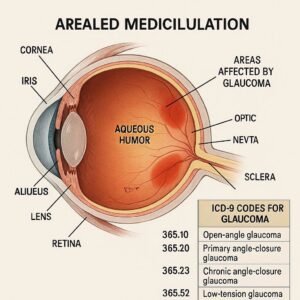
ICD-9 Code for Glaucoma
Understanding the ICD-9 Coding System for Eye Diseases
Before diving into the specific codes, it’s helpful to grasp how the ICD-9 system was organized. ICD-9 codes are alphanumeric, typically 3 to 5 characters long. The first three characters represent the core category of the disease, while the fourth and fifth digits provide greater specificity about the etiology, anatomic site, or severity.
For diseases of the eye and adnexa (the structures surrounding the eye), the ICD-9 codes fall within the range of 360-379. Glaucoma, being a major ophthalmic condition, has its own dedicated subcategory.
Important Note for Readers: As of October 1, 2015, all HIPAA-covered entities in the U.S. must use ICD-10-CM for diagnosis coding. Using ICD-9 for current patient encounters or billing is non-compliant and will result in claim denials. This article serves as an educational resource for historical context and legacy data understanding.
Why Knowing Legacy ICD-9 Codes Still Matters
You might wonder why we’re discussing a retired coding system. The reasons are practical and important:
-
Historical Medical Records: Millions of patient records from before 2015 are coded in ICD-9. Understanding these codes is crucial for interpreting a patient’s full medical history.
-
Long-Term Research: Clinical studies that began before the transition to ICD-10 rely on ICD-9 data. Researchers analyzing trends in glaucoma diagnosis or treatment outcomes over decades need to be fluent in both systems.
-
Data Migration and Analysis: When healthcare systems migrated to ICD-10, they often had to map old ICD-9 data to new codes. Understanding the source (ICD-9) helps ensure accurate data translation and continuity.
The Specific ICD-9 Codes for Glaucoma
Glaucoma is not a single diagnosis but a group of eye conditions that damage the optic nerve, often associated with increased intraocular pressure. The ICD-9 system reflected this variety through a series of specific codes. The primary category for glaucoma is 365.
Here is a detailed breakdown of the most common glaucoma-related ICD-9 codes.
Primary Glaucoma Codes (365.xx)
This family of codes covers the most frequently diagnosed forms of glaucoma.
| ICD-9 Code | Full Description | Clinical Context & Notes |
|---|---|---|
| 365.0 | Borderline glaucoma (ocular hypertension) | Used for patients with consistently elevated intraocular pressure but no detectable optic nerve damage or visual field loss. A risk factor, not yet definitive glaucoma. |
| 365.1 | Open-angle glaucoma | The most common form. The drainage angle remains open, but the trabecular meshwork is inefficient. Often asymptomatic until late stage. |
| 365.10 | Open-angle glaucoma, unspecified | Used when the specific type of open-angle glaucoma (e.g., primary, low-tension) is not documented. |
| 365.11 | Primary open-angle glaucoma | The classic, most common diagnosis. |
| 365.12 | Low-tension glaucoma | Optic nerve damage occurs despite intraocular pressure within the statistically normal range. |
| 365.13 | Pigmentary glaucoma | Caused by pigment granules from the iris flaking off and clogging the drainage system. |
| 365.2 | Primary angle-closure glaucoma | A medical emergency. The iris physically blocks the drainage angle, causing a sudden, painful pressure spike. |
| 365.20 | Primary angle-closure glaucoma, unspecified | |
| 365.21 | Intermittent angle-closure glaucoma | Angle closure occurs in episodes, with pressure rising and then spontaneously resolving. |
| 365.22 | Acute angle-closure glaucoma | The definitive code for a sudden, painful acute attack. |
| 365.23 | Chronic angle-closure glaucoma | The angle is permanently closed, leading to chronic pressure elevation. |
| 365.3 | Corticosteroid-induced glaucoma | A secondary glaucoma caused by the use of steroid medications (eye drops, oral, inhaled, or topical on skin near eyes). |
| 365.4 | Glaucoma associated with congenital anomalies, dystrophies, and systemic syndromes | Glaucoma present at birth (e.g., in Axenfeld-Rieger syndrome) or developing due to a systemic disease like Sturge-Weber. |
| 365.5 | Glaucoma associated with disorders of the lens | Caused by lens-related issues, such as phacomorphic glaucoma (swollen cataractous lens) or lens particle glaucoma after cataract surgery. |
| 365.6 | Glaucoma associated with other ocular disorders | Develops as a complication of another eye disease (e.g., uveitis, trauma, tumor, or retinal vein occlusion). |
| 365.7 | Glaucoma stage | Crucially, this is NOT a diagnosis itself. These are supplementary codes used in addition to a primary glaucoma code from 365.1-365.6 to specify disease severity. |
| 365.70 | Glaucoma stage, unspecified | |
| 365.71 | Mild stage | |
| 365.72 | Moderate stage | |
| 365.73 | Severe stage | |
| 365.74 | Indeterminate stage |
Key Takeaway: A complete ICD-9 glaucoma code required specificity. For example, a diagnosis might be 365.11 (Primary open-angle glaucoma) and 365.72 (Moderate stage).
Related and Post-Procedural Codes
Sometimes, other codes were necessary to fully capture the patient’s situation.
-
360.42: Glaucoma absolute (end-stage) – This code was used for the most severe, irreversible stage of glaucoma resulting in no light perception vision.
-
V45.69: Other states following surgery of the eye and adnexa – This V-code (for factors influencing health status) might be used in conjunction with a glaucoma code if the patient had a prior glaucoma surgery (like a trabeculectomy) that was currently influencing care.
-
V58.69: Long-term (current) use of other medications – Often used for patients on long-term topical glaucoma medication therapy.
The Critical Shift: From ICD-9 to ICD-10 for Glaucoma
The transition from ICD-9 to ICD-10-CM represented a massive increase in specificity. This is especially true for chronic conditions like glaucoma. Understanding the differences highlights the limitations of the old system and the benefits of the new.
A Comparative Table: ICD-9 vs. ICD-10 for Glaucoma
| Aspect | ICD-9-CM (Retired) | ICD-10-CM (Current) | Implication |
|---|---|---|---|
| Code Structure | 3-5 digits, numeric | 3-7 characters, alphanumeric | ICD-10 allows for vastly more combinations. |
| Primary Code | 365.xx | H40.- | The “H” chapter is for diseases of the eye and adnexa. |
| Specificity | Moderate. Laterality (right/left/bilateral) was not part of the code. | High. Laterality is mandatory (right, left, bilateral). | ICD-10 provides a precise anatomical picture. |
| Disease Stage | Used a separate supplementary code (365.7x). | Stage is integrated into the primary code via a 6th character. | Streamlines coding and ties stage directly to the diagnosis. |
| Example: Bilateral Mild POAG | 365.11 (POAG) + 365.71 (Mild stage). No laterality in code. | H40.1130 (Primary open-angle glaucoma, bilateral, mild stage). | One code in ICD-10 conveys what took two codes + a written note in ICD-9. |
Why the Change Was Necessary
The shift was driven by the need for better data. ICD-9’s 13,000 codes were exhausted and lacked the detail needed for modern healthcare analytics, value-based care, and precise epidemiology. With over 68,000 codes, ICD-10 allows for:
-
Better Tracking of Outcomes: Knowing which eye is affected and the specific stage of glaucoma helps track disease progression and treatment efficacy more accurately.
-
Improved Public Health Reporting: More granular data helps identify trends in specific types of glaucoma across populations.
-
Enhanced Reimbursement Accuracy: Codes more closely match clinical documentation, leading to fewer coding errors and claim disputes.
Practical Scenarios: Applying ICD-9 Glaucoma Codes
Let’s walk through how these codes were used in real-world clinical documentation before 2015.
Scenario 1: New Diagnosis
-
Clinical Note: “Patient presents for routine exam. IOP is 24 OD and 26 OS. Gonioscopy shows open angles. Cup-to-disc ratio is 0.6 bilaterally with mild superior rim thinning. HVF shows new paracentral scotoma OS. Diagnosis: Primary open-angle glaucoma, moderate stage, bilateral.”
-
ICD-9 Codes: 365.11 (Primary open-angle glaucoma) + 365.72 (Moderate stage). The billing form or chart would list both codes.
Scenario 2: Post-Surgical Follow-Up
-
Clinical Note: “Patient returns for 3-month follow-up after trabeculectomy OD. IOP well-controlled at 14 OD on no medications. OS remains stable on latanoprost. Chronic angle-closure glaucoma, severe stage OU, status post-filtering surgery OD.”
-
ICD-9 Codes: 365.23 (Chronic angle-closure glaucoma) + 365.73 (Severe stage) + V45.69 (State following eye surgery).
Scenario 3: Ocular Hypertension
-
Clinical Note: “Patient with family history of glaucoma. IOP consistently 22-24 OU over three visits. Angles open, optic nerves healthy, full visual fields. Diagnosis: Ocular hypertension, monitor closely.”
-
ICD-9 Code: 365.0 (Borderline glaucoma/Ocular hypertension).
Conclusion
Navigating the ICD 9 code for glaucoma requires understanding its structured yet limited categories, from the broad 365 series to the specific fifth digits defining open-angle, angle-closure, and secondary types. While supplanted by the more precise ICD-10 system, this legacy knowledge remains vital for interpreting decades of medical history and research data. Ultimately, accurate coding, whether past or present, forms the backbone of effective patient care, clear communication, and meaningful health data analysis.
Frequently Asked Questions (FAQ)
Q: Can I use ICD-9 codes for billing my glaucoma patients today?
A: No. Since October 1, 2015, the use of ICD-10-CM is mandatory for all diagnostic coding in HIPAA-covered transactions in the United States. Using ICD-9 will result in immediate claim denial.
Q: How do I find the modern ICD-10 code for my old ICD-9 glaucoma diagnosis?
A: The Centers for Medicare & Medicaid Services (CMS) and the National Center for Health Statistics (NCHS) provided General Equivalence Mappings (GEMs). However, mapping is not always one-to-one. It’s best to use an up-to-date ICD-10 codebook or encoder software, referencing the full clinical documentation (including laterality and stage) to select the correct H40.- code.
Q: Why did ICD-9 use a separate code for glaucoma stage (365.7x)?
A: The ICD-9 system was designed in an era where such specificity was not demanded for billing or national statistics. The stage was considered supplemental information. The modern shift to outcome-based care made integrating severity directly into the diagnosis code essential, which ICD-10 accommodates.
Q: Where can I find an official, complete list of retired ICD-9 codes?
A: The CDC maintains an archive of the official ICD-9-CM guidelines and codes. You can find it on the CDC’s National Center for Health Statistics website under “Classification of Diseases, Functioning, and Disability.”
Additional Resources
-
For Current Glaucoma Coding: The American Academy of Ophthalmology (AAO) provides excellent coding guides and updates for ICD-10-CM specific to ophthalmology. Visit the AAO website
-
For Official Code Sets: The CMS ICD-10-CM Official Guidelines and code tables are the definitive source for current coding information. Visit the CMS ICD-10 Website
-
For Patient Education on Glaucoma: The Glaucoma Research Foundation offers reliable, patient-friendly information about glaucoma types, symptoms, and treatments. Visit the Glaucoma Research Foundation
Disclaimer: This article is intended for educational and informational purposes only. It is not a substitute for professional medical coding advice. Always consult the most current official ICD-10-CM coding guidelines and resources for accurate, compliant coding. The author and publisher disclaim any liability for errors or omissions or for results obtained from the use of this information.
Author: The Professional Web Writer Team
Date: January 24, 2026