When navigating the complexities of medical billing, clinical documentation, or even personal healthcare records, you might find yourself searching for a specific diagnostic code. The query “ICD-9 code for grief” is one that arises from both professional necessity and personal understanding. It reflects a need to categorize and acknowledge the profound human experience of loss within a structured medical framework.
This comprehensive guide is designed to be your ultimate resource. We will explore the specific ICD-9 code, its clinical meaning, its modern equivalent, and the crucial distinction between normal grief and conditions that require deeper clinical attention. Our goal is to provide clarity, context, and compassionate understanding, blending technical accuracy with human-centric insight.
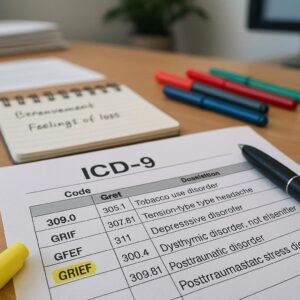
ICD-9 Code for Grief
Understanding ICD-9 and Its Purpose
Before we dive into the specific code, it’s essential to grasp what the ICD-9 system is and why it matters.
What is ICD-9?
The International Classification of Diseases, 9th Revision, Clinical Modification (ICD-9-CM) was a system used by healthcare providers and coders to classify and code all diagnoses, symptoms, and procedures recorded in conjunction with hospital care in the United States. It served as the foundational language for medical records, insurance billing, and epidemiological research for decades.
Why Are Diagnosis Codes Important?
Diagnosis codes are not just bureaucratic red tape. They create a universal shorthand that allows for:
-
Accurate Billing: Insurance companies require specific codes to process claims for services.
-
Tracking Public Health: Aggregated code data helps researchers and government agencies track the prevalence of diseases and health conditions.
-
Clinical Communication: They provide a standardized way for healthcare providers to summarize a patient’s condition.
“While a code may seem like a simple number, in healthcare, it is a critical piece of data that connects patient care, administration, and the broader health ecosystem.”
It’s vital to note that ICD-9 was officially replaced by ICD-10 in the United States as of October 1, 2015. However, understanding ICD-9 codes remains relevant for historical record review, legacy data analysis, and for those working with older medical documents.
The Specific ICD-9 Code for Grief: V62.82
The direct answer to the search query is:
ICD-9-CM Code: V62.82 – Bereavement
This code is found within the “Supplementary Classification of Factors Influencing Health Status and Contact with Health Services,” a V-code section. V-codes are used for circumstances other than a disease or injury that are the focus of a patient’s encounter with the healthcare system.
Decoding V62.82:
-
V62: This category is titled “Other psychosocial circumstances.”
-
.82: This extension specifically denotes “Bereavement.”
Clinical Context of V62.82
V62.82 was used when bereavement (uncomplicated grief) was a recorded factor affecting a patient’s care. This might occur in several scenarios:
-
A patient visits their primary care physician for insomnia or fatigue following the loss of a loved one.
-
A counselor provides supportive therapy to an individual adapting to life after a loss.
-
A healthcare provider needs to document the psychosocial context for a patient’s current health status.
The use of this code acknowledged that grief, while not a mental disorder, was a significant life stressor that could impact health and was a valid reason for seeking medical or supportive services.
Important Note on “Uncomplicated” Bereavement
The key word linked to V62.82 is “uncomplicated.” This refers to the normal, natural, and expected grieving process. The symptoms—such as sadness, tearfulness, loss of interest in usual activities, difficulty sleeping, and changes in appetite—are considered proportional to the loss and typically improve with time and social support.
From ICD-9 to ICD-10: The Code for Grief Today
Since 2015, the healthcare system has used ICD-10-CM. The conceptual equivalent for grief in this newer, more detailed system is:
ICD-10-CM Code: Z63.4 – Disappearance and death of family member
This code is listed under the category “Persons with potential health hazards related to family and personal history and certain conditions influencing health status.”
Key Differences and Why They Matter:
The shift from “Bereavement” (V62.82) to “Disappearance and death of family member” (Z63.4) is subtle but significant. Z63.4 is broader; it can be used for grief but also for the stress related to a missing family member. Furthermore, ICD-10 offers vastly more specificity for mental health conditions related to grief, which we will explore next.
Comparative Table: ICD-9 vs. ICD-10 for Grief-Related Coding
| Feature | ICD-9-CM (Historical) | ICD-10-CM (Current) |
|---|---|---|
| Primary Code for Grief | V62.82 – Bereavement | Z63.4 – Disappearance and death of family member |
| Code Category | V-codes (Factors Influencing Health Status) | Z-codes (Factors Influencing Health Status) |
| Specificity | Limited to “Bereavement.” | Broader descriptor. Allows for more detailed clinical documentation elsewhere. |
| Related Disorder | 309.0 – Adjustment disorder with depressed mood (could be used for more severe cases) | F43.21 – Adjustment disorder with depressed mood F43.22 – Adjustment disorder with anxiety F43.23 – Adjustment disorder with mixed anxiety and depressed mood F43.20 – Adjustment disorder, unspecified |
| Prolonged Grief | No specific code. | F43.8 – Other reactions to severe stress (This is where Prolonged Grief Disorder is currently classified, with more specific criteria). |
When Grief Becomes More: Recognizing Complicated and Prolonged Grief
This is the most critical part of understanding grief in a medical context. While V62.82 and Z63.4 represent the normal experience, sometimes grief becomes debilitating and requires a different clinical diagnosis.
What is Complicated Grief (Prolonged Grief Disorder)?
Prolonged Grief Disorder (PGD) is a recognized mental health condition where the pain of loss remains severe, persistent, and disabling for an extended period (typically longer than 12 months for adults). It impairs the individual’s ability to function in daily life.
Symptoms of Prolonged Grief Disorder may include:
-
Intense yearning/longing for the deceased.
-
Preoccupation with thoughts or memories of the deceased.
-
Identity disruption (e.g., feeling part of oneself has died).
-
Avoidance of reminders that the person is gone.
-
Intense emotional pain (anger, bitterness, sorrow).
-
Difficulty engaging with friends, pursuing interests, or planning for the future.
-
Emotional numbness.
-
Feeling that life is meaningless.
Coding for Prolonged Grief Disorder
In ICD-10-CM, while there isn’t a unique code solely for PGD, it is typically coded under:
-
F43.8 – Other reactions to severe stress. Clinicians will document “Prolonged Grief Disorder” in the medical record to provide specificity.
Important Note for Readers:
The upcoming ICD-11 (the 11th revision) formally introduces 6B42 – Prolonged grief disorder as a distinct diagnosis, highlighting its importance in modern mental healthcare. This represents a major step in validating and treating this serious condition.
Practical Guidance: For Patients, Families, and Coders
For Individuals and Families
If you or a loved one is grieving:
-
Normalize Your Experience: Understand that grief is a natural, individual process with no set timeline.
-
Seek Support: Do not hesitate to talk to your primary care doctor or a counselor, especially if symptoms are affecting your physical health or daily functioning. Using a code like Z63.4 helps them document the reason for your visit and provide appropriate support.
-
Recognize Warning Signs: If grief feels unbearable, unending, or is causing significant impairment a year or more after the loss, seek an evaluation from a mental health professional. What you are experiencing may be treatable.
For Medical Coders and Healthcare Professionals
-
Historical Records: When encountering older records, V62.82 specifically denotes uncomplicated bereavement as a contributing factor.
-
Current Practice: Use Z63.4 for documenting grief or bereavement as a factor influencing care.
-
Clinical Judgment is Key: Distinguish between Z63.4 and adjustment disorder codes (F43.2-) or F43.8 based on the clinician’s assessment of the severity, duration, and functional impact of the symptoms. The clinical documentation in the note must support the code choice.
Conclusion
The search for the “ICD-9 code for grief” leads us to V62.82 (Bereavement), a code that historically acknowledged the health impact of loss. Today, its successor is ICD-10’s Z63.4. More importantly, this journey through medical classification underscores the vital distinction between normal grief and the debilitating condition of Prolonged Grief Disorder. Understanding these codes empowers better clinical communication, accurate documentation, and, ultimately, more compassionate and effective support for those navigating the challenging path of loss.
FAQ: ICD-9 Code for Grief
Q1: Can I still use the ICD-9 code V62.82?
A: No. For all healthcare services provided in the U.S. after October 1, 2015, you must use ICD-10-CM codes. V62.82 is only relevant for interpreting historical medical records.
Q2: What is the current ICD-10 code for grief counseling?
A: The most common code is Z63.4 (Disappearance and death of family member). This Z-code is appropriate when the focus of care is on coping with bereavement.
Q3: How is “depression” coded differently from “grief”?
A: Major Depressive Disorder has its own set of codes (e.g., F32.x series in ICD-10). While grief can involve depressive symptoms, it is context-specific to a loss. A clinician differentiates based on criteria like the presence of guilt not related to the loss, persistent low self-worth, or active thoughts of suicide, which are more indicative of a major depressive episode.
Q4: Is there a time limit for “normal” grief?
A: There is no strict deadline. However, if intense grief symptoms remain severe and disabling for more than 12 months (6 months for children), it may meet the criteria for Prolonged Grief Disorder and warrants professional evaluation.
Additional Resources
For more information on coping with loss and understanding grief-related disorders, we recommend this authoritative resource from the American Psychiatric Association:
American Psychiatric Association: What is Prolonged Grief Disorder?
Disclaimer: This article is for informational and educational purposes only. It is not intended as medical advice, clinical coding advice, or a substitute for professional healthcare. Always consult with a qualified healthcare provider for diagnosis and treatment, and with a certified medical coder for billing and documentation guidance. While based on official coding manuals, coding guidelines can change; always refer to the most current ICD-10-CM Official Guidelines for Coding and Reporting.