If you’re navigating medical billing, historical records, or simply trying to understand an old diagnosis, you might find yourself asking: “What was the ICD-9 code for headache?” While the medical coding world has moved on, understanding this system remains crucial for countless records and historical data analysis. This guide will provide a comprehensive, clear, and honest look at the ICD-9 coding for headaches, placing it in the context of today’s healthcare environment.
We’ll explore not just the code itself, but its structure, why it was replaced, and how to bridge the gap between past and present coding systems. Our goal is to make this technical subject accessible and truly useful, whether you’re a healthcare professional, a medical coder, a student, or a curious patient.
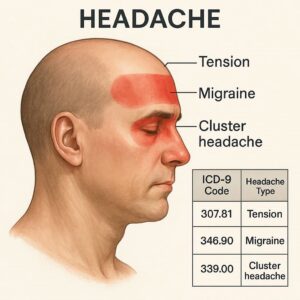
ICD-9 Code for Headache
Understanding the ICD-9-CM System: A Historical Framework
Before we zero in on the specific code, it’s essential to understand the system it belonged to. The International Classification of Diseases, 9th Revision, Clinical Modification (ICD-9-CM) was the diagnostic coding standard used in the United States from 1979 until October 1, 2015. Its primary purposes were to translate medical diagnoses and procedures into universal alphanumeric codes for:
-
Billing and Reimbursement: Insurance companies used these codes to process claims.
-
Epidemiological Tracking: Public health officials tracked the incidence and prevalence of diseases.
-
Clinical Research: Data aggregated by codes helped identify trends and outcomes.
The ICD-9-CM system eventually became outdated. It ran out of space for new codes, lacked the specificity needed for modern medicine, and was not aligned with the rest of the world’s coding standards. This led to the mandatory transition to ICD-10-CM on October 1, 2015, a system with vastly more detail and specificity.
The Specific Code: ICD-9-CM 784.0 – Headache
So, what was the ICD-9 code for headache? The answer is 784.0.
In the ICD-9-CM taxonomy, this code fell under:
-
Chapter 16: Symptoms, Signs, and Ill-Defined Conditions (780-799)
-
Subcategory 784: Symptoms involving the head and neck
-
Final code 784.0: Headache
This categorization is telling. Code 784.0 was a “symptom code,” not a “disease code.” It indicated that the patient presented with the symptom of headache, but without a specified underlying cause like migraine or a brain tumor. This lack of specificity was one of the major limitations of ICD-9.
A Note on Specificity in ICD-9
Unlike today’s ICD-10, the ICD-9 code 784.0 was not further subdivided by type, location, or cause. Whether a patient had a tension-type headache, a cluster headache, or an unspecified headache, the code was generally the same: 784.0. For more specific diagnoses, there were separate codes in other chapters, such as:
-
346.xx: Migraine
-
339.xx: Other headache syndromes (like cluster headaches)
However, if the physician’s documentation simply stated “headache,” 784.0 was the default.
The Transition from ICD-9 to ICD-10: A World of Difference
The shift from ICD-9 to ICD-10 for headache coding is arguably one of the best examples of why the change was necessary. ICD-10 demands precision, leading to better patient care, more accurate billing, and richer data.
Comparative Table: ICD-9 vs. ICD-10 for Headache
| Feature | ICD-9-CM (784.0) | ICD-10-CM (R51 Series) |
|---|---|---|
| Code Structure | Single, broad code. | A family of codes with laterality and specificity. |
| Primary Code | 784.0 – Headache | R51 – Headache |
| Specificity | Very low. One code for all unspecified headaches. | High. Requires additional characters to specify type. |
| Laterality | Not indicated. | Required for certain types (e.g., R51.0 – Headache with left side predominance). |
| Example of a Complete Code | 784.0 | R51.9 (Headache, unspecified) |
| R51.0 (Headache with left side predominance) | ||
| G44.209 (Tension-type headache, unspecified, not intractable) |
As you can see, the ICD-10 system transforms a simple symptom note into a detailed clinical picture. This specificity helps in tracking the effectiveness of treatments for different headache types and understanding patient populations more clearly.
How to “Map” or Translate ICD-9 784.0 to ICD-10
If you encounter an old record with code 784.0 and need to understand its modern equivalent, you follow a process called “code mapping.” The general equivalency is:
ICD-9-CM 784.0 → ICD-10-CM R51.9 (Headache, unspecified)
However, a skilled coder or professional would never simply convert an old code blindly. They would:
-
Consult the original medical documentation from the ICD-9 encounter to glean any additional details about the headache.
-
Apply ICD-10 coding guidelines based on that documentation.
-
Select the most specific code possible. If the old record says “migraine,” the code would move to the G43 series, not R51.
Important Note: “Code 784.0 is a relic of a less precise era in medical documentation. Today, using its ICD-10 counterpart requires a diligent review of clinical notes to capture the nuance now required for accurate coding and patient care.” — A Professional Medical Coder’s Perspective.
Why Knowing About ICD-9 784.0 Still Matters Today
You might wonder why we’re discussing a retired code. Here are several practical reasons this knowledge remains relevant:
-
Historical Record Review: Researchers analyzing health trends pre-2015 must understand ICD-9 codes.
-
Long-term Patient Care: Patients with chronic conditions have records spanning the transition. Understanding old codes is key to continuity.
-
Legal and Disability Cases: Historical diagnoses coded in ICD-9 are often critical evidence.
-
Learning Foundation: Understanding the limitations of ICD-9 helps students and new coders appreciate the rationale and structure of ICD-10.
Helpful List: Common Reasons You Might Still Encounter ICD-9 Code 784.0
-
Reviewing medical charts from before October 2015.
-
Handling a patient’s long-term disability claim that originated years ago.
-
Conducting academic research on headache epidemiology over decades.
-
Auditing old billing records for a clinic or practice.
-
Studying the evolution of medical classification systems.
Practical Scenarios and Coding Examples
Let’s put this into a real-world context with a few scenarios.
Scenario 1: The Unspecified Headache (Pre-2015)
-
Date: September 15, 2014.
-
Documentation: “Patient presents with a generalized headache for two days. No visual aura, nausea, or trauma. Diagnosis: Headache.”
-
ICD-9 Code: 784.0
Scenario 2: Translating an Old Record (Post-2015)
-
Task: You are summarizing a patient’s lifelong history for a new specialist. An entry from 2012 lists code 784.0. The original note only says “complains of headache.”
-
ICD-10 Equivalent for Summary: R51.9 (Headache, unspecified). You would also add a note that this was a historical diagnosis from the ICD-9 era.
Scenario 3: The Importance of Specific Documentation
-
Date (ICD-9 Era): July 10, 2010.
-
Poor Documentation: “Headache.” -> Code: 784.0.
-
Better Documentation: “Patient describes a unilateral, throbbing headache with photophobia and nausea, consistent with migraine without aura.” -> Code: 346.10 (Migraine without aura, intractable).
This example shows that even under ICD-9, better documentation led to a more specific—and clinically useful—code.
Key Takeaways and Best Practices for Professionals
-
ICD-9 is Obsolete for Current Use: It is illegal to use ICD-9 codes for billing on services rendered after October 1, 2015, in the U.S.
-
Specificity is King: Whether dealing with old codes or new, always seek the most specific diagnosis supported by the documentation.
-
Documentation is the Foundation: The medical record is the source of truth. Clear documentation then leads to accurate coding, whether in ICD-9 or ICD-10.
-
Context is Crucial: When you see 784.0, understand it represents a symptom in a historical context, not a definitive diagnosis by today’s standards.
Additional Resources
For the most authoritative and up-to-date information on current medical coding, always consult primary sources:
-
The Centers for Medicare & Medicaid Services (CMS) ICD-10 Website: https://www.cms.gov/medicare/coding/icd10
-
The World Health Organization (WHO) ICD Online Browser: https://icd.who.int/browse10/2019/en
Conclusion
The ICD-9 code for headache, 784.0, serves as a snapshot of a past era in medical coding—one defined by broader categories and less detailed clinical requirements. Its transition to the highly specific ICD-10-CM system, primarily code family R51, underscores the evolution towards precision medicine. Understanding this code is key for interpreting historical data, while mastering its modern counterparts is essential for today’s accurate patient care, billing, and health data analysis.
Frequently Asked Questions (FAQ)
Q: Can I still use the ICD-9 code 784.0 on a medical bill today?
A: No. For any service provided on or after October 1, 2015, in the United States, you must use ICD-10-CM codes. Using ICD-9 will result in claim denial.
Q: What is the direct ICD-10 code for the old 784.0?
A: The most direct equivalent is R51.9 – Headache, unspecified. However, coders must always review the full documentation to see if a more specific code (like one for migraine or tension-type headache) is warranted.
Q: Why did ICD-9 have so few codes for headaches?
A: The ICD-9 system was designed in an earlier technological and medical era. It had a limited structure that could not accommodate the vast number of new codes needed for modern medical specificity and ran out of space.
Q: I’m a patient and see 784.0 on an old bill. What does it mean?
A: It simply means that during that visit, “headache” was documented as a reason for your care. It does not indicate a specific type of headache like a migraine. For details about your diagnosis, you should refer to the actual doctor’s notes from that visit.
Disclaimer: This article is for informational and educational purposes only. It is not intended as medical advice or as a substitute for professional coding guidance. Medical coding is complex and governed by official guidelines. Always consult current ICD-10-CM code sets, official coding resources, and your organization’s compliance policies for accurate coding. The author is not liable for any errors or actions taken based on this content.